The Spider Bite That Keeps Winning After You Escape
Spider venom effects that linger for three days after the spider is gone — that’s not how most people imagine danger works. You picture fangs, fast pain, something you’d know to run from. The brown recluse doesn’t give you any of that. A small red mark, maybe some irritation, and then the tissue starts going quiet in ways that don’t announce themselves until it’s already deep.
For years, doctors stared at those wounds and blamed bacteria. The logic wasn’t crazy — flesh was dying, infection spreading, so they reached for antibiotics. But some patients weren’t getting better. Some were getting worse on a schedule that antibiotics couldn’t explain. Something else was running the clock.
Key Facts
- The brown recluse spider, Loxosceles reclusa, produces venom whose key enzyme, sphingomyelinase D, can stay biochemically active in tissue for up to 72 hours after a bite.
- Recluse venom acts systemically, interacting with blood vessels, lowering blood pressure, and disrupting clotting, rather than working only at the bite site.
- Necrotic lesions from severe bites can reach up to 40 centimeters in diameter in the worst documented cases.
- More than 100 species exist in the Loxosceles genus worldwide, but fewer than a dozen are regularly studied for venom composition.
- An estimated 7.4 per 100,000 people in endemic US regions report spider bites annually, with Loxosceles species responsible for a significant share of serious cases (CDC, 2021).
In short: Brown recluse spider venom works slowly and systemically, not with fast pain. Its key enzyme, sphingomyelinase D, stays active in tissue for up to 72 hours, disrupting blood vessels and clotting long after the bite. For years doctors blamed bacteria, but imaging revealed the venom itself drives the tissue damage and circulatory effects.
Spider Venom Effects That Scientists Got Wrong
Nobody had a way to look closely enough at the spider itself. Not really closely. But when researchers finally turned micro-CT scanning and fluorescence imaging on Loxosceles reclusa — the brown recluse — the jaw anatomy told a different story than anyone expected. Venom glands, previously undetected, sitting right inside the jaws. Documented in Loxosceles studies, these glands weren’t passive structures — they were active. Pumping. Doing work. The bacterial theory had survived as long as it did partly because no one had thought to question what was happening at the structural level before infection entered the picture.
That last detail kept me reading for another hour.
This wasn’t a minor correction. It was a reversal. Wounds weren’t getting infected and then worsening — the venom itself was running a slow, methodical campaign through the tissue, long after the spider had gone back under the floorboard it came from.
How the Venom Targets Your Circulatory System
Why does this matter? Because most venomous animals go for speed — paralysis, fast knockdown, instant pain so overwhelming the prey can’t think straight.
Recluse spider venom effects work nothing like that. The key compounds — a class of enzymes called sphingomyelinases — don’t just chew through tissue at the bite site. They interact with blood vessels. They lower blood pressure. Clotting gets disrupted, making bleeding harder to stop. The attack isn’t local. It goes systemic, quietly, on a timeline that makes no visible noise until it’s already well underway. For more on how venom compounds interact with human biology, this-amazing-world.com has covered some of the most astonishing predator adaptations on the planet.
Think about what that actually means. You get bitten — maybe it stings for a moment, maybe you don’t even notice. Two days pass. Your body is losing a fight against something you can’t see, can’t locate, can’t do anything about. It’s already inside you, working on its own schedule.
Small Spider, Long Shadow of Spider Venom Effects
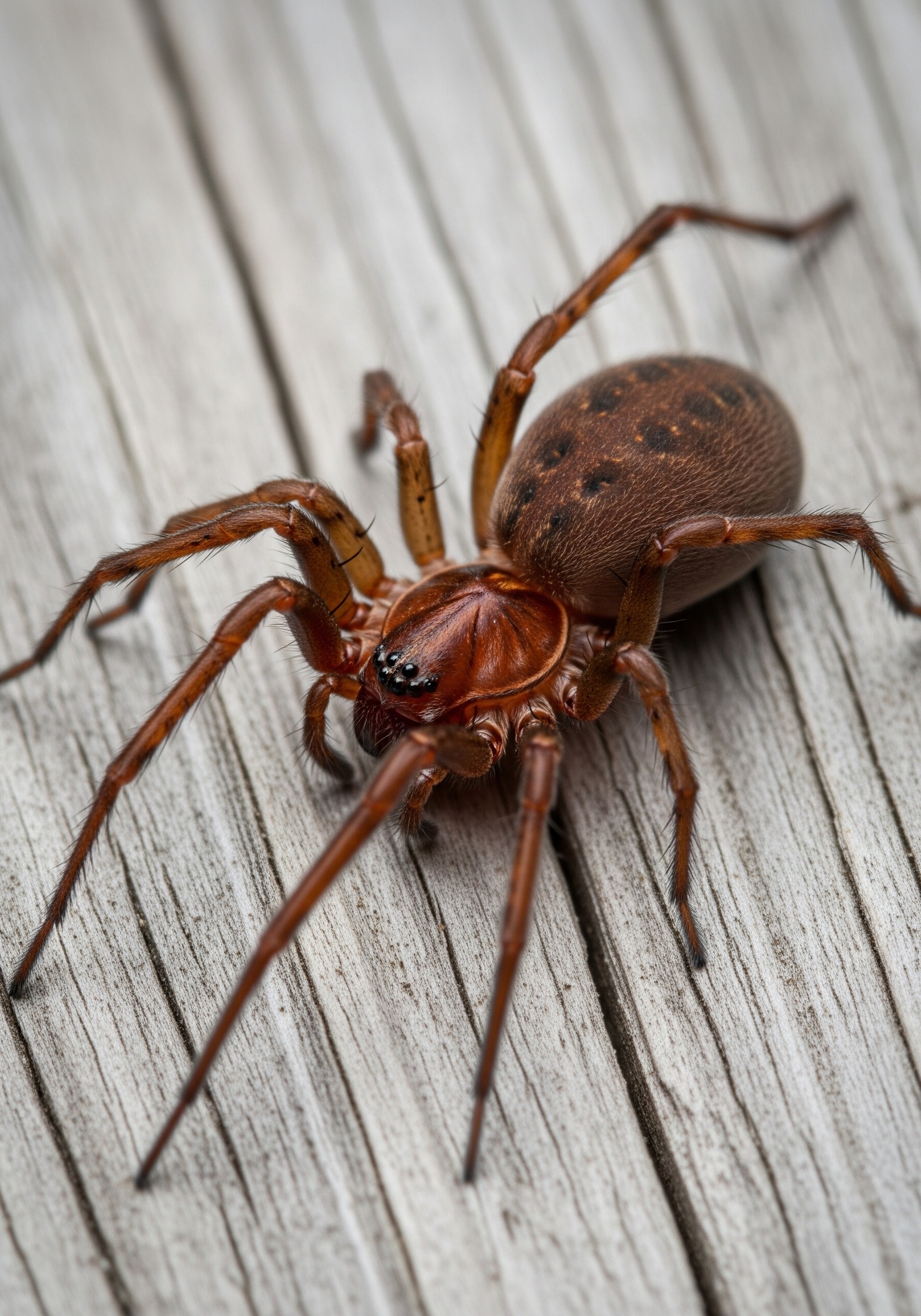
The brown recluse is not a dramatic animal. It’s not brightly colored. It doesn’t rear up or perform.
Loxosceles species across the Americas evolved a strategy built entirely on subtlety — their spider venom effects aren’t optimized for instant lethality, they’re optimized for sustained physiological disruption. Which, from an evolutionary standpoint, is actually the smarter play. A spider that can incapacitate something hours after the initial contact never needs a second encounter. The work is done. The spider is somewhere else entirely.
And they’re not rare. They live in homes, garages, basements, folded into clothing piles across huge swaths of the United States and South America. You don’t need to go find them. Turns out, they’ve already found you.
Why Doctors Kept Missing the Real Cause
Here’s the thing — the bacterial theory wasn’t entirely wrong. Incomplete in a way that cost patients real damage, yes. But not wrong.
When a recluse bites, the venom creates conditions that invite secondary infection. Tissue starts dying. The immune system floods the area. Bacteria move in. So when doctors cultured those wounds and found bacteria, treating it made sense. The venom compounds still circulating in the bloodstream were continuing their work unchecked the whole time — and nobody was targeting that.
A treatment framework built on the wrong primary cause is not a minor procedural error — it’s the kind of systemic misread that compounds quietly until someone finally asks a harder question.
Spider venom effects that include systemic circulatory disruption change the entire treatment calculus. Managing blood pressure, watching for hemorrhagic complications, understanding that the damage clock started at the moment of the bite — not when things looked bad enough to worry about. That’s the new framework. The implications for emergency medicine are significant, and they don’t disappear just because the insect that caused it is small enough to lose behind a dryer.
How It Unfolded
- 1870s — Early taxonomic descriptions of Loxosceles species recorded in South America; venom properties not yet characterized.
- 1950s–1960s — First clinical case series linking Loxosceles bites to necrotic lesions published; bacterial infection widely assumed to be the primary driver.
- 2000s — Sphingomyelinase D identified as the principal enzyme behind tissue destruction and circulatory disruption, shifting scientific consensus toward a venom-first model.
- 2020s — Micro-CT and fluorescence imaging reveal previously unmapped venom gland complexity inside the jaw structure of L. reclusa, overturning assumptions about venom delivery and dosage control.
By the Numbers
- An estimated 7.4 per 100,000 people in endemic US regions report spider bites annually, with Loxosceles species responsible for a significant portion of medically serious cases (CDC spider bite data, 2021).
- Sphingomyelinase D — the key enzyme in recluse venom — can stay biochemically active in tissue for up to 72 hours post-bite. Long past when most victims first seek care.
- Necrotic lesions from severe bites: up to 40 centimeters in diameter in the worst documented cases, sometimes requiring surgical debridement months later.
- More than 100 species in the Loxosceles genus exist worldwide. Fewer than a dozen are regularly studied for venom composition — which means the full scope of this venom strategy is almost certainly underestimated.
Field Notes
- Micro-CT imaging showed the venom delivery system in Loxosceles jaws is more anatomically complex than anyone had mapped — gland positioning suggests the spider can actually modulate how much venom it delivers during a bite (researchers actually call this controlled envenomation), rather than releasing a fixed dose every time.
- Most bites happen at night, in bedding or clothing the spider was disturbed in.
- Many victims don’t feel the bite until hours later — which compounds the diagnostic delay significantly, because by the time anyone’s looking for answers, the timeline is already blurry.
- Some South American Loxosceles species carry venom profiles with even more potent phospholipase activity than their North American counterparts. Regional evolutionary pressure, fine-tuning the same weapon, for a very long time.
Why This Changes How We Think About Hidden Predators
At its core, the story of spider venom effects in recluse spiders is a story about assumption. Small, unremarkable animals get assigned proportionally small danger. Evolution doesn’t care about that math. It rewards whatever works — and a venom that keeps winning long after the predator has left the room is extraordinarily effective by any measure.
What other small species are carrying weapons we haven’t examined carefully enough? What else have we been misreading because the animal didn’t look threatening enough to take seriously? The new imaging research doesn’t just correct a medical misunderstanding — it opens a different set of questions entirely, ones that reach well beyond this single genus.
But real human stakes are sitting underneath all of this. People are misdiagnosed every year. Given antibiotics that don’t touch the core problem. Wounds progress further than they needed to. The chain runs directly from a spider you’d overlook on a garage wall to a patient who either recovers fully or ends up in surgery — and the difference is whether the biology was understood in time.
Editor’s Take — Alex Morgan
What stays with me about this story isn’t the venom — it’s the decades of confident misdiagnosis that preceded understanding it. We had the wounds in front of us. We had patients getting worse. We kept reaching for the explanation that fit the tools we already had, and nobody thought to look at the spider’s jaw under a better lens until recently. That gap between evidence and assumption is where people actually got hurt. That’s the part the research papers don’t linger on, and probably should.
The brown recluse isn’t a monster. It’s just an animal that evolved a remarkably effective tool, and we spent decades misreading what that tool actually does — not the venom itself, but the mechanism, the timeline, the systemic reach. That’s the part that sticks. Science has a way of humbling assumptions you didn’t even know you were making. If this kind of story keeps you up at night, there’s more at this-amazing-world.com — and the next one is stranger.
Frequently Asked Questions
Q: How long does brown recluse venom stay active in the body?
The key enzyme in brown recluse venom, sphingomyelinase D, can remain biochemically active in tissue for up to 72 hours after a bite, often long past when most victims first seek care. This delayed action is part of why the bite is so dangerous: the venom continues damaging tissue and disrupting the circulatory system on its own schedule, even after the spider is gone and the bite mark looks minor.
Q: Why did doctors blame bacteria for recluse bite wounds?
When a recluse bites, the venom kills tissue and creates conditions that invite secondary bacterial infection. Because doctors cultured those wounds and found bacteria, treating with antibiotics seemed logical. But the venom compounds circulating in the bloodstream kept working unchecked. Micro-CT and fluorescence imaging in the 2020s revealed active venom glands inside the spider’s jaws, shifting the consensus toward a venom-first model of injury.
Q: How dangerous is a brown recluse bite?
A brown recluse bite can be serious. Necrotic lesions from severe bites can reach up to 40 centimeters in diameter in the worst documented cases, sometimes requiring surgical debridement months later. The venom acts systemically, lowering blood pressure and disrupting clotting. Because many victims don’t feel the bite for hours, diagnosis is often delayed, which can allow the wound to progress further than it otherwise would.
Q: How many Loxosceles spider species are there?
More than 100 species exist in the Loxosceles genus worldwide, but fewer than a dozen are regularly studied for venom composition, meaning the full scope of this venom strategy is likely underestimated. Some South American Loxosceles species carry venom profiles with even more potent phospholipase activity than their North American counterparts, reflecting regional evolutionary pressure fine-tuning the same chemical weapon over long periods.
Illustrations are AI-generated. Article fact-checked and human-edited. Our editorial standards.