The Christmas Night Train from Rome to Munich Is Pure Magic
Budget airlines were supposed to bury the Christmas night train Rome to Munich for good — and for a while, it looked like they had. Night trains across Europe went quiet, routes folded, and an entire way of moving through the continent seemed to belong to another century. Then December came around again, the Espresso Monaco rolled out of Roma Termini, and somewhere above the snowline the past and present started talking to each other.
FS Treni Turistici’s “Espresso Monaco” returns for December 2024 — two round trips between Rome and Munich along one of Europe’s most breathtaking alpine corridors. It exists at the crossroads of nostalgia and practicality, and somehow delivers something neither of those words quite captures.
Key Facts
- FS Treni Turistici’s Espresso Monaco ran two December 2024 round trips between Rome and Munich, departing Roma Termini at 19:57 on December 5th and 12th.
- The route crosses the Brenner Pass, the lowest major Alpine crossing at 1,371 metres above sea level, in continuous use since Roman times around 15 BCE.
- Night train ridership across Europe increased by over 30% between 2019 and 2023, per the advocacy group Back-on-Track.
- Roughly 1,100 kilometres separate Roma Termini from Munich Hauptbahnhof, a distance the Espresso Monaco covers in approximately 17 hours each direction.
- Munich’s Christkindlmarkt has records dating to 1310 and attracts over 3 million visitors annually.
In short: The Christmas night train Rome to Munich, FS Treni Turistici’s Espresso Monaco, ran two December 2024 round trips across the 1,371-metre Brenner Pass, covering roughly 1,100 kilometres in about 17 hours. Themed as a Christmas market on rails, it rides Europe’s night train revival, with ridership up over 30% between 2019 and 2023.
Why the Night Train to Munich Feels Different
Travel writers keep returning to the night train as a romantic ideal, and the reason is older than most of them realise. Sleeping carriages became widespread on continental routes as early as the 1870s. The Compagnie Internationale des Wagons-Lits, founded in 1872, essentially invented the luxury sleeper — the notion that the journey itself deserved to be lived in, not merely endured. That philosophy never died. It went quiet for a few decades while budget airlines monopolised European movement, and now it’s roaring back.
The Espresso Monaco is one of its loudest voices. What makes this particular run so compelling isn’t just the destination pairing — Rome and Munich are two of Europe’s most iconic cities — it’s the corridor between them. Threading the Brenner Pass, the train moves between the Italian and Austrian Alps along a route that has carried merchants, soldiers, pilgrims, and poets for centuries. In December, that corridor transforms. Villages appear below in halos of yellow light. Church spires rise out of fog. The landscape doesn’t just pass — it performs.
Night trains also rewire your relationship with distance. You fall asleep in one country and wake up in another. The Alps didn’t disappear — they simply happened while you weren’t watching. That’s not a loss. That’s a gift.
The Route Stops That Make the Journey Sing
Verona boards passengers just after 22:00 — Shakespeare’s city, Romeo’s city, a city whose Christmas market fills the Piazza Bra with light and the smell of roasted chestnuts. Trento follows in the early hours, a town so committed to its Christmas market that it regularly ranks among the best in all of Italy. Then Bolzano, the bilingual capital of South Tyrol, where Italian and Austrian cultures have been overlapping for centuries and the stalls sell both struffoli and strudel.
Finally, Innsbruck — a jewel of a city pinned between mountains, its Golden Roof glittering under December frost — reached before most commuters have finished their morning coffee. Four stops that read like a shortlist of Europe’s most atmospheric winter destinations, each one opening like an advent calendar window as the train rolls northward into colder, more alpine air. The Espresso Monaco departs Roma Termini at 19:57 on December 5th and 12th, pulling north through Italy’s spine before crossing into Austria and arriving in Munich just after 13:00 the following day. It’s a reminder that travel — real travel — has always been about what lies between the pins on the map, not just the pins themselves. There’s a reason explorers throughout history have described the journey as inseparable from the discovery, a feeling as relevant in the quiet depths of a wild river as on a snow-laced rail line threading through the Alps.
Return trips leave Munich at 13:40 on December 7th and 14th, arriving back in Rome at 06:33. The sun rises somewhere over northern Italy on that return leg. Travellers have reported it as one of the most quietly beautiful moments of the entire experience.
Onboard: A Christmas Market on Rails
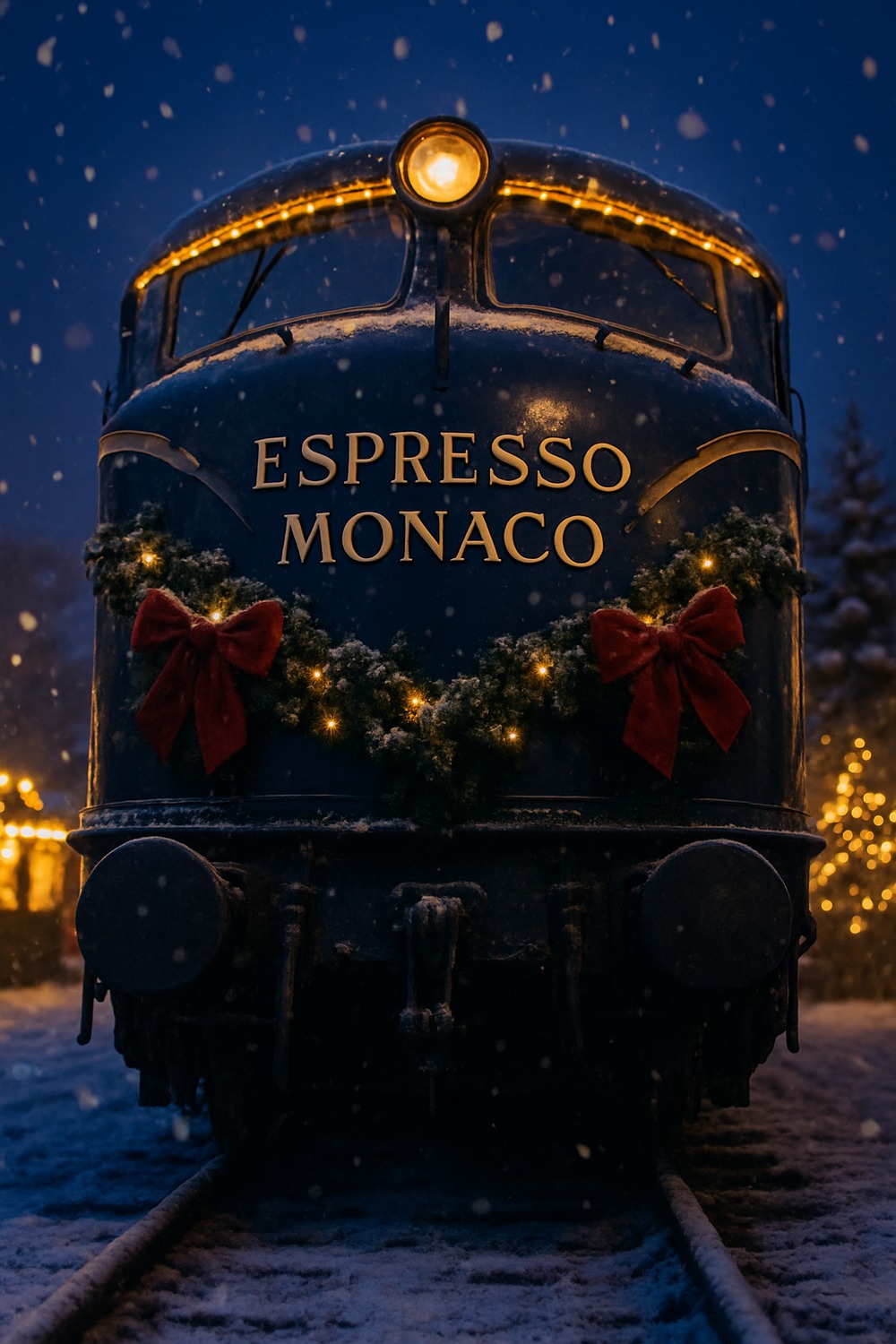
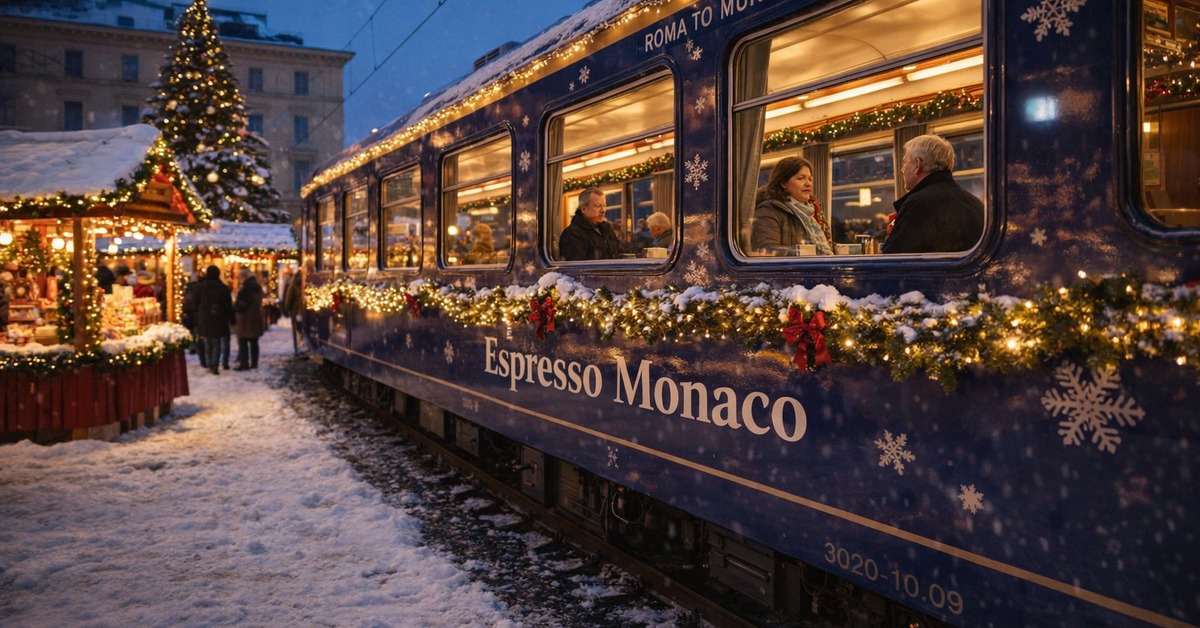
FS Treni Turistici — the tourist division of Italy’s national rail operator Ferrovie dello Stato — has built the Espresso Monaco around an explicit promise: the train is not a vehicle for reaching the Christmas markets; it is itself a Christmas market. Carriages are decorated with seasonal themes, festive music plays softly through public spaces, and onboard food and drinks lean deliberately into the holiday. A small gift waits for each passenger — an unexpected gesture that costs nothing in logistics but delivers a disproportionate amount of joy.
Why does this matter? Because the appetite for meaningful transit turns out to be real and growing. Night train ridership across Europe increased by over 30% between 2019 and 2023, according to the European rail advocacy group Back-on-Track (researchers actually call this the “meaningful transit” shift — the growing conviction that getting somewhere should feel like something). This revival has been driven not just by environmental preference but by exactly that appetite, a finding confirmed by research published by the BBC’s travel desk. The Christmas night train Rome to Munich sits squarely within the trend. It’s also a practically zero-stress alternative to the December airport experience — no security theatre, no departure gate waiting rooms, no luggage carousels. You board, you find your seat or sleeper berth, and the train does the rest.
One traveller described boarding in Rome last December as feeling like “stepping into someone else’s warmer, better life.” That’s not a small thing to offer a person in the middle of winter.
The Christmas Night Train Rome to Munich and Alpine History
At 1,371 metres above sea level, the Brenner Pass is the lowest of the major Alpine crossings — and it has been in continuous use since Roman times. Emperor Augustus had it surveyed and improved around 15 BCE. Charlemagne crossed it. Medieval merchants dragged wool, silk, and spices through it for centuries. The railway arrived in 1867, when the Brenner Railway became one of the first mountain railways in Europe — an engineering achievement so audacious for its time that it drew engineers from around the world to study its construction.
Rail engineers still call the Brenner one of their greatest inherited achievements — and riding it in December, that judgment feels completely earned. That’s the corridor the Christmas night train Rome to Munich traverses: tunnel and viaduct and snowfield, grades that humans have been navigating for over two thousand years.
What changes in winter is the quality of the light. Snow compresses the landscape, stripping away colour until what remains is pure form — ridge lines, valley floors, the dark vertical lines of spruce forests against white slopes. The sun angles low and golden over the Dolomites even at midday. The train window becomes a moving painting, and no two frames are identical. Passengers describe losing track of time not because they’re bored but because the landscape holds their attention so completely that the usual mental clock simply stops.
Slow Travel’s Comeback and What It Means for Europe
And the numbers behind this revival are anything but soft. After decades of low-cost aviation dominance, night trains are staging a comeback that analysts at the International Union of Railways (UIC) described in 2023 as “structurally driven, not merely fashionable.” Austria’s ÖBB Nightjet network has expanded to over 20 routes. France relaunched its Paris-to-Nice sleeper in 2021. Belgium, the Netherlands, and Germany have all announced new overnight services through 2025 and 2026.
The Christmas night train Rome to Munich is one data point in this much larger shift reshaping how Europeans — and international visitors — think about continental movement. The environmental case is hard to ignore: aviation accounts for roughly 2.5% of global CO2 emissions, while rail produces approximately 14 times less carbon per passenger kilometre on electrified lines. History has a way of treating the people who ignored this kind of evidence unkindly, and the travellers who spent the last twenty years choosing speed over experience have quietly started voting differently with their bookings.
Choosing a 17-hour train over a 2-hour flight says something about how you value your time — not as a resource to be optimised, but as an experience to be inhabited. Munich’s Christkindlmarkt, one of the oldest in the world with records dating to 1310, will still be glowing when the train pulls in. A child travelling the route for the first time last year reportedly pressed her face to the glass as the train emerged from a tunnel above Innsbruck and the full panorama of the Inn valley opened below. Her father said she didn’t speak for ten minutes.
Some landscapes do that.
How It Unfolded
- 15 BCE — Emperor Augustus surveys and improves the Brenner Pass; the crossing enters recorded imperial use
- 1867 — Brenner Railway completed, becoming one of Europe’s first mountain railways, using spiral viaduct engineering rather than a summit tunnel
- 1872 — Compagnie Internationale des Wagons-Lits founded, establishing the luxury sleeper car and the philosophy that the journey deserves to be lived in
- 2021–2024 — European night train revival accelerates: France relaunches Paris–Nice sleeper; ÖBB Nightjet expands to 20+ routes; FS Treni Turistici debuts the Espresso Monaco for Christmas 2024
By the Numbers
- Night train ridership across Europe increased by over 30% between 2019 and 2023, driven by environmental and experiential demand (Back-on-Track, 2023)
- Brenner Pass elevation: 1,371 metres above sea level — the lowest major Alpine crossing, in continuous use since Roman times, circa 15 BCE
- Electrified rail produces approximately 14 times less CO2 per passenger kilometre than short-haul aviation (International Union of Railways, UIC, 2022)
- Munich’s Christkindlmarkt has records dating to 1310 — one of the oldest Christmas markets in the world, now attracting over 3 million visitors annually
- Roughly 1,100 kilometres separate Roma Termini from München Hauptbahnhof; the Espresso Monaco covers that distance in approximately 17 hours each direction
Field Notes
- Completed in 1867, the Brenner Railway was built without a single summit tunnel — engineers instead used a spiral viaduct system to gain altitude gradually, a technique genuinely revolutionary at the time and still visible from the train today.
- Bolzano’s Christmas market, one of the stops on the Espresso Monaco route, has run continuously since 1991 but draws on a tradition dating back to the 14th century — held in a city where both Italian and German are official languages, giving it a cultural texture found nowhere else in Europe.
- FS Treni Turistici operates the Espresso Monaco as part of a broader revival of Italy’s historic tourist train network, which also includes routes through Sicilian countryside and along Adriatic coastal lines that were nearly decommissioned in the early 2000s.
- Researchers studying the psychology of travel still can’t fully explain why overnight train journeys produce disproportionately positive memories compared to journeys of similar duration by other modes — the “sleeper effect” in travel satisfaction remains genuinely poorly understood.
Frequently Asked Questions
Q: How do I book the Christmas night train Rome to Munich, and how far in advance should I do it?
Tickets for the Espresso Monaco are available through FS Treni Turistici and the broader Trenitalia booking platform. Only two departure dates exist in each direction — December 5th and 12th from Rome, December 7th and 14th from Munich — which means capacity is genuinely limited. Sleeper berth availability in particular sells out weeks ahead. Early booking, ideally six to eight weeks in advance, is strongly advised for anyone wanting a couchette or private compartment.
Q: What’s the difference between the seat types available on the Espresso Monaco?
European night trains typically offer three tiers: standard reclining seats, couchette berths (shared compartments with fold-down bunks, usually four or six per cabin), and private sleeper compartments with full beds and sometimes en-suite facilities. The Espresso Monaco follows this general structure, though specific configurations vary by season and rolling stock. Couchettes offer the best balance of comfort and price for most travellers; private sleepers are worth the premium for couples or anyone prioritising uninterrupted sleep across the 17-hour journey.
Q: Is the Christmas night train Rome to Munich only for people visiting the Christmas markets?
A common misconception — the train is a scheduled rail service that happens to run during the Christmas market season, not a charter experience exclusive to market visitors. Anyone travelling between Italy and Bavaria in early December can use it. That said, the onboard festive theming, the gift for each passenger, and the timing make it an experience clearly designed with the holiday atmosphere in mind. You don’t have to visit a single market stall to find the journey worthwhile. The route through the Brenner corridor in December is reason enough on its own.
Editor’s Take — Sarah Blake
What strikes me about the Espresso Monaco isn’t the nostalgia — it’s the defiance. This train runs twice in December, on fixed dates, for roughly 1,100 kilometres through some of the most demanding mountain terrain in Europe, and people plan their entire Christmas around it. Not because it’s faster or cheaper. Because somewhere between Roma Termini and München Hauptbahnhof, the journey stops being a means to an end. The revival of the night train isn’t a trend. It’s a correction.
There’s a version of Christmas that airports have never understood and never will. It’s not about efficiency or optimised transit. It’s about the slow accumulation of atmosphere — mulled wine warming your hands, mountains appearing in darkness outside the glass, the particular silence of a sleeping carriage at 2 a.m. somewhere above the snowline. Europe’s night trains are coming back because people are remembering what travel felt like before it became something to be survived. What might you notice, looking out that window, if you finally gave yourself the time?
Illustrations are AI-generated. Article fact-checked and human-edited. Our editorial standards.