The 5,500-Year-Old Star Map That Rewrites History
Every civilization leaves behind the things it couldn’t stop thinking about. For the Sumerians, it was the sky — and the ancient Sumerian star map they pressed into wet clay around 3300 BC is still, five millennia later, the oldest of its kind ever found.
In the late 1800s, archaeologists excavating the ruins of Nineveh in modern-day Iraq pulled a small clay disk from the underground library of King Ashurbanipal. Researchers assumed it was Assyrian. They catalogued it. It took until 2008 — and a team at the University of Würzburg running detailed computer simulations against reconstructed ancient night skies — for anyone to realize what they actually had. The tablet dates to around 3300 BC. Not Assyrian. Sumerian. Off by roughly 2,000 years, and off by an entirely different civilization.
Key Facts
- The ancient Sumerian star map was pressed into wet clay around 3300 BC, making it the oldest known star map on Earth
- A team at the University of Würzburg confirmed its true Sumerian origin in 2008 using computer simulations of reconstructed ancient skies
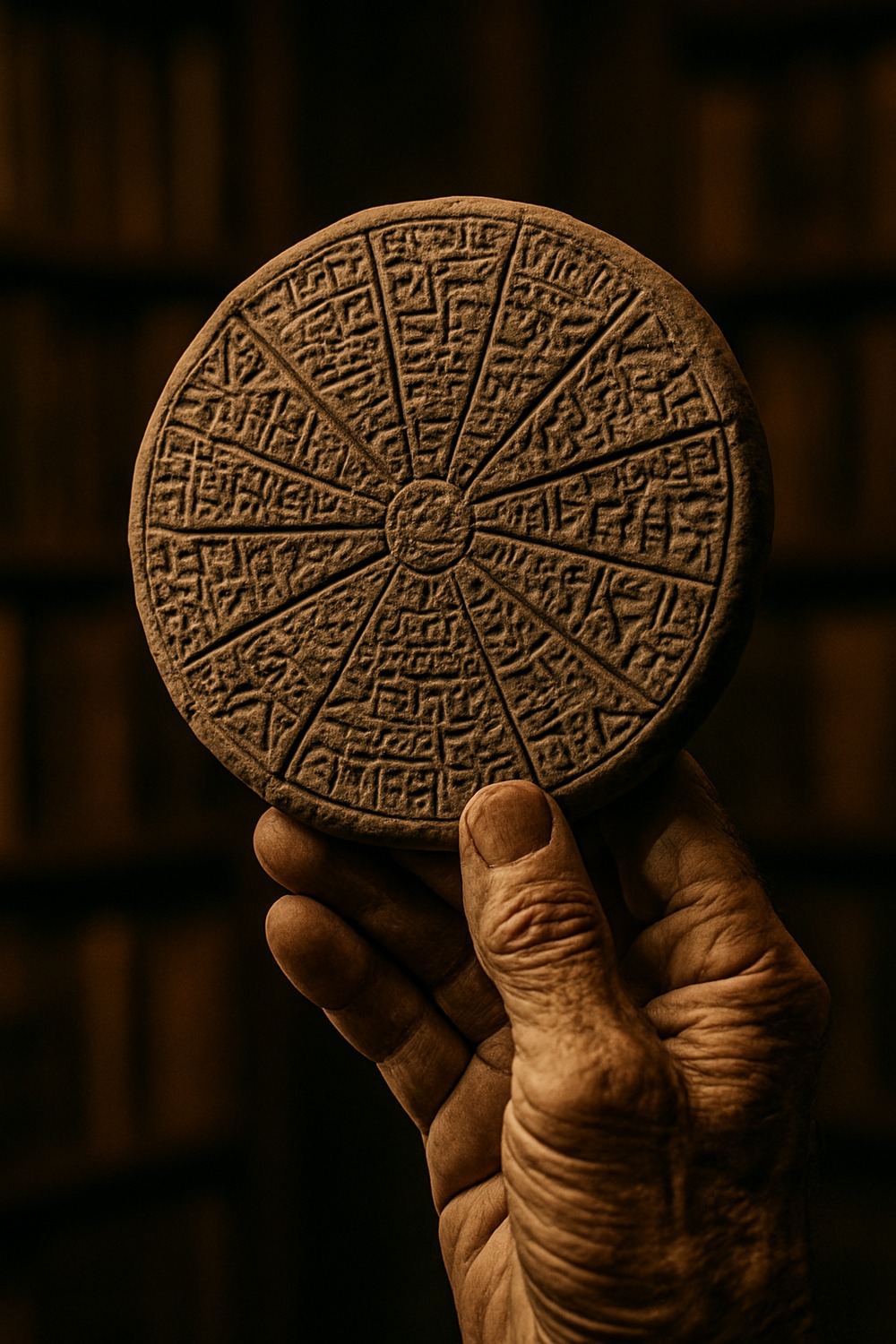
- The clay disk divides the visible sky into eight precise angular segments and functions as an ancient astrolabe
- King Ashurbanipal’s library at Nineveh held an estimated 30,000+ clay tablets at its peak
- The Antikythera Mechanism, long called humanity’s oldest complex scientific instrument, dates to around 100 BC, roughly 3,200 years after this star map
In short: The ancient Sumerian star map, pressed into wet clay around 3300 BC, is the oldest known star map on Earth. Recovered from Nineveh’s ruins and misclassified as Assyrian for over a century, a University of Würzburg team confirmed its true origin in 2008 by simulating reconstructed ancient skies.
The Ancient Sumerian Star Map Nobody Understood
Scholar Ernst Weidner had studied it decades earlier and gotten close, but the simulation technology didn’t exist yet to confirm what he suspected. When the Würzburg team finally ran the numbers, the result made the tablet the oldest known star map on Earth.
It’s not decorative. It’s not a sketch someone made while bored. The lines carved into this clay disk divide the sky into precise angular segments — the kind of geometric thinking you’d expect from a civilization that had been doing serious mathematics for a long time. The Sumerians had. They absolutely had.
How One Clay Disk Changed Everything We Knew
What does 3300 BC actually look like on a timeline? The Great Pyramid of Giza wouldn’t be built for another 700 years. Writing had only just emerged — barely. And yet someone in ancient Sumer was sitting down, night after night, watching the sky, translating what they saw into a precise geometric instrument pressed into wet clay before it dried.
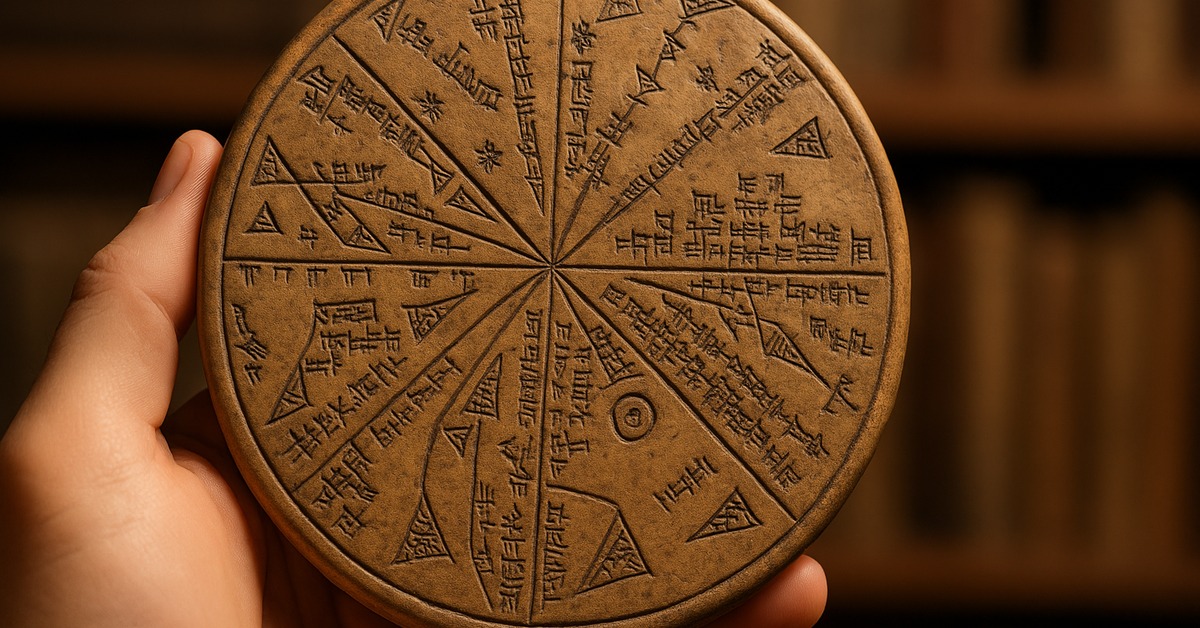
The tablet functions as an ancient astrolabe — a tool for fixing the positions of stars and planets relative to the horizon. Eight segments, each representing a different region of the sky above Mesopotamia. And the accuracy isn’t rough or approximate. These are carefully engineered angular divisions that require both sustained observation and actual mathematical understanding, not just pattern recognition. You can read more about early tools of human discovery at this-amazing-world.com.
Not a religious offering. An instrument.
What the Sumerians Were Actually Tracking Up There
Why does this matter? Because the tablet’s markings suggest it recorded more than just star positions — researchers believe it tracked specific planets, noted seasonal shifts, and possibly documented rare celestial events.
Some scholars have proposed that certain lines on the ancient Sumerian star map correspond to a massive meteor impact over the Austrian Alps — an event that would have blazed across the sky and terrified anyone watching from the ground that night. Which is a genuinely extraordinary leap from “ancient clay scribbles” to “cosmic event recorder.” But the geometry supports it.
Here’s the thing: these weren’t researchers in laboratories. They were human beings standing outside after dark, necks craned upward, trying to make sense of something vast and completely beyond their control. Sound familiar?
The Tablet Survived 5,000 Years — Then Almost Got Ignored
Clay is extraordinary stuff. Baked hard by fire or simply by time, it outlasts papyrus, outlasts wood, sometimes outlasts stone. This particular disk survived the violent destruction of Nineveh in 612 BC, survived burial under rubble for over two millennia, survived excavation in the 1800s, survived the boat ride to England, and survived decades sitting misclassified in museum storage — filed as an Assyrian curiosity, labeled, catalogued, set aside.
Nobody suspected it was the oldest astronomical record in human history. It just… waited.
Ancient Astronomers Were Doing Real Science
We’ve been conditioned — subtly, persistently — to think of ancient peoples as spiritually motivated sky-watchers at best, and superstitious guessers at worst. This tablet challenges that assumption directly. The Sumerians weren’t gazing at stars in reverent awe.
They were measuring them. Systematically. With tools they built themselves.
History has a way of treating the people who ignored this kind of evidence unkindly. The angular divisions etched into the clay show a command of geometry that wasn’t supposed to exist this early in the record. If Sumerian astronomy was this sophisticated by 3300 BC, then centuries of accumulated knowledge had to exist before this tablet was made. This isn’t the beginning of the story. It might be somewhere in the middle — and whatever came before it is gone.
How It Unfolded
- 3300 BC — A Sumerian astronomer presses the oldest known star map into wet clay in ancient Mesopotamia, dividing the visible sky into eight precise angular segments
- 612 BC — Nineveh is violently destroyed; the tablet is buried under rubble in the ruins of King Ashurbanipal’s library, where it will remain for more than two thousand years
- Late 1800s — British archaeologists excavate Nineveh and recover the disk; it is shipped to England and catalogued as an Assyrian artifact, misidentified by roughly 2,000 years
- 2008 — A team at the University of Würzburg runs computer simulations against reconstructed ancient night skies and confirms the tablet’s true Sumerian origin and its status as the oldest star map on Earth
By the Numbers
- The tablet dates to approximately 3300 BC, predating the Assyrian Empire by roughly 2,000 years — confirmed by the University of Würzburg’s 2008 computer simulation analysis
- Eight equal angular sky segments
- King Ashurbanipal’s library at Nineveh held an estimated 30,000+ clay tablets at its peak — one of the largest repositories of written knowledge anywhere in the ancient world, and the tablet sat inside it misidentified for over a century
- The Antikythera Mechanism — long called humanity’s oldest complex scientific instrument — dates to around 100 BC. That’s 3,200 years after this star map was already made and buried and forgotten.
Field Notes
- The disk shape isn’t accidental. Circular star maps let ancient astronomers represent the full visible sky from a fixed location, rotating the disk to align with the horizon at different times of year — essentially an analog computer for the night sky.
- January 13, 3123 BC — one specific night some researchers believe the tablet may document exactly: a massive asteroid or comet entering Earth’s atmosphere over Europe, visible across the ancient world, terrifying enough to record permanently in clay (researchers actually call this the Köfels impact event).
- The Sumerians developed one of the earliest sexagesimal number systems — base 60 — which is why we still divide hours into 60 minutes and circles into 360 degrees. Their mathematical thinking is literally baked into how we measure time and space today.
Why This Story Matters Far Beyond Archaeology
The ancient Sumerian star map isn’t a curiosity behind museum glass. It’s evidence of something that keeps getting buried and then rediscovered: that human beings have always needed to understand the universe around them. Not purely for survival — though timing harvests and predicting floods certainly helped — but out of something harder to name. Persistence. Restlessness. The refusal to just accept that the sky does what it does and leave it at that.
And long before universities existed, before telescopes, before any of the infrastructure we associate with organized science, people were doing science. Observing. Recording. Building on what the person before them noticed.
Easy to read history as a straight line running from primitive to sophisticated. This tablet breaks that line cleanly. The Sumerians weren’t primitive. They were early. There’s a real difference, and it matters more than most history books suggest.
We’re not the first generation to look up and feel the pull of it. Every telescope launched, every galaxy mapped, every star chart printed carries the same instinct that pressed a stylus into wet clay one night in ancient Mesopotamia — the same question, asked across an unbroken chain of sky-watchers stretching back at least 5,500 years, and almost certainly much further, into eras that left nothing behind that survived.
Editor’s Take — Sarah Blake
What strikes me hardest about this tablet isn’t the geometry — it’s the gap. Whoever made this didn’t start from nothing. They inherited something: observations, a method, a habit of looking up and writing it down. That inheritance is gone. We have the artifact but not the lineage behind it, which means this disk doesn’t mark a beginning so much as a surviving fragment of something much older and much larger. That’s the story nobody’s quite told yet.
A clay disk found in an Iraqi ruin doesn’t just tell us about the Sumerians. It tells us something about the species — about this deep, persistent need to look up, measure what’s there, write it down, and pass it on. That need built every observatory and space agency that came after it. If this kind of story keeps you up at night, there’s more waiting at this-amazing-world.com. The next one is stranger.
Frequently Asked Questions
Q: How old is the ancient Sumerian star map?
The tablet dates to approximately 3300 BC, making it the oldest known star map ever found, roughly 5,500 years old. It predates the Assyrian Empire by about 2,000 years. Researchers at the University of Würzburg confirmed this dating in 2008 by running computer simulations against reconstructed ancient night skies over Mesopotamia.
Q: Why was the Sumerian star map misidentified for so long?
British archaeologists excavated the clay disk from Nineveh in the late 1800s and catalogued it as an Assyrian artifact, off by roughly 2,000 years. It sat misclassified in museum storage for over a century because the simulation technology needed to confirm its true Sumerian origin did not exist until 2008.
Q: What was the Sumerian star map actually used for?
The tablet functions as an ancient astrolabe, a tool for fixing the positions of stars and planets relative to the horizon. Its eight precise angular segments each represent a region of the Mesopotamian sky. Some scholars believe certain lines may document a meteor impact event, possibly the Köfels event dated by some to January 13, 3123 BC.
Q: How does the Sumerian number system still affect us today?
The Sumerians developed one of the earliest sexagesimal number systems, based on 60. This is why we still divide hours into 60 minutes and circles into 360 degrees. Their mathematical thinking, dating back at least to 3300 BC, is literally baked into how modern civilization measures both time and space.
Illustrations are AI-generated. Article fact-checked and human-edited. Our editorial standards.