The Duck With a Blue Bill That’s Fighting to Survive
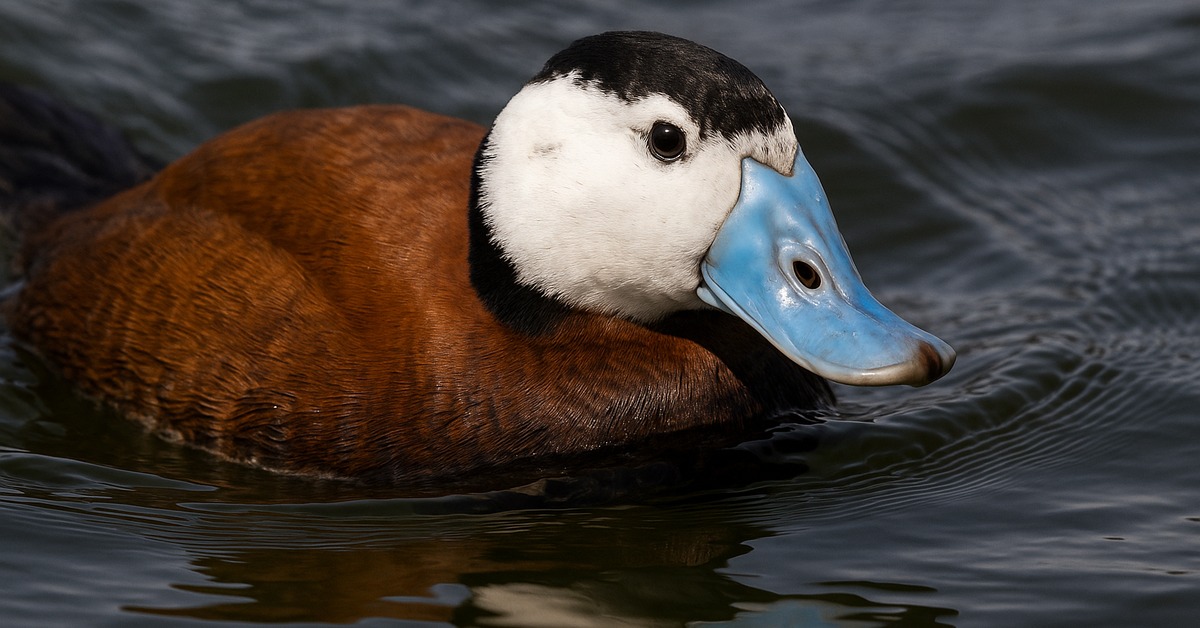
A cobalt-blue bill that bright looks painted on — and the White-headed Duck carries it like it has nothing to prove. That color isn’t vanity. It’s a survival signal, and understanding why changes how you see everything else about this bird.
Scattered across wetlands from southern Spain to Central Asia, the White-headed Duck is a compact, stiff-tailed diving bird that most people have never encountered — and probably couldn’t pick out of a lineup. Up to 48 centimeters long. Built like a submarine. The males wear that unmistakable blue bill like a badge, and the story behind it goes somewhere much stranger than you’d expect from a bird this small.
Key Facts
- The White-headed Duck measures up to 48 centimeters long and is a stiff-tailed diving bird of the Palearctic
- Spain’s conservation effort grew the Iberian population from around 22 birds in 1977 to over 2,500 by the early 2000s
- Fewer than 15,000 individuals were estimated globally in the 1970s, triggering protections under the Ramsar Convention on Wetlands
- Up to 10,000 White-headed Ducks have been recorded at single wintering sites in Iran
- The invasive North American Ruddy Duck, introduced to Britain in the mid-twentieth century, threatens the species through introgressive hybridization
In short: The White-headed Duck blue bill signals male fitness, brightening with hormone levels during breeding season. A Palearctic diving bird up to 48 cm long, it nearly vanished, dropping to around 22 Iberian birds by 1977 before Spain’s recovery effort and a controversial Ruddy Duck cull pulled the species back from genetic swamping.
Why the White-headed Duck’s Blue Bill Actually Matters
That bill isn’t decoration. During breeding season, male White-headed Ducks use bill coloration as a direct signal of fitness — the brighter the blue, the more attractive the male appears to females. Researchers studying the species have documented how bill intensity correlates with hormone levels, essentially functioning as a real-time health readout running across a duck’s face. It’s one of the more elegant examples of honest signaling in the bird world.
So what does a dull bill say about a male’s chances? Not great things. Females have evolved to read these signals over thousands of generations — they’re not easily fooled. A faded bill means a weaker male, and in a species already under pressure, mate selection carries extra weight. Every breeding season becomes a high-stakes audition with no callbacks.
Where These Ducks Actually Live — And Gather
The White-headed Duck calls the Palearctic home — a massive geographic band stretching from the Iberian Peninsula across to Kazakhstan and beyond. Shallow, reed-fringed lakes and marshes are where they spend their time, diving for aquatic invertebrates and plant material. Normal enough, as ducks go.
But winter changes everything. They abandon their scattered summer territories and converge. At wetlands in Iran, Turkey, and parts of Central Asia, flocks of thousands form on the water. Scientists studying waterfowl aggregation have recorded remarkable wildlife concentrations across the globe — but 10,000 White-headed Ducks showing up on a single lake still turns heads.
Ten thousand birds. Ten thousand blue bills catching winter light off the surface of one body of water.
It sounds like something that belongs in a nature documentary with a swelling orchestral score. And it used to happen more reliably than it does today.
The Threats Closing In on a Vulnerable Species
Follow the numbers backward and the story gets darker fast. Habitat destruction has been the primary driver of decline — wetlands across their range have been drained, polluted, or converted for agriculture at a rate that’s left the species with fewer and fewer safe places to land. Hunting pressure during migration compounded the losses for decades. By the late twentieth century, the global population had dropped to genuinely alarming levels, with some estimates placing the total below 10,000 individuals.
For a species that once gathered in flocks that size at a single location, the irony is pretty bleak.
Why does this matter beyond the raw numbers? Because a population floor that low is the kind of number from which species don’t always come back — and this one nearly didn’t. Something else entered the picture around the same period — something that arrived from the outside and proved far harder to fight because you can’t see it happening until it’s already happened.

The Invasive Duck That’s Erasing a Species Genetically
Here’s the thing: one of the biggest dangers facing the White-headed Duck isn’t a predator or a pollutant. It’s another duck. The Ruddy Duck, native to North America, was introduced to Britain in the mid-twentieth century as part of a wildfowl collection. It escaped. It spread across Europe. And when it encountered the White-headed Duck, it didn’t compete with it — it interbred, producing fertile offspring that dilute the White-headed Duck’s genetic identity, generation by generation, quietly and completely.
This kind of threat is called genetic swamping (researchers actually call this “introgressive hybridization,” which sounds more clinical than what it actually is — the slow erasure of a species from the inside). It’s particularly hard to combat because the hybrids look almost right, behave almost right. But the original genetic blueprint is being overwritten in slow motion.
Spain launched a controversial culling program targeting Ruddy Ducks specifically to protect their recovering White-headed Duck population. It worked. The debate about method versus outcome never fully quieted down, and probably shouldn’t have.
Watching a species lose its genetic identity to an introduced bird while bureaucracies debated the ethics of intervention — that’s not a conservation dilemma, that’s a failure of urgency dressed up as principle.
Where to See This
- Doñana National Park, southwestern Spain — one of the best sites for observing the recovered Iberian population, particularly during winter months from November through February.
- The Wildfowl & Wetlands Trust (WWT), UK — actively monitored the Ruddy Duck spread and contributed data that shaped the European eradication response; their Slimbridge reserve in Gloucestershire remains a key research center.
- For a closer look at genetic swamping and conservation genetics, the IUCN’s Threatened Waterfowl Specialist Group publishes detailed status assessments on White-headed Duck recovery that are freely available online.
By the Numbers
- Fewer than 15,000 individuals estimated globally in the 1970s — alarming enough to trigger international protections under the Ramsar Convention on Wetlands.
- Spain’s conservation effort grew the Iberian population from around 22 birds in 1977 to over 2,500 by the early 2000s. Twenty-two birds. That’s not a population, that’s a parking lot. The recovery is one of the more dramatic single-species turnarounds in European waterfowl history.
- Up to 10,000 White-headed Ducks recorded at single wintering sites in Iran.
- Males measure up to 48 cm — roughly pigeon-sized, but far more hydrodynamic, capable of diving several meters to forage on aquatic vegetation and invertebrates.
Field Notes
- That stiff, upright tail held at a sharp angle above the water is one of the most distinctive field marks — and serves no known aerodynamic function, which suggests it probably plays some role in social signaling or display that researchers haven’t fully unpacked yet.
- Rarely flies unless it has to. White-headed Ducks will dive to escape predators rather than take to the air, which makes wetland connectivity between sites critically important — these birds aren’t going to just fly around a gap in suitable habitat.
- Climate change is quietly reshaping the species’ range, pushing suitable wetland habitat northward. Whether the White-headed Duck can shift its migratory behavior fast enough to keep pace is still an open question.
Why This Small Duck’s Survival Matters Beyond Its Species
And here’s the part that gets lost whenever someone reduces this to a species count: the White-headed Duck is what conservationists call an umbrella species. Protect it, and you’re protecting the wetland ecosystem it depends on — which in turn supports hundreds of other species of plants, fish, insects, and birds that never make it onto anyone’s conservation watchlist. The battles being fought for this bird in Spain and Iran aren’t really about one duck.
They’re about whether functioning wetland habitats can survive at all across a region that’s losing them faster than anyone’s restoring them.
Every time a White-headed Duck dives beneath the surface of a healthy marsh, it’s a sign that the ecosystem beneath it is still holding together. We talk about population numbers and hybridization rates and climate projections, but what those numbers actually represent is a living system — fragile, interdependent, assembled over thousands of years — that can come apart within a single human generation. That’s the part that gets swallowed by the statistics.
The White-headed Duck is a signal. Right now, the signal is mixed.
Editor’s Take — Alex Morgan
Twenty-two birds. That number stopped me cold the first time I read it — not because it’s the lowest I’ve encountered in conservation reporting, but because Spain pulled the species back from that edge through sheer, unglamorous persistence. What strikes me most isn’t the recovery itself; it’s that the genetic threat arrived quietly, wearing the face of another duck, and the response required doing something deeply uncomfortable to fix it. The White-headed Duck’s story is a blueprint, and not a comfortable one.
This bird survived hunting pressure, habitat loss, and a genetic invasion from an introduced species that nobody saw coming until it was already well underway. It’s still here — improbably, stubbornly here. But its future runs directly through wetlands that keep getting weighed against the farmland or development they could become instead. Small birds have a way of telling big truths. This one’s no different. If this kind of story keeps you up at night, there’s more waiting at this-amazing-world.com — and the next one is even stranger.
Frequently Asked Questions
Q: Why does the White-headed Duck have a blue bill?
The male’s cobalt-blue bill is a survival signal, not decoration. During breeding season, bill coloration acts as a direct fitness indicator, with brighter blue making males more attractive to females. Researchers have documented that bill intensity correlates with hormone levels, essentially functioning as a real-time health readout running across the duck’s face.
Q: How close did the White-headed Duck come to extinction?
Fewer than 15,000 individuals were estimated globally in the 1970s. In Spain, the Iberian population dropped to around just 22 birds by 1977. Spain’s conservation effort grew that population to over 2,500 by the early 2000s, one of the more dramatic single-species turnarounds in European waterfowl history, triggering Ramsar Convention protections.
Q: What threat does the Ruddy Duck pose to the White-headed Duck?
The Ruddy Duck, native to North America, was introduced to Britain in the mid-twentieth century, escaped, and spread across Europe. Rather than competing, it interbreeds with the White-headed Duck, producing fertile hybrids that dilute the species’ genetic identity through introgressive hybridization, sometimes called genetic swamping, the slow erasure of a species from the inside.
Q: Where can you see White-headed Ducks today?
Doñana National Park in southwestern Spain is one of the best sites for observing the recovered Iberian population, particularly during winter from November through February. Wintering flocks of up to 10,000 birds have been recorded at single sites in Iran, with additional concentrations in Turkey and parts of Central Asia.
Illustrations are AI-generated. Article fact-checked and human-edited. Our editorial standards.