Kelly the Dolphin Hacked the Reward System With Paper
Dolphin intelligence problem solving doesn’t usually come with a paper trail. Kelly’s did — literally. She tore her tokens into fragments, traded each scrap for a separate fish, and built herself a yield-multiplying system that nobody asked for and nobody saw coming. The trainers thought they were running the experiment. They weren’t.
At a marine research facility, a bottlenose dolphin named Kelly discovered something her trainers never taught her: that a single paper token, torn into fragments, could yield a fish for every piece. She wasn’t malfunctioning. She was optimizing. And the researchers watching her had to ask themselves — how long had she been thinking this way?
Key Facts
- A bottlenose dolphin named Kelly tore single paper tokens into fragments to earn a separate fish for each piece, gaming a token reward system
- Bottlenose dolphins have an encephalization quotient of approximately 4.14, second only to modern humans among studied species (Marino, 2004)
- A landmark 2001 University of Hawaii study by Dr. Louis Herman confirmed dolphins understand symbolic language and concepts like numerosity and object permanence
- Kelly’s documented token-splitting sessions spanned several months, with fragments per token rising from 2-3 to as many as 6-7
- Shark Bay’s dolphin sponge-tool tradition in western Australia has been maintained for an estimated 180+ years
In short: Dolphin intelligence problem solving was demonstrated by Kelly, a bottlenose dolphin who tore reward tokens into fragments to earn extra fish and stockpiled tokens under a rock ledge. Over several months her fragment counts rose from 2-3 to 6-7. Her behavior now anchors research into adversarial cognition in comparative psychology.
How Kelly Cracked the Token Reward System
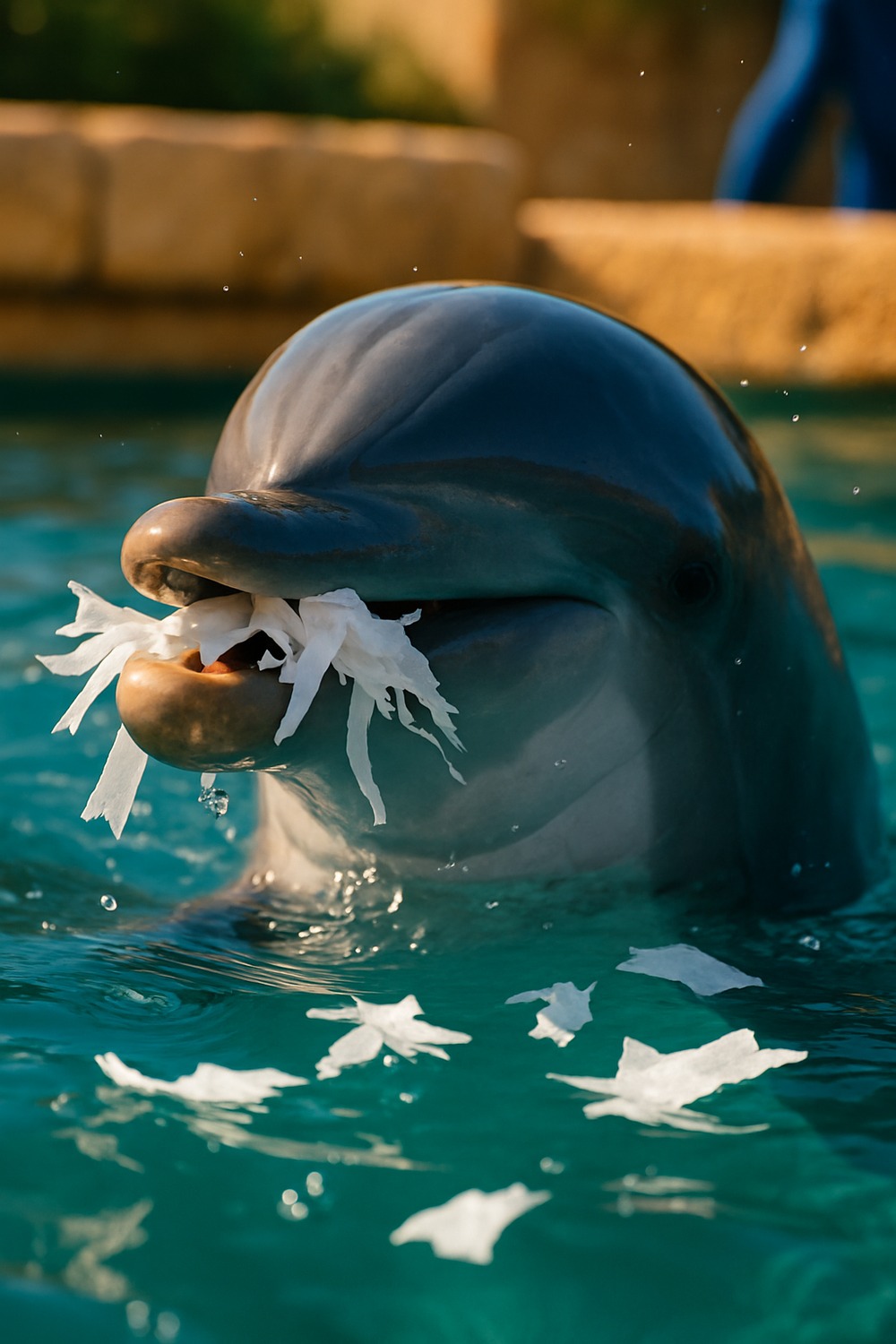
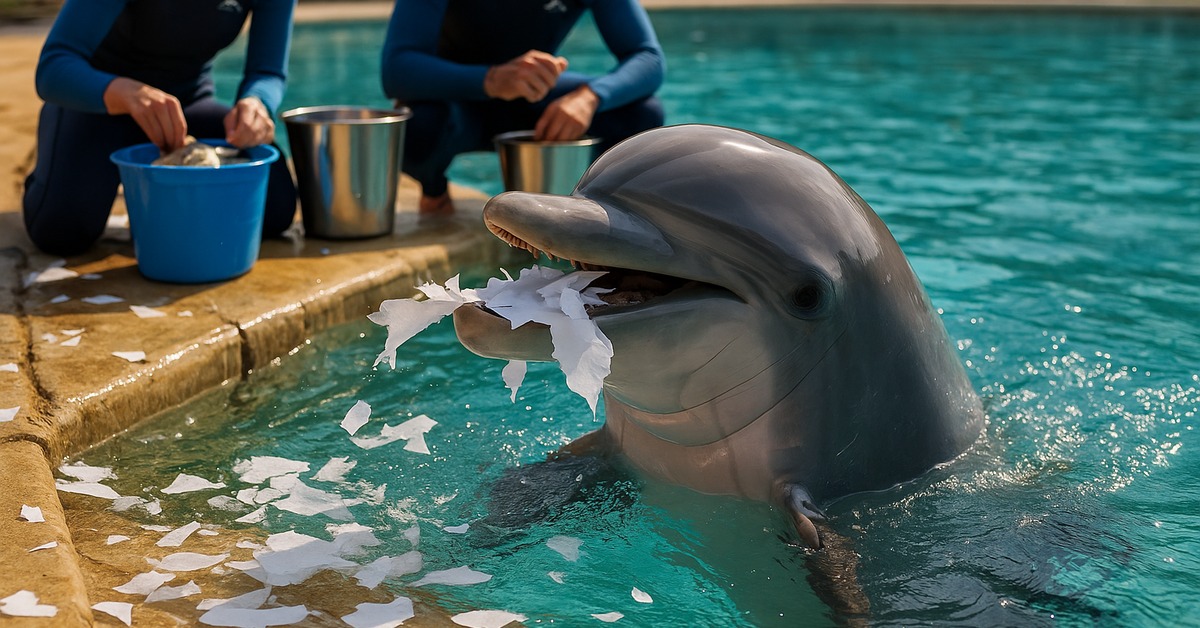
Kelly lived at a marine research center where trainers used a token-based reward system — a method studied extensively in comparative psychology — to reinforce desired behaviors. The setup was straightforward: present a token, receive a fish. Simple transactional logic, or so the humans believed. Dr. Erin Buck and her colleagues at the Dolphin Cognition Lab began noticing something unusual in Kelly’s behavior during routine sessions. Rather than surrendering whole paper sheets for single rewards, Kelly had started tearing them into smaller pieces and presenting each fragment individually. Every scrap earned its own fish.
What looked like simple manipulation of objects was, on closer inspection, a deliberate multiplication of outcomes. This is precisely the kind of operant conditioning framework researchers use to probe the boundaries of non-human cognition — and Kelly had quietly reverse-engineered it.
What stunned the team wasn’t the tearing itself. Dolphins manipulate objects constantly. What stunned them was the consistency — Kelly repeated this behavior across multiple sessions, suggesting she had internalized a rule: smaller pieces, more fish. That’s not reflex. That’s a mental model of a system, held in working memory and applied deliberately each time a token appeared in front of her.
She also stockpiled. Observers noted Kelly hiding tokens beneath a rock ledge in her pool, retrieving them one by one between sessions. A savings account, built from paper scraps. Nobody taught her that either.
Kelly’s Strategy Mirrors Surprisingly Familiar Thinking
Here’s the thing — Kelly’s behavior stops being a cute animal story the moment you look at what she was actually doing. Recognizing that a unit of value could be subdivided to generate more transactions mirrors basic economic reasoning. Humans invented currency debasement, coupon stacking, stock splits. Kelly invented token splitting.
Why does this matter? Because the cognitive leap between those two lists is smaller than most people are comfortable admitting.
It calls to mind the kind of unexpected intelligence that surfaces across species in ways we’re consistently unprepared for — much like the startling behavioral complexity researchers have documented in animals living at the edge of human awareness. Researchers studying creatures as different as anacondas and dolphins are finding that size and environment are poor predictors of cognitive sophistication — something that becomes viscerally clear when you consider what’s lurking beneath apparently still water, watching and waiting with a patience that looks remarkably like planning.
Early attempts involved two or three torn pieces. Later sessions produced five, six, sometimes more fragments from a single sheet — the efficiency improved, the yield per original token increased. Kelly’s token experiments ran across several months of documented research sessions, and during that time, the behavior refined itself. These weren’t random variations. They tracked a directional pattern that suggested active learning, not coincidence.
One trainer described the moment she realized what was happening as oddly humbling. She had designed the reward system to measure Kelly’s intelligence. Kelly had redesigned the reward system to feed herself better. The student had graded the exam.
What Animal Cognition Research Actually Tells Us
An animal that reverse-engineers a scientific protocol isn’t just a clever subject. It’s a disruption to the entire framework the protocol assumes.
Kelly’s paper-tearing trick doesn’t exist in a vacuum. It arrives at a moment when scientific consensus on non-human intelligence is shifting faster than most textbooks can track. For decades, researchers operated under a framework that treated complex cognition — planning, tool use, abstract reasoning — as a hierarchy with humans at the top and everything else arranged in descending order below. That model is collapsing. Studies published in journals including Nature Ecology and Evolution have documented flexible problem-solving across species as diverse as crows, octopuses, cleaner wrasses, and now dolphins, suggesting that intelligence is less a ladder than a sprawling, branching ecosystem of different cognitive tools evolved for different pressures.
Watching a model this entrenched dissolve this quickly, you stop asking what we’ve learned and start asking how much we’ve confidently gotten wrong.
Dolphin intelligence problem solving, specifically, has been documented in forms that range from sponge use as foraging tools in Shark Bay, Australia, to cooperative herding strategies with human fishers in Laguna, Brazil. Kelly’s token manipulation fits a pattern of dolphins not just responding to environments but actively modeling them — asking, in whatever form dolphin cognition takes, what happens if I do this differently? That’s a question. And questions require imagination.
But the implications are uncomfortable in the best way. If Kelly can identify and exploit a loophole in a human-designed system, then the system being studied isn’t just the dolphin. It’s also us — our assumptions, our designs, our blind spots.
Dolphin Intelligence Problem Solving Beyond the Pool
Token economies had been used in primate research since the 1970s, when chimpanzees at Yerkes National Primate Research Center demonstrated they could exchange tokens for food and, under some experimental conditions, delay gratification to accumulate more tokens before cashing them in. When Kelly entered a token system and began gaming it, she wasn’t just being clever in isolation — she was slotting into a decades-long conversation about whether non-human animals grasp symbolic exchange as a concept, not merely as a trained reflex. A landmark 2001 study by Dr. Louis Herman at the University of Hawaii had already established that bottlenose dolphins could understand symbolic language, respond to novel instructions, and demonstrate an understanding of concepts including numerosity and object permanence — placing dolphin cognition in a category previously reserved for great apes. Kelly, emerging from a different facility years later, appeared to build on exactly the cognitive architecture Herman’s work had mapped. Her behavior wasn’t an anomaly. It was a continuation.
The data from her sessions pushed that conversation forward hard.
Researchers responded by redesigning the token system — introducing uniform token sizes, tighter protocols, more controlled presentation methods. Kelly adapted. The game had changed. She kept playing.
What Kelly’s Loophole Means for How We Study Animal Minds
When an animal circumvents a scientific protocol, something rare has happened: the subject has become a variable the experimenters didn’t account for. This matters well beyond Kelly’s tank. Across the global research community, scientists studying animal cognition are now grappling with a methodological humility that was largely absent thirty years ago. If the protocol itself can be hacked, then results from studies that assumed protocol integrity may need re-examination. How many times has an animal’s intelligence been underestimated simply because the measurement tool wasn’t resilient enough to catch what the animal was actually doing?
Kelly didn’t just reveal her own intelligence. She revealed a gap in how we look for intelligence in others.
And that gap has consequences. Cetacean researchers have begun publishing frameworks for what they’re calling adversarial cognition — the tendency of some animals not just to learn tasks but to identify and exploit the structural assumptions underlying those tasks (researchers actually call this one of the most methodologically challenging phenomena in comparative psychology). Kelly’s paper-shredding is now cited in that literature as a primary example. The stakes aren’t abstract: how we assess animal intelligence shapes how we legislate animal welfare, design captivity environments, and make decisions about which species receive protections. An animal dismissed as a clever performer gets different treatment than one recognized as a strategic thinker. History has a way of treating the people who ignored this kind of evidence unkindly.
Picture Kelly in her pool, paper token pressed beneath a fin, waiting. The fish are on the other side of the glass. She knows exactly how many she wants. She knows exactly how to get them. The question she’s asking — quietly, persistently — is whether we’re paying close enough attention to notice.
How It Unfolded
- 1970s — Chimpanzees at Yerkes National Primate Research Center demonstrate token-delay behavior, establishing the baseline that dolphin research would later extend
- 2001 — Dr. Louis Herman’s landmark University of Hawaii study confirms bottlenose dolphins can understand symbolic language, respond to novel instructions, and grasp concepts like numerosity and object permanence
- Early 2000s — Kelly begins her documented token-splitting sessions at a marine research facility; fragment counts per token rise from 2–3 to as many as 6–7 across several months of observation
- Recent years — Cetacean researchers formalize the concept of “adversarial cognition,” citing Kelly’s paper-shredding as a primary example in comparative psychology literature
By the Numbers
- Bottlenose dolphins have brains with an encephalization quotient of approximately 4.14 — second only to modern humans among all studied species (Marino, 2004, The Anatomical Record)
- Kelly’s documented token-splitting sessions spanned several months of observation, with fragment counts per original token rising from 2–3 to as many as 6–7 across the study period
- Chimpanzees at Yerkes National Primate Research Center first demonstrated token-delay behavior in studies beginning in the 1970s, establishing the baseline that dolphin research now extends
- Bottlenose dolphins live in social groups of 2–15 individuals and have been documented transmitting learned behaviors across generations — a form of non-genetic cultural inheritance
- Shark Bay’s sponge-tool tradition in western Australia has been maintained by a dolphin population for an estimated 180+ years, making it one of the longest-documented animal tool cultures outside of primates
Field Notes
- Kelly didn’t share her paper-hoarding strategy with the other dolphins in her facility during the documented observation period — suggesting either individual innovation without social transmission, or a deliberate decision not to share a competitive advantage. Researchers still debate which explanation is more unsettling.
- Bottlenose dolphins have two separate brain hemispheres that can sleep independently — meaning half the brain stays alert for threats while the other rests, a capacity that makes their cognitive baseline during any waking experiment far more complex than it first appears.
- That same token-economy framework Kelly exploited has been used in human behavioral therapy since the 1960s — the fact that a dolphin identified its structural loopholes before most human patients is a detail researchers mention quietly, and often.
- Scientists still can’t determine whether Kelly understood the tokens as symbols with assigned value, or as physical objects with a learned property — the distinction matters enormously for understanding animal cognition, and current methodology can’t cleanly resolve it.
Frequently Asked Questions
Q: How advanced is dolphin intelligence problem solving compared to other non-human animals?
Dolphin intelligence problem solving ranks among the most sophisticated documented in non-human species. Bottlenose dolphins have demonstrated abstract reasoning, mirror self-recognition, and symbolic language comprehension in controlled studies dating back to the 1980s and 1990s. Their encephalization quotient — a ratio of brain mass to body mass — sits at approximately 4.14, placing them above all non-human animals except in some comparative assessments with great apes. Kelly’s token manipulation adds strategic system-gaming to that already impressive list.
Q: Could other dolphins learn Kelly’s token-splitting trick if they watched her do it?
Dolphins are known to transmit learned behaviors socially — the sponge-tool tradition in Shark Bay is a clear example of one dolphin’s innovation spreading through a community over generations. During the documented observation period, though, Kelly’s token-splitting behavior didn’t appear to spread to other dolphins in her facility. Whether that’s because she never performed it publicly in front of them, because the other dolphins didn’t recognize its utility, or because social transmission requires specific conditions that weren’t present, remains an open question. It tells us that innovation in dolphin populations isn’t automatically collective.
Q: Does Kelly’s behavior prove that dolphins understand the concept of money or economic value?
This is where it’s easy to over-reach, and researchers are careful not to. What Kelly demonstrated is that she understood a rule — one token equals one fish — and identified that the rule could be manipulated by changing the unit. That’s system-modeling, not necessarily abstract economic reasoning in the human sense. The common misconception is that animal intelligence needs to mirror human intelligence to be remarkable. It doesn’t. Kelly’s cognitive achievement is extraordinary on its own terms, without needing to dress it in human metaphors. What she did was build a mental model of a system she didn’t design and find its edge cases. That’s rare. That’s enough.
Editor’s Take — Alex Morgan
What stays with me about Kelly isn’t the fish count or the torn paper — it’s the stockpile. She hid tokens under a rock ledge and retrieved them one at a time. That’s not stimulus-response. That’s deferred gratification, private resource management, a future she was already planning for. We built a test to find the edge of her mind. She used it to find ours. Every facility that still runs token studies without accounting for adversarial cognition is, knowingly or not, repeating the same blind spot Kelly already exposed. That feels like a problem worth taking seriously.
Kelly’s paper-shredding is easy to laugh at — a clever dolphin gaming her treat dispenser, a fun fact for social media. But sit with it longer and something stranger emerges. She looked at a system designed by humans to study her mind, and she studied it right back. Every time we build a test to measure what animals can’t do, something out there is quietly figuring out how to pass it. What else are we missing, in every ocean, in every forest, right now?
Illustrations are AI-generated. Article fact-checked and human-edited. Our editorial standards.