The Pretty Insect That’s Quietly Destroying U.S. Crops
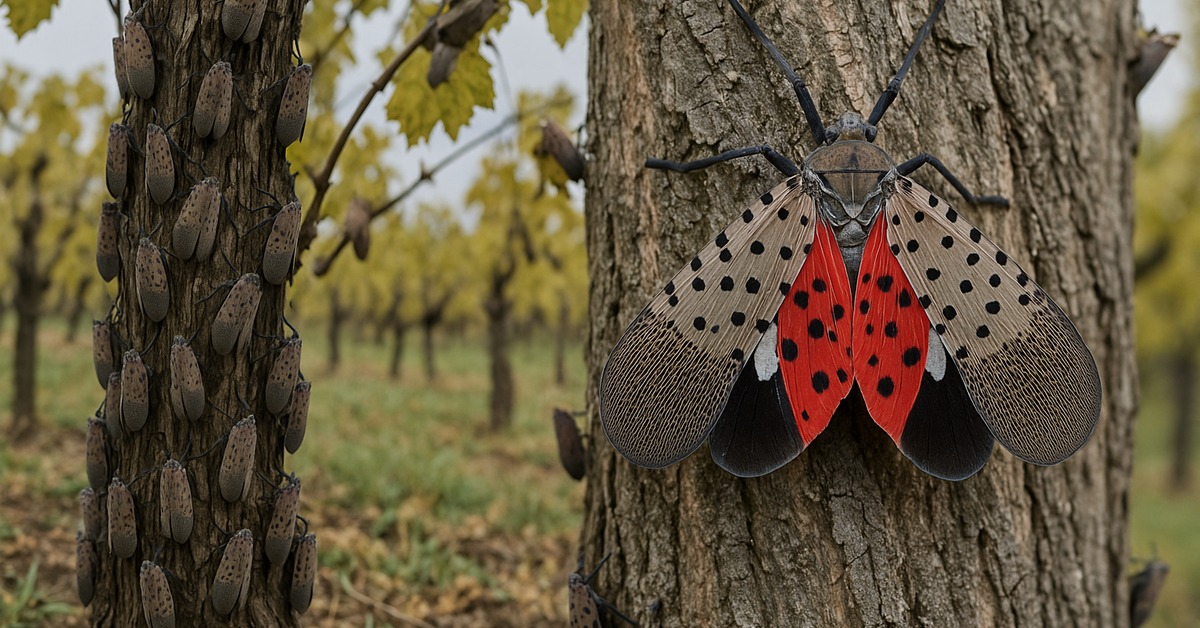
Most invasive species look the part — drab, aggressive, obviously wrong. The spotted lanternfly invasive pest doesn’t bother with that disguise. Red hindwings, black spots, something almost lacquered about the way it sits still. People photograph it. And while they’re doing that, it’s already laid eggs on the chair they dragged outside to get a better angle.
Confirmed in 14 U.S. states and feeding on over 70 plant species, it moves the way all the worst invasives do — not under its own power, mostly, but under ours. Shipping pallets. Tire treads. The back of a moving truck. A hitchhiker that doesn’t announce itself until the damage has been compounding for months.
Key Facts
- The spotted lanternfly (Lycorma delicatula) was first detected in the U.S. in Berks County, Pennsylvania in 2014, traced to a stone shipment
- As of 2023 the insect is confirmed in 14 U.S. states and feeds on over 70 plant species including grapes, apples, hops, and black walnut
- A 2019 Penn State study estimated potential annual agricultural losses in Pennsylvania alone at up to $324 million if unmanaged
- Pennsylvania’s grape industry generates over $800 million annually and sits inside the lanternfly’s expanding footprint
- Some South Korean vineyards reported 30-50% yield reductions during peak infestation years
In short: The spotted lanternfly invasive pest, first detected in Pennsylvania in 2014, has spread to 14 U.S. states and feeds on over 70 plant species by draining plant phloem. A 2019 Penn State study estimated up to $324 million in potential annual Pennsylvania agricultural losses, with the insect spread almost entirely by human transport of egg masses.
How the Spotted Lanternfly Invasive Pest Arrived Here
First detected in Berks County, Pennsylvania in 2014 — almost certainly tucked inside a stone shipment — Lycorma delicatula had already burned through South Korean vineyards before a single entomologist on this continent was formally tracking it. Entomologist Dr. Emelie Swackhamer of Penn State Extension has been on it since that first sighting, watching it establish itself with what she’s described as alarming efficiency. Wikipedia’s entry on the spotted lanternfly lays out the South Korea precedent in detail. So why weren’t we more prepared?
Speed was always going to be the obstacle. Within a few years of the Pennsylvania detection, it had crossed into New Jersey, New York, Delaware, Virginia. The insect itself isn’t a great flier. But humans are extraordinarily good at moving things without checking them — egg masses on car tires, on outdoor furniture, on a stack of patio stones sitting in a truck bed, traveling hundreds of miles while everyone’s listening to podcasts.
What These Bugs Actually Do to Plants
Here’s the thing: it doesn’t chew. Doesn’t bore into wood. The spotted lanternfly pierces plant tissue and drains the phloem — the sugary internal fluid that moves nutrients through a plant’s vascular system. Dr. Urban, a Penn State researcher who’s documented repeated feeding cycles on grapevines, describes it as cumulative stress: the plant doesn’t collapse immediately, it just gets weaker. Season after season. Think of it like someone slowly bleeding your car’s fuel line — not all at once, just enough that you don’t notice until you’re stranded.
Then there’s the honeydew problem. As the insects feed, they excrete a sticky residue that coats bark and leaves. Within days, black sooty mold grows on it. That mold blocks photosynthesis — so one pest effectively delivers two separate rounds of damage, and farmers don’t just lose yield, they sometimes lose the plant entirely. The mold as secondary weapon. It’s almost elegant in how awful it is.
Why Pennsylvania’s Wine Country Is Ground Zero
Pennsylvania’s grape industry generates over $800 million annually — and it sits almost perfectly inside the spotted lanternfly’s expanding footprint. Vineyards in Chester County and Lancaster County have documented canopy loss, reduced brix levels (that’s the sugar content that determines wine quality), and feeding pressure that doesn’t let up through the growing season.
The spotted lanternfly invasive pest doesn’t need to kill every vine to devastate a harvest. Stress enough of them at the wrong time, and the math stops working.
Watching an industry that took generations to build get quietly drained by an insect most people still can’t identify on sight — that’s not a crisis in slow motion. That’s already the crisis.
Farmers are scrambling. Pesticide applications every few weeks. Sticky band traps around tree trunks. It’s expensive, it’s labor-intensive, and none of it is a permanent fix. Some growers are absorbing costs they hadn’t budgeted for and won’t be able to sustain indefinitely.

The Invasive Tree That’s Making Everything Worse
Tree of heaven, Ailanthus altissima — another invasive from China that colonized roadsides, vacant lots, and forest edges across the eastern U.S. decades ago — is the spotted lanternfly’s preferred host. The lanternfly loves it. But when tree of heaven populations get depleted in an area, the insects don’t leave. They pivot, straight onto the high-value agricultural crops: grapevines, apple trees, hops, peaches, black walnut, red maple.
Why does this matter? Because cutting down tree of heaven — which sounds like the obvious fix — can actually accelerate pressure on surrounding farms.
It’s a trap researchers at the USDA are still working through, trying to figure out whether targeted removal helps or backfires in the short term. The U.S. is effectively managing two invasive species that enable each other, and neither problem dissolves without making the other worse.
Biocontrol is just as knotted. Some birds eat spotted lanternflies, but not at any scale that matters. A parasitic wasp, Anastatus orientalis, has shown real promise in lab settings — but releasing non-native species into the wild to control other non-native species requires years of study and still carries risk. Every potential answer arrives with its own set of footnotes.
And then there’s the climate angle. Warmer winters are letting egg masses survive that would once have been killed by hard freezes. The USDA has modeled the spotted lanternfly’s potential range as covering most of the eastern seaboard — a range that is almost certainly still expanding. Related coverage on invasive species is at this-amazing-world.com.
How It Unfolded
- 2014 — First U.S. detection in Berks County, Pennsylvania, traced to a stone shipment; Dr. Emelie Swackhamer begins tracking the population at Penn State Extension.
- 2018 — Quarantine zones established across multiple Pennsylvania counties; New Jersey and New York confirm sightings as the insect moves along human transport corridors.
- 2019 — Penn State study estimates potential annual agricultural losses in Pennsylvania alone at up to $324 million if the spotted lanternfly goes unmanaged.
- 2023 — Confirmed in 14 U.S. states; USDA models project the insect’s viable range could eventually cover most of the eastern seaboard as winters warm.
By the Numbers
- 14 U.S. states confirmed as of 2023 — up from a single county in Pennsylvania in 2014, with the spread driven almost entirely by human transport of egg masses (USDA APHIS).
- 70+ plant species affected, including grapes, apples, hops, cherries, black walnut, and red maple.
- A 2019 Penn State study estimated potential annual agricultural losses in Pennsylvania alone at up to $324 million if the spotted lanternfly goes unmanaged — and that figure excludes secondary losses to rural tourism and small business.
- South Korea benchmark: some vineyards there reported 30–50% yield reductions during peak infestation years. That country has been dealing with this insect longer than the U.S. has. That number is probably the most sobering thing on this list.
Field Notes
- Four nymph stages before adulthood — and the early black-and-white spotted nymphs get misidentified constantly, which delays reporting by weeks or months.
- Strong fliers, decent jumpers, but slow to react (researchers actually call this behavioral sluggishness a factor in the success of manual control campaigns). That’s why Pennsylvania’s Department of Agriculture launched the “Stomp It Out” campaign — literally encouraging people to crush any spotted lanternfly they see on contact.
- Egg masses look like dried mud or putty. Gray, waxy, completely unremarkable on bark or fence posts or the back of a lawn chair — and that’s exactly why accidental transport is so hard to prevent. Nobody’s searching for a smear of dried-looking gunk before loading the car for a road trip.
Why This Threat Matters Far Beyond One Farm
But the spotted lanternfly invasive pest isn’t really a farming story, or not only that. Damage accumulates at the edges of an ecosystem quietly, without drama, without a single moment you can point to and say “there, that’s when it went wrong.” The insects don’t announce themselves. They find a plant. They feed. They reproduce. By the time the signs are too obvious to ignore, thousands of acres have already absorbed years of compounding stress.
For grape growers and orchardists and hop farmers in the insect’s path, this is immediate and personal — livelihoods that took generations to build. For everyone else, the people who pick up a bottle of local wine or grab apples at a farmers’ market without thinking much about where they came from, the distance between “their problem” and “your problem” is shorter than it looks.
Editor’s Take — Alex Morgan
What keeps pulling me back to this story isn’t the agricultural losses — it’s the egg mass on a bumper. Invisible, unremarkable, already moving. The spotted lanternfly spread is, at its core, a story about how unaware we are of what we’re carrying. South Korea had the roadmap. We had the warning. What we didn’t have was anyone looking at the right object at the right moment. That gap — between knowing a threat exists and actually seeing it — is where invasions happen. It’s still happening now.
The spotted lanternfly is still spreading. New states confirm sightings every season. Researchers are racing to find solutions that don’t create new ones. And right now, somewhere on the eastern seaboard, an egg mass the size of a matchbook is sitting on a bumper headed somewhere it’s never been before. These are the stories that don’t tend to make front pages — quiet, incremental, already in motion. More of them live at this-amazing-world.com. The next one is stranger.
Frequently Asked Questions
Q: How did the spotted lanternfly invasive pest reach the United States?
The spotted lanternfly was first detected in the U.S. in Berks County, Pennsylvania in 2014, almost certainly arriving inside a stone shipment from Asia. Native to China, it had already damaged South Korean vineyards before reaching North America. Within a few years it crossed into New Jersey, New York, Delaware, and Virginia, spread largely by humans moving egg masses on vehicles, furniture, and freight rather than by the insect’s own flight.
Q: What damage does the spotted lanternfly do to plants?
The spotted lanternfly pierces plant tissue and drains the phloem, the sugary fluid carrying nutrients through the plant’s vascular system, causing cumulative stress that weakens plants season after season. As the insects feed, they excrete sticky honeydew that coats bark and leaves, and within days black sooty mold grows on it, blocking photosynthesis. This delivers two separate rounds of damage, costing farmers yield and sometimes the entire plant.
Q: Why is Pennsylvania’s wine country considered ground zero for the spotted lanternfly?
Pennsylvania’s grape industry generates over $800 million annually and sits almost perfectly inside the spotted lanternfly’s expanding footprint. Vineyards in Chester and Lancaster counties have documented canopy loss, reduced brix levels (sugar content that determines wine quality), and feeding pressure that lasts through the growing season. A 2019 Penn State study estimated potential annual agricultural losses in Pennsylvania alone at up to $324 million if the insect goes unmanaged.
Q: Why does the tree of heaven make the spotted lanternfly problem worse?
Tree of heaven (Ailanthus altissima), another invasive from China, is the spotted lanternfly’s preferred host. When tree of heaven populations get depleted in an area, the insects do not leave; they pivot onto high-value crops like grapevines, apple trees, hops, peaches, black walnut, and red maple. This means cutting down tree of heaven, the seemingly obvious fix, can actually accelerate feeding pressure on surrounding farms, creating a trap USDA researchers are still studying.
Illustrations are AI-generated. Article fact-checked and human-edited. Our editorial standards.