Arctic Peoples Who Mined Iron From Meteorites
Arctic meteorite iron tools exist because the sky solved a problem nobody asked it to. No iron in the tundra, no smelting tradition, no trade route south — and yet, somehow, blades. Sharp ones. The kind that last through winters that kill everything else. Ten thousand years before a European keel touched those waters, someone looked at a mass of fallen star-metal and understood, without any metallurgical vocabulary to guide them, exactly what it was for.
Long before smelting furnaces existed anywhere near the Arctic Circle, Inuit and Paleo-Eskimo communities had already solved the metal problem. They found it lying in the snow. Massive iron meteorites, crashed into the tundra thousands of years ago, became the raw material for some of the most ingenious toolmaking in human prehistory. How a people with no access to conventional metallurgy built a sophisticated iron economy from fallen stars is a story that’s still being pieced together.
Key Facts
- The Cape York meteorite in northwestern Greenland crashed onto the ice sheet roughly 10,000 years ago, weighing an estimated 58 tonnes across several fragments
- Inuit and Paleo-Eskimo communities cold-hammered the meteoritic iron using basalt hammerstones traced to source outcrops 200 to 400 kilometres away
- Meteoritic iron contains between 5% and 60% nickel by mass, compared to less than 0.1% in typical terrestrial iron ores, enabling chemical identification
- A University of Copenhagen 2020 study cross-referenced iron artifacts from fourteen Arctic sites, confirming Cape York as the dominant source of pre-contact iron tools
- Robert Peary removed the largest Cape York fragment, Ahnighito, in 1897 and sold it to the American Museum of Natural History, where it still sits weighing 31 tonnes
In short: Arctic meteorite iron tools were made by Inuit and Paleo-Eskimo communities who cold-hammered fragments of the 58-tonne Cape York meteorite, which fell in Greenland roughly 10,000 years ago. Using basalt hammerstones carried 200 to 400 kilometres, they built a trade network spanning fourteen documented sites, confirmed by isotopic fingerprinting of the iron’s nickel content.
When Space Rock Became the Sharpest Tool Around
Weighing an estimated 58 tonnes across several fragments, the Cape York meteorite in northwestern Greenland crashed onto the ice sheet roughly 10,000 years ago. For centuries before European contact, Inuit communities knew exactly where it was — and exactly what it was worth. The Cape York meteorite wasn’t just a curiosity. It was infrastructure. Archaeologist Vagn Fabritius Buchwald, whose meticulous analysis of iron artifacts from Greenland and the Eastern Arctic remains a cornerstone reference, identified tool fragments chemically matched to Cape York across a wide geographic range. It’s the most documented source of Arctic meteorite iron tools, and its story keeps getting stranger the closer you look.
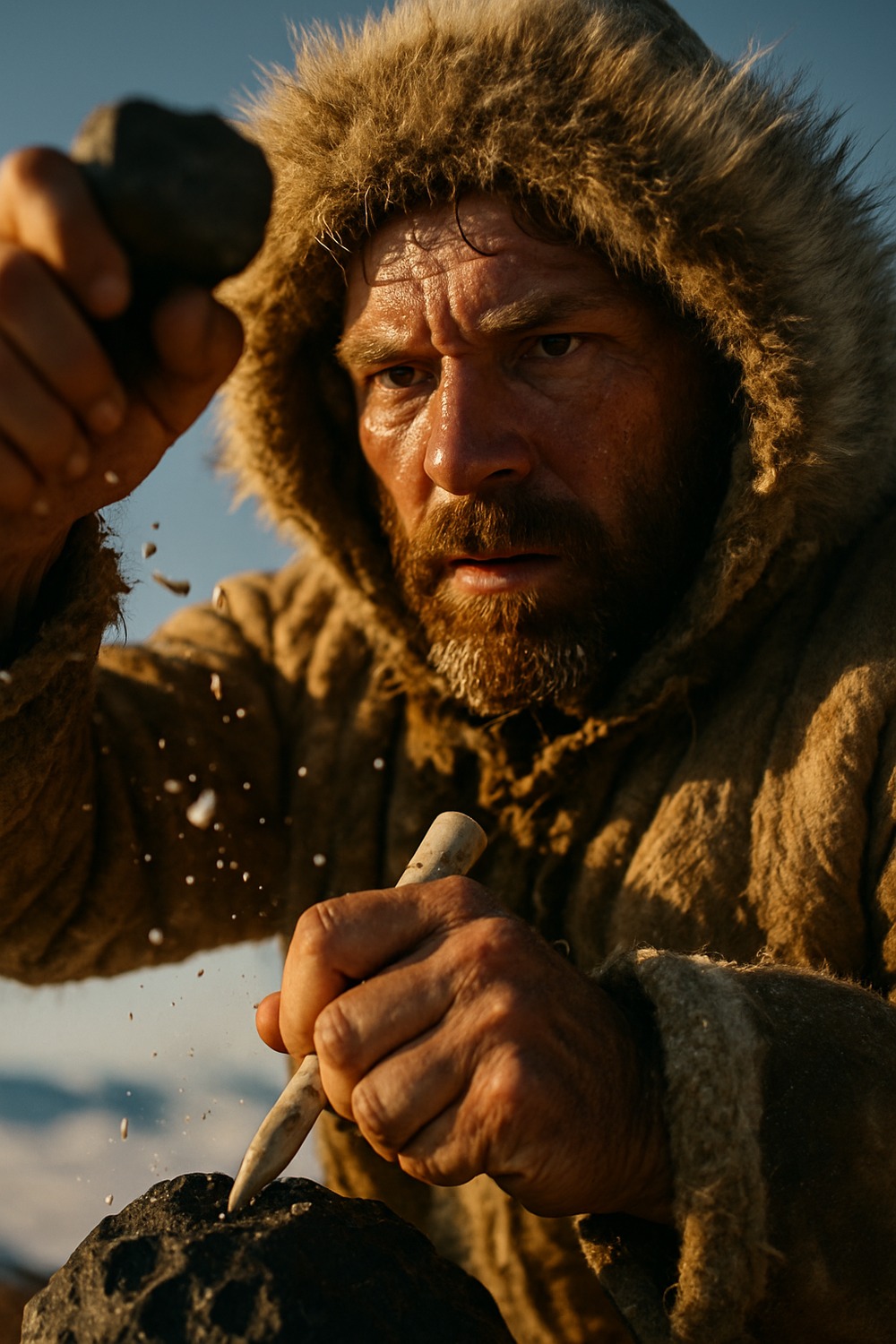
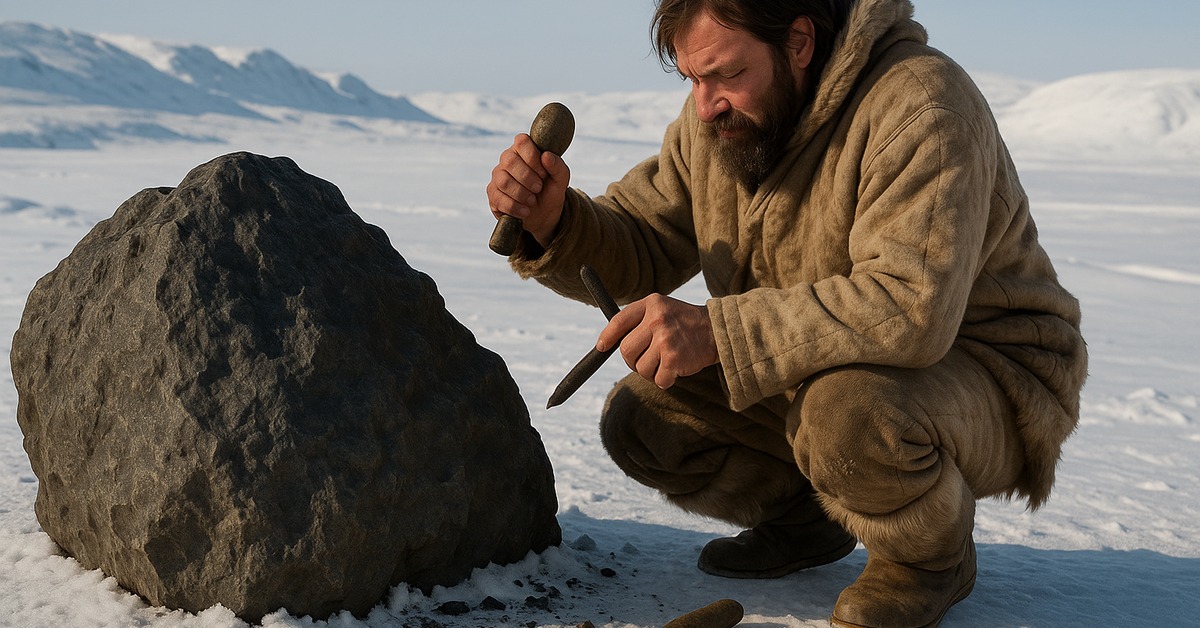
Shaping meteoritic iron without a forge required brutal patience. The metal is extraordinarily tough — far harder than wrought iron — and doesn’t respond to heat in a traditional smithing sense without proper equipment. So communities cold-hammered it. They struck it, again and again, using hard stone tools to knock off flakes and shape edges. Slow, exhausting, technically demanding work.
But it produced blades that held an edge in conditions that would destroy bone or antler alternatives. Knives, harpoon tips, and scraper blades made from meteoritic iron have been recovered from sites across the Canadian Arctic and Greenland. Thin. Precisely worked. The people making them understood their material at a granular level, even without a metallurgical vocabulary to describe it.
Basalt Hammers Carried Hundreds of Miles — Here’s Why
Here’s the thing about the logistics: to work meteoritic iron at all, communities needed hammerstones hard enough to shape it. Basalt — dense, fine-grained, durable — was the preferred material. But basalt doesn’t occur everywhere in the Arctic. In some regions, the nearest suitable outcrops were hundreds of kilometres from the meteorite sites themselves. The Arctic iron economy demanded commitment on a scale that seems almost unreasonable until you understand what was at stake: the difference between cutting and not cutting, between surviving a winter and not.
Archaeological surveys conducted across Baffin Island and northern Greenland have recovered basalt hammerstones at meteorite working sites that isotopic and mineralogical analysis traces to sources between 200 and 400 kilometres away. A single good hammerstone might be carried, repaired, and carried again across a lifetime of seasonal travel. These weren’t accidental inclusions in someone’s pack. They were transported deliberately, repeatedly, and over generations.
Picture a family group pausing on a sea-ice crossing, their sledge weighted with a stone that’s been in the family for thirty years. Worn smooth on one face. It works. You don’t leave it behind.
Cosmic Metal Became the Arctic’s First Trade Currency
Why does this matter? Because the iron didn’t stay where it fell.
Finished iron artifacts tell an even wider story. Studies of tool assemblages from sites across the eastern Arctic — from Ellesmere Island to southern Baffin — show meteoritic iron appearing in communities that had no direct access to Cape York or any other known meteorite source. In a landmark 2019 analysis published by Smithsonian Magazine drawing on isotopic fingerprinting research, scientists confirmed that iron artifacts recovered far from any known meteorite fall site shared the chemical signature of Cape York material. This wasn’t independent discovery. This was trade — deliberate, sustained, and operating across distances that reframe what we think Arctic communities were doing in the centuries before European contact.
Arctic meteorite iron tools functioned as a kind of hard currency (researchers actually call this “prestige material exchange,” and the label undersells it). Communities that controlled access to the meteorite sites held something everyone needed. A finished iron blade represented hours of skilled labor, rare raw material, and transport costs measured in calories burned across frozen terrain. Exchanging one wasn’t casual. It was the kind of transaction that built relationships, created obligations, and probably shaped social status in ways we’re only beginning to understand.
That changes the picture of Arctic prehistory significantly. These weren’t isolated bands scraping by.
And the evidence isn’t subtle — these were participants in a sophisticated exchange network, moving high-value goods across a geography that most people today couldn’t traverse with modern equipment. The scale of it, once you map it, stops looking like survival and starts looking like civilization.
Arctic Meteorite Iron Tools and the Science of Fingerprinting Stars
Meteoritic iron carries a distinct elemental signature — specific ratios of nickel, cobalt, gallium, and germanium that vary between falls and remain stable through cold-hammering. That’s how researchers know which tools came from which meteorite. In a 2020 study led by researchers at the University of Copenhagen’s Natural History Museum of Denmark, analysts compared iron artifacts from fourteen different Arctic sites against known meteorite compositions. The match rate was striking: the overwhelming majority of pre-contact iron tools tested traced back to Cape York, with a smaller subset potentially linked to other, less well-documented falls in the region.
Nickel content alone tells you something immediately useful. Terrestrial iron ores — the kind you smelt — contain very little nickel. Meteoritic iron is nickel-rich, often running between 5% and 60% nickel by mass depending on the meteorite’s classification. A single portable X-ray fluorescence scan of an artifact surface can now produce a preliminary reading in minutes, which matters when you’re working with fragile museum collections and can’t take samples large enough for full destructive analysis.
Researchers at the National Museum of Denmark continue to build the reference database, cross-referencing new artifact finds with updated meteorite catalogues. Each match is a data point. Over time, those data points begin to sketch trade routes that no written record could ever document.
What We Still Don’t Know — and Why It Matters
For all the forensic precision of isotopic analysis, significant gaps remain. Oral histories recorded from Greenlandic Inuit communities in the late nineteenth and early twentieth centuries suggest that knowledge of the meteorite’s location was passed down within specific family groups — treated, in some accounts, as proprietary. Whether that knowledge translated into formal authority, hereditary status, or spiritual guardianship is unclear. Who controlled access to the Cape York fragments, and on what terms, remains an open question. Comparable patterns appear in other cultures where rare materials intersect with cosmological meaning — volcanic obsidian in Mesoamerica, jade in pre-Columbian South America — but projecting those frameworks onto Arctic societies risks distortion.
History has a way of treating the people who flattened these communities into isolated subsistence groups unkindly — because the iron keeps turning up in the wrong places, hundreds of kilometres from where it should be, in the hands of people who weren’t supposed to be trading at all.
What’s equally uncertain is the scale of production at any given time. The Cape York main mass is enormous, but meteoritic iron isn’t uniformly distributed through a meteorite body. Working it required finding accessible surfaces, which means the rate at which usable material could be extracted was probably irregular. A severe winter, a change in sea-ice conditions blocking access, an injury to the community’s most skilled toolmaker — any of these could disrupt supply in ways that rippled through a trade network hundreds of kilometres wide.
Navarana, a Greenlandic woman whose family history was recorded by the explorer Knud Rasmussen in the early 1900s, described the meteorite site at Saviksoah — the Inuit name meaning “the great iron” — as a place of both practical and spiritual significance. The iron fed them. It also meant something more.
How It Unfolded
- ~10,000 years ago — the Cape York meteorite crashes onto the Greenland ice sheet, scattering across several fragments totalling an estimated 58 tonnes
- ~800–1,200 years ago — documented Inuit cold-hammering of Cape York iron begins, producing blades, harpoon tips, and scraper edges traded across the Eastern Arctic
- 1818 — British explorer John Ross becomes the first European to document Inuit use of meteoritic iron tools, encountering knife blades he couldn’t identify the source of
- 1897 — Robert Peary removes the largest Cape York fragment, Ahnighito, and sells it to the American Museum of Natural History, ending centuries of community access to the site
- 2019–2020 — isotopic fingerprinting studies by researchers at the University of Copenhagen’s Natural History Museum of Denmark confirm Cape York as the dominant source of pre-contact Arctic iron tools across fourteen archaeological sites
By the Numbers
- Approximately 58 tonnes across its known fragments — that’s the estimated mass of the Cape York meteorite, making it one of the largest iron meteorite masses ever recovered (Natural History Museum of Denmark, 2020)
- Basalt hammerstones used to work meteoritic iron have been traced to source outcrops between 200 and 400 kilometres from the working sites where they were recovered
- Between 5% and 60% nickel by mass is typical of meteoritic iron — compared to less than 0.1% in typical terrestrial iron ores — making chemical identification straightforward with modern equipment
- Fourteen distinct Arctic archaeological sites were included in the University of Copenhagen’s 2020 isotopic cross-referencing study of pre-contact iron tools
- Documented Inuit use of Cape York iron dates to at least 1,200 years before European contact — though the meteorite itself fell roughly 10,000 years ago
Field Notes
- When American explorer Robert Peary removed the largest Cape York fragment — known as Ahnighito — in 1897 and sold it to the American Museum of Natural History, Inuit communities lost access to a tool-making resource their ancestors had relied on for centuries. Ahnighito still sits in the museum today, weighing 31 tonnes.
- Meteoritic iron was sometimes deliberately alloyed with other materials during cold-hammering: traces of copper and bone have been found embedded in artifact edges, suggesting early composite tool construction without any smelting involved.
- Saviksoah — “the great iron,” the Inuit name for the Cape York meteorite site — predates any European record by centuries, indicating generational knowledge transfer about the resource that was precise enough to be location-specific.
- Researchers still can’t determine whether communities actively managed extraction rates at the meteorite site to extend its usefulness over time, or simply worked it opportunistically — a question with significant implications for understanding Arctic resource management strategies.
Frequently Asked Questions
Q: How were Arctic meteorite iron tools actually made without a forge or fire-based metalworking?
Cold-hammering is the short answer — striking the meteoritic iron repeatedly with hard stone tools, typically basalt, to chip away material and shape working edges. It’s slow, labour-intensive work that requires understanding the metal’s grain structure to avoid fracturing the piece. Both archaeological tool assemblages and oral accounts recorded from Greenlandic Inuit communities in the nineteenth and early twentieth centuries document the technique. Some tools show evidence of hundreds of individual hammer strikes.
Q: Why did Arctic peoples use meteorite iron rather than trading for smelted iron from further south?
For most of the period when these tools were in use — roughly 800 to 1,800 years ago in the Eastern Arctic — there was no accessible smelted iron anywhere close enough to trade for. Nearest iron-producing cultures were separated by sea crossings and overland distances that made regular exchange impractical. Meteoritic iron was simply the only iron available. Not a second choice — the first and only option, and communities adapted their entire toolmaking practice around its specific properties.
Q: Does Arctic meteorite iron tools research change our understanding of Inuit prehistory more broadly?
Significantly, yes. The old assumption — that pre-contact Arctic communities were largely isolated, subsistence-level groups with minimal long-distance interaction — doesn’t survive contact with the evidence. Distribution of Cape York iron across sites hundreds of kilometres from the source demonstrates sustained, organised trade networks operating across the Eastern Arctic for centuries. That implies communication, relationship maintenance, and economic planning on a scale that rewrites the baseline assumptions of the field. It’s not a minor revision. It’s a structural reframe.
Editor’s Take — Sarah Blake
What stays with me isn’t the iron itself — it’s Ahnighito, sitting in a Manhattan museum since 1897, thirty-one tonnes of star-metal that once underpinned an entire regional economy. Peary took it because he could, and the transaction gets footnoted in exploration history as an acquisition. But somewhere in the accounting of what that removal actually cost — in tools not made, relationships not maintained, a trade network quietly dissolving — there’s a story about what we choose to call civilization, and what we choose not to notice when it belongs to someone else.
A piece of iron falls from space ten thousand years ago. Lies in the snow for millennia. Then someone finds it, understands what it is, and builds an economy around it — all without a single written record, a single coin, or a single smelting furnace. The Arctic kept that secret for centuries. We’re still learning to read it. What else are we looking past, buried in the ice, waiting to rewrite everything?
Illustrations are AI-generated. Article fact-checked and human-edited. Our editorial standards.