A Mother Jackal Chased an Eagle Mid-Air to Save Her Cub
Nobody films a miracle on purpose — but the drone was already running when the mother jackal saves cub story wrote itself in real time over the Maasai Mara grassland, and the footage hasn’t stopped circulating since.
Kenya’s Maasai Mara National Reserve is the kind of place where predation is so routine that researchers sometimes stop watching. Whatever algorithm controls the universe of dramatic moments apparently wasn’t done that day, though. An eagle snatched a jackal cub clean off the ground, climbed into open sky — and a mother made a decision that probably shouldn’t have worked. The cub fell. It survived.
Key Facts
- The footage was captured by a drone over Kenya’s Maasai Mara National Reserve, where a black-backed jackal (Canis mesomelas) mother pursued an eagle that had snatched her cub
- Martial eagles span up to 1.9 meters (6.2 feet) and strike at speeds exceeding 100 km/h, per African Raptors 2021 data
- A black-backed jackal sprints at roughly 56 km/h (35 mph), fast enough to stay beneath a climbing eagle during the low-altitude window
- Black-backed jackal litters average 3-6 pups, but more than half do not survive their first three months, mostly due to predation
- Drone monitoring in the Maasai Mara has increased more than 300% since 2018, expanding aerial observation of predator-prey events
In short: The mother jackal saves cub footage, filmed by a drone over Kenya’s Maasai Mara, shows a black-backed jackal sprinting at roughly 56 km/h beneath a climbing eagle until the bird dropped her cub, then concealing it in a den. Martial eagles strike at over 100 km/h, and with over half of jackal cubs lost to predation, the rescue was rare.
How a Mother Jackal Saves Cub From Certain Death
The black-backed jackal (Canis mesomelas) is not a large animal. In the Maasai Mara ecosystem, they sit comfortably in the “things that get eaten” column as often as the “things that eat” one. Ecologist Dr. Femke Broekhuis, who’s spent years studying carnivore behavior in exactly this kind of terrain, has noted that smaller carnivores face a nearly constant stack of aerial and terrestrial threats.
According to Wikipedia’s entry on black-backed jackals, females are intensely protective of their litters — but the question nobody had good footage to answer was: how far does that instinct actually extend? Turns out, it goes airborne.
She didn’t hesitate. Didn’t retreat, didn’t freeze in that way prey animals sometimes do when the calculus of a situation is too terrible to process. The mother locked onto that bird as it climbed and ran — flat out, no detour, no exit — directly beneath the eagle’s flight path. That’s not a reflex firing. That’s something closer to a choice.
The Eagle Gripped Tight — Then Let Go
Here’s the thing about eagles: they’re not built to doubt themselves. A martial eagle or a Verreaux’s eagle-hawk — both documented hunters in the Mara region — can carry prey exceeding a kilogram at speeds that make the whole encounter feel like physics operating without permission.
And yet.
Why does this matter? Because the cold energy math a predator runs constantly in the background — is this meal worth what it costs to keep? — is exactly what the mother was attacking, not the bird itself. Under the sustained pressure of her pursuit, the barking, the positioning, the sheer refusal to stop, the eagle dropped the cub. Nobody can say for certain what tipped the calculation. The noise? A risk of mid-air collision? Predators make those trade-offs hundreds of times a season. This time, the numbers didn’t land in the eagle’s favor. You can find more on predator-prey dynamics caught on camera over at this-amazing-world.com, where wildlife footage keeps pushing the edges of what behavioral science assumed it already knew.
A Cub Hits the Ground — And Nobody Breathes
The cub dropped onto open plain. Hit hard. And didn’t move.
That tiny still shape in the grass held the drone’s frame for what feels, watching it, like a very long time. Then the mother closed the distance — skidded to a stop, pressed her nose against the cub in a gesture so deliberate it barely looks like instinct. The cub moved. Alive. But the mother jackal saves cub story wasn’t finished, because the eagle was still in the area and open grassland offers nowhere to be invisible. A bird with a failed hunt sometimes recalculates and circles back. (Researchers actually call this “re-approach behavior,” and it’s more common than the footage makes it look.)
The statistics around jackal cub survival exist because outcomes are mostly predictable. This wasn’t one of those times.
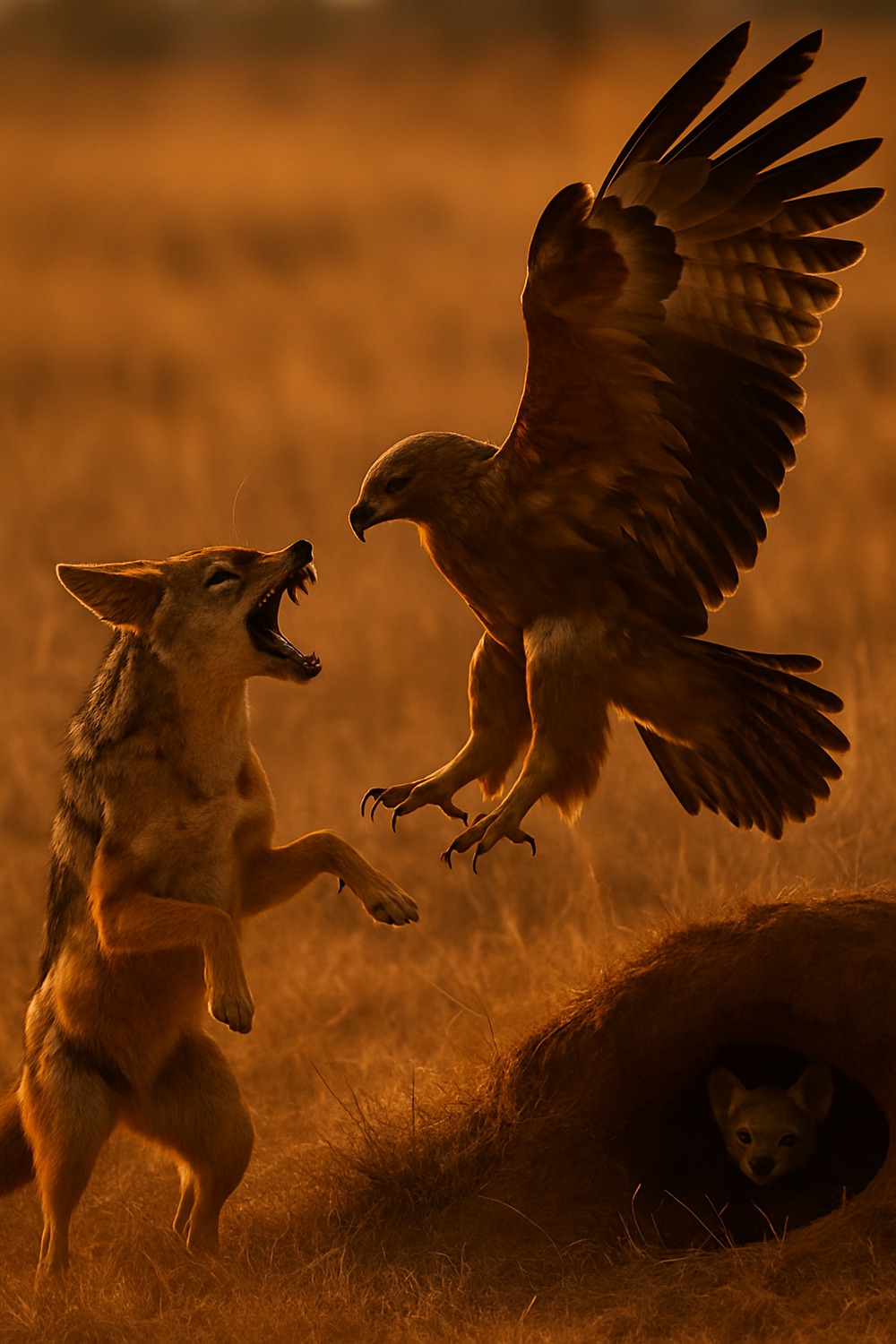
She Didn’t Just Save Him — She Hid Him
What happened after the cub landed is, in some ways, the more interesting part of the footage.
She didn’t just nudge him awake and stand guard. The mother led him — carried him at points — away from the open ground entirely, moving him into a nearby cave and tucking him out of sight, out of reach, out of any aerial sightline. That sequence — assess, relocate, conceal — isn’t one move. It’s three. In order. Under stress. Behavioral ecologists have spent years debating the cognitive depth of jackal parenting, and footage like this shoves those debates into new territory without asking permission. A drone in the Mara caught something that ground-based researchers could have watched for a decade without seeing.
And that gap between what we assumed and what the footage shows is the part that deserves more attention than it’s getting.
How It Unfolded
- 2018 — Drone monitoring programs begin scaling rapidly across the Maasai Mara, increasing aerial observation coverage of predator-prey events.
- 2021 — African Raptors field data confirms martial eagles striking at speeds exceeding 100 km/h, reframing assumptions about avian predation windows.
- 2023 — Serengeti Predator Research Project publishes updated jackal cub mortality figures, noting predation as the dominant cause of first-trimester loss.
- 2026 — Drone footage of the mother jackal’s aerial pursuit and den relocation sequence circulates widely, prompting renewed debate over jackal cognitive modeling in conservation planning.
By the Numbers
- Martial eagles span up to 1.9 meters (6.2 feet) and strike at speeds exceeding 100 km/h — which is why the cub’s survival sits so far outside what the statistics would predict (African Raptors, 2021).
- Black-backed jackal litters average 3–6 pups, but more than half of cubs don’t survive their first three months, mostly due to predation, according to field data from the Serengeti Predator Research Project.
- Drone monitoring in the Maasai Mara up 300%+ since 2018.
- A jackal hits roughly 56 km/h (35 mph) at full sprint — fast enough to stay directly beneath a climbing eagle during the critical low-altitude window, a period of vulnerability most raptors aren’t used to being challenged in.
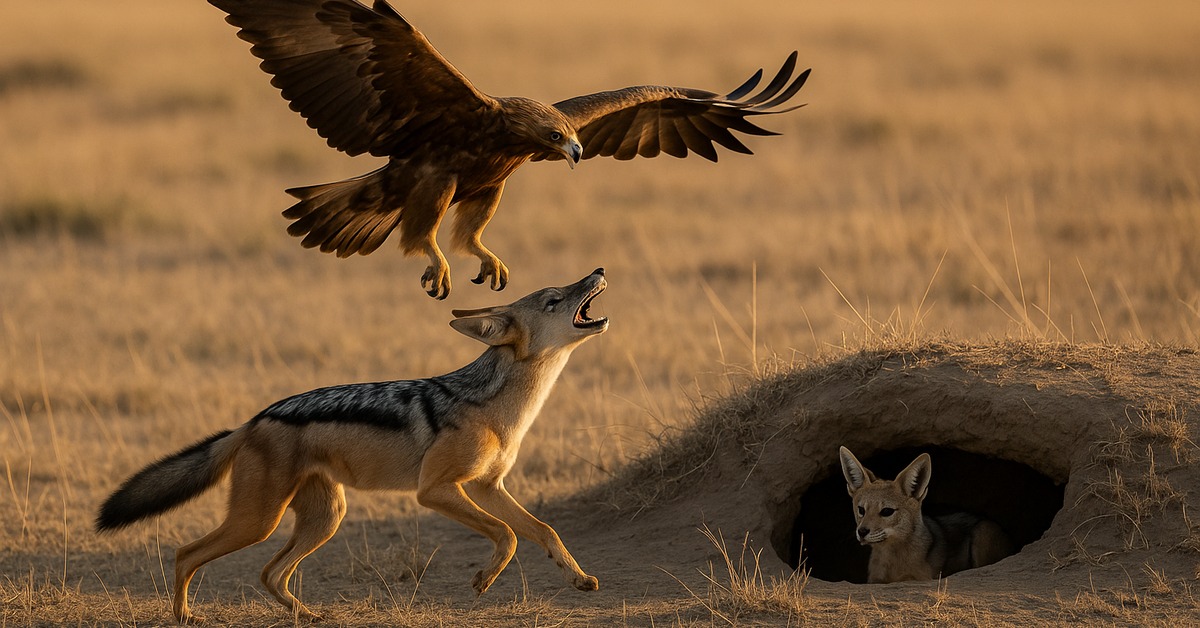
Field Notes
- Jackal mothers have been documented running off hyenas and leopards from den sites — but a sustained aerial pursuit against a bird already in active flight is nearly absent from the published behavioral record, and almost never filmed.
- Both jackal parents typically guard cubs — black-backed jackals are monogamous and share den duties — but only the mother appears in this footage. The male’s absence raises a question nobody’s answered yet: does solo parental defense change how far a parent is willing to go?
- Researchers are now using clips like this one to train AI-assisted models that predict predation escalation before it peaks. That field didn’t exist ten years ago.
Why This Moment Matters Beyond the Mara
It’d be easy to watch this and file it under “nature is intense” and keep scrolling. What the drone actually captured, though, is a documented case of a mother jackal saves cub through a sustained, sequential, adaptive response to a rapidly changing threat. She assessed. She chased. She protected the landing zone. She made a den decision under active pressure from a predator that was still in the air.
That’s not one burst of adrenaline. That’s a chain of decisions.
How we model animal cognition shapes how we design conservation policy — and footage that challenges those models mid-assumption isn’t a curiosity, it’s a correction. If mid-sized carnivores like jackals are operating with more behavioral depth than current frameworks allow, then the strategies built on those frameworks might be working from an incomplete picture. The Mara isn’t just a backdrop for extraordinary footage. It keeps generating data nobody knew to look for.
Editor’s Take — Alex Morgan
What stays with me isn’t the chase — it’s the three-step sequence after the cub landed. Assess, relocate, conceal. That’s not a mammal running on instinct. That’s a mother running a threat model in real time, under a predator that was still airborne, on a timeline measured in seconds. We’ve been cautious about attributing that kind of layered decision-making to mid-sized carnivores. This footage makes that caution feel less like scientific rigor and more like a failure of imagination. Conservation models built on underestimating jackals deserve a harder look.
A jackal mother ran flat out beneath a bird of prey, in open sky, with nothing but speed and refusal. And it worked. The wild doesn’t usually rewrite its endings — the statistics exist precisely because outcomes are mostly predictable. This time they weren’t. Some moments don’t need anything added to them. They just need a drone pointed in the right direction at the right second. There’s more where this came from at this-amazing-world.com — and honestly, the next one is stranger.
Frequently Asked Questions
Q: What happened in the mother jackal saves cub footage from the Maasai Mara?
A drone over Kenya’s Maasai Mara National Reserve captured an eagle snatching a black-backed jackal cub off the ground and climbing into open sky. The mother jackal ran flat out directly beneath the eagle’s flight path, and under sustained pursuit the bird dropped the cub. The cub hit the ground hard but survived. The mother then pressed her nose to it, confirmed it was alive, and moved it to a nearby cave, out of any aerial sightline.
Q: How could a jackal force an eagle to drop its prey?
Eagles run a constant energy calculation: whether a meal is worth what it costs to keep. The mother jackal attacked that calculation rather than the bird itself, through sustained pursuit, barking, and positioning. Martial eagles span up to 1.9 meters and strike at over 100 km/h, but a jackal sprinting at roughly 56 km/h can stay beneath a climbing eagle during the low-altitude window. The noise or collision risk likely tipped the trade-off against keeping the cub.
Q: How rare is it for a jackal cub to survive an eagle attack?
Extremely rare. Black-backed jackal litters average 3 to 6 pups, but more than half of cubs do not survive their first three months, mostly due to predation, according to the Serengeti Predator Research Project. A sustained aerial pursuit against a bird already in active flight is nearly absent from the published behavioral record and almost never filmed. The cub’s survival sits far outside what the statistics would predict, which is why the footage drew so much attention.
Q: Why does this jackal footage matter to wildlife researchers?
The mother’s response was not a single burst of adrenaline but a three-step sequence: assess, relocate, conceal, executed under active pressure from an airborne predator. Behavioral ecologists have been cautious about attributing that kind of layered decision-making to mid-sized carnivores like jackals. Researchers are now using clips like this to train AI-assisted models that predict predation escalation, a field that did not exist ten years ago, and the footage challenges cognitive models that shape conservation policy.
Illustrations are AI-generated. Article fact-checked and human-edited. Our editorial standards.