Ladybugs: Nature’s Tiny Pest Controllers in Disguise
Here’s the thing about ladybugs as natural pest control agents — the reputation was built on charm, but the résumé was built on something else entirely. That spotted shell cracking open on a summer morning, shaking out wings with no business fitting inside something that small, isn’t a magic trick. It’s the surface of a system that’s been running, quietly and without recognition, for longer than agriculture itself. Scientists are still catching up to how much is actually happening in there.
Key Facts
- A single ladybug larva eats up to 400 aphids before it pupates.
- One adult ladybug may consume as many as 5,000 aphids over its lifetime.
- There are more than 5,000 known ladybug species worldwide.
- In 1888 the vedalia beetle (Rodolia cardinalis) was introduced in California to combat cottony cushion scale, an early biological pest control success.
- The harlequin ladybird (Harmonia axyridis), introduced from Asia for biological control, now outcompetes native species across Europe and North America.
In short: Ladybugs natural pest control works through tiny jaws and a chemical defense. A single larva eats up to 400 aphids; an adult may eat 5,000 over its lifetime. With 5,000-plus species worldwide, they suppress aphids, mites, and whiteflies, though the invasive harlequin ladybird now threatens native populations.
A Shell That Speaks in Color
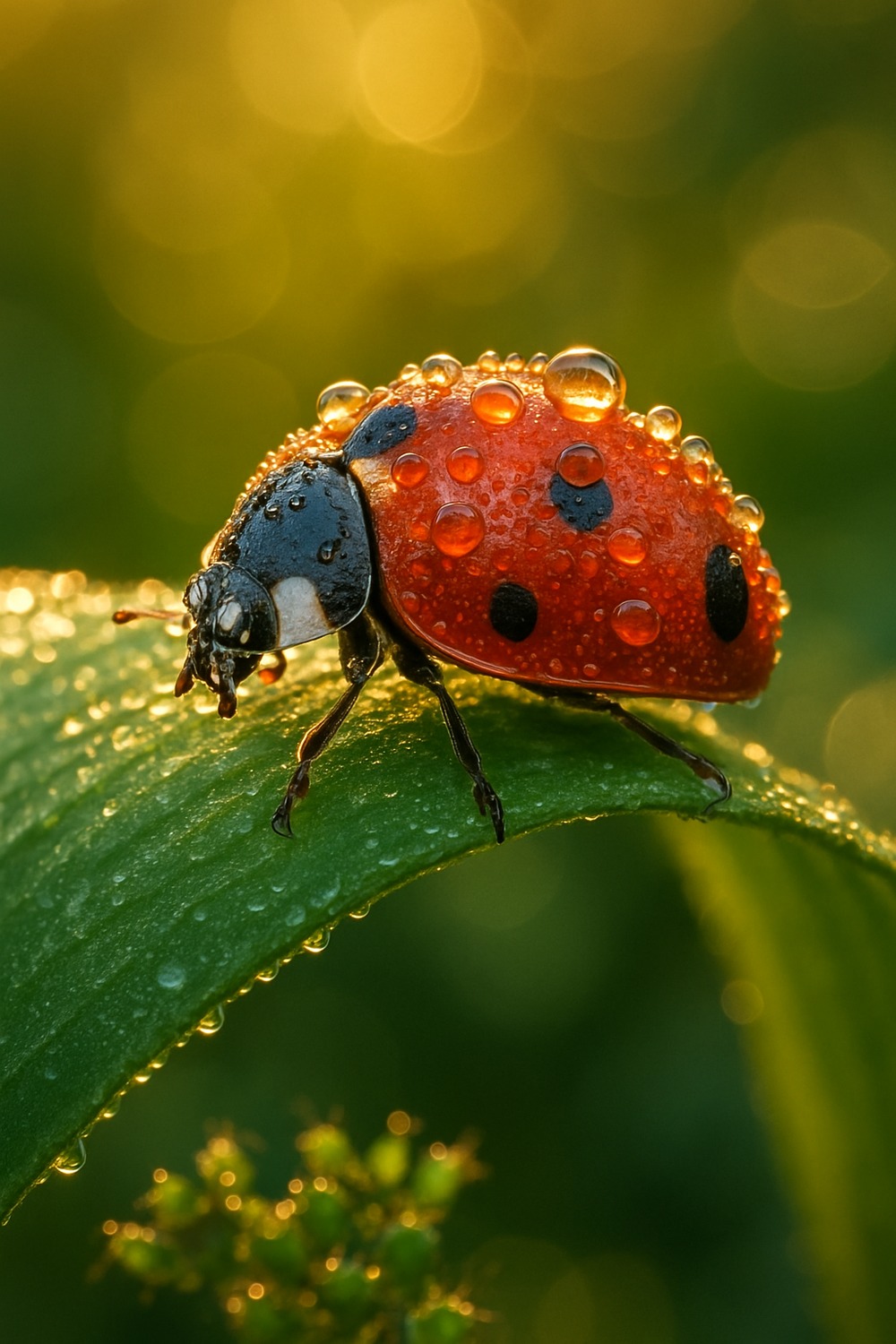
That red-and-black pattern isn’t decoration. It’s a warning, aimed squarely at every bird, lizard, and spider in the neighborhood — most of whom have already learned the hard way what it means. Biologists call this aposematism: the evolutionary trick of linking a vivid color signal to a genuinely nasty chemical defense, so predators learn to look elsewhere for lunch. Ladybugs produce toxic alkaloids called harmonine and coccinelline, released through reflex bleeding — a process where yellow, foul-smelling fluid seeps from the leg joints when the beetle feels threatened. Birds that make the mistake of tasting one typically spit it out immediately, shaking their heads and wiping their beaks with what can only be described as deep personal regret.
After a few such encounters, they avoid anything wearing red and black altogether. The ladybug doesn’t need to fight. It just needs to be recognizable.
What makes this stranger still is how tightly the visual signal and the chemical weapon have evolved together. Research in entomological journals has shown that species with more vivid red shells tend to carry higher concentrations of toxic alkaloids — brighter means more poisonous, reliably enough that predators can use the color as a genuine guide. The ripple effects extend far beyond the beetle itself, reshaping how predators behave, which mimics thrive, and how entire local ecosystems are organized — all traced back to one insect the size of a shirt button. Some non-toxic beetle species have figured this out and evolved near-identical coloration without bothering to produce the actual toxins, essentially borrowing the ladybug’s reputation for free. Evolutionary biologists call this Batesian mimicry (and this matters more than it sounds, because it means the ladybug’s defense actively sculpts the behavior of species that never interact with it directly).
Tiny Jaws, Enormous Appetite
Why does this matter at the field level? Because those jaws, while the shell manages the ladybug’s reputation, are quietly handling business at a scale most people never register.
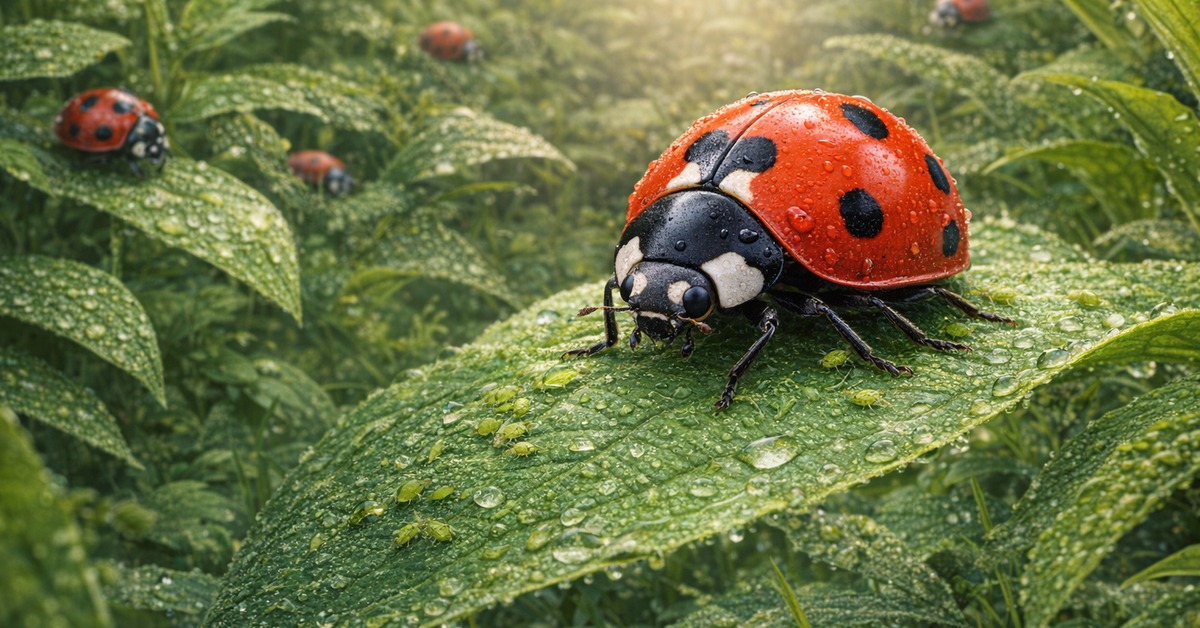
Aphids are the primary target, and ladybugs pursue them with a consistency that borders on industrial. A single larva eats up to 400 aphids before it even pupates. As an adult, one ladybug may consume as many as 5,000 over a lifetime — a number that sounds impressive until you multiply it across thousands of individuals working the same field simultaneously. Aphids don’t sit still for this, of course. They reproduce fast enough to overwhelm a crop in days, piercing stems to drain sap, weakening root systems, and carrying plant viruses that can flatten entire harvests. A healthy ladybug population doesn’t just reduce aphid numbers — it keeps them under pressure with a consistency no chemical spray can replicate, and without the collateral damage that pesticides routinely cause to soil organisms and other beneficial insects.
Aphids aren’t the whole menu. Ladybugs also take scale insects, mites, whiteflies, and the eggs of various crop-damaging pests, which makes them genuinely versatile workers in agricultural systems. Farmers in several countries have experimented with releasing commercially reared ladybugs as biological pest control, with results that are promising but complicated by one stubborn problem: the beetles wander. Released onto a crop, they tend to disperse widely in search of food and mates, thinning out exactly where they’re needed most. It’s a bit like trying to retain good staff by improving the break room. Researchers are now looking at habitat modifications — insectary strips of flowering plants along field edges, for instance — that give ladybugs shelter and supplemental food, nudging them to stay put long enough to make a measurable difference through the full growing season.
Guardians of the Ecosystem’s Balance
Ladybugs don’t operate in isolation. Lacewings, parasitic wasps, ground beetles, and birds all play roles in keeping pest populations in check — but ladybugs hold a particularly valuable position in that network because of their sheer numbers, their dietary flexibility, and their ability to ramp up quickly when aphid populations spike. Ecologists call this density-dependent control: as prey numbers climb, predator populations follow, intensifying pressure exactly when it’s most needed, then pulling back as food becomes scarce. It’s a self-correcting system, and it works.
Calling chemical sprays a substitute for this is, at best, wishful thinking — they hit everything, pests and beneficial insects alike, and in doing so they undermine the very predator-prey dynamics that keep ecosystems stable in the first place. The ladybug doesn’t just eat aphids. It helps maintain the conditions that make the whole system function.
An Uncertain Future in a Warming World
Resilient as they are, ladybugs are under real pressure. Habitat loss and pesticide use have taken a toll, but the more immediate threat in many regions is the harlequin ladybird — Harmonia axyridis, introduced from Asia for biological control purposes and now outcompeting native ladybug species across Europe and North America with an efficiency that nobody intended. Climate change layers on additional uncertainty. Warmer winters may disrupt ladybug hibernation, affecting both survival rates and the timing of spring emergence — and shifting temperatures are already altering the timing of aphid population peaks, which risks desynchronizing the natural rhythm between prey abundance and predator breeding cycles that makes biological control so effective.
And yet the research funding hasn’t kept pace with the urgency. Scientists will readily admit the full implications remain poorly understood — longitudinal field research tracking ladybug communities across different climate zones and farming landscapes is exactly what’s needed, and at present it’s chronically underfunded. That gap between what we know is at stake and what we’re investing to understand it is difficult to justify.
How It Unfolded
- 1800s — European farmers first documented ladybugs as reliable suppressors of aphid outbreaks in hop gardens and orchards, though no formal study existed yet.
- 1888 — The vedalia beetle (Rodolia cardinalis), a close relative, was deliberately introduced in California to combat cottony cushion scale, marking one of the earliest recorded successes in biological pest control.
- 1960s–1980s — Commercial rearing of native ladybug species for field release became widespread across the US and Europe, establishing the biological control industry as a serious agricultural tool.
- 1990s–present — Harmonia axyridis (harlequin ladybird), introduced specifically for pest control, begins displacing native species across North America and Europe — a cautionary chapter in the history of biological interventions.
By the Numbers
- 400 — aphids eaten by a single ladybug larva before pupation
- 5,000 — approximate aphids consumed by one adult ladybug over its lifetime
- 5,000+ — known ladybug species worldwide
- 90%+ — proportion of ladybug diet that may consist of aphids in peak season
- Harmonia axyridis — the harlequin ladybird, now considered invasive across much of Europe and North America
Field Notes
- Ladybug “reflex bleeding” — releasing toxic haemolymph from leg joints — is a passive defense requiring no muscular effort from the beetle.
- The seven-spot ladybird (Coccinella septempunctata) is among the most studied species and remains a benchmark organism in aposematism research.
- Insectary strips — plantings of flowering species along field borders — are increasingly used in integrated pest management to support beneficial insect populations including ladybugs.
- Some ladybug species aggregate in the thousands to overwinter in sheltered spots — crevices, leaf litter, building eaves — before dispersing in spring.
Frequently Asked Questions
- How many aphids can a ladybug eat in a day? Adult ladybugs can consume between 50 and 60 aphids daily under good foraging conditions, though this varies by species and food availability.
- Are all ladybugs beneficial to gardens? Most native species are, yes — but the harlequin ladybird (Harmonia axyridis) is considered problematic in regions outside its native Asia, where it displaces local species and occasionally damages soft fruit crops.
- Do ladybugs bite humans? They can, but it’s rare and causes no real harm. The harlequin ladybird bites more readily than most native species.
- Why do ladybugs come inside in autumn? They’re searching for a sheltered hibernation site. Large aggregations in attics or wall cavities are almost always harlequin ladybirds, not native species.
- Can you buy ladybugs to release in a garden? Commercially available ladybugs are sold in many countries, but wild-caught individuals tend to disperse quickly after release. Habitat improvements — flowering plants, reduced pesticide use — are generally more effective at building a resident population.
Editor’s Take — Alex Morgan
What stays with me isn’t the aphid count or the alkaloid chemistry — it’s the scale mismatch. Something you can balance on a fingernail is doing measurable work in systems that feed millions of people, and we’re still arguing about research funding. The harlequin ladybird story is the part I keep coming back to: we introduced a predator to solve a problem, and it solved that problem while creating a worse one. The ladybug’s whole case for protection is already written in that irony. We just have to decide whether we’re reading it.
A creature a few millimeters across shouldn’t be able to influence crop yields, reshape predator behavior, and serve as a living indicator of ecosystem health all at once. Yet here we are. As agriculture reckons with the long-term costs of chemical dependency and hunts for sustainable alternatives, the ladybug keeps making the same quiet argument it’s always made — that nature’s solutions tend to be more elegant, more precise, and more durable than anything we’ve engineered to replace them. Protecting ladybug habitats, pulling back on broad-spectrum pesticides, and putting real money into biological control research aren’t radical proposals. They’re the logical response to evidence that’s been sitting in the garden the whole time. Whether we’re paying enough attention is a different question entirely.
Illustrations are AI-generated. Article fact-checked and human-edited. Our editorial standards.