Why Millions Serve Whole Fish on Chinese New Year’s Eve
Nobody decided this would last 2,000 years. It started with a sound — two words that rhymed when they shouldn’t have — and somewhere along the way, that accident became sacred.
Every Chinese New Year’s Eve, as red lanterns sway over city streets and families crowd around tables loaded with food, one dish appears with almost religious consistency: a whole fish. Not filleted. Not decorative. The entire creature, head and tail present, placed carefully so it faces the right direction. There’s a reason for everything here — and it starts with a pun.
Key Facts
- In Mandarin the word for fish, yu, is a perfect homophone of yu meaning surplus or abundance, the linguistic basis of the tradition.
- Ceremonial fish bones found in Han dynasty tombs near Xi’an date to approximately 200 BCE, making the ritual roughly 2,200 years old.
- China’s Spring Festival generates an estimated 1 billion individual journeys home each year, the largest annual human migration on Earth (2019 transport data).
- Fish consumption in China spikes roughly 20 to 30% in the weeks before Chinese New Year, driven by the whole-fish tradition and gifting customs.
- China accounts for around 35% of global fish consumption, with the Lunar New Year period among the single largest demand surges in any food category per FAO data.
In short: The Chinese New Year fish tradition centers on serving a whole fish on New Year’s Eve because the Mandarin word for fish, yu, sounds identical to the word for abundance. Ceremonial fish bones in Han dynasty tombs near Xi’an date this roughly 2,200-year-old ritual to around 200 BCE, and it survived even the Cultural Revolution behind closed doors.
The Chinese New Year Fish Tradition That Rewrote Language
In Mandarin, the word for fish is “yú” (鱼). It’s a perfect homophone of “yú” (余), meaning surplus or abundance. Two entirely different characters. Same sound. That collision — almost certainly accidental — became the foundation of one of China’s most enduring food rituals. Scholars studying Chinese New Year customs trace this kind of sound-based symbolism, called homophonic association, back through thousands of years of cultural practice.
Which raises the obvious question: when exactly did a linguistic coincidence become a sacred annual obligation?
Not quickly. Language shapes belief the way water shapes stone — slowly, without announcing itself. Once “fish” sounded like “plenty,” every fish on every table carried a quiet promise. And Chinese families weren’t about to let that promise go unanswered on the most important night of the year.
Ancient Bones Tell the Oldest Part of This Story
It is approximately 200 BCE. A Han dynasty burial is being prepared near what will one day be called Xi’an. Among the offerings placed in the tomb: fish bones. Not discarded. Not accidental. Arranged.
Archaeologists found them exactly like that. The Han dynasty ran from 206 BCE to 220 CE, which puts this ritual at roughly 2,200 years old and counting. That’s not tradition in the casual sense — that’s something closer to cultural instinct, passed through hundreds of generations until it arrives, still intact, at a family dinner table in modern Shanghai. That last detail kept me reading for another hour. You can find more ancient rituals that somehow survived at this-amazing-world.com.
What the burial discovery implies is this: fish wasn’t just food. Long before neon lights and fireworks, before red envelopes and television galas, fish was already doing symbolic work. It was already carrying wishes into the afterlife.
Every Detail on That Plate Has a Meaning
The Chinese New Year fish tradition isn’t casual about anything.
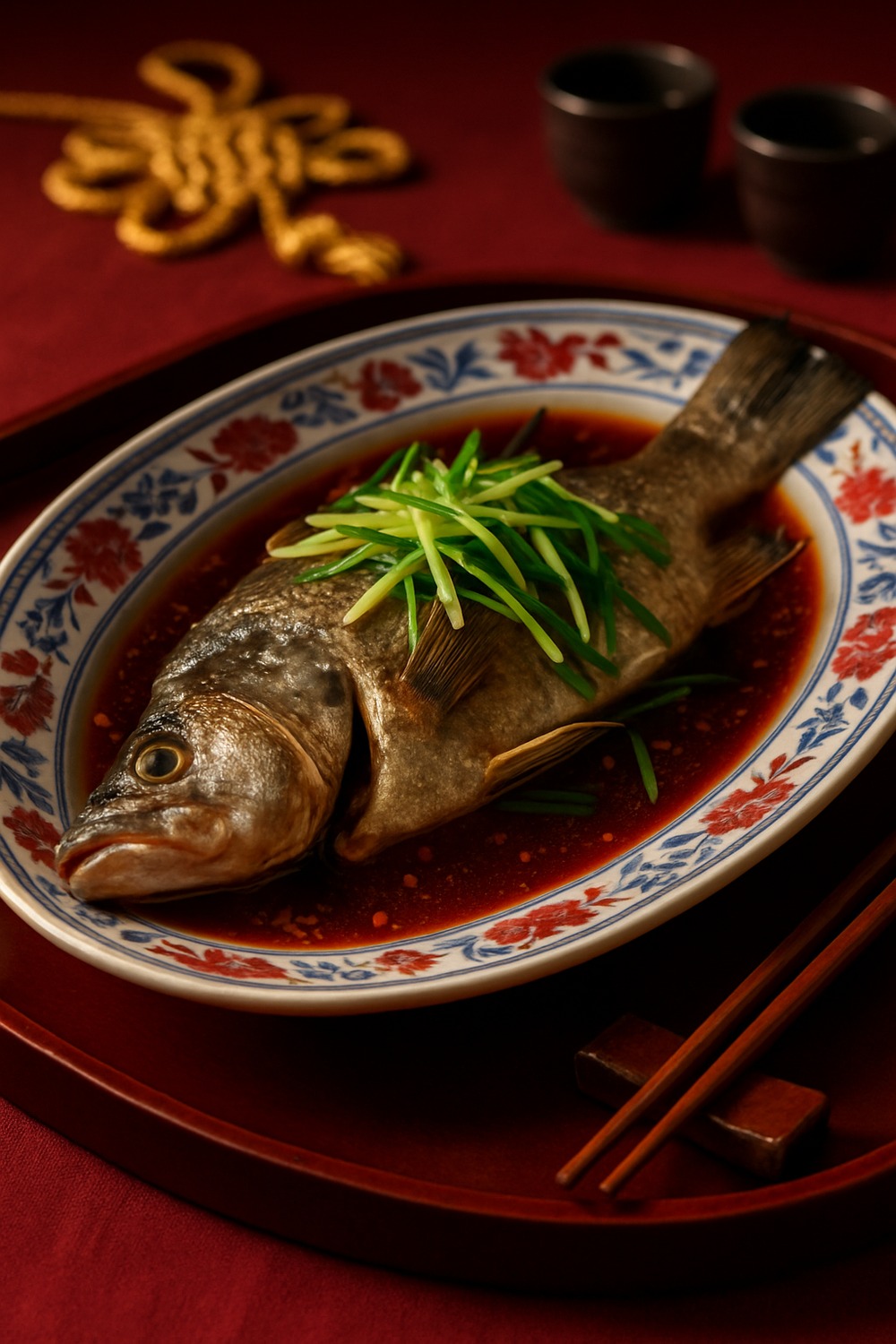
The fish must arrive whole — head and tail intact — because completeness symbolizes a full, unbroken year. The head points toward the most honored guest, usually the eldest at the table. In some households, a coin is balanced beneath the serving plate. In others, the tail is deliberately left uneaten on New Year’s Eve, saved for New Year’s morning — proof that abundance doesn’t just arrive, it stretches forward into the days ahead.
These aren’t quirky regional variations. They’re dialects of the same deep language. And the specificity is entirely the point — the more precise the ritual, the more seriously the wish is meant.
Which Fish Goes on the Table — and Why It Matters
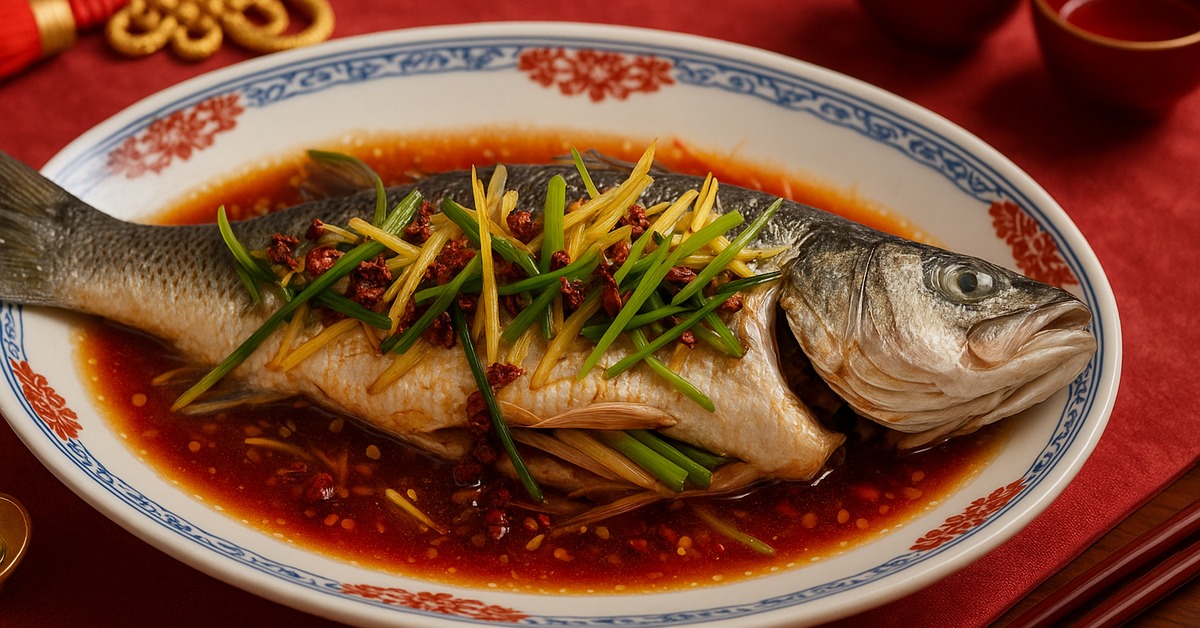
Not just any fish makes the cut. Carp is the most traditional choice, particularly in northern China, partly because of its size and partly because carp carry their own symbolic weight — in Chinese culture, a carp swimming upstream is already a metaphor for perseverance and transformation before it ever reaches the dinner table. Crucian carp and catfish are more common in the south. The classic preparation is steamed, dressed simply with ginger, scallion, and a pour of hot soy-infused oil. The method preserves the fish’s form.
That part is non-negotiable.
Some families won’t touch the fish until a specific moment in the meal. The tension builds quietly — everyone at the table knows what the dish means. Then someone lifts their chopsticks, and the year begins.
The Ritual Survived Everything — Revolution, Famine, Modernity
The Chinese New Year fish tradition didn’t just survive history. It outlasted deliberate attempts to erase it.
During the Cultural Revolution of the 1960s and 70s, traditional customs were actively targeted as feudal or superstitious. Public celebrations were suppressed. And yet, behind closed doors, families kept serving whole fish. The ritual went private rather than extinct. When restrictions eased in the 1980s, it didn’t stage a comeback — it simply continued, like something that had been waiting, very patiently, in the next room.
That kind of persistence is rare. It tells you something: this tradition wasn’t maintained out of obligation or habit. People protected it because the wish still felt worth making. They still do.
By the Numbers
- China’s Spring Festival generates an estimated 1 billion individual journeys home each year — the largest annual human migration on Earth, per Chinese government transport data (2019).
- Fish consumption in China spikes roughly 20–30% in the weeks before Chinese New Year, driven almost entirely by the whole-fish tradition and gifting customs.
- The Han dynasty tombs near Xi’an where ceremonial fish bones were found date to approximately 200 BCE.
- China accounts for around 35% of global fish consumption, and the Lunar New Year period represents one of the single largest demand surges in any food category according to FAO fisheries data — which, when you think about it, means a pun is partially responsible for a measurable shift in global seafood markets.
Field Notes
- In Cantonese-speaking regions, fish is sometimes served last — not first — so the symbolism is the final thing anyone tastes before midnight.
- The direction the fish’s head points isn’t random: in many families it faces the guest of honor or the household’s most senior member, and that person traditionally takes the first bite from just behind the head, considered the most auspicious part of the fish.
- Two fish, sometimes.
- Some Taiwanese families serve one fish on New Year’s Eve and keep a second whole overnight, eating it on New Year’s Day — physically enacting the idea that good fortune doesn’t just arrive, it carries over. The ritual made material.
Why This Tradition Still Matters in a Modern World
In an era when most people order food through an app and eat alone over a screen, placing a whole fish at the center of a table is a quietly radical act.
A billion people pausing, on the same night, around the same dish — not because anyone required it, but because the wish still feels worth making. Think of it like a technology for hope: it takes the abstract desire for a better year and makes it physical, edible, shared. Something you can smell and see and pass across the table to someone you love.
And it’s spreading. Chinese diaspora communities in the United States, the United Kingdom, Australia, and across Southeast Asia carry the tradition with them. What began in Han dynasty burial chambers now lands on tables in San Francisco, London, and Sydney.
The fish travels.
A whole fish on New Year’s Eve is a 2,000-year-old wish pressed into a single meal — language and archaeology and family love folded together under a cloud of ginger-scented steam. The word sounds like abundance. So abundance arrives. Simple as that. And not simple at all. If this kind of story is your thing, there’s more waiting at this-amazing-world.com — and the next one is stranger.
Frequently Asked Questions
Q: Why is a whole fish served at Chinese New Year?
The tradition rests on a pun. In Mandarin, the word for fish, yu, is a perfect homophone of yu meaning surplus or abundance. This sound-based symbolism, called homophonic association, turned the fish into a vessel for wishing prosperity. The fish must arrive whole with head and tail intact because completeness symbolizes a full, unbroken year, and the head is traditionally pointed toward the most honored guest or eldest person at the table.
Q: How old is the Chinese New Year fish tradition?
Archaeologists have found ceremonial fish bones deliberately arranged in Han dynasty tombs near Xi’an dating to approximately 200 BCE. Since the Han dynasty ran from 206 BCE to 220 CE, this places the ritual at roughly 2,200 years old and counting. That discovery implies fish was already doing symbolic work long before neon lights and fireworks, carrying wishes into the afterlife and surviving through hundreds of generations to modern dinner tables.
Q: Which fish is traditionally used and how is it prepared?
Carp is the most traditional choice, especially in northern China, both for its size and its own symbolic weight, since a carp swimming upstream represents perseverance and transformation. Crucian carp and catfish are more common in the south. The classic preparation is steamed, dressed simply with ginger, scallion and a pour of hot soy-infused oil, a method that preserves the fish’s whole form, which is considered non-negotiable for the tradition’s meaning.
Illustrations are AI-generated. Article fact-checked and human-edited. Our editorial standards.