One Ancient Oak Tree Supports 2,300 Species of Life
Over 2,300 species depend on a single ancient oak tree ecosystem — and most of them can’t survive anywhere else. Not nearby. Not on a similar tree. This specific tree, this specific bark chemistry, this specific hollow forming over four centuries. That’s not habitat. That’s a contract written in biology, and it took fifty million years to negotiate.
Most of us walk past old oaks without a second glance. We see bark. We see leaves. We maybe notice a squirrel. But researchers have spent decades cataloguing what lives inside, beneath, and around these trees — and what they’ve found reshapes the way we think about forests, conservation, and what a single organism can quietly hold together. So how does one tree become a world?
Key Facts
- A single mature English oak (Quercus robur) can support 2,300 species, including 38 land bird species, 1,178 invertebrates, and 716 lichens and bryophytes, confirmed by the UK’s Woodland Trust in 2019
- The oak genus Quercus contains around 500 species globally
- A 2017 University of Oxford study found a single large oak could host up to 500,000 individual arthropods on a warm summer evening
- Caterpillars of over 400 moth and butterfly species feed in the oak canopy
- A mature oak can transpire up to 40,000 litres of water into the atmosphere on a hot summer day
In short: A single mature English oak (Quercus robur) can support 2,300 species, including 38 land birds, 1,178 invertebrates, and 716 lichens and bryophytes, according to a 2019 Woodland Trust figure. Built over roughly 50 million years of co-evolution, the tree functions as a layered ecosystem from root to crown, transpiring up to 40,000 litres of water daily.
How the Ancient Oak Tree Ecosystem Actually Works
Roughly 50 million years of co-evolution built this — a slow negotiation between tree and insect, fungus and bird, bacterium and bark. The oak genus Quercus contains around 500 species globally, but it’s the English or pedunculate oak, Quercus robur, that holds the British biodiversity record. Researchers at the UK’s Woodland Trust confirmed in 2019 that a single mature oak can support 2,300 species — including 38 species of land bird, 1,178 invertebrates, 716 lichens and bryophytes, and hundreds of fungi. That figure isn’t an estimate. It’s an accumulation of survey work, microscopy, and eDNA analysis built across several decades.
Nothing else in the British landscape comes close. Here’s the thing: most of those species aren’t just visiting the tree. They need it. Not in a vague, ecological sense — they need its specific chemistry, its specific bark texture, its specific leaf shape and timing. Purple hairstreak butterflies spend their entire larval lives on oak leaves and nowhere else. The gall wasp lays its eggs inside leaf tissue, chemically manipulating the tree into building it a home — a hard, round structure called a gall. The tree, in a sense, builds nurseries for its own residents without being asked.
Dig down below the root line and the collaboration continues. A web of mycorrhizal fungi threads through the soil, trading phosphorus and water for the sugars the oak produces through photosynthesis. The tree can’t efficiently access nutrients without the fungi. The fungi can’t photosynthesise without the tree. Neither is in charge. Both survive.
Layers of Life, Root to Crown
Walk around an old oak and you’re moving through distinct ecological floors, each packed with its own cast of residents. Mosses and liverworts cling to the north-facing bark at the base, where moisture lingers longest. Higher up, complex lichen communities signal air quality — certain species only appear where pollution is low, making ancient oaks unofficial monitoring stations for atmospheric health. One study from the University of Oxford in 2017 found that a single large oak could host up to 500,000 individual arthropods on a warm summer evening. Caterpillars of over 400 moth and butterfly species feed in the canopy: winter moth, mottled umber, oak beauty — each timed to hatch precisely when oak leaves are young and soft.
That timing matters more than it sounds. A shift of even a few days in leaf emergence, driven by climate change, can decouple the whole chain. The caterpillars arrive. The birds that feed them to their chicks don’t. Chick survival drops. The reversal travels upward through the food web like a slow shock. This kind of interconnection — what ecologists call phenological mismatch (and this matters more than it sounds) — is one reason biodiversity scientists now treat ancient oaks as sentinel species in fragile ecosystems, organisms whose health signals the condition of everything around them.
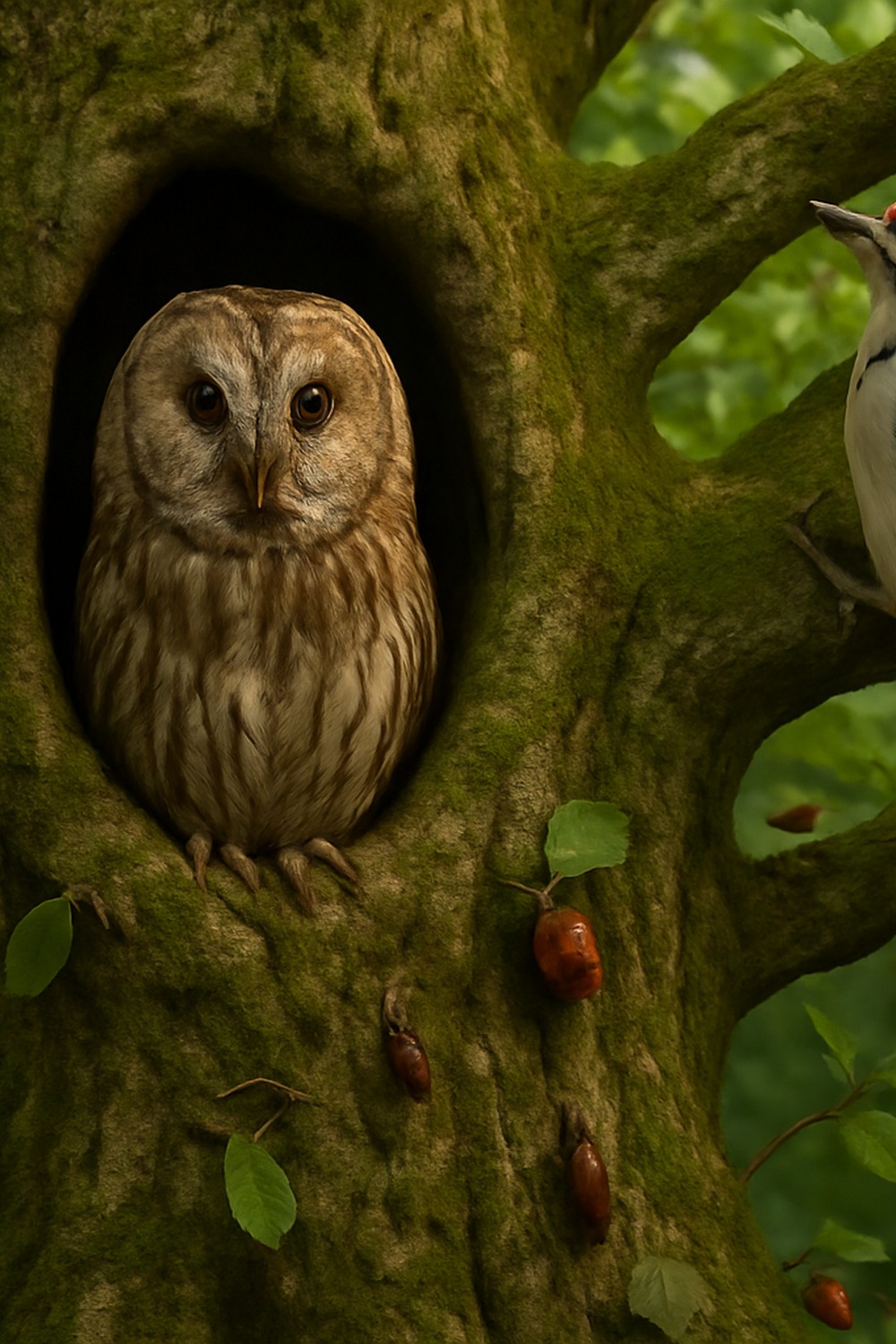
As oaks age, they hollow from the inside — a process called heart-rot, caused by fungi breaking down the dead heartwood at the tree’s core. It sounds like damage. It isn’t. The living sapwood on the outside carries water and nutrients perfectly well. Meanwhile, the hollow interior becomes prime real estate: lesser horseshoe bats roost in crevices behind loose bark, barn owls nest in the main cavity, and the rare noble chafer beetle can only breed in the soft, decaying wood at the base of the hollow. Remove the decay and you remove the beetle. It’s that direct.
Above everything, the canopy delivers one final service. A mature oak can transpire up to 40,000 litres of water into the atmosphere on a hot summer day — cooling the air, seeding clouds, changing local weather. The tree is less a fixed object than a slow, breathing machine, and the machine has been running, in some cases, for more than a thousand years.
Ancient Oaks in Global Context
Why does this matter beyond Britain? Because the pattern repeats on every continent where oaks grow, and the conservation implications are enormous.
Across North America, bur oaks on the prairie-forest border support over 500 species of caterpillar alone — a figure documented by entomologist Doug Tallamy of the University of Delaware, whose 2021 research reshaped how American conservation planners think about native plantings in urban gardens. Tallamy’s data showed that replacing a conventional garden tree with a native oak increases insect abundance in the surrounding area by a factor of four within three years. Four times more moths, beetles, and bees — from one planting decision. Ecologists at the National Geographic Society have described oaks as keystone species across three continents, holding food webs together in ways that no other single genus replicates. The ancient oak tree ecosystem, in this global frame, isn’t a relic. It’s a template.
What surprises researchers most isn’t the abundance of life on oaks — it’s the specificity. Scientists at the Max Planck Institute for Chemical Ecology in Jena discovered in 2018 that oak leaf volatiles — the chemical compounds the tree releases when insects begin feeding — act as recruitment signals, drawing parasitoid wasps that attack the very caterpillars eating the leaf. The relationship between oak and organism isn’t generic woodland habitat. It’s wired to the chemistry of the leaf, the pH of the bark, the particular tannins that make oak wood resistant to rot for centuries. The tree is defending itself chemically in real time, and outsourcing the defence to other species.
And that changes how we read every encounter on an oak. The wasp hovering near chewed leaf edges isn’t random. The spider at the branch junction isn’t lucky. They’ve been chemically called. The tree has been in conversation with them for millions of years — not as metaphor, but as biochemistry — and that reframes what a forest actually is.
Watching a species-web this intricate unravel in real time, you stop calling it ecological pressure and start calling it what it is: a slow erasure of something irreplaceable.
Threats to the Ancient Oak Tree Ecosystem and What We’re Doing
Britain currently has more ancient oaks than the rest of Europe combined — a fact that sounds like strength but is actually a warning. It means the population is heavily concentrated, vulnerable to a single pathogen, a single policy failure, a single bad decade of land management. Acute oak decline, first formally documented by Forest Research between 2007 and 2015, now affects thousands of trees across England and Wales. The disease involves a bacterial complex — primarily Gibbsiella quercinecans and Brenneria goodwinii — working alongside larvae of the agrilus beetle, which bores beneath the bark. Trees can decline from apparently healthy to dead in as little as five years. The mechanism is understood. The cure is not yet available at scale.
Ancient oaks also face a quieter pressure: isolation. When a veteran tree stands alone in a field, it can no longer exchange fungal networks with neighbours. Its mycorrhizal partners weaken. The hollow specialists — bats, beetles, owls — need corridors to move between ancient trees, and when those corridors are broken by roads, crops, and development, local populations collapse. A 2020 report by the Ancient Tree Forum found that England lost 7,000 veteran trees between 2018 and 2020 alone, many through agricultural intensification on private land where no legal protection applies.
Conservation organisations are responding. Maintained since 2004, the Woodland Trust’s Ancient Tree Inventory has now logged over 240,000 veteran and ancient trees across the UK, crowd-sourced from volunteers who photograph and GPS-tag individual specimens. Each record is a baseline. When a tree dies or is felled, the loss is documented. That data is already being used in planning applications to protect the most irreplaceable specimens — slow work, mapped one tree at a time, but building a picture no satellite survey could produce alone.
What Ancient Oaks Tell Us About Time
Some of the oaks alive today were already old when the Magna Carta was signed in 1215. The Major Oak in Sherwood Forest, Nottinghamshire, is estimated to be between 800 and 1,000 years old and still produces acorns. Dendrochronologists at Oxford’s Environmental Change Network have used oak ring sequences to reconstruct European climate stretching back 7,000 years — the longest continuous biological climate record derived from any single organism type on land. The Knightwood Oak in the New Forest was already a mature tree when Shakespeare was writing. These aren’t curiosities. They’re continuous biological records, each growth ring a year of climate data, each hollow a centuries-long register of which species came and went. The tree doesn’t just support life. It archives it.
What the ring data shows is unsettling. Growth rates in ancient oaks across southern England have slowed measurably since the 1980s, correlating with increased summer drought and disrupted rainfall patterns. Trees that survived the Black Death, the Little Ice Age, and two world wars are showing stress signatures that ecologists haven’t recorded before. The ancient oak tree ecosystem is durable — but durability has limits, and those limits are now being tested at a pace the tree’s evolutionary history never prepared it for.
Stand next to a thousand-year-old oak and you’re standing next to something that has absorbed ten centuries of English winters, ten centuries of spring insects, ten centuries of birds returning from Africa to nest in its canopy. There’s a jay above the Knightwood Oak right now — wary, watchful, scanning the same branches its ancestors have scanned for generations. The tree will probably outlive every living person reading this. Whether it outlives the century depends on decisions being made today, in planning offices and agricultural policies far from the forest floor.
Where to See This
- The New Forest, Hampshire, England — home to some of Britain’s oldest pedunculate oaks including the Knightwood Oak; best visited April through June when insect activity peaks and birds are nesting.
- The Ancient Tree Forum (ancienttreeforum.co.uk) coordinates UK conservation efforts and publishes guidance for landowners managing veteran trees on private land.
- Search the Woodland Trust’s Ancient Tree Inventory at ancient-tree-hunt.org.uk to find and log veteran oaks near you — volunteers have mapped over 240,000 trees and the project is ongoing.
By the Numbers
- 2,300+ species depend on oak trees in Britain — the highest biodiversity count for any native tree species (Woodland Trust, 2019)
- 500 individual species documented on a single ancient oak in Wessex, including gall wasps, wood mice, and over 80 lichen species
- 40,000 litres of water transpired by a single mature oak on a hot summer day, measurably affecting local microclimate
- 7,000 veteran trees lost in England between 2018 and 2020, many with no legal protection (Ancient Tree Forum, 2020)
- 7,000 years — the length of European climate record reconstructed from oak ring sequences by Oxford’s Environmental Change Network, the longest continuous land-based biological climate archive in existence
Field Notes
- In 2018, researchers at the Max Planck Institute for Chemical Ecology confirmed that damaged oak leaves release volatile compounds that actively recruit parasitoid wasps to attack feeding caterpillars — a real-time, chemically mediated defence system operating invisibly above every woodland walk.
- The noble chafer beetle — a rare, iridescent species that can only breed in decaying wood inside ancient oak hollows — has declined so severely that conservationists have begun installing artificial “deadwood habitat” inside hollow oaks to supplement natural rot. The beetle, not the wood, is what they’re trying to save.
- Ancient oaks don’t die from hollowing out. The living sapwood on the outer ring is sufficient to sustain the tree indefinitely; the hollow core actually reduces wind resistance and helps very old trees survive storms that would destroy younger, solid-stemmed competitors.
- Scientists still can’t fully explain why some ancient oaks support dramatically more species than others of similar age and size growing in apparently identical conditions. Microsite chemistry, historical land use, and soil fungal legacy all appear to play roles — but the interaction between them remains poorly understood.
Frequently Asked Questions
Q: How does an ancient oak tree ecosystem support so many species?
The ancient oak tree ecosystem works through layered habitat and chemical complexity. Food comes in at least seven forms — leaves, acorns, bark, sap, wood, roots, and galls — each exploited by different specialist species. Oak’s chemistry is unusually complex, supporting both creatures that tolerate tannins and fungi that break down those same compounds. Over 50 million years of co-evolution means hundreds of species have adapted specifically to oak’s particular biology, and many can’t survive on any substitute.
Q: Why are ancient oaks more valuable than younger oak trees?
Age creates habitat that youth can’t replicate. Ancient oaks develop hollow interiors, loose bark plates, deep fissures, exposed deadwood, and extensive root buttresses — each a specialist microhabitat. A 500-year-old oak has had centuries to accumulate mycorrhizal fungal networks, rare lichen communities, and the specific decay fungi that beetle larvae need to breed. A young oak, even a healthy one, simply hasn’t had time to build these structures. Hollow formation alone typically takes 200 to 400 years to reach the size that bats and owls require.
Q: Are ancient oak trees endangered in the UK?
Britain holds more ancient oaks than the rest of Europe combined, but the population faces serious pressure. Acute oak decline is killing thousands of trees across England and Wales, and no treatment is yet available at scale. Many veteran oaks on private land have no legal protection and can be felled without planning permission. The Ancient Tree Forum reported in 2020 that 7,000 veteran trees were lost in just two years. The species itself isn’t endangered — but its oldest, most biodiverse individuals are being lost faster than they can be replaced, and it takes centuries to grow a true ancient.
Editor’s Take — Alex Morgan
What stays with me about this story isn’t the number — 2,300 species, fine — it’s the specificity of the dependence. The noble chafer beetle breeds nowhere except inside ancient oak heartwood. The purple hairstreak larva eats nothing except oak leaf. These aren’t flexible organisms hedging their bets. They’ve committed entirely to one tree, and if that tree goes, they go with it. We talk about biodiversity loss in aggregates and percentages. But it happens one irreplaceable specialist at a time, in a hollow that took four centuries to form.
A thousand-year-old oak has survived more history than any building standing near it. Plagues, climate shifts, revolutions — the tree held its ground through all of it, quietly sustaining hundreds of species that never made it into any history book. The real question isn’t whether we value ancient trees — most people say they do. It’s whether we value them enough to change the policies that are quietly removing them, one veteran tree at a time, from landscapes that took millennia to build and cannot be rebuilt in any human lifetime. Next time you pass an old oak, stop. Listen. The city inside it is still open.
Illustrations are AI-generated. Article fact-checked and human-edited. Our editorial standards.