Orcas Figured Out How to Hunt Great White Sharks
Nobody was looking for this behavior. That’s what makes it so strange — the technique had probably been happening for years before anyone thought to connect the disappearing sharks to the two orcas with the floppy dorsal fins.
Off the coast of Gansbaai, South Africa — a place that used to advertise itself as the “Great White Capital of the World” — something quietly changed around 2015. The sharks that had ruled those waters for millions of years started vanishing. Not from overfishing. Not from habitat loss. Something had figured out how to hunt them, and it was doing it efficiently enough to reshape an entire ecosystem.
Key Facts
- Two orcas named Port and Starboard, identified by their collapsed dorsal fins, are linked to at least 8 confirmed great white kills near Gansbaai, South Africa, between 2015 and 2023.
- Great white sightings near Gansbaai dropped by an estimated 50 to 75% since 2015 following regular orca activity (Dyer Island Conservation Trust).
- Orcas flip great whites upside down to induce tonic immobility, then extract only the liver, which can weigh up to 300 pounds and account for nearly a third of the shark’s body weight.
- A great white’s liver is rich in squalene, an energy-dense oil that makes it an ideal fuel source for orcas burning thousands of calories daily in cold Atlantic water.
- Marine biologist Dr. Alison Towner has documented this liver-extraction hunting behavior, which orcas appear to teach each other as a culturally transmitted technique.
In short: Orcas hunting great white sharks off Gansbaai, South Africa have reshaped an entire ecosystem. A pair named Port and Starboard flip sharks into tonic immobility and surgically extract only the 300-pound, squalene-rich liver. Great white sightings dropped 50 to 75% since 2015, triggering a documented trophic cascade as displaced predators reshuffle.
How Orcas Hunting Great White Sharks Actually Works
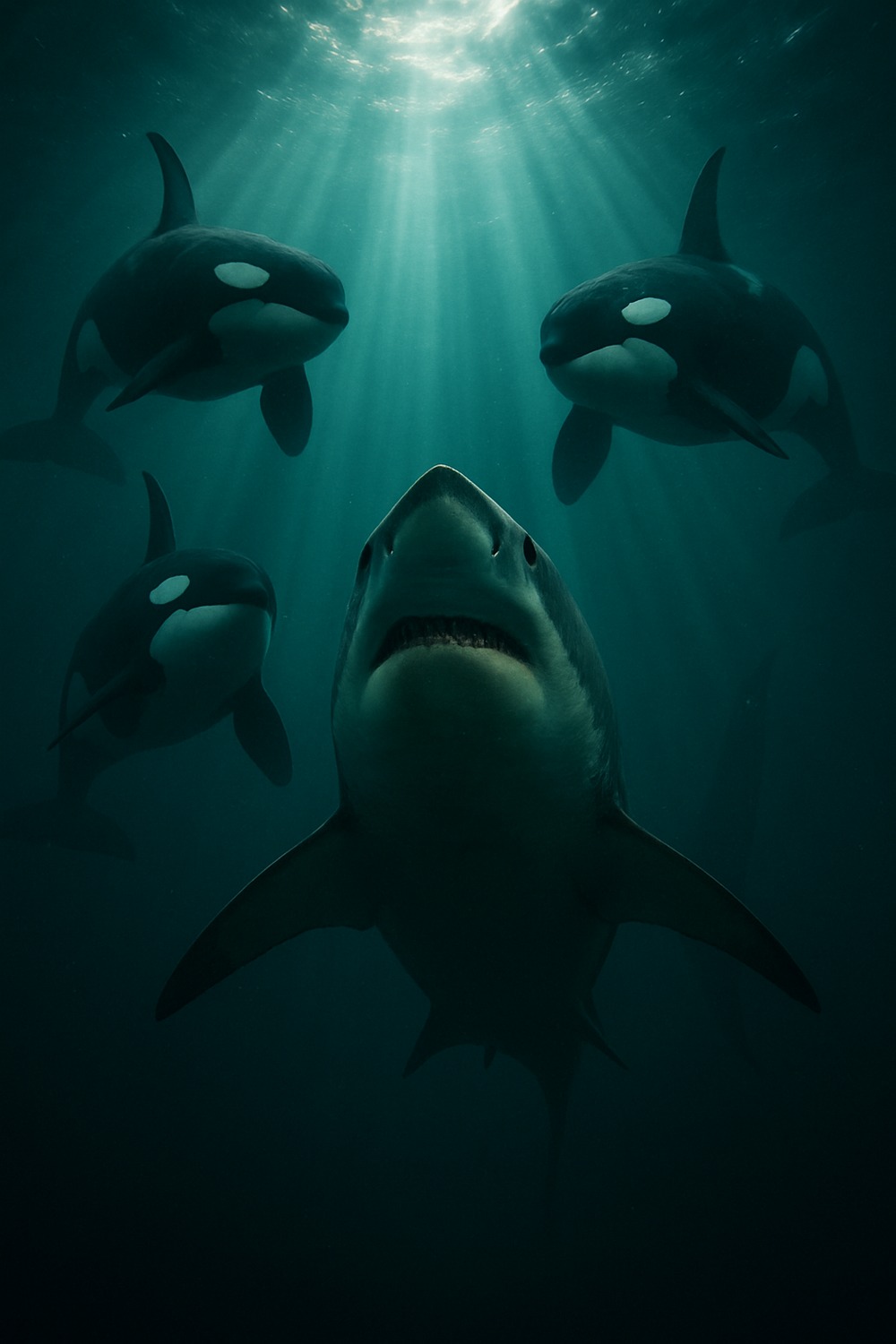
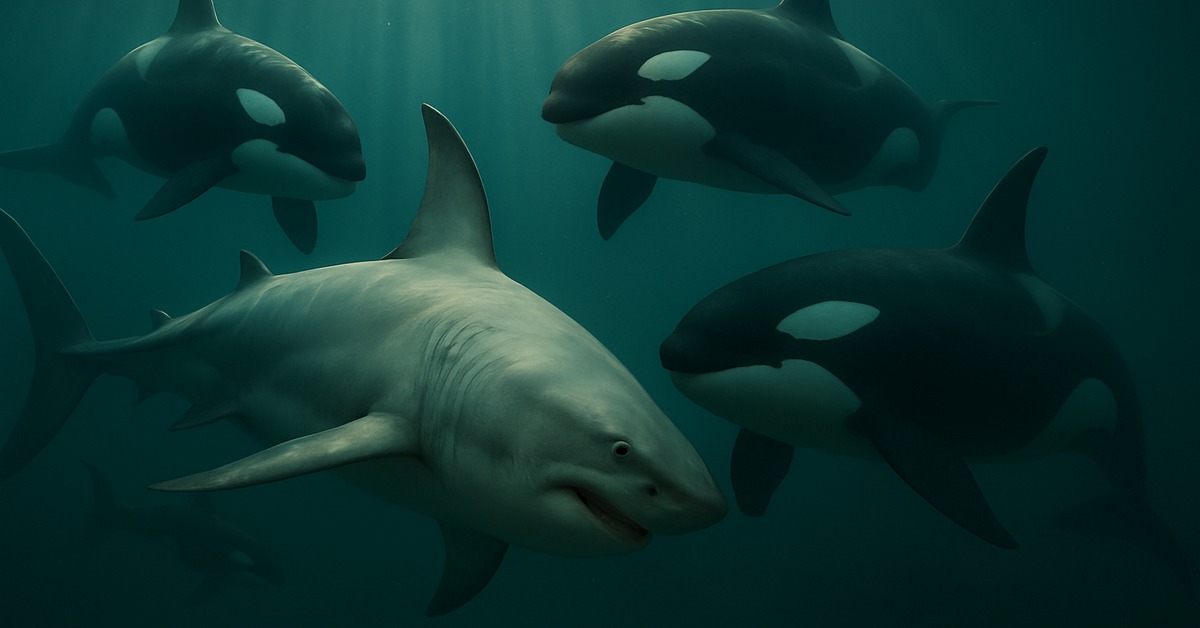
The technique is almost surgical. A pair of orcas approaches a great white — sometimes up to 16 feet long, weighing over 1,500 pounds — and works in tight coordination. One distracts. The other flanks. Together, they flip the shark upside down, inducing a state called tonic immobility — a kind of paralysis that hits sharks when they’re inverted. Marine biologist Dr. Alison Towner has studied this behavior for years, and her documentation reads less like predation fieldwork and more like notes on a craft that’s been refined over time.
The shark doesn’t struggle. It can’t. Within minutes, it’s completely still.
A 1,500-pound apex predator. Drifting. And then the orcas get to the actual point of the whole operation.
The Liver: Why Orcas Only Take One Organ
They don’t eat the shark. Not most of it. What they’re after is the liver — specifically, only the liver — and they extract it with a precision that’s genuinely difficult to explain if you’ve never seen footage of it. A great white’s liver can weigh up to 300 pounds and accounts for nearly a third of the shark’s total body weight. It’s packed with squalene, an oil so energy-dense it shows up in human pharmaceuticals. For an orca burning thousands of calories a day in cold Atlantic water, it’s essentially the perfect fuel source. The rest of the shark gets left to sink. Untouched. You can read about other animals that quietly break the predator rules over at this-amazing-world.com.
That last fact kept me reading for another hour.
Most predators eat opportunistically — whatever’s available, whatever’s easiest. These orcas know exactly what they want before the hunt starts. That kind of targeted behavior implies something that doesn’t sit comfortably in how we usually talk about animal instinct.
Port and Starboard: The Duo That Changed Everything
The orcas responsible for most of the documented great white kills near Gansbaai aren’t anonymous. They have names: Port and Starboard, named for their distinctively collapsed dorsal fins — each one flopping in a different direction, which makes them easy to identify from a research boat. Since scientists first started tracking them working together, orcas hunting great white sharks has gone from a single documented curiosity to a recorded behavioral pattern with a paper trail. These two have been photographed and tracked across hundreds of miles of South African coastline.
Their impact is measurable. Also, depending on how you think about ecosystems, pretty unsettling.
When Port and Starboard show up near a bay, the great whites leave. Not gradually — immediately. Like something deep in their biology overrides every reason to stay.
What Happens to an Ecosystem When Its Apex Predator Runs?
This is where the story stops being about two orcas and starts being about everything else. When great whites fled Gansbaai’s waters, the local ecosystem didn’t just lose a predator. It reshuffled. Bronze whaler sharks, which great whites normally keep in check, started moving in. Sevengill sharks followed. Prey species that great whites had been regulating — Cape fur seals, certain fish populations — began behaving differently almost immediately. Scientists call this a trophic cascade, and watching one unfold in real time is something researchers almost never get to observe directly. Orcas hunting great white sharks produced one of the clearest examples ever recorded.
Shark-watching tours in Gansbaai started returning empty. Boats that used to guarantee sightings went weeks without a single great white. An entire local economy built around one animal — suddenly operating on hope and old photos.
The Part No One Expected: The Orcas Are Teaching Each Other
Here’s the thing — this doesn’t appear to be instinct. Orcas are deeply cultural animals, which is a phrase that sounds abstract until you sit with what it actually means. What one group learns, others can pick up. The liver-extraction technique used by Port and Starboard has been documented in other orca pods, in other locations, at other points in time.
That’s not coincidence.
That’s transmission. Killer whales passing hunting strategies across generations isn’t new to science, but watching a brand-new technique spread in something close to real time is rare enough that researchers are still working out the implications. It shifts how we think about animal intelligence in ways that are hard to fully articulate — because what it implies is that this isn’t a Gansbaai problem. It’s a skill that could spread. More orca groups in more oceans could adopt the same strategy. The great white’s status as the ocean’s default apex predator may not just be challenged in one bay — it could be challenged, one pod at a time, across entire ocean basins.
By the Numbers
- Since 2015, great white sightings near Gansbaai dropped by an estimated 50–75% following regular orca activity — numbers published by the Dyer Island Conservation Trust based on years of field reports.
- Up to 300 pounds of fat-rich tissue in a single organ.
- Port and Starboard linked to at least 8 confirmed great white kills between 2015 and 2023, with suspected involvement in several more that couldn’t be fully documented.
- Orcas have a brain-to-body ratio placing them among the most cognitively complex animals on Earth — second only to humans among marine mammals in certain measures of neural complexity, which is a sentence that sounds less surprising once you’ve read about Port and Starboard for a while.
Field Notes
- Tonic immobility in sharks isn’t unique to orca attacks — researchers and divers have induced it by hand for decades. But no other wild predator had been documented exploiting it as a hunting strategy until these two showed up.
- Orcas aren’t technically whales.
- They’re the largest species of dolphin, which means the most effective great white hunters on the planet belong to the same family as bottlenoses. Turns out the taxonomy has always been quietly strange.
- The smell of a dead great white triggers rapid departure in other great whites — in one study, sharks fled the area and didn’t return for up to a year after orca activity.
Why This Rewrites What We Know About Ocean Power
The great white shark spent millions of years at the top of the ocean food chain. Nothing hunted it. Nothing needed to. It was fast, armored with electroreception, capable of sensing blood across vast distances — the ocean’s default apex predator by every biological measure. And then two orcas with collapsed dorsal fins worked out how to bring one down in under three minutes. The story of orcas hunting great white sharks isn’t just a wildlife curiosity. It’s a live demonstration of what happens when intelligence meets raw power and decides to be methodical about it.
For conservationists, the questions are urgent. If great whites are being displaced from their historical hunting grounds, what happens to the seal populations they kept in check? The fish those seals eat? The kelp forests those fish inhabit? Pull one thread in an ecosystem — even a thread that looks like it should be too strong to pull — and you don’t just change one thing.
You change everything connected to it.
The ocean has been running roughly the same power structure for millions of years. Two orcas with bent fins filed a challenge, and the ecosystem is already responding in ways researchers are still scrambling to document. The great white isn’t going extinct — but its role may be shifting in ways we genuinely haven’t seen before. The predator becoming prey, even temporarily, rewrites rules that felt permanent. If this kind of thing keeps you up at night, there’s more waiting at this-amazing-world.com — and some of it is even harder to explain.
Frequently Asked Questions
Q: How do orcas actually kill a great white shark?
A pair of orcas works in tight coordination, with one distracting the shark while the other flanks it. Together they flip the great white upside down, inducing tonic immobility, a paralysis that hits sharks when inverted. The shark cannot struggle and goes completely still within minutes. Near Gansbaai, two orcas have brought down a 1,500-pound great white in under three minutes.
Q: Why do orcas only eat the shark’s liver?
Orcas target the liver specifically because it is exceptionally energy-dense. A great white’s liver can weigh up to 300 pounds, accounting for nearly a third of the shark’s total body weight, and is packed with squalene, an oil so calorie-rich it appears in human pharmaceuticals. For an orca burning thousands of calories daily in cold water, it is the perfect fuel. The rest of the shark is left to sink untouched.
Q: What happened to the Gansbaai ecosystem when great whites fled?
When great whites fled Gansbaai’s waters after 2015, the local ecosystem reshuffled in a documented trophic cascade. Bronze whaler sharks and sevengill sharks moved in, while prey species like Cape fur seals began behaving differently almost immediately. Great white sightings dropped an estimated 50 to 75%, and shark-watching tour boats that once guaranteed sightings went weeks without a single great white.
Illustrations are AI-generated. Article fact-checked and human-edited. Our editorial standards.