She Cut Herself Open to Save Her Baby — And Survived
It is March 5, 2000. Inés Ramírez Pérez has been in labor for twelve hours, alone, and she picks up a kitchen knife.
She is 40 years old. She is in a one-room home in the mountains of Oaxaca, Mexico. Her eighth baby isn’t coming, the nearest clinic is hours away over unpaved mountain roads, and every option she has is a bad one. So she makes the only decision left — the one that no medical textbook had ever recorded a living person making. She is about to perform a C-section on herself.
Key Facts
- On March 5, 2000, Ines Ramirez Perez, a 40-year-old woman in Oaxaca, Mexico, performed a cesarean section on herself after twelve hours of obstructed labor.
- She used a kitchen knife and several gulps of aguardiente liquor as her only anesthetic, and the incision took about an hour.
- Her son, Orlando Ruiz Ramirez, was delivered alive and surgeons later closed her wound with seven stitches across six layers of tissue.
- Dr. R.F. Valle and Dr. J.A. Castillo documented the case in the International Journal of Gynecology and Obstetrics, published in 2004.
- Approximately 295,000 women die from childbirth-related causes each year globally according to 2017 WHO data.
In short: In 2000 in rural Oaxaca, Mexico, Ines Ramirez Perez carried out a self-performed C-section with a kitchen knife after twelve hours of obstructed labor with no clinic in reach. Both she and her son Orlando survived, making it the only verified case in recorded medical history and a stark indictment of failed maternal healthcare access.
How One Woman’s Self-Performed C-Section Defied Medicine
A self-performed C-section isn’t supposed to be survivable. Even in a sterile hospital, with a trained team and proper anesthesia, the procedure carries serious risks — hemorrhage, infection, catastrophic organ damage. Dr. R.F. Valle and Dr. J.A. Castillo, who documented Inés’s case in the International Journal of Gynecology and Obstetrics, described her survival as essentially without medical parallel. They’d spent careers in obstetrics. They had never seen anything remotely like it.
The obvious question hangs there: how does someone with zero surgical training know where to cut?
She’d watched livestock. Years of helping animals through difficult births had given Inés a hands-on, visceral literacy in anatomy that most people never develop. That knowledge — not from textbooks, not from training, but from actually being there when things went wrong with a ewe or a goat — may have guided her blade more than anyone is entirely comfortable admitting.
She Drank Aguardiente and Made the First Cut
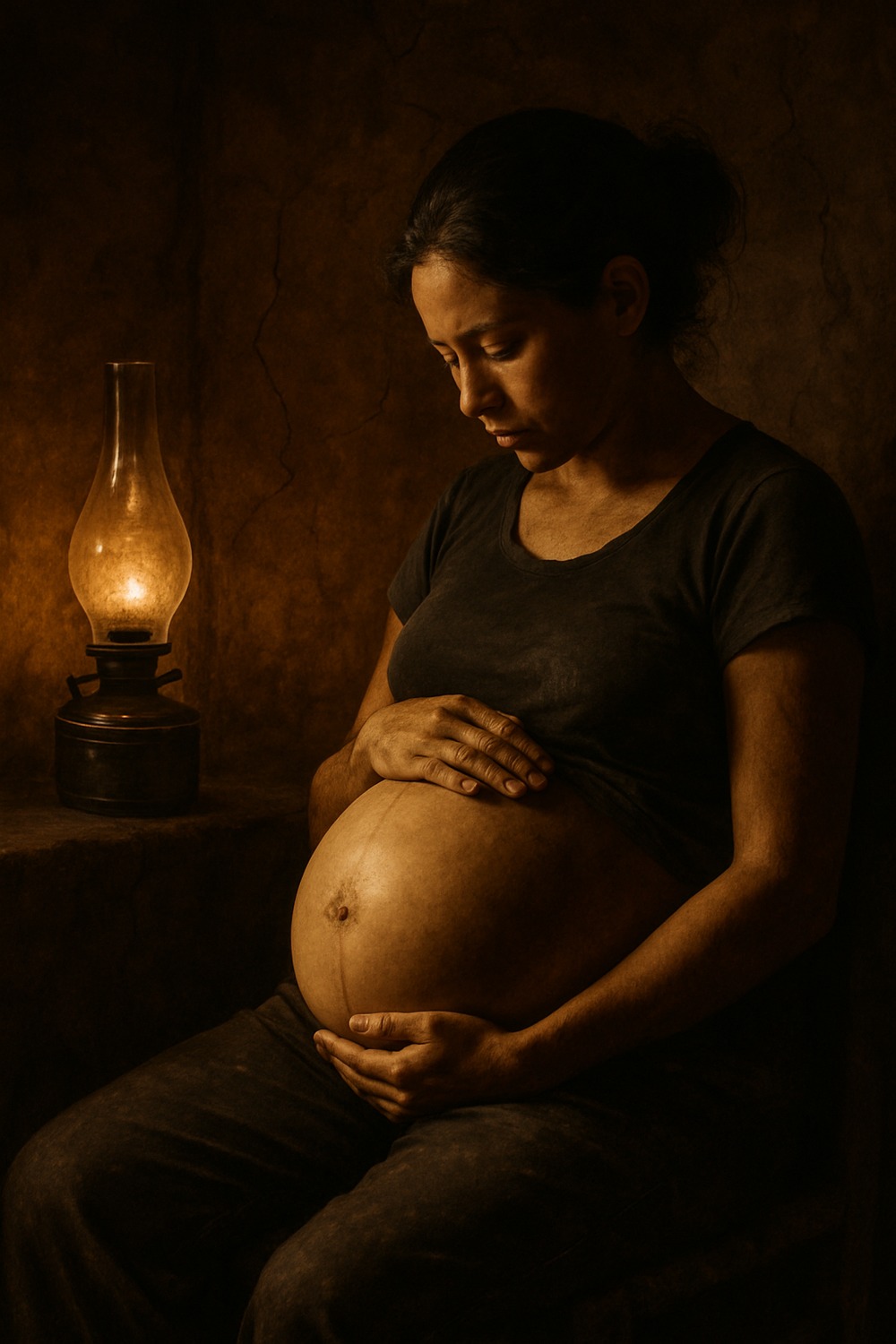
Before she picks up the knife, Inés drinks several gulps of aguardiente — a strong local liquor — as her only anesthetic. Then she lies down on a low wooden bench, says a prayer, and begins.
The incision takes about an hour. She cuts through skin, fat, and muscle, layer by layer, fully conscious the entire time. At one point the pain becomes so severe that she stops. She stays stopped just long enough to understand that stopping means both she and the baby die. Then she keeps cutting. When she finally reaches her uterus, she pulls her son out with her own hands. He cries immediately. She ties the umbilical cord herself, then lies there bleeding until she can get one of her older children to go for help.
She doesn’t pass out. Not once.
That’s not courage as an abstract concept you read about. That’s courage as a decision made one agonizing inch at a time, in the dark, with no one watching.
What Happens When Help Finally Arrives Hours Later
Eight hours after the birth, a health assistant reaches Inés. He finds her lying on the bench — conscious, her intestines partially outside her body, her newborn son Orlando Ruiz Ramírez alive and breathing beside her.
She is transferred first to a clinic in Jamiltepec, then to a larger hospital. Surgeons there close her wound with seven stitches across six layers of tissue. They note, in their clinical documentation, that the incision is remarkably precise given the circumstances. The self-performed C-section had not severed a single major blood vessel.
Orlando is healthy. Inés has no major complications. The doctors treating her describe their astonishment in formal medical language, but if you read the case report carefully you can feel what they’re actually thinking underneath all that professional restraint. They’d never seen anything like it.
Nobody had.
She’d Already Lost a Baby the Same Way
Here’s what makes the story harder to absorb: this wasn’t her first obstructed labor. A previous baby had died in delivery — also at home, also without help. That loss is the shadow behind everything she did on that March night. She didn’t just feel the labor stalling. She recognized it. She knew precisely what obstructed labor meant because she’d already buried a child who died from it.
She wasn’t acting on instinct alone. She was acting on memory.
That last detail kept me reading about this case for another hour after I first found it.
The Medical World Couldn’t Quite Believe It Either
The doctors who reviewed her case had to verify it wasn’t fabricated. The documentation published in 2004 includes photographs of the wound, witness testimony, and full clinical examination results. Every layer of evidence confirmed the same story.
Dr. Valle and Dr. Castillo wrote that her case represented “an unprecedented example of maternal determination.” Medical journals don’t typically use language like that. They’re not built for it. But then, they don’t typically encounter cases like this one.
The procedure she performed is classified as a classical caesarean incision — vertical, midline, the oldest style of C-section there is. It’s not the technique most commonly used in hospitals today, but it’s the most anatomically intuitive if you’re cutting without guidance, without imaging, without anyone telling you where to go. Whether she chose this approach deliberately or arrived at it through sheer anatomical logic, it was medically correct.
That detail has never stopped being strange to sit with.
By the Numbers
- Approximately 295,000 women die from childbirth-related causes each year globally (WHO, 2017 data) — the overwhelming majority of those deaths are preventable with access to basic obstetric care.
- The only verified case in recorded medical history.
- The nearest medical facility was roughly 80 kilometers away over mountain roads — a journey that in 2000 meant several hours by foot or animal transport, not minutes by ambulance.
- C-sections now account for approximately 21% of all births worldwide (Lancet, 2021). In remote parts of Oaxaca in 2000, surgical delivery was functionally nonexistent for women like Inés — not rare, not difficult to access, but simply gone.
Field Notes
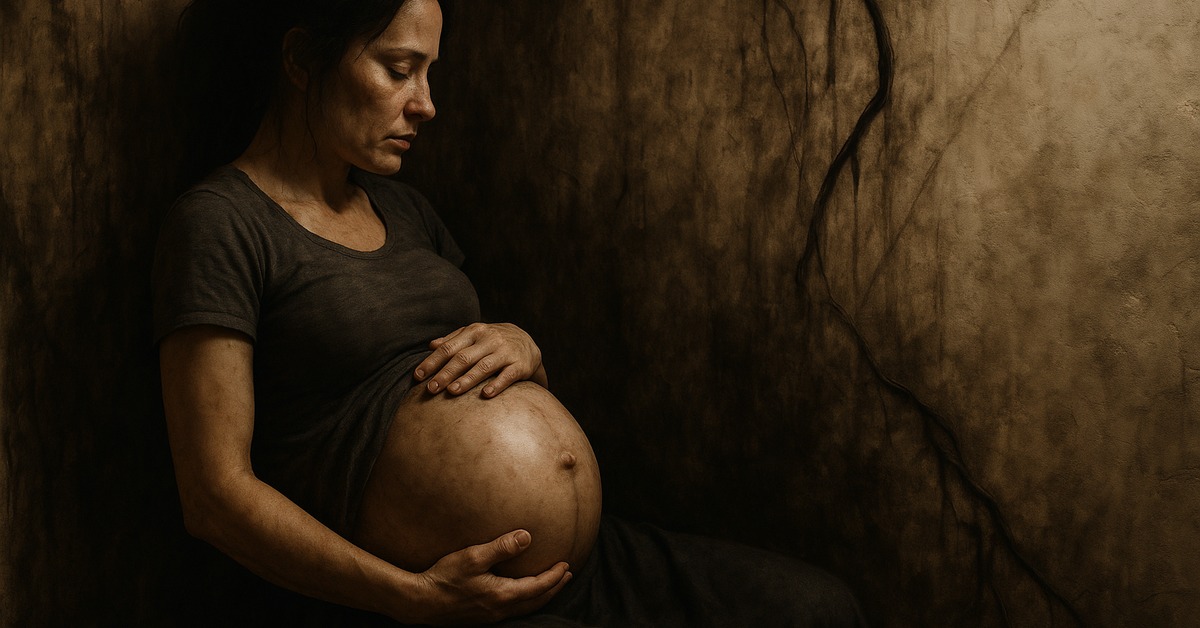
- Inés had given birth seven times before Orlando. Six of those children survived. Her long experience with difficult births — human and animal — shaped her understanding of when a delivery was failing and what might be done about it.
- The knife was an ordinary kitchen knife. She cleaned it before cutting. When doctors examined the wound hours later, infection was minimal — a fact that still puzzles clinicians who’ve studied the case.
- Orlando Ruiz Ramírez grew up healthy. His existence is, in every literal sense, entirely contingent on his mother’s refusal to accept the alternative.
Why This Story Still Matters More Than Ever
The story of Inés’s self-performed C-section gets filed sometimes as a curiosity — an almost impossible medical footnote, a thing you mention at dinner because it sounds unreal. But that framing lets us off too easy.
It is a story about what happens when systems abandon the people who need them most. In 2000, in a mountainous region of Oaxaca, a woman was so completely failed by accessible healthcare that her only option was a kitchen knife and a few swallows of liquor. She survived. Millions of women in comparable situations don’t — not because they lacked her determination, but because the outcome of obstructed labor without intervention isn’t usually survival. It’s two deaths instead of one.
Every year the global conversation about maternal mortality produces numbers and percentages and carefully worded policy recommendations. Inés’s story is what those numbers feel like when they become a person. A woman on a wooden bench at midnight. A decision no one should ever be forced to make.
And the fact that she made it, that it worked, that Orlando grew up — that isn’t just remarkable. It’s a rebuke. To every broken system, every inaccessible clinic, every community left without the basic infrastructure that makes safe birth possible. Her survival isn’t proof that women don’t need proper obstetric care. It’s the starkest possible proof of what they’re forced to do when they don’t have it.
Inés Ramírez Pérez is still alive. Orlando is in his mid-twenties. The scar is real, documented, and in medical literature permanently. She did what no human being had ever done before — and then she recovered, raised her son, and kept living. Some stories don’t need anything added to them. They just need to be told. There’s more at this-amazing-world.com, and the next one goes somewhere you won’t expect.
Frequently Asked Questions
Q: Who is Ines Ramirez Perez and what did she actually do?
Ines Ramirez Perez is a Mexican woman who, on March 5, 2000, in the mountains of Oaxaca, performed a cesarean section on herself after twelve hours of obstructed labor with no medical help available. Using a kitchen knife and aguardiente liquor as anesthetic, she cut through six layers of tissue over roughly an hour and delivered her son Orlando alive. Both survived.
Q: How did she survive a procedure with no surgical training?
Her survival, documented in 2004 by doctors R.F. Valle and J.A. Castillo, had essentially no medical parallel. Years of helping livestock through difficult births gave her a hands-on anatomical literacy. Her incision was a classical vertical midline cut, the most anatomically intuitive approach without imaging, and it severed no major blood vessel. Surgeons later closed the wound with seven stitches.
Q: Why was she forced to operate on herself at all?
The nearest medical facility was roughly 80 kilometers away over mountain roads, a journey that in 2000 meant several hours, not minutes. Surgical delivery was functionally nonexistent for women in remote Oaxaca. She had already lost a previous baby to obstructed labor at home, so she recognized the danger. Globally, about 295,000 women still die yearly from preventable childbirth causes.
Illustrations are AI-generated. Article fact-checked and human-edited. Our editorial standards.