Aloka the Pilgrimage Dog Gets Life-Saving Surgery
Here’s the thing about a dog who’s walked 2,300 miles with Buddhist monks: the body keeps its own accounting. Aloka the Peace Dog — the pilgrimage dog whose surgery at Charleston Veterinary Referral Center became something people couldn’t stop sharing — came through a sixty-minute procedure that specialists say was anything but routine. A lab mix. Road dust and rainstorms and thousands of unnamed country roads. And then, a surgical team that showed up without sending a bill.
He arrived at Charleston Veterinary Referral Center in South Carolina carrying more miles in his paws than most humans cover in a lifetime. Aloka — a lab mix who has padded beside Buddhist monks through Louisiana rainstorms, Carolina sunrises, and thousands of unnamed country roads — needed a surgical team equal to his story. He found one. What happened next raises a question that stays with you: what does healing look like for a creature whose entire identity is forward motion?
Key Facts
- Aloka, a Labrador mix, walked more than 2,300 miles alongside Buddhist monks across the American South, roughly the straight-line distance from New Orleans to Boston.
- His surgery at Charleston Veterinary Referral Center in South Carolina was completed in sixty minutes, compared to a typical 3 to 4 hours for comparable procedures.
- Three specialist veterinarians, Dr. Patricia Sura (surgery), Dr. Sophy Jesty (cardiology), and Dr. Emmett Swanton (anesthesia), contributed their services entirely without charge.
- Aloka’s recovery protocol limits him to ten-minute walks, no more than six times per day.
- Veterinary cardiology became a board-certified specialty recognized by the American College of Veterinary Internal Medicine in the 1990s.
In short: Aloka the pilgrimage dog, who walked over 2,300 miles beside Buddhist monks across the American South, underwent a sixty-minute pilgrimage dog surgery at Charleston Veterinary Referral Center. Three specialists donated their services without a bill. His recovery is now measured in ten-minute walks, six times a day, a deliberate inversion of his life of constant motion.
The Dog Who Walked America Into Attention
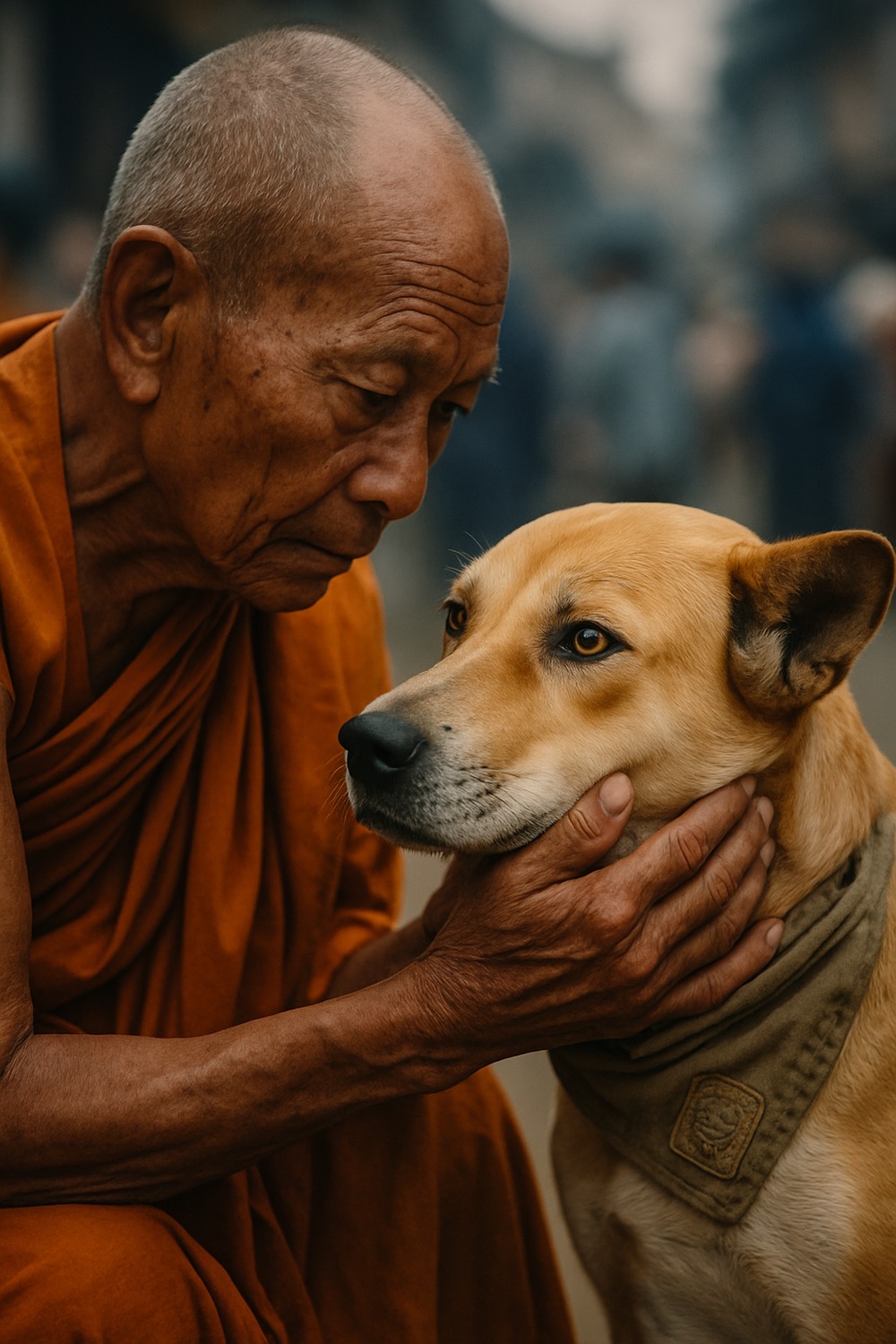
Aloka didn’t start out as a symbol. He started out as a dog — bright-eyed, muddy-pawed, trotting alongside a small group of Buddhist monks who had committed to a years-long walking pilgrimage across the United States. The tradition of walking pilgrimage, known in Buddhist practice as a form of pilgrimage meant to cultivate mindfulness, compassion, and presence, stretches back more than two millennia across Asia. By 2024, he’d covered more than 2,300 miles on foot — through the wharfs of New Orleans, across the low country of South Carolina, through heat and downpour and the long, quiet stretches where the road doesn’t seem to end. What made Aloka’s journey unusual wasn’t the miles themselves. It was the dog. Strangers who watched the group pass reported something hard to articulate: the dog moved like he understood the purpose of the walk. Not performing devotion. Simply present.
That kind of sustained physical effort takes a toll. Even a healthy, well-conditioned dog accumulates wear across that distance — joints stressed, systems tested, a body pushed far beyond the rhythms of ordinary domestic life. Irregular terrain, unpredictable shelter, weather exposure across multiple climate zones: that’s what the monks’ pilgrimage demanded of a canine companion. Aloka made it look effortless. He wasn’t. The signs were there, building quietly beneath that cheerful, forward-tipping gait, waiting for someone with the right equipment to finally read them clearly.
When the team at Charleston Veterinary Referral Center first evaluated him, the stakes crystallized fast. This wasn’t a routine check. This was a dog whose body had been quietly carrying a problem across half a continent — and the window for intervention had arrived.
A Surgical Team That Simply Showed Up
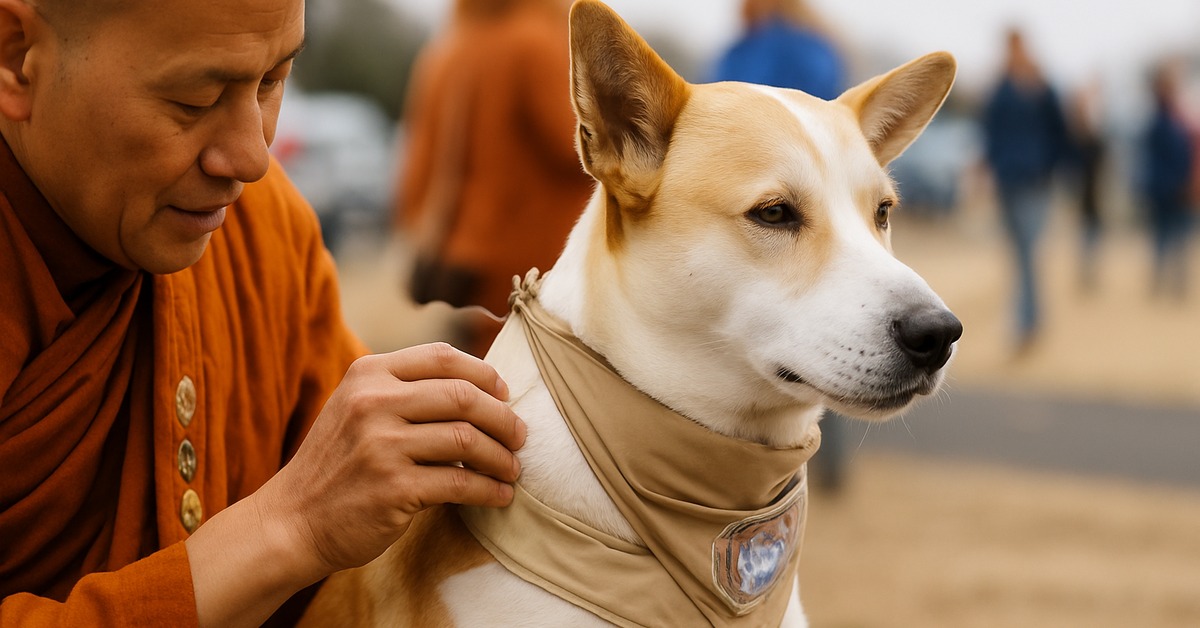
There’s a particular kind of generosity that doesn’t announce itself. The team at Charleston Veterinary Referral Center didn’t issue a press release. They didn’t negotiate. Dr. Patricia Sura led the surgery with the precision that only comes from thousands of hours of practice — the kind of focused quiet in an operating room that communicates more than words can. Dr. Sophy Jesty monitored Aloka’s heart throughout, tracking every beat with the attention that cardiac veterinary specialists bring to cases where the margin for error doesn’t exist. Dr. Emmett Swanton managed anesthesia, reading each breath in the careful way that turns a routine parameter into a real-time conversation with a patient who can’t speak. Not one bill was issued. It calls to mind other moments in veterinary medicine where extraordinary care was extended to extraordinary animals — the rescue of Somboon the elephant, another case where specialists showed up not for recognition but because the animal’s life demanded it.
Sixty minutes. That number is worth pausing on.
Procedures of this type — depending on the specific cardiac or internal condition identified in a dog of Aloka’s age and size — can routinely run three to four hours under less skilled hands, in facilities less precisely organized. The compression of that timeline wasn’t luck. It was expertise, preparation, and a team who’d done the work of knowing each other’s movements before they ever entered the room. Sixty minutes under anesthesia means less systemic stress, faster recovery, and a dog waking into the world again with more resources left in his body than a longer procedure would have permitted. Surgical nurse Tiffany and assistant Lauren extended that care into recovery — tracking Aloka’s walks at exactly ten minutes each, no more than six times a day. Precision in recovery is medicine too. That discipline, that charted gentleness, is where healing actually happens.
What Veterinary Cardiac Care Has Become
Why does this level of care exist at all? Because thirty years of disciplinary evolution built the room Aloka recovered in.
According to the Smithsonian, the boundary between human and animal medicine has narrowed dramatically since the early 2000s — surgical techniques, imaging technology, and pharmacological protocols once reserved exclusively for human patients are now standard at specialized veterinary referral centers across the United States. Veterinary cardiology, which only became a formal board-certified specialty recognized by the American College of Veterinary Internal Medicine in the 1990s, now encompasses interventional procedures, echocardiography, and post-operative monitoring protocols that rival the complexity of human cardiac care. Aloka’s pilgrimage dog surgery didn’t happen in a vacuum — it happened inside that decades-long evolution. Charleston Veterinary Referral Center sits at the sharper edge of that landscape.
What’s counterintuitive is how recently all of this became possible. A dog with Aloka’s condition, presenting at a general practice clinic even twenty years ago, might have received palliative management at best. The convergence of specialized training, referral infrastructure, and — critically — the willingness of a skilled team to donate their services entirely, produced an outcome that would have been statistically improbable not long ago. The pilgrimage dog surgery represents not just one animal’s survival, but a benchmark of what’s now achievable when expertise and compassion occupy the same room at the same time.
Skill can be trained. The decision to show up without expectation of return — that comes from somewhere else entirely, and it changes what medicine can mean. Watching a team extend that to an animal who can offer nothing back, you stop treating it as exceptional and start wondering why we ever accepted less as the norm.
Aloka’s Pilgrimage Dog Surgery and the Road to Recovery
Recovery from cardiac or major internal surgery in dogs follows a protocol built on one fundamental principle: controlled rest is not the opposite of healing — it is healing. For a dog like Aloka — who has spent years in constant forward movement, whose every instinct has been organized around locomotion and terrain and the companionship of motion — the instruction to rest is a profound inversion. The American College of Veterinary Internal Medicine has published guidelines since at least 2018 emphasizing that restricted activity in the immediate post-surgical period directly correlates with reduced complication rates and improved long-term outcomes. Six walks a day, ten minutes each. Total. The discipline required of his guardian Louis mirrors the discipline of the pilgrimage itself: one deliberate step at a time, measured not by miles but by recovery markers visible only to those paying close attention.
Too much activity too soon increases the risk of surgical site stress, elevates cardiac load before the body has rebuilt its compensatory reserves, and can delay the tissue repair that happens most efficiently in stillness. Aloka’s walks are precisely calibrated not as a deprivation but as a dosage (researchers actually call this “controlled exercise rehabilitation” — and it matters more than it sounds). Sixty minutes of walking, spread across six sessions, gives the cardiovascular system just enough demand to maintain circulation and prevent atrophy without overwhelming healing tissue. It’s medicine delivered in increments of grass and morning air.
He’s tucked under blankets now, drowsy and safe. Guardian Louis sits close. The monks who walked all those miles beside him understand, perhaps better than most, that stillness is its own form of movement — that pausing is not the absence of the journey but a different expression of it.
Why Stories Like This One Travel Further Than Miles
Before the surgery, Aloka was already drawing attention — and the reason isn’t hard to find. In 2023, researchers at the University of British Columbia studying human-animal emotional bonding found that stories of animals engaged in purposeful, extended companionship with humans activated neural pathways associated with empathy and moral elevation — the same responses triggered by witnessing acts of courage or sacrifice. The image of a dog walking beside Buddhist monks, not on a leash, not reluctantly, but alongside, touches something in people that statistics never reach. Aloka’s 2,300-mile journey, compressed into photographs and brief accounts shared across social media, produced exactly that effect at scale. Countless strangers found themselves moved, without fully knowing why, by the sight of a dog still moving forward. The pilgrimage dog surgery extended that response: people who’d never met Aloka felt genuine relief when news of his recovery emerged.
And what that reveals isn’t sentimentality. It’s something more structural — a recognition that the animals who share our lives most fully also carry the clearest reflection of our own values back to us. Aloka walked because the monks walked. He kept going because the group kept going. His pilgrimage dog surgery became a kind of collective holding of breath, a shared hope organized around one animal’s body, because his journey had already made him something beyond a pet. He’d become a participant in a story humans told about endurance and faith and the simple act of continuing.
A lab mix from Louisiana, covered in road dust, asleep under a blanket in South Carolina. The miles have paused. The story hasn’t.
How It Unfolded
- 2019 — Aloka begins walking alongside Buddhist monks departing the wharfs of New Orleans on an extended pilgrimage across the American South.
- 2022 — The group reaches the Carolinas, with Aloka having logged well over 1,500 miles on foot through multiple climate zones and seasons.
- 2024 — Aloka’s health condition is identified, prompting referral to a specialist veterinary center for evaluation and surgical intervention.
- 2025 — The pilgrimage dog surgery is performed at Charleston Veterinary Referral Center; Dr. Patricia Sura completes the procedure in sixty minutes; Aloka begins supervised recovery under the care of guardian Louis, nurse Tiffany, and assistant Lauren.
By the Numbers
- 2,300+ miles walked by Aloka alongside Buddhist monks across the American South — equivalent to roughly the straight-line distance from New Orleans to Boston.
- 60 minutes — the total duration of Aloka’s surgery, compared to a typical range of 3–4 hours for comparable procedures in less specialized settings.
- 10 minutes — the precisely prescribed maximum length for each of Aloka’s post-operative walks during his recovery period.
- 6 — the maximum number of walks allowed per day during Aloka’s recovery phase, each one monitored and recorded by his care team.
- 3 specialist veterinarians — Dr. Patricia Sura (surgery), Dr. Sophy Jesty (cardiology), and Dr. Emmett Swanton (anesthesia) — contributed their services entirely without charge.
Field Notes
- Dogs who participate in extended walking pilgrimages in Buddhist traditions are not a modern phenomenon — records from Tibetan and Japanese pilgrimage routes describe canine companions joining monks on foot journeys as early as the 12th century, though none documented with the mileage precision of Aloka’s contemporary journey.
- Veterinary cardiology didn’t become a board-certified specialty in the United States until the 1990s — meaning the level of cardiac monitoring Aloka received during surgery simply wasn’t available as a formal discipline within living memory.
- The ten-minute walk restriction in post-cardiac surgery recovery isn’t arbitrary: it’s calibrated to maintain peripheral circulation while keeping heart rate below the threshold that would stress surgical repairs still in the earliest stages of tissue integration.
- Researchers still can’t fully explain why some dogs maintain exceptional cardiovascular health across years of sustained physical effort while others develop complications — individual genetic variation, diet, and stress response all appear to contribute, but no predictive model yet reliably identifies which animals are at risk before symptoms appear.
Frequently Asked Questions
Q: What was the pilgrimage dog surgery performed on Aloka, and why was it necessary?
Performed at Charleston Veterinary Referral Center in 2025, the pilgrimage dog surgery addressed a serious internal health condition that had developed — likely over time — during Aloka’s years of sustained physical exertion across more than 2,300 miles. The exact nature of the condition required specialist evaluation and surgical intervention rather than medication alone. Led by Dr. Patricia Sura, the procedure was completed in sixty minutes, significantly faster than comparable surgeries typically take in non-specialist settings.
Q: How long will Aloka’s recovery take, and can he walk again?
Post-operative recovery from major veterinary surgery typically spans several weeks to months, depending on the procedure and the individual animal’s response. Aloka’s current protocol limits him to ten-minute walks, no more than six times per day — a carefully calibrated regimen designed to support circulation without stressing healing tissue. Whether he’ll eventually return to long-distance pilgrimage walking depends on how his body responds over coming months. His care team is tracking every detail of his progress.
Q: Why do dogs like Aloka develop health problems from pilgrimage walking if they seem healthy throughout?
Dogs rarely show obvious distress during sustained exertion — their threshold for masking discomfort is high, and conditions can progress silently over months or years of cumulative stress. Aloka’s outward vitality wasn’t misleading. It simply reflects how dogs are wired to keep moving. The underlying condition was building quietly beneath that cheerful forward motion, invisible without the diagnostic tools available at a specialized referral center. Regular veterinary monitoring for working or traveling dogs is exactly the kind of precaution this case underscores.
Editor’s Take — Alex Morgan
What strikes me about Aloka’s story isn’t the surgery — it’s the arithmetic of generosity. Three specialists, zero billing, sixty minutes of precise skill applied to a dog who can’t thank them in any language they’d recognize. We tend to frame medical heroism around complexity and cost. This team reframed it around presence and refusal to look away. That’s a harder thing to train than surgical technique, and a more honest measure of what a medical institution actually values when no one’s watching the ledger.
Aloka is dreaming under his blankets in South Carolina — a dog whose concept of home has always been a road still ahead. The monks walk on, perhaps a little quieter without him. The team that saved him has moved to the next patient, unremarked. But somewhere in the gap between those two movements — between the dog at rest and the people who chose, without condition, to make that rest possible — something true about medicine gets said without a single word. The road will still be there when he’s ready. What do we build, while we wait, in the spaces where devotion quietly shows up?
Illustrations are AI-generated. Article fact-checked and human-edited. Our editorial standards.