The Honey Badger Mom Who Never Forgets Her Way Home
Nobody set out to study the homing instinct. The researchers near Tsavo in the 1970s were just trying to track where honey badger mothers went when they left their cubs — and then they noticed she always came back. Not roughly. Not approximately. To the exact hole.
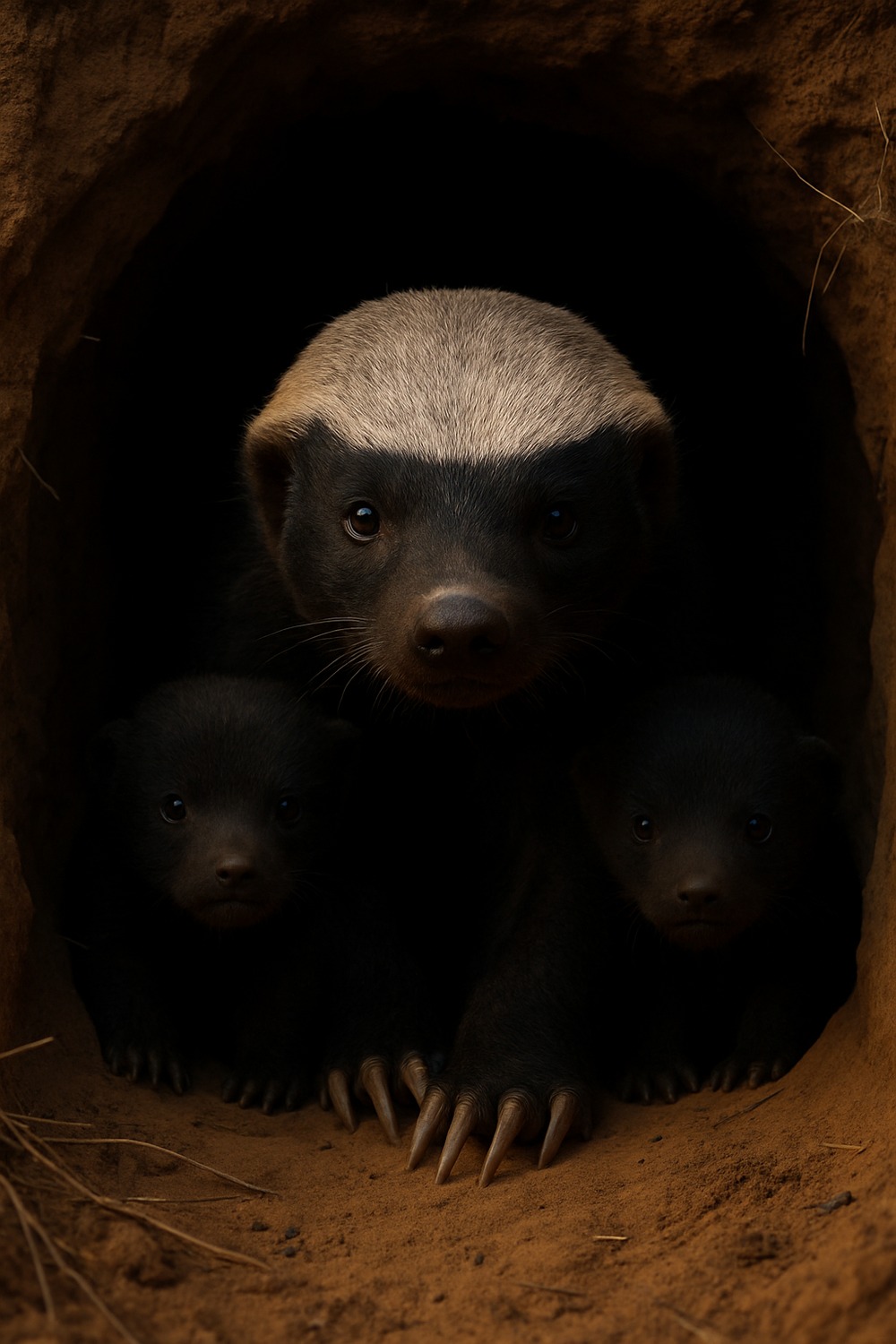
Somewhere in the dry heat of Kenya’s Tsavo region, a honey badger mother slips out of a burrow barely wide enough to fit her stocky body. Her cubs are inside — helpless, hairless, completely dependent. She might travel several miles looking for food. And when she’s done, she’ll thread her way back through identical-looking scrub, past a dozen false trails, straight to the one hole in the earth that matters. Every time.
Key Facts
- Biologists first documented the honey badger homing instinct near Kenya’s Tsavo National Park in the 1970s, tracking female Mellivora capensis.
- Honey badger venom resistance comes from a mutation in nicotinic acetylcholine receptors that has evolved independently in at least four mammal lineages.
- Documented maternal absence per foraging trip reaches up to 36 hours, among the longest recorded for small carnivores.
- Honey badger home ranges can exceed 500 square kilometers in some regions.
- The honey badger weighs around 25 pounds yet shows unusual hippocampus development tied to spatial memory.
In short: The honey badger homing instinct, first documented near Tsavo in the 1970s, lets a mother return to an exact den after foraging trips lasting up to 36 hours across ranges exceeding 500 square kilometers. Layered scent trails, spatial memory, and an unusually developed hippocampus power this precise navigation.
The Honey Badger Homing Instinct That Defies Explanation
Biologists first documented this navigational behavior near Kenya’s Tsavo National Park in the 1970s, when field researchers began tracking female Mellivora capensis during denning seasons. What they found wasn’t a mother wandering and stumbling back by luck. She was moving with purpose — often returning via completely different routes, but always to the precise den location. Zoologist Bernd Würsig, who later studied mammalian spatial memory, described this kind of targeted homing as “cognitive mapping under extreme environmental pressure.”
But what’s actually powering it?
The short answer is: we’re still figuring it out. Honey badgers don’t have GPS. They don’t have landmarks in any obvious sense — dry African scrubland looks brutally monotonous to human eyes. What they seem to have is a layered memory system combining scent trails, spatial geometry, and something researchers are only beginning to understand.
How She Reads the Wind Like a Map
Scent plays a massive role. Honey badgers have large, powerful scent glands and an olfactory system built for detail. A mother leaving her den deposits chemical markers along her route — intentional or not — that she can later follow in reverse. But wind shifts. Rain wipes scent trails. Other animals cross the same ground constantly. And yet the badger doesn’t get confused.
Studies on mustelid navigation — the broader family that includes weasels, otters, and wolverines — suggest that spatial memory operates almost like an internal GPS, storing landmark relationships rather than fixed points. The den isn’t just “that hole.” It’s a web of relationships between dozens of features she’s mapped over time, cross-referenced against each other so that losing one data point doesn’t break the whole system.
She updates that map constantly. Every trip adds new data. A fallen branch, a dried riverbed, a specific rock outcropping — each one filed away. And unlike us consulting our phones, she carries all of it in her head. No signal required.
She’s Also Basically Immune to Snake Venom
Navigation alone doesn’t explain how a honey badger mother survives long enough to keep returning. The routes she takes are dangerous. Puff adders, cobras, and black mambas share this landscape, and honey badgers don’t avoid them.
They eat them.
What makes this possible is a genetic mutation in the animal’s nicotinic acetylcholine receptors — the same nerve cell targets that snake neurotoxins attack in most mammals. In honey badgers, those receptors have a slightly different shape. The venom can’t bind properly. It’s like trying to plug the wrong key into a lock. For a deeper look at how animals develop extreme survival adaptations, this-amazing-world.com has stories that’ll genuinely rearrange how you think about the animal kingdom.
She’ll take a strike, stagger, collapse — and wake up twenty minutes later as if nothing happened. Then she gets back up and eats the snake. That last fact kept me reading for another hour. It’s one of the most casually extraordinary things any mammal does on a regular basis, and most people have never heard of it.
Thirty-Six Hours Alone: What the Cubs Are Waiting For
While their mother is gone, the cubs wait in total darkness. A honey badger den is typically just a few feet underground — too small for most predators to enter, but not soundproof, not temperature-controlled, not safe from everything. In their early weeks, the cubs can’t regulate their own body temperature. They rely on huddling together and on the insulating properties of the soil above them.
Thirty-six hours is a long time. Longer than most of us go without checking our phones. And she’s navigating back with no trail of breadcrumbs, no charged device, across scrubland that has probably shifted since she left.
The honey badger homing instinct isn’t just impressive. It’s the difference between survival and death for an entire litter.
The Science Beneath the Surface Is Even Stranger
Turns out the honey badger’s brain — small as it is relative to her body — shows unusual development in the hippocampus, the region associated with spatial memory and navigation. This mirrors findings in other animals known for exceptional homing ability, like homing pigeons and migratory sea turtles. Dr. Jennifer Mather, whose work on animal cognition has pushed researchers to reconsider intelligence across species, has argued that problem-solving and spatial reasoning in “smaller” brains often outperform expectations dramatically.
The honey badger fits this pattern almost too well.
What this suggests is that raw brain size is a terrible proxy for cognitive ability. A creature weighing around 25 pounds is running a navigational system that would genuinely impress robotics engineers. And she’s doing it while hunting, avoiding predators, regulating her body temperature, and nursing cubs. Multitasking doesn’t begin to cover it.
By the Numbers
- Up to 36 hours — the documented maternal absence period per foraging trip near Tsavo, one of the longest on record for small carnivores.
- Honey badger home ranges can exceed 500 square kilometers in some regions. That’s a territory larger than many major cities, and she’s mapping all of it.
- The nicotinic acetylcholine receptor mutation granting venom resistance has evolved independently in at least four separate mammal lineages — but the honey badger’s version is considered among the most robust documented, not just the most famous.
- 35+ different types of food containers opened in captivity. Problem-solving scores among the highest recorded for carnivores of comparable body mass.

Field Notes
- She doesn’t use a single permanent den. Honey badger mothers rotate through dozens of den sites within their territory, which means the honey badger homing instinct isn’t tracking one fixed location — it’s tracking many, simultaneously.
- Her skin is loose enough to rotate nearly 180 degrees within it.
- Honey badgers have been observed stacking objects in the wild to reach elevated targets — tool use once considered exclusive to primates and a handful of birds. Which suggests whatever is happening cognitively goes well beyond navigation.
Why This Small Animal’s Story Matters to All of Us
Here’s the thing: for years, the honey badger was famous primarily for a meme about not caring about anything. The YouTube video. The jokes. And underneath all of that was an animal that had quietly evolved solutions to problems — venom immunity, exceptional navigation, flexible cognition — that humans are still trying to engineer artificially.
The honey badger homing instinct forces a question we don’t ask often enough: what are we missing about the inner lives of animals we’ve barely studied? She’s a proof of concept for what sustained evolutionary pressure can produce, running around in a body the size of a large housecat, solving problems that would stump a reasonably sophisticated machine.
And she does all of it in service of something very simple. She has cubs. They’re waiting. She finds her way back across miles of scorching terrain that looks like nothing to us and everything to her. That’s not instinct in the dismissive sense of the word. That’s intelligence, operating entirely on its own terms, in a language we’re only just starting to learn how to read.
The honey badger isn’t the flashiest animal on the savanna. No size, no speed, none of the visual drama that fills wildlife documentaries. What she has is something harder to film: precision, memory, and a commitment to her cubs that plays out across miles of scorching ground, again and again, in the dark. The most extraordinary stories in nature are often running just beneath the surface — invisible until someone looks closely enough. If this kind of story keeps you up at night, there’s more at this-amazing-world.com. The next one is stranger.
Frequently Asked Questions
Q: When was the honey badger homing instinct first documented?
Field researchers first documented the behavior near Kenya’s Tsavo National Park in the 1970s, when they tracked female Mellivora capensis during denning seasons. Rather than wandering back by luck, mothers returned to the exact den location, often via completely different routes. This observation began as part of a study of where honey badger mothers went when they left their cubs.
Q: How does a honey badger survive snake bites?
Honey badgers carry a mutation in their nicotinic acetylcholine receptors, the same nerve cell targets that snake neurotoxins attack in most mammals. The slightly different receptor shape prevents the venom from binding properly. A badger may take a strike, collapse, and wake roughly twenty minutes later as if nothing happened, then eat the snake. This venom resistance has evolved independently in at least four mammal lineages.
Q: How long do honey badger cubs wait alone?
Documented maternal absences reach up to 36 hours per foraging trip near Tsavo, one of the longest on record for small carnivores. During this time the cubs wait in a den typically just a few feet underground. In their early weeks they cannot regulate their own body temperature, relying on huddling together and the insulating soil above them until the mother returns.
Q: How large is a honey badger’s territory?
Honey badger home ranges can exceed 500 square kilometers in some regions, a territory larger than many major cities. A mother maps all of it, rotating through dozens of den sites rather than using one permanent location. This means her homing instinct tracks many den positions simultaneously, updating the mental map with new landmarks like a fallen branch or rock outcropping on every trip.
Illustrations are AI-generated. Article fact-checked and human-edited. Our editorial standards.