The Motherless Macaque Who Found His Father
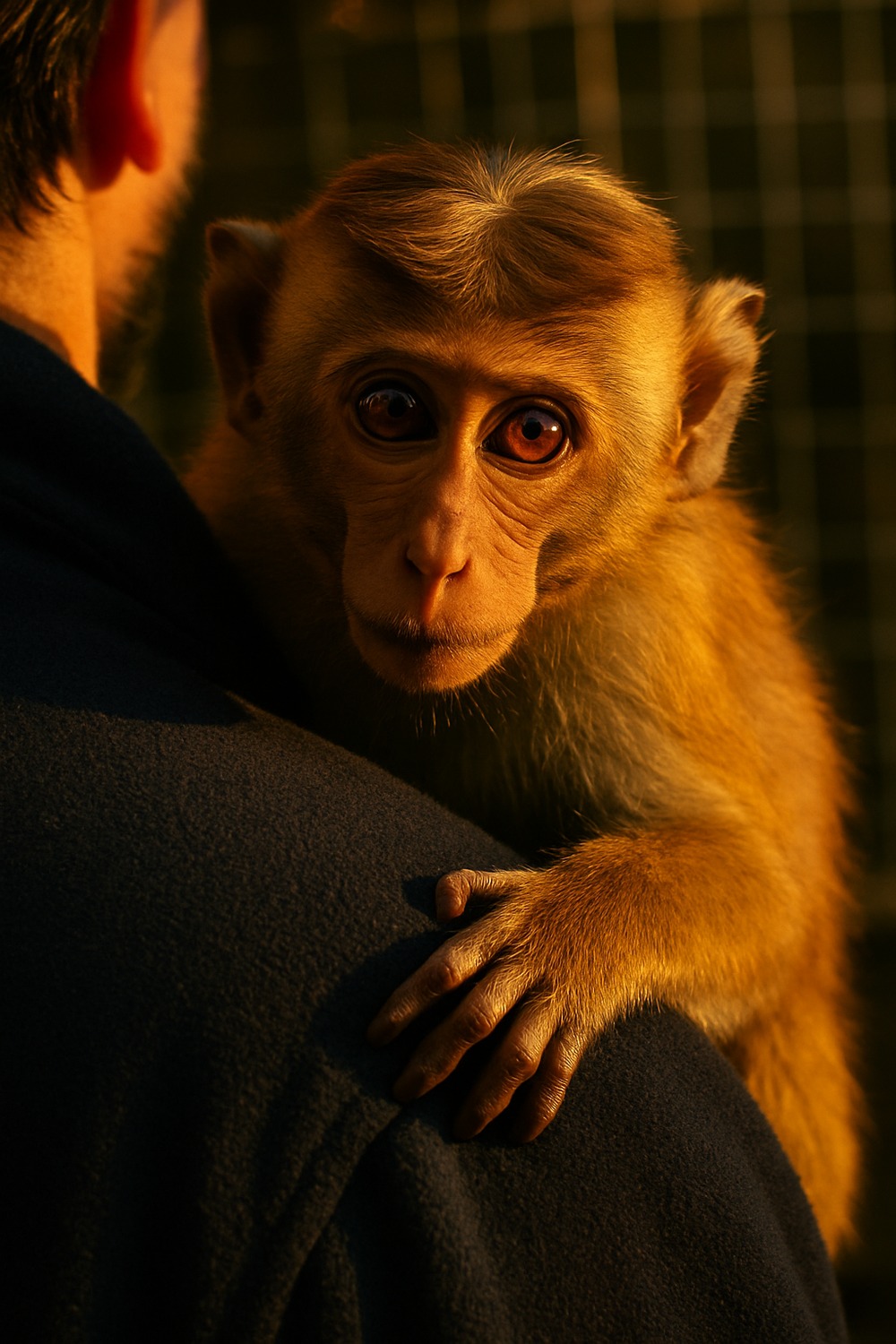
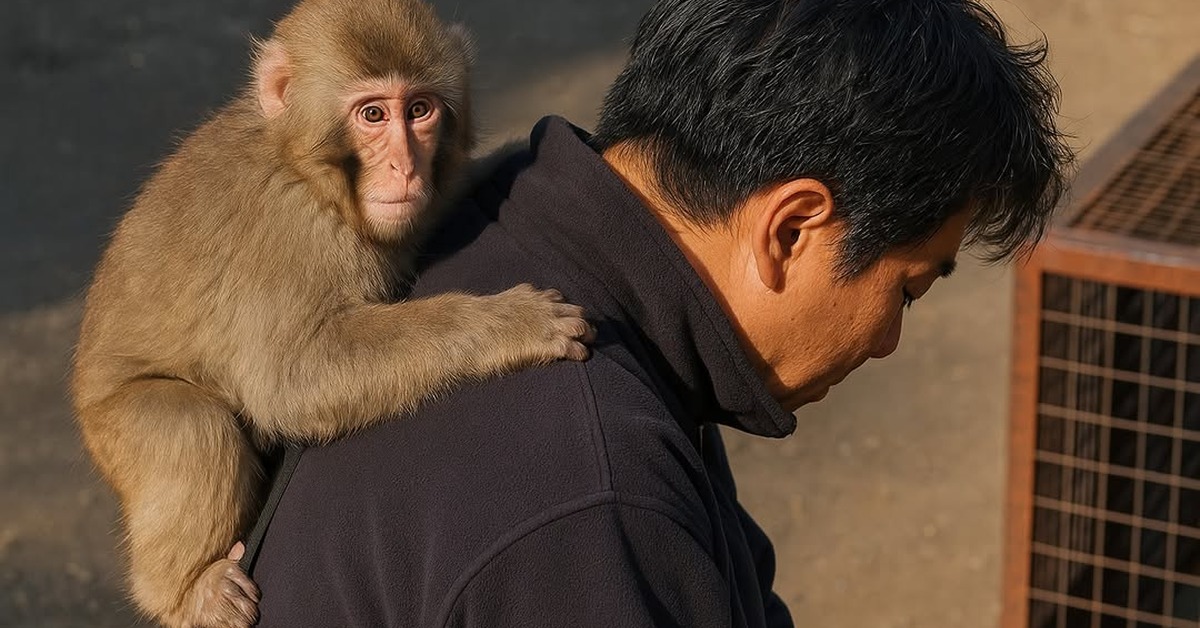
Here’s the thing about toque macaque paternal bonds — they’re not supposed to exist, not like this. Punchy, a young macaque on Sri Lanka’s Monkey Mountain, clings to his father’s back through every leap, every nap, every push through guava scrub. Two tiny hands. One shaggy leg. A bond that field researchers spend careers waiting to document, playing out in plain sight of anyone who bothers to watch.
But Punchy’s story starts somewhere much darker. A few months ago, he had no mother, no troop, no standing. He was comforted instead by a battered stuffed doll — a thrift-store toy pressed into service by a caretaker who couldn’t bear to watch him grieve alone. For weeks, that doll was his entire world of warmth and touch. What happened next is the kind of thing field researchers spend careers waiting to document.
Key Facts
- Toque macaques (Macaca sinica) are found only on the island of Sri Lanka and are classified as Endangered on the IUCN Red List, with declining population trends in the 2023 revision.
- Primatologist Wolfgang Dittus began the landmark toque macaque study at Polonnaruwa in 1968, a Smithsonian Institution project now 56 years old.
- Sri Lanka’s dry-zone forest cover, the primary toque macaque habitat, has shrunk by an estimated 35% since 1990 (IUCN Primate Specialist Group, 2023).
- Max Planck Institute research published in 2022 found maternal loss in juvenile macaques produces measurable cortisol elevation within 72 hours and suppressed immune markers within 2 to 4 weeks.
- In 2019, researchers at Polonnaruwa documented a male toque macaque carrying and grooming an unrelated juvenile for 11 consecutive days, confirmed by genetic testing to be non-paternal.
In short: A toque macaque paternal bond, rare in this matriarchal Sri Lankan species, saved an orphaned juvenile named Punchy after his mother died and a stuffed doll became his only comfort. His father began grooming, then carrying him. Studied at Polonnaruwa since 1968, the species is Endangered, with dry-zone forest down 35% since 1990.
When Paternal Bonds Replace What’s Missing
Toque macaques (Macaca sinica) are one of the most intensively studied primates on Earth — and one of the least known outside academic circles. Found only on the island of Sri Lanka, they’ve been the subject of continuous field research since primatologist Wolfgang Dittus began his landmark study at Polonnaruwa in 1968, a project now running more than five decades under the Smithsonian Institution. What that research confirmed, year after year, is that toque macaque society is profoundly matriarchal. A female’s rank determines her offspring’s rank. Her alliances shape her children’s futures. Lose her, and a juvenile loses nearly everything — social standing, protection, first access to food.
That architecture, the toque macaque‘s social architecture, wasn’t designed with orphans in mind. Which makes Punchy’s situation a near-textbook disaster scenario. Without his mother, older cousins shoved him aside at feeding sites. He had no advocate in troop disputes, no grooming partner to lower his cortisol, no warm body to press against at night. Research from the Max Planck Institute for Evolutionary Anthropology, published in 2022, found that maternal loss in macaques produces measurable stress hormone spikes within seventy-two hours — and that juveniles without social substitutes show impaired immune response within weeks. The body keeps the score. So does the brain.
And yet. Fathers exist in toque macaque troops, even if their role is poorly understood. They’re present. Sometimes they watch. Occasionally, something shifts — and this time, whatever shifted, it shifted all the way.
The Doll, the Grief, and What Came After
Touch deprivation in infant primates produces neurological damage that no amount of later social recovery can fully reverse — a finding first established by Harry Harlow’s devastating wire-mother experiments at the University of Wisconsin in the 1950s, and refined by decades of subsequent work. The stuffed toy detail might seem sentimental, but it isn’t. Physical contact, even with an inanimate object, keeps certain developmental windows from slamming shut. The caretaker who gave Punchy that doll wasn’t anthropomorphizing. They were buying time. If you’ve ever read about why a baby monkey clings to a stuffed toy for weeks — that behavior is documented, heartbreaking, and biologically logical in ways that are difficult to look away from. It’s the same desperate arithmetic playing out in Punchy’s small body: something warm is better than nothing cold. The doll was a placeholder for a world that had gone quiet.
What changed was gradual, then sudden — the way most recoveries are. Researchers working with the Monkey Mountain sanctuary observed Punchy’s father tolerating proximity first, then grooming, then carrying. The sequence matters. In macaque society, carrying a juvenile is not a casual act. It signals investment. It broadcasts to the troop that this animal is claimed, protected, worth the social cost of defending. By 2024, field notes from the site documented consistent father-offspring travel patterns lasting across multiple foraging sessions — a behavioral signature that researchers typically associate with established maternal bonds, not paternal ones.
The doll disappeared from Punchy’s world at roughly the same time. He didn’t need it anymore.
What Science Actually Knows About Primate Fathers
Why does this matter? Because the triggers for paternal care in macaques remain genuinely contested — and what happens when we get it wrong has consequences at the species level, not just the individual one.
Paternal care in macaques sits in an uncomfortable grey zone — documented often enough to be real, rare enough to resist clean explanation. A National Geographic survey of primate paternal behavior notes that across the macaque genus, active fathering appears in roughly a third of documented species. Primatologists at Kyoto University’s Primate Research Institute have been chasing this question since the 1990s, using genetic paternity testing combined with behavioral observation to separate biological fathers from social caregivers. Their finding: the two categories overlap less than anyone expected. Many caregiving males are not confirmed biological fathers. Some confirmed biological fathers provide no care at all. The toque macaque paternal bond, where it occurs, appears to be a choice — not a reflex.
That word — choice — is doing a lot of scientific work here, and not everyone is comfortable with it. Animal behaviorists typically prefer “individual variation in caregiving propensity,” which is accurate but less honest about what the data looks like from ground level. What the data looks like is this: some male toque macaques, when presented with a vulnerable juvenile, move toward it. Others don’t. The variables that predict which outcome occurs include the male’s rank, his prior relationship with the mother, troop size, and something researchers from the University of Edinburgh’s School of Biological Sciences described in a 2019 paper as “unresolved motivational substrate” — which is academic language for “we don’t know yet.” Punchy’s father apparently had whatever that substrate requires. The troop registered the change. The shoving stopped.
The Toque Macaque Paternal Bond Under Pressure
Sri Lanka’s toque macaques face a conservation picture that makes Punchy’s individual story feel urgent at a species level. Troop sizes are shrinking. Genetic diversity within isolated populations is declining. Sri Lanka’s dry-zone forests — the primary habitat — have contracted by an estimated 35% since 1990, according to data compiled by the IUCN Primate Specialist Group in their 2023 assessment. As troops compress and fragment, the social structures that allow for paternal adoption become harder to maintain. A troop under resource stress is a troop where tolerance shrinks. Juveniles without maternal protection get pushed further to the margins, not pulled back in. The same ecological pressure that increases the frequency of orphaned juveniles simultaneously reduces the social slack that allows a father to step forward without paying a steep status cost.
A species losing its safety net faster than researchers can document what that net was made of — that’s not a conservation footnote. That’s the whole problem.
This is the conservation paradox hiding inside Punchy’s story. The toque macaque paternal bond isn’t just a behavioral curiosity — it’s a potential survival mechanism for a species whose social margins are shrinking. Dittus’s long-term Polonnaruwa dataset, now spanning more than five decades, shows that troops which maintain internal social complexity — including diverse caregiving arrangements — show better recovery rates after population crashes than troops with rigid, narrow hierarchies. Flexibility, turns out, is a kind of resilience. Fathers who step in aren’t outliers disrupting the social order. They may be exactly what keeps the order from collapsing entirely.
Monkey Mountain’s guava scrub is not a pristine wilderness. It’s a managed landscape at the edge of human settlement, where researchers, caretakers, and macaques have spent years negotiating an uneasy proximity. Punchy rides his father’s back through that landscape every day — past tourists with cameras, past the caretaker who once pressed a stuffed toy into his small hands, past all the ordinary chaos of a troop that has absorbed his loss and moved on. He doesn’t know he’s a data point. He knows he has somewhere to hold on.
Where to See This
- Polonnaruwa, Sri Lanka’s North Central Province, is the longest-running toque macaque research site on Earth — visitors can observe wild troops year-round, with February through April offering the clearest sightings during dry season foraging.
- Wolfgang Dittus’s Smithsonian Institution research program at Polonnaruwa remains the authoritative source for behavioral data on Macaca sinica — the project website hosts decades of published findings stretching back to the study’s 1968 founding.
- Updated conservation assessments for the toque macaque are published by the IUCN SSC Primate Specialist Group and accessible at iucnredlist.org — essential reading for anyone wanting to understand the species’ current status beyond the individual story.
By the Numbers
- Toque macaques are classified as Endangered on the IUCN Red List, with population trends assessed as declining in the 2023 revision.
- Sri Lanka’s dry-zone forest cover — primary toque macaque habitat — has shrunk by an estimated 35% since 1990 (IUCN Primate Specialist Group, 2023).
- Dittus’s Polonnaruwa research project, begun in 1968, is now 56 years old — one of the longest continuous primate field studies in scientific history.
- Troop sizes in healthy toque macaque populations range from 8 to 50 individuals; fragmented habitat populations average closer to 12, reducing social buffering capacity by roughly 3×.
- Maternal loss in juvenile macaques produces measurable cortisol elevation within 72 hours and suppressed immune markers within 2–4 weeks, according to Max Planck Institute research published in 2022.
Field Notes
- In 2019, researchers at Polonnaruwa documented a male toque macaque carrying and grooming an unrelated juvenile for 11 consecutive days following the juvenile’s mother’s death — genetic testing confirmed no paternal relationship, making the behavior one of the clearest examples of alloparental adoption recorded in the species.
- Toque macaques are the only macaque species endemic to Sri Lanka — every individual alive belongs to a population confined to a single island roughly the size of Ireland, making local habitat loss immediately species-level in consequence.
- Wildlife rehabilitators across Southeast Asia have documented juvenile primates forming strong attachment behaviors to inanimate objects within 48 hours of maternal loss (researchers actually call this contact-substitute bonding) — the behavior mirrors Harlow’s 1950s findings almost exactly, six decades later, in the wild.
- Researchers still can’t reliably predict which male toque macaques will adopt orphaned juveniles and which won’t — the behavioral cues that precede adoption look nearly identical to the cues that precede aggression, and no published model has successfully distinguished them prospectively.
Frequently Asked Questions
Q: How rare is a toque macaque paternal bond in wild populations?
Active, sustained paternal caregiving in toque macaques is documented but uncommon enough that it doesn’t appear in baseline behavioral descriptions of the species. Dittus’s decades of field data at Polonnaruwa include notable instances, but they remain exceptions rather than norms. What’s striking about Punchy’s case is not just the bond’s existence but its intensity — consistent carrying, grooming, and troop-signaling behaviors that typically require weeks or months to develop even between mothers and offspring.
Q: Can a motherless toque macaque actually survive long-term with only paternal support?
Survival odds for motherless juveniles drop sharply without social substitution — but substitution doesn’t have to come from a mother. Research from the Max Planck Institute and the Smithsonian’s Polonnaruwa program both show that consistent caregiving from any high-ranking adult, male or female, substantially improves juvenile survival rates. The key variables are access to food, protection from aggression, and physical contact. A committed father can provide all three. What he can’t fully replace is the matrilineal rank inheritance — Punchy’s social ceiling may still be lower than it would have been with his mother alive.
Q: Do toque macaque fathers recognize their own offspring?
This is where common assumptions break down. Genetic paternity studies, including work by Kyoto University’s Primate Research Institute, show that caregiving males in macaque species frequently aren’t the biological father at all — and confirmed biological fathers often provide no care. Individual temperament, prior social relationships with the mother, and immediate behavioral cues from the juvenile all seem to matter more than genetic relatedness alone. The toque macaque paternal bond doesn’t appear to be primarily driven by kin recognition in the way many people expect.
Editor’s Take — Alex Morgan
What stays with me about Punchy isn’t the happy ending — it’s the doll. That a caretaker reached for a stuffed toy because nothing else was available, and that it worked, and that the science of why it worked goes back to the 1950s and nobody’s been surprised since. We’ve known for seventy years what touch deprivation does to infant primates. We’ve known it. Punchy’s father arriving when he did isn’t a miracle. It’s a reminder that the social architecture of a species is more elastic than the textbooks suggest — and that we keep being surprised by that elasticity because we stopped looking for it.
Every troop of toque macaques in Sri Lanka’s shrinking dry-zone forests contains animals carrying histories like Punchy’s — losses absorbed, hierarchies renegotiated, small bodies finding new places to hold. Most of those recoveries will go unobserved, undocumented, unsaved to anyone’s hard drive. The forests where they happen are quieter every decade. What we know about paternal bonds in these animals comes from a handful of research sites and a few decades of patient watching. What we don’t know is how much of this social resilience vanishes before anyone thinks to look — and whether, by the time we do look, there will be enough forest left to look into.
Illustrations are AI-generated. Article fact-checked and human-edited. Our editorial standards.