Owl Ear Tufts: Feathered Decoys and Hidden Hunters
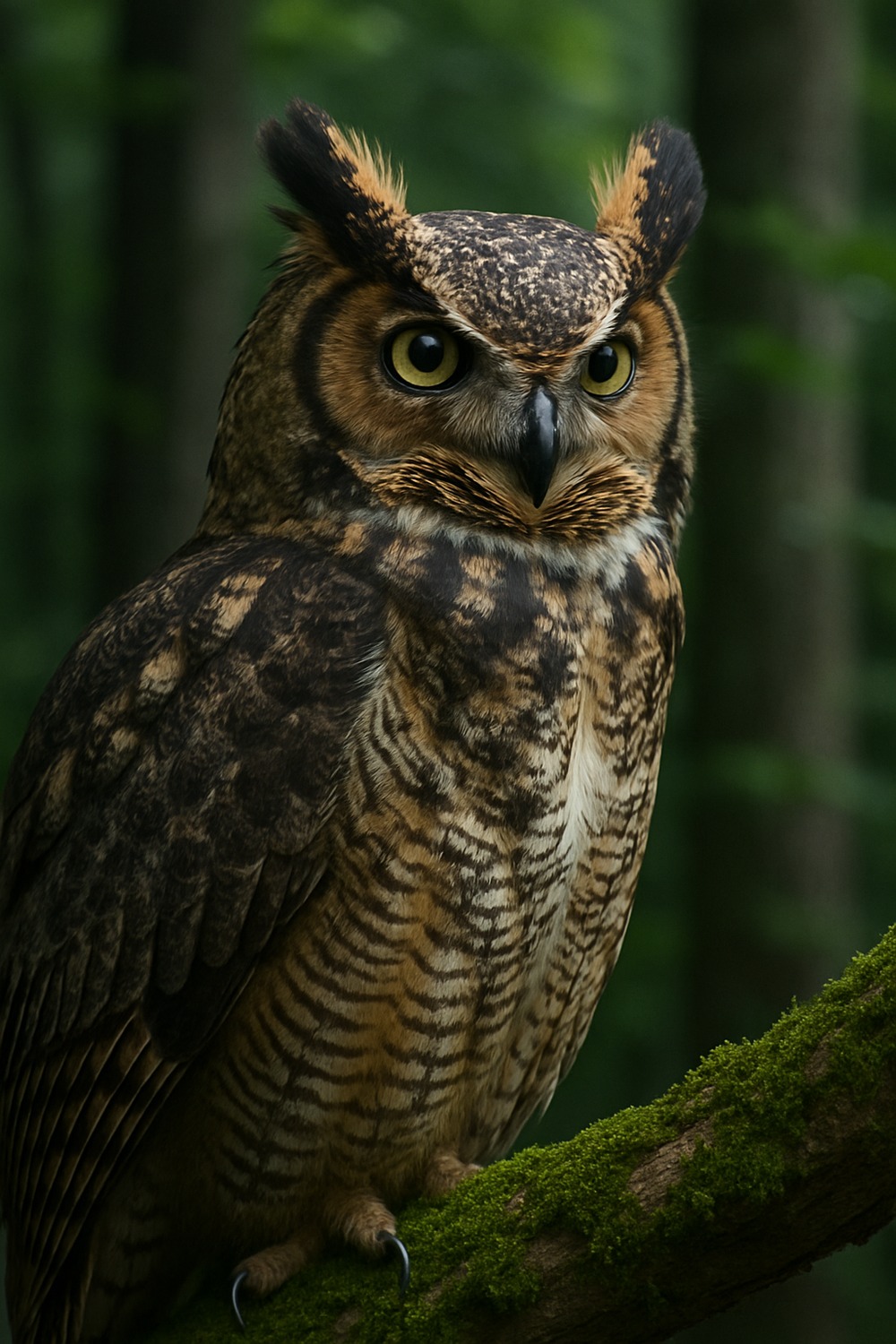
Owl ear tufts are one of vertebrate anatomy’s most successful cons — and almost nobody calls them out for it. Those twin feathered points crowning a great horned owl’s skull look so much like ears that poets, painters, and every child who’s ever drawn one have accepted them without question. They aren’t ears. Not remotely. They’re elongated contour feathers, a disguise worn on the outside while the actual hearing apparatus — buried, invisible, and genuinely strange — does its work underneath layers of soft plumage on either side of the face. The gap between what this bird shows you and what it actually is kept pulling me back.
Key Facts
- There are roughly 250 owl species worldwide, about a third of which carry ear tufts
- Barn owls use an interaural time difference of 30-40 microseconds to calculate vertical sound angle
- In Cornell’s 1981 experiments, barn owls struck prey within 1 degree of accuracy in complete darkness
- Ear openings in asymmetric species like the boreal owl can be offset by several millimeters vertically
- Owl ear tufts contribute 0 percent to hearing, being elongated contour feathers
In short: Owl ear tufts are not ears at all but elongated contour feathers used for camouflage and social signaling. The real hearing apparatus is a facial disc and concealed, often asymmetrically placed ear openings that let barn owls strike prey within one degree of accuracy in total darkness, as Cornell demonstrated in 1981.
The Art of the False Ear
Across dozens of species — long-eared owls threading the skies of North America and Eurasia, African fish owls, screech owls settled into suburban trees — owl ear tufts appear again and again despite wildly different habitats and hunting strategies. Scientists puzzled over why so many separate lineages independently arrived at the same fake-ear solution. The leading answer involves camouflage: compress the tufts, stretch the body vertically, and an owl becomes something remarkably close to a broken branch stub, all jagged texture and woody shadow. Predators slide past. Prey never registers the threat.
But the tufts aren’t just a disguise. Researchers observing long-eared owls — both captive and wild — documented clear behavioral patterns tied to tuft position (and this matters more than it sounds). High and fanned apart signals alertness, mild aggression, territorial posturing. Flat against the skull means submission or calm. During courtship, males and females run through elaborate tuft-display sequences that appear to communicate fitness and receptivity — which is remarkable when you consider that the whole structure is essentially decorative plumage repurposed as a semaphore flag.
One feature, two completely separate jobs. Evolution is efficient like that.
Where the Real Ears Hide
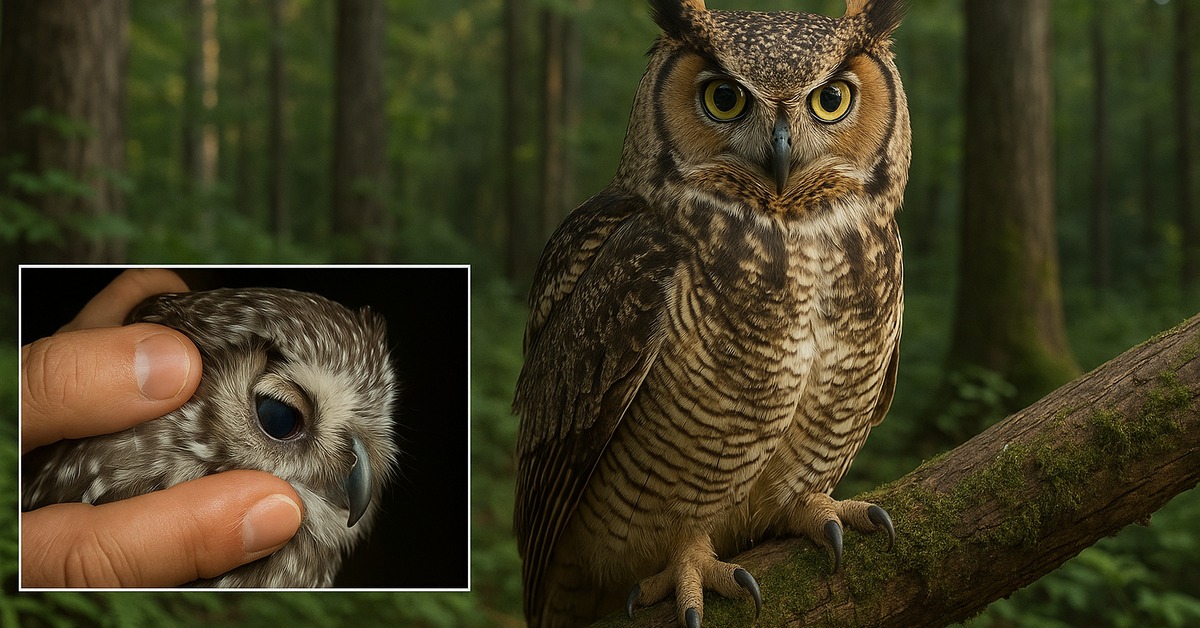
Pull the feathers back from either side of an owl’s facial disc and you find the actual ears: wide bare-skin openings framed by specialized auricular feathers forming a parabolic collecting dish. That flat, almost humanoid arrangement of feathers — the facial disc itself — acts as a biological satellite antenna. And it’s adjustable. Muscles around the disc reshape it in real time, fine-tuning the acoustic focus the way you’d cup a hand behind your ear, except the owl does it automatically, continuously, while hunting in the dark. I’ve seen footage of this and it’s genuinely unsettling how deliberate it looks.
What makes the system strange is the asymmetry. In barn owls, great grey owls, and boreal owls, the two ear openings sit at different heights on the skull — one measurably higher than the other, sometimes by several millimeters, and in some species that asymmetry extends into the skull bones themselves. A sound arriving from below hits the lower ear a fraction of a millisecond before the upper one. The brain processes that time difference — somewhere around thirty to forty microseconds — to calculate vertical angle with startling accuracy.
What changed everything was the 1981 Cornell experiments. Researchers ran barn owls striking targets in absolute darkness and the birds landed within one degree of accuracy in both planes. One degree. In the dark.
Combine vertical localization with horizontal calculation from left-right arrival timing and you get a precise three-dimensional map of prey location built entirely from sound — no light required, no second guess.
Noise, Evolution, and the Hunter’s Dilemma
Why does habitat shape hearing so dramatically? Because acoustic pressure differs completely depending on where an owl hunts. Short-eared owls working open grassland face a different problem than spotted owls moving through dense Pacific Northwest forest. Forest birds contend with acoustic clutter — leaves, running water, wind through vegetation — that can swamp the faint rustle of a vole in leaf litter. Studies suggest forest-dwelling owls evolved more pronounced facial disc curvature and tighter feather packing around the ear openings, maximizing sensitivity at the exact frequencies small mammals generate when moving.
Grassland hunters face the opposite problem: prey sound dissipating across open distance, which apparently favors broader acoustic reception tuned to lower frequencies that carry farther through open air. Turns out the acoustic pressures of different environments have pushed owl ear morphology in measurably different directions, and researchers are still working out exactly how far that specialization goes. An animal shaped that precisely by its soundscape deserves more credit than it usually gets — and the ornithologists who’ve spent careers mapping these differences know they’re still finding new layers.
Silent Flight, Deadly Precision
None of this auditory engineering matters much if the owl’s own wingbeats drown out the signal. Comb-like leading edges on primary feathers and a velvety surface texture across the wing break up turbulence and suppress aerodynamic noise — the same noise that makes most birds detectable from a distance. But the silence isn’t only about sneaking up on prey.
A hunting owl in flight carries a cone of quiet with it, its brain receiving uninterrupted environmental sound data even at speed, in darkness, with nothing to go on but the geometry of arriving sound waves. It’s also about keeping the owl’s own acoustic field clean — a distinction most people miss entirely when they read about silent flight. Three completely separate systems, all pointing at the same problem: asymmetric skull anatomy, an actively adjustable acoustic dish for a face, and feathers engineered to eliminate self-generated noise, all working simultaneously.
And that’s what stopped me when I was reading through the research. Evolution doesn’t usually build something this layered without a very good reason — and whatever hunted early owls in the dark must have been a serious reason.
Where to See This
- Bosque del Apache National Wildlife Refuge, New Mexico, USA — short-eared and great horned owls are reliably active at dusk from October through March, with open grassland habitat making flight behavior easy to observe.
- The Owl Research Institute, Charlo, Montana, USA — one of the few institutions actively studying wild owl hearing and facial disc function in North American species, with published field data going back decades.
- For a practical starting point: Jonathan Slaght’s Owls of the Eastern Ice covers owl sensory biology in readable depth, and the Cornell Lab of Ornithology’s All About Birds database has species-specific acoustic profiles worth comparing side by side.
By the Numbers
- ~250 — owl species worldwide, roughly a third of which carry ear tufts
- 30–40 microseconds — the interaural time difference barn owls use to calculate vertical sound angle
- 1 degree — striking accuracy barn owls achieved in complete darkness during Cornell’s 1981 lab trials
- Several millimeters — vertical offset between ear openings in highly asymmetric species like the boreal owl
- 0 — the number of owl ear tufts that contribute directly to hearing
Field Notes
- Facial disc feathers are not fixed — muscles actively reshape the disc during hunting, functioning like a continuously self-adjusting satellite dish
- Skull bone asymmetry, not just soft tissue, contributes to vertical sound localization in several species
- Serrated primary feathers that enable silent flight also preserve acoustic clarity mid-hunt, serving a dual function often overlooked in popular accounts
- Tuft position functions as social signal across multiple contexts: threat display, courtship, submission — distinct postures with documented behavioral correlates
- Open-country and forest owls show measurably different facial disc geometry, a direct morphological response to different acoustic environments
Frequently Asked Questions
Do owl ear tufts help with hearing at all?
No — not even partially. Owl ear tufts are contour feathers with no acoustic function. The structures that actually collect sound are the owl’s facial disc and the concealed ear openings beneath its plumage.
Why do some owls have ear tufts and others don’t?
Current evidence points to habitat camouflage as the primary driver. Owls roosting in broken woodland or vertical vegetation benefit from a silhouette that mimics a branch stub, and tufts help create that profile. Species hunting in open environments with fewer perches show less consistent tuft development.
Which owls have the most asymmetric ears?
Barn owls, great grey owls, and boreal owls show the most pronounced skull asymmetry — in some cases the asymmetry extends into the cranial bones themselves, not just the soft-tissue ear openings. These are also among the owls with the most precisely documented sound-localization abilities.
Can owls really hunt in total darkness?
Barn owls demonstrably can. The 1981 Cornell experiments established that barn owls strike prey within one degree of accuracy in both the horizontal and vertical planes under conditions of complete darkness — relying solely on sound-based spatial mapping.
Are owl ear tufts used for communication?
Yes, actively. Tuft position correlates with documented behavioral states — erect and splayed for alertness or aggression, flattened for submission or rest. Courtship displays in long-eared owls involve tuft movements that researchers interpret as signals of fitness and receptivity.
Do larger ear tufts mean better camouflage?
Not necessarily in a simple linear way. Tuft effectiveness depends on how well the bird can compress them and how closely the resulting silhouette matches local vegetation. Some species with relatively modest tufts produce a more convincing branch-stub profile than species with dramatic ones, depending on habitat.
Editor’s Take — Alex Morgan
What stays with me isn’t the Cornell one-degree result, impressive as that is. It’s the layering — three independent adaptations, asymmetric skull, adjustable facial disc, sound-killing feathers, all converging on the same problem without any of them knowing about the others. And then the tufts sitting on top of it all, doing completely separate work, running their own social signaling operation. Most animals give you one trick. Owls give you five, and hide the four that actually matter.
Next time you spot an owl on a roost, those feather tufts rising against the sky like a small crown, worth pausing on what you’re actually looking at. The dramatic part is the fake part. Owl ear tufts are theater — functional theater, camouflage and social signal compressed into the same feathers — but theater. The real machinery is hidden: asymmetric ear canals, a face shaped into a dish, feathers designed to eat sound. What an animal shows the world and what it actually does are often completely different things, and owls make that gap more visible than almost anything else. Or less visible, I suppose, which is exactly the point.
Illustrations are AI-generated. Article fact-checked and human-edited. Our editorial standards.