The Stuffed Toy That Saved a Baby Monkey’s Social Life
Nobody planned for the stuffed orangutan to matter this much. But when Punch — a newborn Japanese macaque at Ichikawa City Zoo — arrived in July 2025 with no mother and no troop, a plush toy became the only thing standing between him and the kind of early isolation that rewires a primate brain for good.
Within days of his birth outside Tokyo, Punch’s mother abandoned him. Zookeepers stepped in immediately — bottles, warmth, round-the-clock feeding rotations. But pretty fast they figured out that milk alone wasn’t the problem they were solving. A baby macaque doesn’t just need calories. It needs something to grip. Something warm and present and there. Something that, neurologically speaking, tells the developing brain that the world is safe enough to learn in.
Key Facts
- Punch, an orphaned Japanese macaque at Ichikawa City Zoo near Tokyo, was abandoned by his mother days after birth in July 2025.
- Zookeepers gave Punch a plush orangutan toy, which he clutched constantly as a contact-comfort surrogate.
- Harry Harlow’s 1950s experiments showed infant rhesus macaques spent up to 18 hours daily clinging to a cloth surrogate over a wire one that dispensed milk.
- Japanese macaque troops in the wild average 20 to 100-plus individuals, per Kyoto University Primate Research Institute studies.
- Grooming can account for up to 20% of a macaque’s daily activity, and the critical window for social development narrows significantly after week 12.
In short: Baby macaque resilience follows Punch, an orphaned Japanese macaque at Ichikawa City Zoo given a plush orangutan after his mother abandoned him in July 2025. Citing Harlow’s contact-comfort research, the article shows how the toy preserved social wiring until a troop member’s grooming integrated him into the group.
Baby Macaque Resilience Begins With One Stuffed Toy
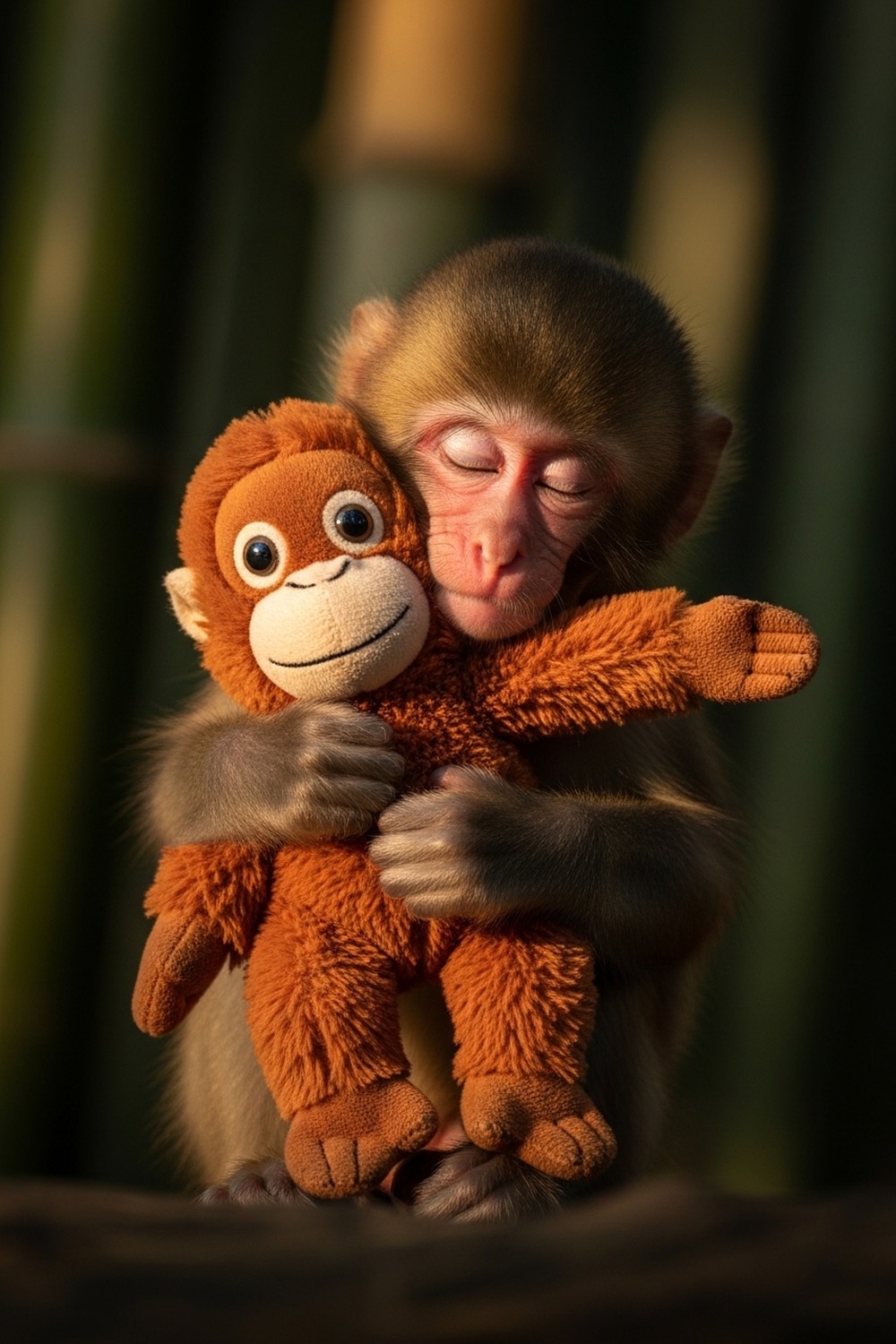
So they handed him a plush orangutan. And Punch grabbed it like it was the only solid thing in the universe.
Which — and this is the part that sent me down a research rabbit hole at midnight — it kind of was. Primatologist Harry Harlow demonstrated in the 1950s that infant rhesus macaques consistently preferred a cloth surrogate mother over a wire one that actually dispensed milk. Not occasionally. Overwhelmingly. Up to 18 hours a day clinging to cloth, running to the wire version only to eat, then running straight back. What that established was that contact comfort isn’t a bonus feature of early development. It’s load-bearing. Remove it, and the whole structure starts to wobble.
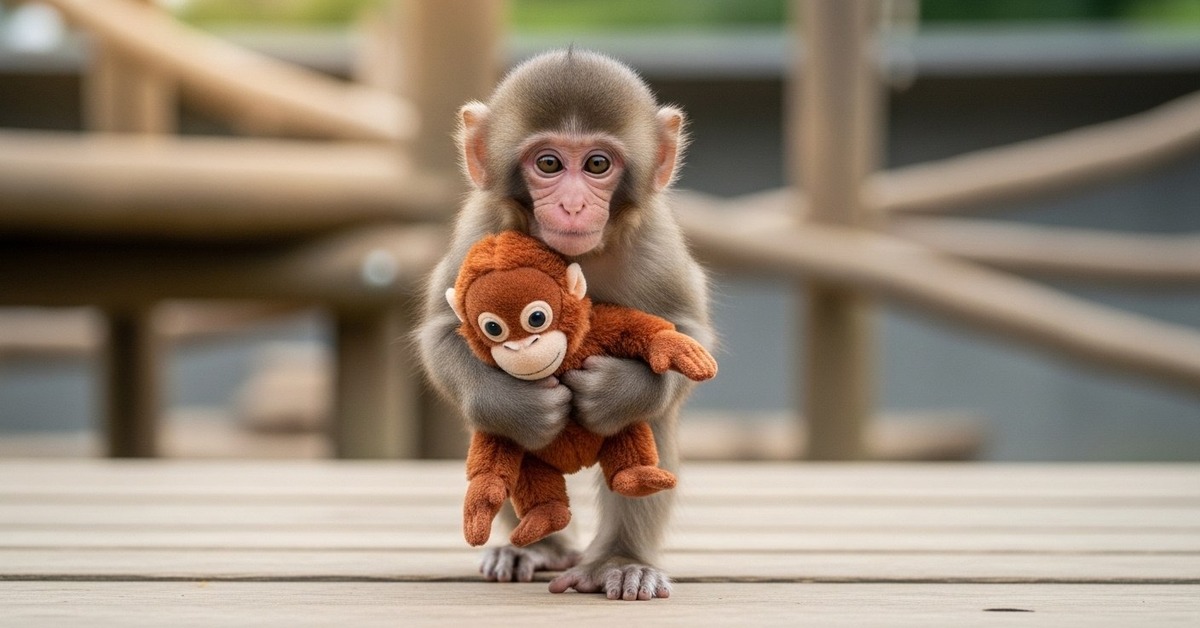
Punch carried that stuffed orangutan everywhere. Clutched against his chest, pressed to his face, dragged across the enclosure floor with the total commitment of someone who has decided this object is non-negotiable. The toy wasn’t a comfort object in the soft, decorative sense. It was doing the job of the most important relationship in a young macaque’s life — and doing it surprisingly well, all things considered.
What Grooming Actually Means in Macaque Society
Japanese macaques are social in a way that goes well beyond “likes to hang out.” Wild troops can exceed 100 individuals, and the internal architecture is intricate — a layered hierarchy where every interaction is information. Young macaques spend years absorbing the unspoken rules: who defers to whom, when to push, when to back off completely. They learn it by watching their mothers move through the group. By reading social situations through her reactions before they’re old enough to navigate those situations themselves.
Punch didn’t have any of that. No translator. No model. He was starting from zero with nothing but instinct and a stuffed toy, trying to figure out a social language that normally takes years of guided observation to learn. You can get a sense of how layered those dynamics get in this piece on the animal kingdom’s most complex social communities — it reframes what “social animal” actually means.
That last detail about the learning window kept me reading for another hour.
Then Another Monkey Reached Out
Here’s where baby macaque resilience stops being theoretical.
Another member of the troop started grooming Punch. And in macaque society, grooming isn’t maintenance — it’s a declaration. It’s a social contract written in fingertips that says: I’ve assessed you. I’ve decided you’re worth my time. You belong here. In primate economics, time and attention are the hardest currencies to earn, and someone had just spent both of them on an orphan with a stuffed toy.
For Punch, that session was a door opening. Once one monkey accepted him, others followed. He started climbing on juvenile backs, joining play groups, getting gently corrected when he pushed too far — which is itself a meaningful signal. You only bother correcting someone you expect to understand the correction. You only invest in teaching someone you’ve already decided is part of the group.
He isn’t just surviving. He’s learning the rules.
The Stuffed Toy Did Something Science Is Still Catching Up To
The plush orangutan may have done more than keep Punch calm. Researchers studying early attachment in primates have found that even imperfect surrogates — cloth, plush, basic physical contact with caregivers — can preserve the neural pathways associated with social bonding. Animals raised in total isolation during early development show lasting deficits in social behavior, emotional regulation, and the ability to read others’ cues. The damage isn’t behavioral. It’s structural. The brain stops building the architecture it needs to connect.
The stuffed toy wasn’t a mother. But it may have kept the wiring intact long enough for real connection to arrive.
That’s what makes Punch’s story interesting in a scientific sense, not just an emotional one. The toy bought him time. And in early primate development, time is the resource everything else depends on — the difference between a brain that learns to connect and one that quietly stops trying.
By the Numbers
- Japanese macaque troops in the wild average 20–100+ individuals (Kyoto University Primate Research Institute, ongoing longitudinal studies) — which means social integration isn’t a personality preference, it’s a survival skill.
- Harlow’s cloth-vs-wire experiments: infants spent up to 18 hours daily clinging to the cloth surrogate, even when only the wire one had milk.
- The critical window for social development narrows significantly after week 12. Animals deprived of all contact in the first 6 months showed near-complete inability to integrate into groups later — not reluctance, inability.
- Grooming can account for up to 20% of a macaque’s daily activity. More time than foraging, in some food-rich environments.
Field Notes
- Japanese macaques are the northernmost non-human primates on Earth — surviving winters that hit -15°C in Nagano, which makes their dense social structure not just cultural but thermal. They huddle. The troop is literally warmth.
- Juvenile “babysitters” in macaque groups — older but not yet adult members — often act as low-stakes social practice partners for the very young, a kind of protected space to make mistakes before full adult interactions begin.
- Some primatologists have documented orphaned macaques forming lasting bonds with unrelated peers that functionally mirror maternal attachments, providing the same behavioral scaffolding that mothers typically offer. Not a replacement exactly. More like a workaround the species seems to have built in.
Why Punch’s Story Is Bigger Than One Baby Monkey
Baby macaque resilience — the real kind, not the caption on a feel-good video — isn’t a fixed trait. It’s not something Punch was born with in some measurable, finite quantity that either holds or runs out. What the research keeps pointing toward is that resilience is built, incrementally, through connection. A toy first. Then a caregiver’s hands. Then one other creature willing to reach out and groom a stranger who has no obvious claim on their time.
Each of those acts deposited something into Punch’s development that couldn’t have come from anywhere else.
Which reframes the whole story. Punch didn’t survive because he was tough. He survived because enough individuals — human and primate — showed up for him at the moments that mattered. Resilience, here, isn’t internal. It’s relational. It’s something that gets built between individuals, not inside them.
That has real implications for how we think about animal welfare, about orphaned wildlife programs, about what “care” actually requires beyond the basics of feeding and shelter. And it applies uncomfortably close to home, if you let yourself sit with it for a minute.
Punch presumably still has his stuffed orangutan somewhere. Some objects earn permanent status. But what he has now — a troop that grooms him, plays with him, bothers to correct him when he gets something wrong — that’s not something any toy could have provided on its own. It took real connection to build that. One small act at a time, from individuals who had no particular reason to bother. There’s more of this kind of thing at this-amazing-world.com, and some of it gets considerably stranger.
Illustrations are AI-generated. Article fact-checked and human-edited. Our editorial standards.