The Proboscis Monkey’s Giant Nose: Nature’s Wildest Feature
Stand in a Borneo mangrove at dusk and something moves in the canopy — a rustling branch, a shadow — and then a face appears that looks like nothing else on Earth. That nose, drooping and fleshy, dominates the proboscis monkey’s features in a way that seems almost impossible: a structure so extreme it took millions of years to evolve, and a shrinking forest may erase it within a generation.
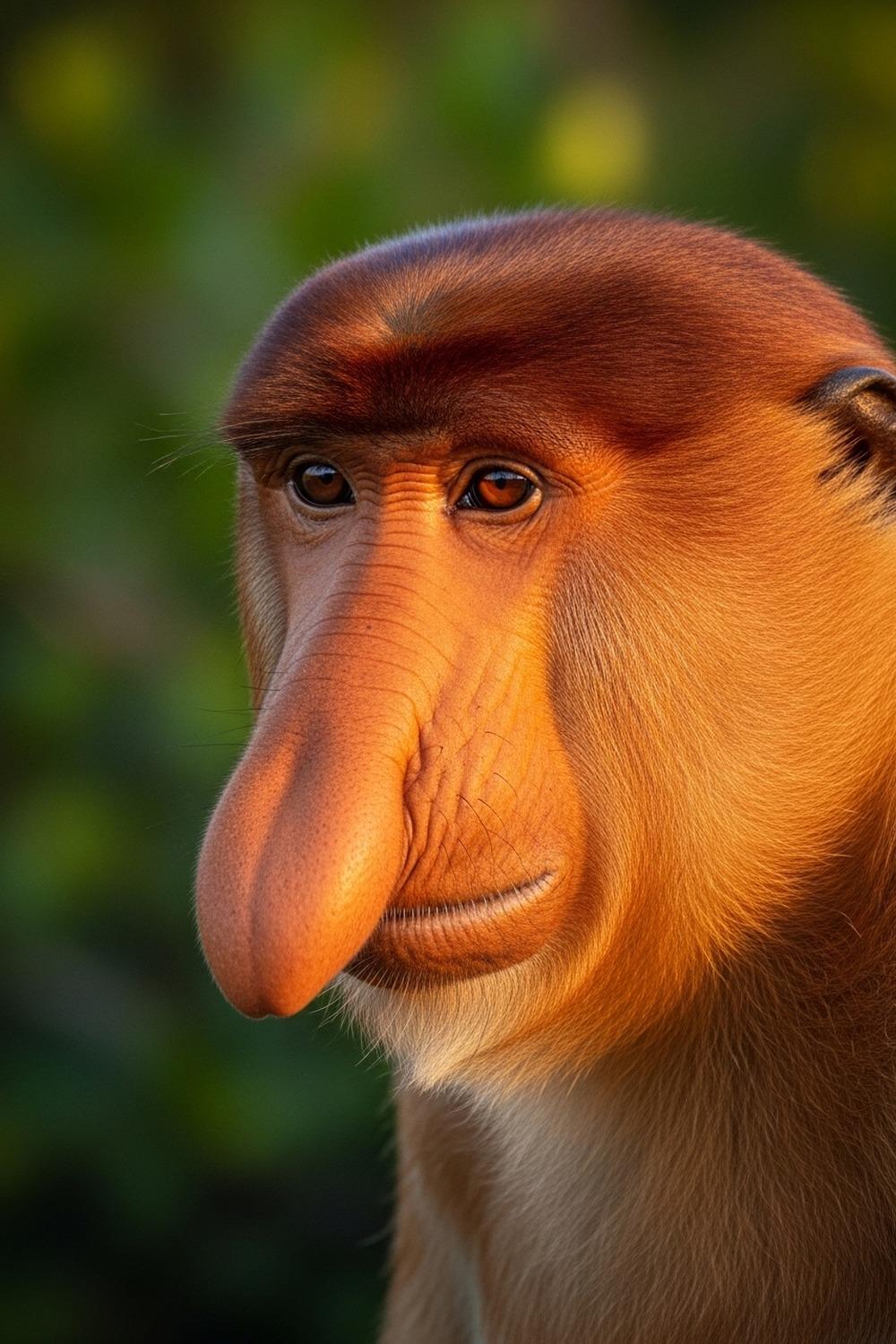
The proboscis monkey (*Nasalis larvatus*) lives only on Borneo, deep in swampy coastal forests shared by Brunei, Malaysia, and Indonesia. Males weigh up to 24 kilograms — among Asia’s heaviest monkeys — but it’s not their bulk that made them famous. The nose, drooping and cartoonish, is what has seized human attention for centuries. How does an appendage that looks like a prop from a sketch show actually help an animal survive?
Key Facts
- The proboscis monkey, Nasalis larvatus, lives only on Borneo in swampy coastal forests shared by Brunei, Malaysia, and Indonesia.
- A 2018 Kyoto University study of 59 males confirmed the enlarged nose acts as a sexually selected resonating chamber correlated with body mass.
- Males weigh up to 24 kilograms, roughly twice the weight of females, one of the most pronounced sexual dimorphisms in Asian primates.
- The IUCN Red List classified the species as Endangered in its 2020 assessment, with population decline over 50% in three decades.
- Borneo has lost approximately 50% of its forest cover since 1970, per Global Forest Watch data through 2022.
In short: The proboscis monkey nose, found only on Borneo, is a sexually selected resonating chamber that amplifies male calls. A 2018 Kyoto University study of 59 males linked nose size to body mass and reproductive success. The species is now Endangered, with over 50% population decline as Borneo lost roughly 50% of forest cover since 1970.
The Proboscis Monkey’s Nose: What It Actually Does
Scientists weren’t entirely sure, for a long time, what the enlarged nose of the male proboscis monkey was for. Sexual selection seemed straightforward enough: females preferred males with larger noses, and over thousands of generations, that preference sculpted one of the primate world’s most extreme facial features. Then, in 2018, researchers at Kyoto University published a study analyzing the nose’s acoustic function. They confirmed that the pendulous proboscis acts as a sexually selected resonating chamber — amplifying vocalizations into deeper, louder calls that travel farther through dense forest canopy.
Across 59 males, the researchers measured nasal length and found a direct correlation: bigger nose, bigger body mass, more reproductive success. Evolution, running its brutal arithmetic. Here’s the thing about what this actually costs an animal: a male proboscis monkey’s nose can grow so large it literally flops over his mouth when he’s not calling. He has to push it aside to eat. That’s not a minor inconvenience — it’s a structure so energetically costly and anatomically intrusive that it could only persist because the mating advantage is overwhelming.
Female proboscis monkeys have upturned noses, smaller but still prominent by primate standards. They do not develop the dramatic droop. Young males start with the upturned shape too, and the nose only begins its slow elongation at sexual maturity — a visible biological clock marking the moment a male enters the competition.
Swimming, Leaping, and Living in Swamp Country
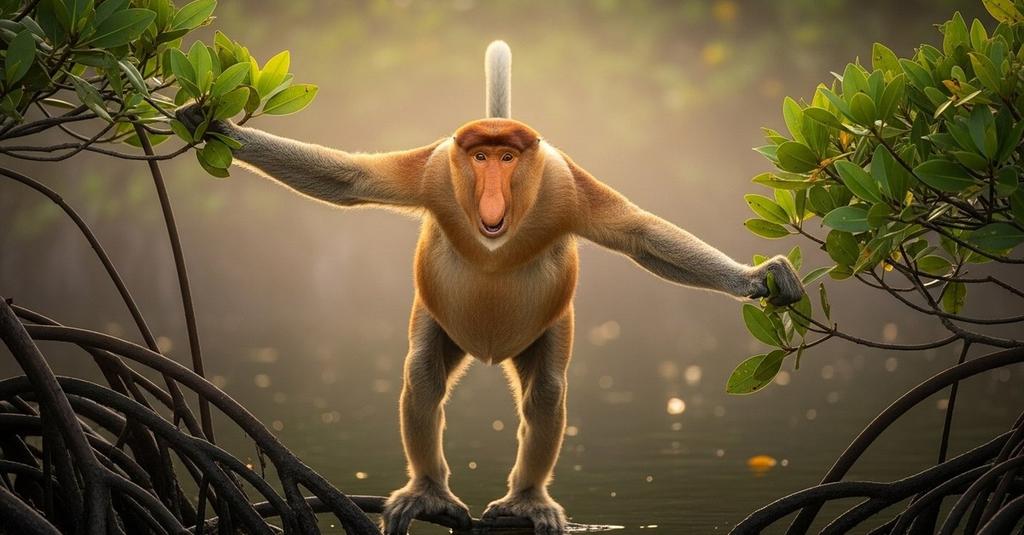
Borneo’s coastal mangroves are not forgiving terrain. Saltwater floods in on the tide. Roots tangle into mazes above the waterline. The forest floor is mud, brackish water, and the occasional crocodile waiting in the shallows. Proboscis monkeys didn’t just adapt to this environment — they built an entire behavioral toolkit around it. They’re among the very few primates that swim regularly, crossing rivers up to 20 meters wide with a confident, front-crawl-like stroke. Juveniles learn by watching adults, their small hands gripping a mother’s shoulders as she launches into the water. It’s social learning in one of the least likely classrooms on Earth.
If you’ve spent time reading about how primate bonds shape survival — and the extraordinary lengths a young monkey will go to for security and connection — this piece on a motherless toque macaque forming an unlikely bond with its father captures that instinct in striking detail. The same desperation for attachment, the same calculated trust.
What makes them unique is their digestive system. Proboscis monkeys are foregut fermenters — a strategy more commonly associated with cattle than primates. Their complex, multi-chambered stomachs break down leaves, unripe fruit, and seeds that would cause dangerous bloating in most other monkeys. The Sabah Wildlife Department in Malaysian Borneo documented groups consuming over 50 plant species, with leaves forming the bulk of the diet, especially in the dry season. But this specialization makes them almost entirely dependent on intact forest. There’s no backup plan built into the biology.
A field researcher in Sabah once described watching a troop cross a 15-meter river at dusk. The large male launched himself from a branch overhanging the water, hit the surface with a flat, ungainly splash, and emerged on the other side shaking himself off like a dog.
The rest of the troop followed one by one.
The crocodile watching from the bank didn’t move. Nobody waited to see if it would.
A Forest That’s Running Out of Time
What changed? Everything — starting in the 1970s, when Borneo’s forest began collapsing in earnest. Roughly half the island’s forest cover has vanished in the last 50 years. That’s not a gradual fade — it’s a structural collapse. Palm oil plantations, logging concessions, and agricultural expansion carved the island’s interior into fragments, leaving wildlife populations isolated in patches too small to sustain viable breeding groups.
According to a 2020 assessment published by the IUCN Red List, the proboscis monkey is now classified as Endangered. Population estimates suggest a decline of over 50% in the past three decades. These aren’t projections — they’re a record of what’s already happened.
The proboscis monkey’s hyper-specialization — the gut that only works on intact forest plants, the swimming that only helps when there are rivers to cross, the nose that only wins mates in populations large enough to sustain sexual selection — makes it uniquely fragile in a fragmented landscape. An animal that evolved for complexity can’t simplify on demand. When the forest shrinks to a strip along a river, the troop shrinks with it. Inbreeding follows. Genetic diversity collapses. The nose that took millennia to build becomes a liability in a gene pool too small to carry it forward. Watching a species disappear at this speed, you stop calling it a trend.
Reproduction for proboscis monkeys is slow: females typically give birth to a single infant every two years. Population recovery, even under ideal conditions, takes decades. The forest doesn’t wait decades. The chainsaws work faster than the birth rate, and that gap is where endangered species disappear.
What Researchers and Rangers Are Fighting to Preserve
Danau Girang Field Centre in Sabah, operated in partnership with Cardiff University, has been running systematic proboscis monkey surveys since 2009. They use boat transects along the Kinabatangan River to track population density and group structure. Data compiled across more than a decade of fieldwork paints a picture of a species that’s holding on in a few key stretches of protected riverbank — but just barely.
Conservation efforts for the proboscis monkey are concentrated along Borneo’s river systems, where intact riparian forest offers the last viable corridors between fragmented habitat patches. The Kinabatangan floodplain is one of the last places on Earth where you can watch proboscis monkeys gather in trees at dusk, a dozen or more silhouettes against a tangerine sky, before settling in for the night above the water that keeps terrestrial predators at bay.
In Indonesia, the Balikpapan Bay in East Kalimantan supports one of the larger remaining proboscis monkey populations. A 2019 survey by the Wildlife Conservation Society estimated roughly 1,500 individuals in the bay’s mangrove system — a significant number, but one hemmed in on all sides by coal mining infrastructure and urban expansion. Forest corridors that once connected mangrove to inland forest have been severed. The monkeys are, in effect, living on an island within an island. Genetic exchange between groups has dropped. Stability in a closed system is just slow decline by another name.
Local rangers in Sabah’s Lower Kinabatangan Wildlife Sanctuary patrol river corridors in flat-bottomed boats, monitoring troop movements and deterring illegal logging. It’s early mornings, rain, and the particular frustration of enforcing boundaries in a landscape where economic pressure is immense. But sectors with active ranger presence show measurably higher troop densities than unpatrolled stretches — a quiet, unglamorous data point that keeps the species in the ledger.
Why This One Primate Carries So Much of Borneo’s Story
The proboscis monkey has become, almost by accident, one of the clearest indicators of Borneo’s ecological health. It can’t persist in degraded forest. It can’t adapt to agricultural landscapes. It won’t colonize secondary growth. Where they are present in good numbers, the forest system is, by definition, largely intact. Where they’ve vanished, the forest has gone first. Ecologists call them an umbrella species — protect their habitat, and you protect hundreds of other species that share it. Pygmy elephants, clouded leopards, orangutans, Borneo pygmy slow lorises. The nose that looks like a punchline is actually a bellwether.
Carbon storage extends the stakes beyond Borneo’s borders. Tropical forests store roughly 25% of the world’s terrestrial carbon. Borneo’s lowland forests, where proboscis monkeys live, are among the most carbon-dense ecosystems on the planet. Their destruction doesn’t just erase a species — it releases stored carbon accumulated over thousands of years, feeding the very climate disruption that makes conservation harder everywhere else.
Deforestation and climate change aren’t separate crises in Borneo. They’re the same crisis, running in parallel. And the proboscis monkey sits at the intersection of both, a living measure of how fast both are moving.
Stand on the bank of the Kinabatangan at dusk. The air smells of river mud and wet bark. Something moves in the canopy — a rustle, a branch shaking. Then a face appears, that extraordinary nose pointed downward, dark eyes watching you with the calm curiosity of an animal that has no framework for what’s happening to its world. It doesn’t know what a palm oil concession is. It only knows this tree, this river, this light.
Where to See This
- The Lower Kinabatangan Wildlife Sanctuary in Sabah, Malaysian Borneo, is the most accessible site for proboscis monkey sightings — river cruises at dawn and dusk between July and October offer the highest chance of encounters, when troops gather near the water’s edge before roosting.
- The Danau Girang Field Centre (www.danaugirang.com.my), operated with Cardiff University in Sabah, runs conservation research programs and accepts volunteer researchers — direct engagement with active fieldwork studying proboscis monkey populations.
- The documentary series *Borneo: The Mysterious Island* (BBC Natural History Unit, 2019) provides extraordinary footage of proboscis monkey swimming behavior and troop dynamics, and is a useful primer before visiting.
By the Numbers
- Over 50% population decline recorded over the past three decades (IUCN Red List, 2020 assessment).
- Males weigh up to 24 kg — roughly 2× the weight of females, one of the most pronounced examples of sexual dimorphism in Asian primates.
- Borneo has lost approximately 50% of its forest cover since 1970, according to Global Forest Watch data through 2022.
- Proboscis monkey nasal length in dominant males correlates directly with body mass — a ratio confirmed across 59 individuals in the 2018 Kyoto University study.
- The Kinabatangan floodplain, spanning roughly 560,000 hectares, holds one of the largest remaining protected corridors for the species in Malaysian Borneo.
Field Notes
- In 2012, researchers observing a troop in Sabah documented a male proboscis monkey using a rudimentary doggy-paddle stroke to cross a 17-meter-wide river channel while carrying an infant clinging to his chest — the first recorded instance of adult male infant-carrying during river crossings in the species.
- Proboscis monkeys can’t digest ripe, sugary fruit efficiently — the fermenting chambers in their gut can cause dangerous gas buildup, making a fruit bowl that would delight most primates genuinely dangerous to them.
- The species’ closest relative is the odd-nosed monkey group of Southeast and East Asia, but the proboscis monkey’s nose exceeds all of them in absolute size — no other living primate grows a nasal appendage this large relative to face size.
- Researchers still can’t fully explain why female proboscis monkeys also have enlarged noses compared to most primates — if the feature is purely sexually selected in males, why did females evolve any nasal elongation at all? The honest answer is that no one knows yet.
Frequently Asked Questions
Q: Why does the proboscis monkey have such a large nose?
The proboscis monkey’s enlarged nose in males functions primarily as a resonating chamber, amplifying vocalizations to attract mates and signal dominance. A 2018 Kyoto University study confirmed a direct correlation between nose size, body mass, and reproductive success across 59 males. Females have historically preferred larger-nosed males, and this sexual selection pressure has driven the feature to increasingly extreme proportions over evolutionary time. The nose essentially works like a loudspeaker built from cartilage and skin.
Q: Are proboscis monkeys good swimmers, and why?
Yes — proboscis monkeys are exceptional swimmers for primates, capable of crossing rivers up to 20 meters wide using a front-crawl-like stroke. This ability evolved in direct response to their mangrove and riverine forest habitat in Borneo, where rivers act as both barriers and highways. Swimming allows troops to escape terrestrial predators, cross between feeding areas, and access roosting sites safely above the water. Juveniles learn by watching adults, meaning the skill is socially transmitted as well as biologically facilitated by their relatively large body mass and buoyancy.
Q: Are proboscis monkeys dangerous to humans?
Proboscis monkeys are not aggressive toward humans under normal circumstances and there are no documented cases of unprovoked attacks. A common misconception is that their large size makes them threatening — males can weigh 24 kg — but they are leaf-eating, river-dwelling animals with no predatory instinct toward people. Observers on river cruises in Sabah regularly pass within meters of feeding troops without incident. The real risk runs the other direction: human disturbance, habitat destruction, and hunting pressure are what endanger them, not any behavior on their part.
Editor’s Take — Alex Morgan
What stays with me about the proboscis monkey isn’t the nose — it’s the gut. An animal so committed to a single forest system that it evolved a completely different digestive architecture to survive there. That’s not adaptability. That’s the opposite of adaptability. It’s total, irreversible specialization. And it means that every hectare of mangrove cleared isn’t just removing habitat — it’s removing the only conditions under which this animal’s biology makes sense. You can’t relocate that. You can’t retrofit it. The forest and the monkey are, at a metabolic level, the same thing.
The proboscis monkey didn’t choose to be extraordinary. Evolution made that decision across millions of years of incremental pressure — a nose a little larger, a gut a little more complex, a swimming stroke a little stronger, generation by generation, until something genuinely singular emerged. That singularity is now balanced against half a century of chainsaw arithmetic. Borneo still has stretches of river where you can watch a troop settle into the trees at nightfall, their impossible faces catching the last of the light. The question is how many more seasons that image has left in it — and whether the people with the power to answer that are paying attention.
“
Illustrations are AI-generated. Article fact-checked and human-edited. Our editorial standards.