The Owl Moth’s Terrifying Trick: Eyes That Aren’t There
A pair of painted circles. That’s all the owl moth eyespots defense really is — two rings on a pair of wings, no venom, no speed, just the audacity to bet everything on a split-second illusion that’s been stopping hunters cold for millions of years. But here’s what makes it genuinely unsettling: the math behind it suggests the moth understands predator neurology better than the predator understands itself.
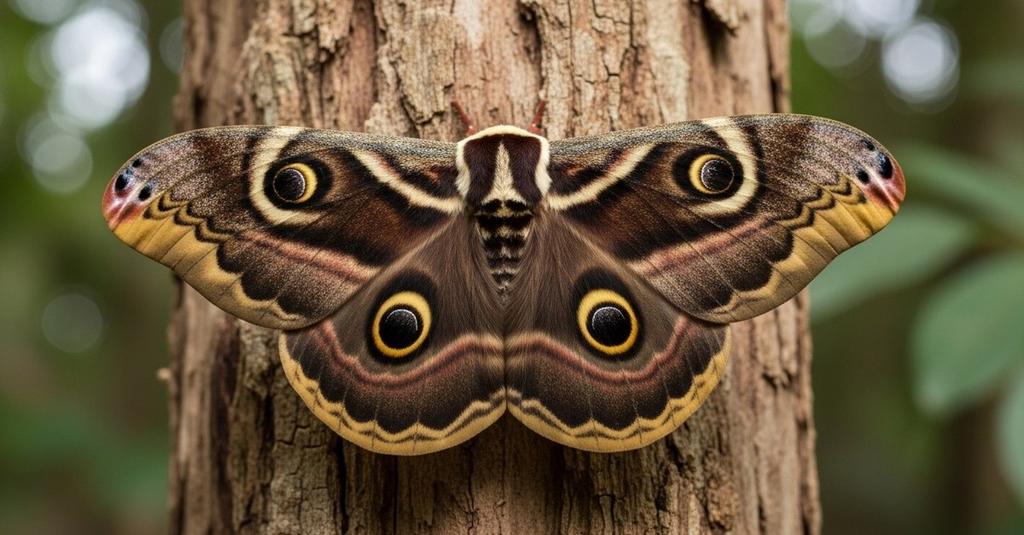
Deep in the monsoon forests of northern India and across the hill ranges of Southeast Asia, Brahmaea wallichii spends daylight pressed motionless against bark. At rest, it’s invisible — just another patch of textured brown wood, another nothing on a tree trunk. But disturb it, and something changes in less than 50 milliseconds. The wings snap wide open.
What most people notice first is the shock of it — the sudden appearance of what looks unmistakably like two enormous eyes staring back. What researchers have been trying to figure out for decades is what comes after: How does a pattern of scales fool a brain that’s been hunting for millions of years? And what does it actually cost this moth to pull off that trick?
Key Facts
- Brahmaea wallichii reaches a wingspan of up to 160 millimeters, placing it among the top 15 largest moth species globally (Natural History Museum, London).
- The wing-snap display exposes both hindwing eyespots in about 50 milliseconds, faster than a human eye can blink.
- The white highlight point within each eyespot covers less than 2 percent of its area, yet removing it reduced predator flinch responses by up to 40 percent.
- At least 80 species across Brahmaeidae and Saturniidae exhibit eyespot displays, evolved independently at least 7 times within Lepidoptera (University of Cambridge, 2016).
- Adult Brahmaea wallichii moths have no functional mouthparts, do not feed, and survive on larval fat reserves for just 10 to 14 days.
In short: The owl moth eyespots defense lets Brahmaea wallichii, a moth with a 160-millimeter wingspan, snap its wings open in 50 milliseconds to flash two huge fake eyes at predators. A tiny white highlight covering under 2 percent of each eyespot does 40 percent of the deterrent work by hijacking the fast pattern-recognition circuits in bird brains.
The Science Behind Owl Moth Eyespots Defense
The eyespots on Brahmaea wallichii aren’t decorative accidents — they’re the product of tens of millions of years of evolutionary pressure, shaped into one of the most precisely tuned defensive signals in the animal kingdom. Research from the University of Jyväskylä in Finland has repeatedly shown that eyespot size relative to wing area is the single most critical factor in deterrence effectiveness. With a wingspan reaching 160 millimeters, Brahmaea wallichii carries eyespots that fill nearly a third of each hindwing, putting it in a class of its own among Lepidoptera. The bigger the eyespot in proportion to total wing surface, the more reliably it triggers a flinch response in avian predators. This phenomenon is formally categorized as deimatic behaviour — a startle-based anti-predator display used across dozens of unrelated species.
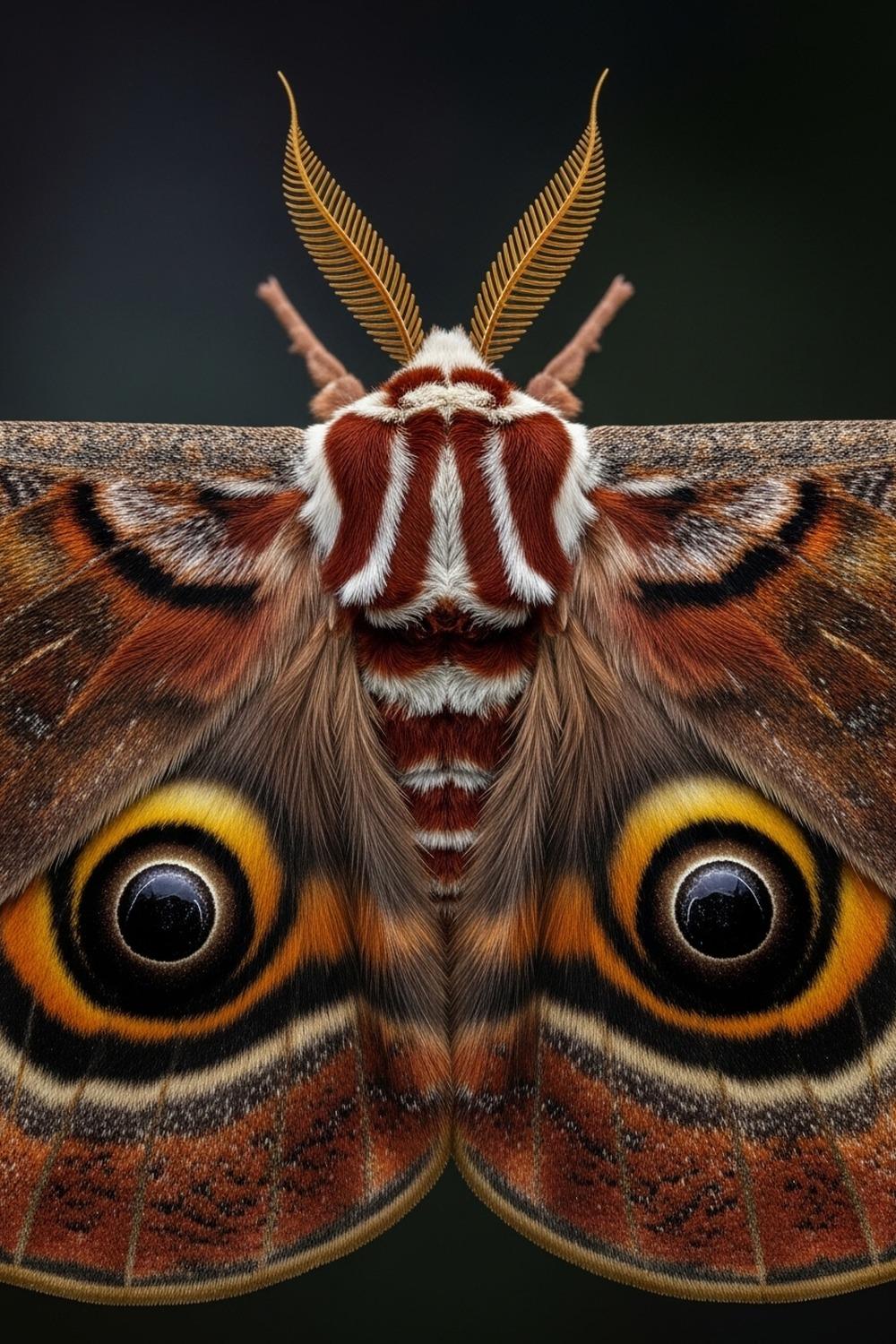
Here’s the thing: what makes the owl moth’s version work isn’t just raw size. It’s precision layering. Each eyespot features a dark outer ring, a pale iris band, a dark pupil, and a small white highlight point that mimics reflected light. That last detail — that tiny reflection covering less than 2% of the eyespot’s total area — appears to be the crucial threshold.
A flat disc of color signals pattern. A disc with a convincing highlight signals depth, signals something wet and alive looking back. Birds process visual stimuli faster than nearly any other vertebrate class, and that highlight point appears to be the trigger that pushes the image from “strange marking” into “eye.” The neural shortcut fires. The bird retreats.
Field observers in Uttarakhand, India, have documented something striking: great tits and hill mynas abandon approach runs within milliseconds of a resting owl moth spreading its wings. Not cautious retreat. Immediate, full-velocity flight. The reaction is reflexive, not considered — and that’s exactly the design.
The Two-Stage Defense System
Why does this moth need two completely different strategies? Because the eyespots only work because of what comes before them. An owl moth’s forewings are a masterwork of disruptive coloration — irregular bands of dark brown, ash gray, warm ochre, and near-white that fracture the wing’s outline and mimic the exact grain pattern of lichen-crusted bark. When the moth presses flat against a tree trunk in daylight, the geometry of its body virtually disappears. This is convergent evolution at work: the Sunda flying lemur in the same Southeast Asian forests uses cryptic coloration across its gliding membrane to vanish against the canopy — same principle, different animal, same reason: a large body that needs to become invisible.
The forewings conceal. The hindwings perform. This functional division runs deep into the wing structure itself. When a moth rests, the hindwings fold completely beneath the forewings — the eyespots invisible, sealed away like a stage curtain. The moment vibration or shadow registers, fast-twitch thoracic muscles snap the forewings upward in under 50 milliseconds, exposing both eyespots simultaneously.
Studies at the Natural History Museum in London, examining pinned specimens collected as far back as 1854, reveal something telling: hindwing pigmentation is consistently more vivid and contrast-rich than the forewing. This suggests evolutionary pressure specifically optimized the hindwing pattern for maximum visual impact rather than durability or thermal regulation. The forewings were built to hide. The hindwings were built to shock.
But there’s a cost buried in that design.
The rapid wing-snap display burns energy and temporarily disrupts the moth’s thermal camouflage. If a predator isn’t deterred on the first display — and occasionally, experienced corvids aren’t — the moth has partially revealed itself and partially exhausted its first-line defense. It’s calculated risk, and across millions of years of survival data, the mathematics have clearly worked out.
When the Illusion Fails
No defense works on every predator every time. Younger birds, first encountering the owl moth eyespots defense, show the strongest flinch responses. As individual predators age and accumulate experience, habituation begins — learning through repeated exposure that the large “eyes” don’t belong to an actual threat. A 2022 analysis published by Smithsonian Magazine on eyespot evolution confirmed that habituation is the primary long-term pressure shaping eyespot complexity. As experienced predators begin to see through simpler patterns, only moths with more detailed, more convincing eye mimicry survive to reproduce. The arms race escalates.
This is where scale becomes the moth’s advantage again. Even a habituated crow or myna that intellectually “knows” the eyespots aren’t real still has to override a deep autonomic flinch response every single encounter. That cognitive override takes measurable milliseconds. In the wild, milliseconds are the difference between a caught meal and successful escape. The owl moth eyespots defense doesn’t need to fool the predator permanently — it needs to create enough hesitation for the moth to drop from its perch, flutter erratically, and reach undergrowth cover. The illusion only has to last the length of a breath.
What researchers find genuinely puzzling is the variation in eyespot morphology across different regional populations of Brahmaea wallichii. Specimens from the eastern Himalayan foothills consistently show darker, higher-contrast eyespots than those from lowland Myanmar. Whether that reflects different dominant predator communities — different sets of eyes the moths are trying to mimic — or simply genetic drift across isolated populations remains an open question that current molecular studies haven’t resolved.
What the Owl Moth Tells Us About Perception
There’s a deeper implication buried in this, one that researchers at the University of Cambridge’s Department of Zoology have been probing since at least 2016 through controlled experiments using both live predators and computerized image-recognition systems. Their central finding reframes everything: the neural circuits that make birds vulnerable to eyespot displays are the same circuits that make them excellent hunters in the first place. Fast, automatic pattern recognition — the ability to detect a predator’s face in a fraction of a second — is the faculty the owl moth hijacks. The moth doesn’t exploit a flaw in avian cognition. It exploits a feature.
The more acute the predator’s visual processing, the more reliably the eyespots trigger a response. Speed is the vulnerability.
Deimatic displays like the owl moth’s aren’t crude tricks that fool simple minds — they’re precision instruments tuned to the specific architecture of sophisticated nervous systems. The owl moth eyespots defense works better on smarter predators, not worse. A spider, with its limited visual processing, remains largely unimpressed. A bird with acute, fast-processing binocular vision is far more susceptible. The illusion scales with the complexity of the target’s perception — and that’s a genuinely strange thing to sit with.
At least 80 species within the Brahmaeidae and Saturniidae families alone display some form of eyespot mimicry, but these evolutionary pathways appear to have emerged independently multiple times. Convergent evolution arriving at the same visual solution from completely different genetic starting points. The eye isn’t just the most powerful organ in nature. It’s the most powerful weapon.
Where to See This
- Namdapha National Park in Arunachal Pradesh, northeastern India, offers some of the best verified sightings of Brahmaea wallichii in its natural habitat. Peak emergence runs from late February through April, coinciding with the end of the cool dry season before monsoon onset.
- Khao Yai National Park in central Thailand, a UNESCO World Heritage Site, hosts regular moth-lighting events run by local naturalist guides where large Brahmaeid moths including owl moth species are regularly documented on light sheets between March and May.
- For readers unable to travel: the Natural History Museum in London holds one of the world’s largest pinned collections of Brahmaeidae and offers high-resolution specimen imaging through its online Data Portal — a remarkable resource for understanding eyespot morphology variation across the species’ range.
By the Numbers
- Up to 160 mm wingspan recorded in wild-caught female specimens of Brahmaea wallichii, placing it among the top 15 largest moth species globally (Natural History Museum, London collections, 2019).
- 50 milliseconds — the approximate time required for the wing-snap display to expose both hindwing eyespots from rest, faster than a human eye can blink.
- At least 80 species across Brahmaeidae and Saturniidae exhibit some form of eyespot anti-predator display, with similar patterns having evolved independently at least 7 times within Lepidoptera (University of Cambridge, 2016).
- The white highlight “reflection” point within each eyespot covers less than 2% of the eyespot’s total area — yet removal of this single element in experimental trials reduced predator flinch responses by up to 40%.
- Adult Brahmaea wallichii moths do not feed. They have no functional mouthparts and live entirely on fat reserves stored during the larval stage, surviving as adults for just 10–14 days.
Field Notes
- In 2017, a field team from the Bombay Natural History Society documented an owl moth in Meghalaya’s East Khasi Hills performing a sustained deimatic display for over four minutes against repeated approaches by a Himalayan bulbul — longer than any previously recorded single display event in the published literature for this species.
- Larvae of Brahmaea wallichii are as visually striking as adults: jet black with bright orange-yellow lateral stripes and long, curved tubercles that make them resemble toxic swallowtail caterpillars — a completely separate defense system running before the moth even reaches adulthood.
- Owl moth adults are almost exclusively nocturnal, yet their eyespot display evolved primarily as a defense against diurnal predators — suggesting the display is triggered during daytime resting when the moth is most vulnerable, not during active flight hours.
- Researchers still can’t fully explain why the eyespots on Brahmaea wallichii so closely resemble owl eyes specifically, rather than eyes of other large predators in its range. Whether this represents genuine mimicry of a known threat or convergence on a universal “large vertebrate eye” template remains genuinely unresolved.
Frequently Asked Questions
Q: How does the owl moth eyespots defense actually work on predators?
The owl moth eyespots defense triggers an automatic flinch response in the nervous systems of birds and small mammals — the same fast-pattern-recognition circuit that allows those animals to detect real predator faces instantly. When the moth snaps its wings open, both hindwing eyespots are exposed simultaneously, creating the sudden visual impression of a large animal staring back. The response is autonomic, not considered — the predator’s body reacts before its brain can fully evaluate the threat, giving the moth its escape window.
Q: Are the eyespots on owl moths actually mimicking owl eyes specifically?
The resemblance to owl eyes is striking — the concentric ring structure, dark pupil, and especially the white highlight that mimics reflected light are all consistent with how an owl’s eye appears at close range. But researchers at Cambridge have noted that the pattern may exploit a broader “large vertebrate eye” template hardwired into avian cognition, rather than being specifically tuned to owl eyes alone. The overlap with owl eye morphology may be coincidental convergence rather than deliberate mimicry — though in evolutionary terms, that distinction matters less than the result.
Q: Do owl moths have any other defenses, or do they rely entirely on the eyespots?
The eyespots are dramatic, but they’re actually the third line of defense, not the first. Initial strategy is cryptic camouflage — the moth’s forewings match bark texture so precisely that most predators don’t detect it. If that fails and a predator approaches, the deimatic display fires. If even that fails, the moth can drop from its resting surface and use erratic, unpredictable flight to reach cover. Adults also carry trace alkaloid compounds in their wing scales derived from larval host plants, which may make them unpalatable to some predators — though this hasn’t been fully quantified in Brahmaea wallichii specifically.
Editor’s Take — Alex Morgan
What keeps pulling me back to this story isn’t the eyespots themselves — it’s the math of the exploit. The owl moth doesn’t need a smarter brain than its predators. It needs to understand their brains better than they understand themselves. That highlight point covering less than 2% of the eyespot’s area, doing 40% of the defensive work — that’s not brute-force mimicry. That’s a surgical understanding of how avian vision processes depth cues. An animal with no brain to speak of has reverse-engineered the perceptual shortcuts of one of evolution’s sharpest visual systems. Watching a species accomplish this kind of precision engineering purely through the blind force of reproductive success, you start to realize we may fundamentally underestimate what happens in the spaces between survival pressure and adaptation.
Roughly 160,000 described moth species exist on Earth, and the majority have never been studied for defensive behavior in any systematic way. The owl moth became famous because it’s large enough to photograph and dramatic enough to share. But somewhere in the understory of a forest we haven’t fully catalogued, smaller, quieter versions of the same trick are almost certainly running — illusions tuned to predator nervous systems we barely understand, operating on biological hardware older than flowering plants. Next time something small and brown presses itself flat against a wall near you, it’s worth asking what it might be about to show you.
“
Illustrations are AI-generated. Article fact-checked and human-edited. Our editorial standards.