A Dog and Cat Touch Noses Daily Through a Fence Gap
Nobody trained them. There was no treat, no whistle, no human deciding this should happen. It just… did.
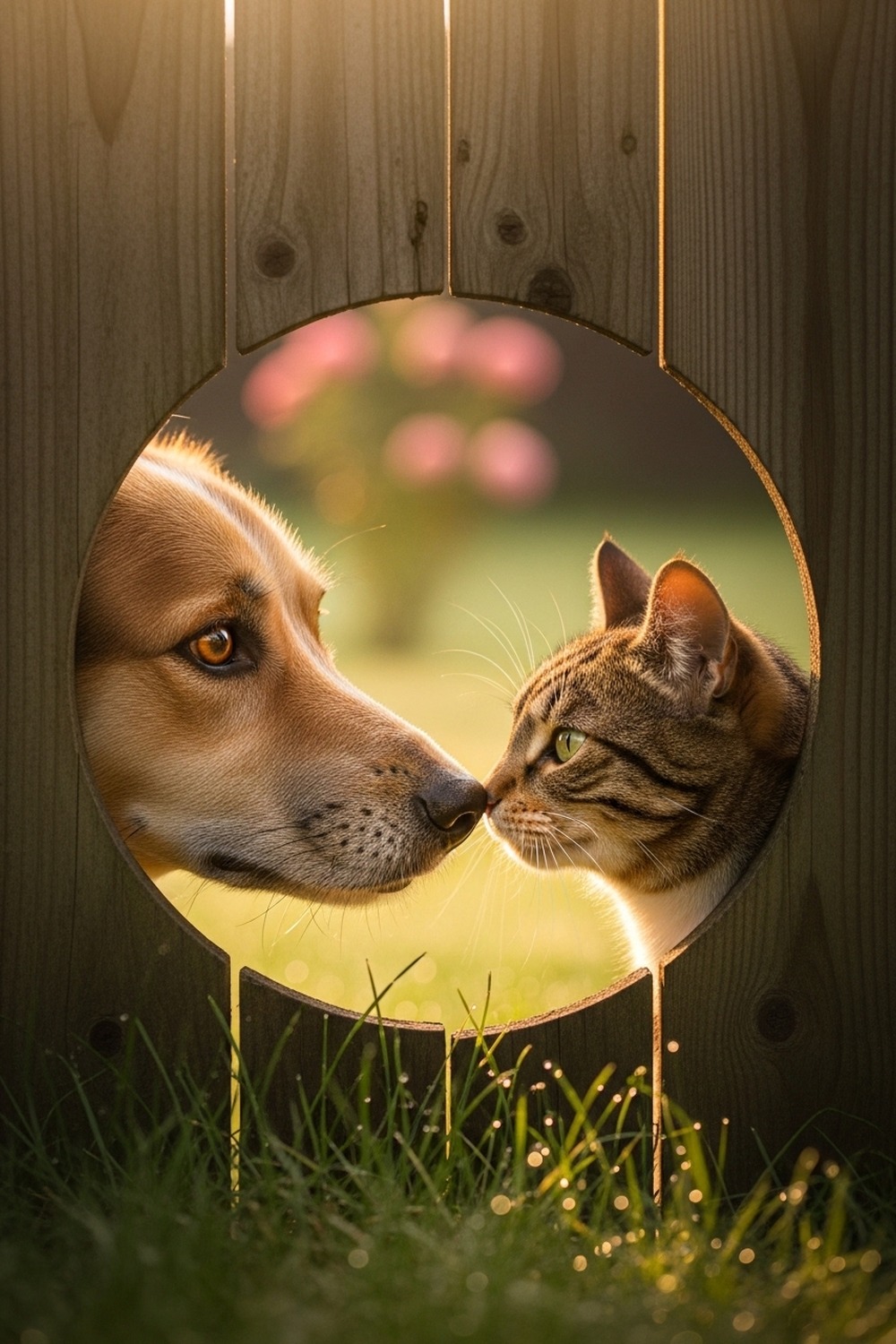
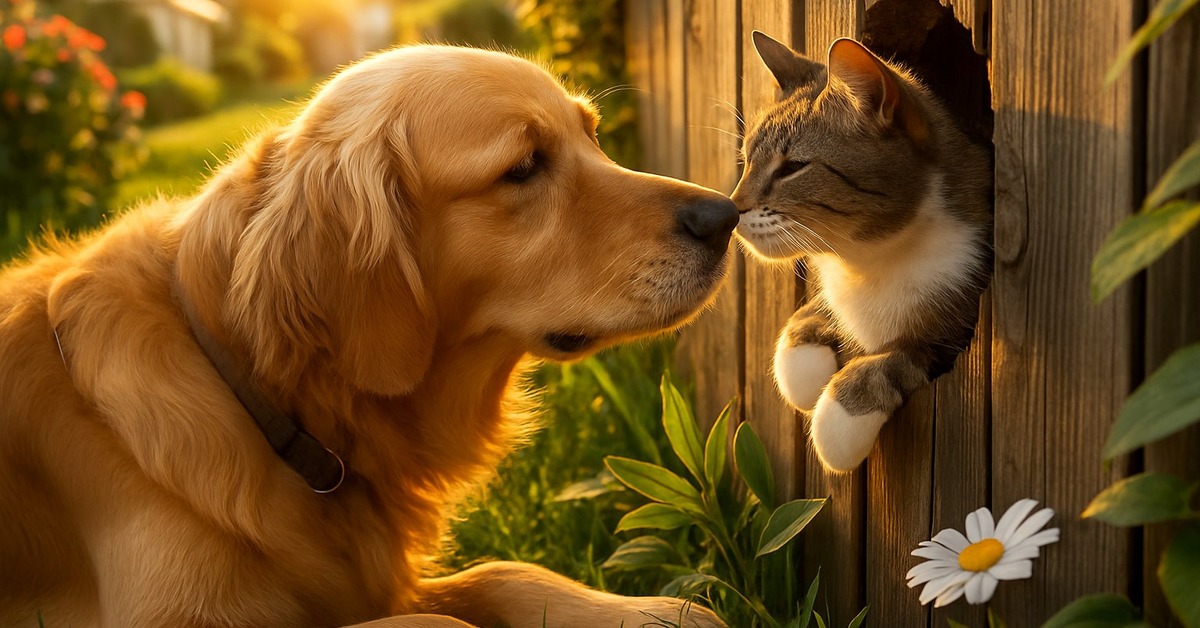
Every morning, same gap in the fence — about the width of a tennis ball — a dog and a cat press their noses together for roughly three seconds and then go about their separate lives. Two yards. One splintered hole in the wood. And somehow, watching it, you get the feeling you’re seeing something science is still trying to catch up to.
Key Facts
- Ethologists call the dog-cat fence interaction nose targeting — a contact greeting documented across dozens of mammal species, signaling safety and recognition.
- Dogs have up to 300 million olfactory receptors, compared to about six million in humans.
- Research published in the journal Science found that mutual gazing between dogs and their owners triggered oxytocin release in both species simultaneously.
- A 2019 study from Oregon State University found roughly 65% of cats show secure attachment styles toward their owners — rates comparable to dogs.
- According to a 2020 American Pet Products Association survey, 46% of U.S. multi-pet households contain both a dog and a cat.
In short: A dog and a cat meet daily at a small fence gap to touch noses — what ethologists call nose targeting. Dogs have 300 million olfactory receptors versus six million in humans. A Science paper documented oxytocin spikes from mutual gazing, and Oregon State 2019 research found 65% of cats show secure attachment.
Why Interspecies Animal Bonding Defies Easy Explanation
Ethologists have a name for what’s happening at that fence. They call it “nose targeting” — a contact greeting documented across dozens of mammal species, used to signal safety and recognition. Researcher Marc Bekoff, professor emeritus of ecology at the University of Colorado, has spent decades arguing that cross-species play and greeting behaviors reveal emotional complexity that science has historically undersold. Which is all well and good. But it still doesn’t fully answer the obvious question: why would a cat lean in?
Cats don’t meet anyone halfway. That’s basically their whole operating system. They swat at strangers, disappear when guests arrive, and ignore humans who’ve loved them for years. So when this particular cat presses its nose through a gap in the wood toward a dog — deliberately, every single morning — that’s not nothing. That’s actually a very big deal dressed up in a very small gesture.
What the Nose Touch Actually Communicates
When animals touch noses, they’re exchanging chemical information through scent glands clustered around the face and muzzle. Think of it less like a handshake and more like handing someone your entire contact file. Dogs have up to 300 million olfactory receptors — compared to about six million in humans — which means that three-second contact carries more data than we could process in an afternoon. For the dog greeting the cat, it’s not just recognition. It’s a running update. Every touch confirms: still safe, still you, still worth showing up for.
The cat gets the same thing back. Familiar scent. Known entity. No threat. And cats are territorial enough that their willingness to approach that gap every morning means this dog has earned a very rare classification.
Trusted. That’s a short list for most cats.
You can explore more about how animals communicate trust at this-amazing-world.com, where the science gets genuinely stranger the deeper you go.
They Built This Habit Without Anyone Teaching Them
Here’s the thing about interspecies animal bonding like this — nobody choreographed it. No treats, no training sessions, no human intervention. Ethologists describe this kind of spontaneously developed ritual as “emergent social behavior”: a pattern that grows from repeated positive contact until the ritual itself becomes the reward. The repetition is the relationship.
The fence gap didn’t separate them. It gave them somewhere to meet.
Think about what that actually means. A structural flaw in a piece of wood became a daily appointment. Both animals figured out, independently, that something good happens at that spot at that time — and so they kept showing up. Not because they were told to. Because they wanted to.
That’s not instinct. That’s trust that got organized into a habit.
The Biology Underneath the Sweetness Is Serious
Repeated positive contact between animals doesn’t just feel good. It changes them, at a chemical level. Studies on oxytocin — the so-called bonding hormone — show that dogs experience measurable spikes during friendly interactions, including those with cats and with humans. Research published in the journal Science found that mutual gazing between dogs and their owners triggered oxytocin release in both species simultaneously. Nose contact is even more direct than that. The physical touch fires the same neurochemical pathways. Over time, these two animals meeting at a fence every morning are literally altering each other’s stress responses.
That last fact kept me reading about this for another hour.
And the cat isn’t exempt from any of this. Cats produce oxytocin too, though researchers note they do so at lower baseline rates than dogs. So a cat choosing repeated close contact with a different species isn’t passive tolerance — it’s an active preference. The cat is selecting this. That’s a high bar for a creature that regularly ignores its own name being called from three feet away.
By the Numbers
- A 2019 study from Oregon State University found that roughly 65% of cats show secure attachment styles toward their owners — rates comparable to dogs, which quietly overturned decades of assumptions about feline emotional detachment.
- 300 million olfactory receptors in a dog’s nose.
- The longest documented interspecies friendship in captivity involved a lion, a tiger, and a bear at Noah’s Ark Animal Sanctuary in Georgia — they lived together for over 15 years after bonding as cubs in 2001, which sounds like the setup for a joke but is completely real.
- 46%
- That last number is the share of U.S. multi-pet households containing both a dog and a cat, according to a 2020 American Pet Products Association survey — making cross-species daily interaction one of the most common animal behavior scenarios in the country, and still one of the least scientifically studied.
Field Notes
- Cats carry scent glands on their cheeks, forehead, and chin — so when this cat leans toward the dog, it’s not only reading information, it may be leaving some behind. Essentially filing the dog under: mine, known, safe.
- Nose-targeting is how dogs de-escalate tension with other dogs before it starts. By extending that behavior to a cat, the dog is treating the cat as a fellow social mammal who deserves the same diplomatic approach. Across a species boundary. Without being taught that species boundaries exist.
- Early cross-species socialization can permanently reshape social preferences — but these two didn’t grow up together.
- Which makes this a case of adult behavioral plasticity, and researchers find that considerably rarer and harder to explain than anything that happens in puppyhood or kittenhood. It means the relationship formed anyway, later, from scratch, out of nothing but repetition and proximity.
Why This Small Moment Carries Real Weight
Interspecies animal bonding stories tend to get filed under “cute content” — something to watch between doomscrolling sessions and then forget. But what’s happening at that fence gap is a genuine window into how social behavior bends and stretches past the boundaries we’ve drawn for it. These two animals aren’t following a script their species wrote. They’re improvising one, morning by morning, using a vocabulary made of scent and proximity and showing up that predates language by millions of years.
Turns out the fence didn’t keep them apart. It just defined where they’d meet.
And maybe the more uncomfortable idea — the one that makes this worth thinking about past the surface-level sweetness — is what it says about connection itself. We tend to assume that closeness requires similarity. Same species, same background, same language, some shared framework for understanding the world. These two have exactly none of that. What they have is a gap in some old wood, a consistent time of day, and enough accumulated trust to close three inches of distance.
Three seconds a day. That’s the whole investment. Two animals, separated by a fence and every conventional rule of nature, maintaining something that operates a lot like friendship on nothing but habit and mutual recognition. They don’t need the whole yard. They just need the gap. If this kind of thing keeps you up at night — the weird, quiet evidence that connection doesn’t follow the rules we’d expect — there’s more at this-amazing-world.com, and the next one is stranger than this.
Frequently Asked Questions
Q: What is the dog and cat actually doing through the fence?
Ethologists call it nose targeting — a contact greeting documented across dozens of mammal species that signals safety and recognition. When animals touch noses, they exchange chemical information through scent glands clustered around the face and muzzle. Researcher Marc Bekoff, professor emeritus of ecology at the University of Colorado, has spent decades arguing that cross-species play and greeting behaviors reveal emotional complexity science has historically undersold. The three-second daily contact functions less like a handshake and more like trading entire contact files between species.
Q: How much information is exchanged in three seconds of nose contact?
Dogs have up to 300 million olfactory receptors — compared to about six million in humans — which means a brief contact carries more data than humans could consciously process in an afternoon. For the dog, the touch is a running update confirming the cat is still safe, still known, still worth showing up for. The cat gets the same in return: familiar scent, known entity, no threat. The fact that a cat repeatedly approaches voluntarily is a meaningful behavioral signal of trust.
Q: Does friendly contact actually change the animals’ biology?
Yes. Studies on oxytocin show dogs experience measurable spikes during friendly interactions, including those with cats and humans. Research published in the journal Science found mutual gazing between dogs and their owners triggered oxytocin release in both species simultaneously. Nose contact is even more direct than that — the physical touch fires the same neurochemical pathways. Cats also produce oxytocin, though at lower baseline rates than dogs, meaning a cat that repeatedly seeks contact with a different species is showing active preference, not passive tolerance.
Q: How common are cross-species pet friendships?
A 2019 study from Oregon State University found that roughly 65% of cats show secure attachment styles toward their owners — rates comparable to dogs — which quietly overturned decades of assumptions about feline emotional detachment. According to a 2020 American Pet Products Association survey, 46% of U.S. multi-pet households contain both a dog and a cat, making cross-species daily interaction one of the most common animal behavior scenarios in the country, and still one of the least scientifically studied at any depth.
Illustrations are AI-generated. Article fact-checked and human-edited. Our editorial standards.