The Mad Piper of D-Day Who Cheated Death at Sword Beach
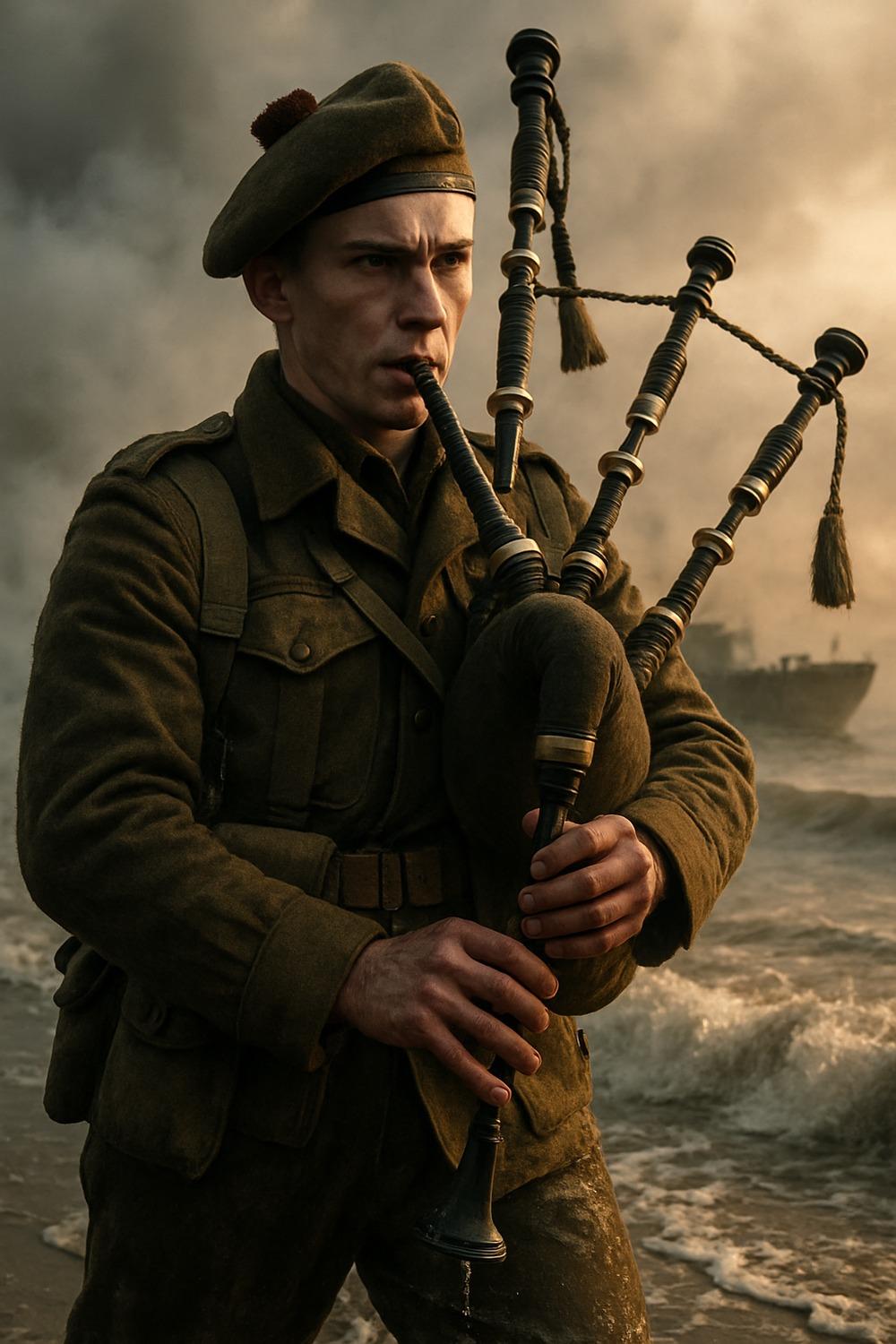
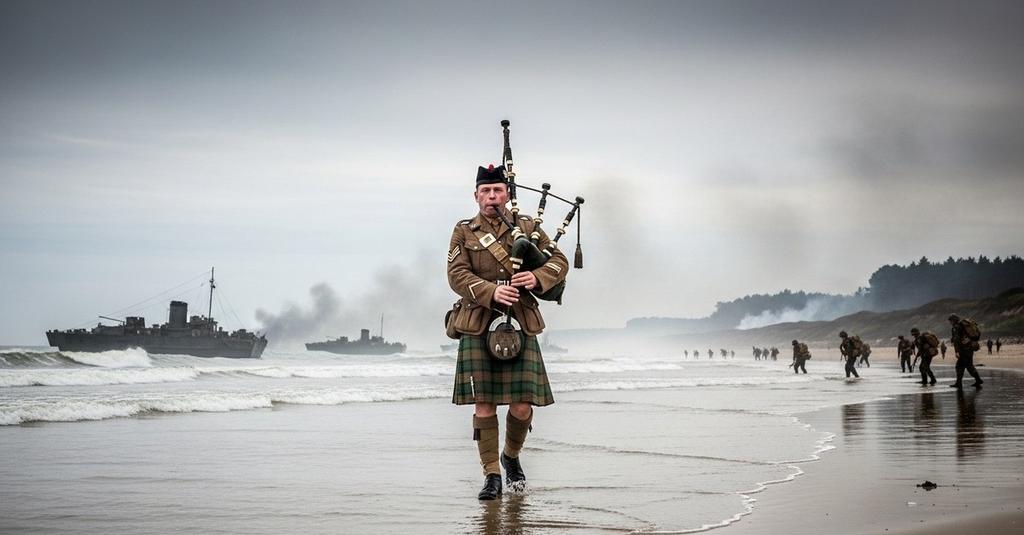
June 6, 1944. A 21-year-old Scottish soldier stepped off a landing craft onto Sword Beach with an instrument and no weapon, playing *Highland Laddie* while men died around him. The bagpipes and D-Day — two things that should never have occupied the same moment — collided that morning through one man’s refusal to accept a rule he thought didn’t apply to him. Bill Millin walked upright through the carnage, unarmed, and German snipers had him in their sights. They chose not to fire. They were certain he was insane.
Born in Glasgow on July 14, 1922, Millin had grown up partly in Fort William, Alberta, before returning to Scotland. His father had been a piper in the First World War — another man who’d carried an instrument into catastrophe — and the training had sunk deep. By the time he enlisted in 1940, the pipes were as much a part of his body as his breathing.
That’s where Lord Simon Fraser entered the picture. The 17th Lord Lovat — aristocrat, commando, one of the most audacious officers in the British Army — came looking for a personal piper and found Millin. What the two of them would accomplish that morning on a Normandy beach was so improbable that historians have spent decades trying to make sense of it. How does a man play the bagpipes through a D-Day assault and walk away without a scratch?
Key Facts
- Bill Millin was a 21-year-old Scottish piper who played bagpipes unarmed across Sword Beach on June 6, 1944.
- He played four tunes under fire, including Highland Laddie and The Road to the Isles.
- Lord Lovat ordered him to play despite a 1940 British War Office ban on front-line pipers.
- German snipers reportedly chose not to shoot Millin because they believed he was insane.
- A bronze statue of Millin was unveiled at Colleville-Montgomery, Normandy, in 2013.
In short: The Bill Millin D-Day piper story recounts a 21-year-old Scottish soldier who walked unarmed across Sword Beach on June 6, 1944, playing bagpipes under fire on Lord Lovat’s orders. German snipers reportedly spared him, believing he was insane. A bronze statue honored him at Colleville-Montgomery in 2013.
The Piper Who Defied Orders at Sword Beach
Operation Overlord — the Allied invasion of Nazi-occupied France — was the largest seaborne assault in history. Sword Beach, the easternmost of the five Allied landing zones, was assigned to the British 3rd Infantry Division and Lord Lovat’s 1st Special Service Brigade. Sword Beach stretched roughly eight kilometres along the Calvados coast. By the time Millin’s craft hit the water on June 6, 1944, it was already soaked in blood. German 88mm guns, machine-gun nests, and mortar fire tore through the men coming ashore.
The sand was chaos. Survival, by most calculations, was a matter of yards and seconds.
Into that — Millin stepped off the ramp and began to play. Lord Lovat had ordered it deliberately. Pipers had been officially banned from the front lines in 1940 by the British War Office; the casualties among them during the First World War had proved catastrophic. Lovat’s response, when Millin raised the regulation, was characteristically sharp: the ban applied to the English. They were Scots. Millin played. The tune was *Highland Laddie*, a traditional Scottish march, and it cut through the noise of the beach — or rather, it existed alongside the noise in a way that seemed to break some fundamental law of war.
Here was music. Here, of all places.
Fellow soldiers told Millin afterward they thought he’d lost his mind. Some said hearing the pipes steadied them. Others said it simply confused them enough to keep moving, which might have been the point. Lovat himself marched up the beach reportedly without breaking his stride, walking stick in hand, as if the whole operation were a Highland estate stroll. What the snipers couldn’t have known — what makes this stranger still — is that Millin wasn’t performing reckless bravado. He was following an order, doing the job he’d been assigned since joining Lovat’s private household as a piper before the war.
Why the Snipers Chose Not to Shoot
Multiple Wehrmacht prisoners, questioned by Allied intelligence in the weeks following D-Day, offered testimony that has haunted this story for eighty years. They’d had Millin in their sights. They’d chosen not to fire. The reason was consistent: they were certain he was insane — and shooting a madman felt, to them, like a waste of a bullet. There’s a dark psychology in that logic. In the middle of industrialised slaughter, these soldiers had a threshold for absurdity they weren’t willing to cross.
Why does a human being survive by being too improbable to process? Because survival under extreme fire doesn’t follow rational calculation. It follows psychology. Bill Millin, simply by being incomprehensible, had fallen below their targeting threshold.
The whole architecture of his survival rested on the fact that his behaviour was genuine. Performed madness might have read differently. Real conviction, it turns out, has its own frequency. Men who’ve spent their lives studying extreme behaviour under combat conditions — notably the military historians at the Imperial War Museum in London — have returned to this episode repeatedly because it sits at the intersection of psychology, chance, and something that resists clinical categories. Courage is too small a word. Luck is too large. It’s one of the most remarkable cases of unintentional psychological warfare in recorded military history — achieved not through training or strategy, but through sheer, bewildering audacity.
Millin played four tunes in total on Sword Beach that morning: *Highland Laddie*, *The Road to the Isles*, *All the Blue Bonnets Are Over the Border*, and *Blue Bonnets Over the Border*. He kept walking. He kept playing.
A Soldier Shaped by an Unstable World
Bill Millin’s story doesn’t start on a beach in Normandy. It starts in a world that was already disappearing — the world of the Highland clan piper, a figure with roots stretching back centuries in Scottish military culture. Pipers had marched into battle at Culloden in 1746, at the Somme in 1916, at Gallipoli. The tradition of the battlefield piper was ancient, brutal, and by 1944 officially extinct. Lord Lovat, whose family seat was Beaufort Castle in Inverness-shire, had grown up with that tradition. He’d recruited Millin precisely to maintain it — or revive it, depending on how you read the 1940 ban.
That act of deliberate historical recovery places the events of June 6, 1944 in a much longer arc than most D-Day accounts acknowledge. Lovat wasn’t just staging a theatrical gesture. He was making a claim about identity — Scottish identity, specifically — in the middle of a war that had already consumed most of what Europe thought it knew about itself. Watching the military establishment double down on tradition at the exact moment when tradition was being systematically erased from the continent, you stop calling it nostalgia. You call it resistance.
The Imperial War Museum has documented this extensively, yet most D-Day narratives skip over it entirely. They focus on logistics, casualty counts, the grand machinery of invasion. The personal piper to a Scottish lord gets a footnote, if that.
By the time Bill Millin and the D-Day operation arrived simultaneously in June 1944, he’d been playing the pipes for most of his life. That fluency mattered. A less practised player might have faltered. Millin didn’t. The instrument becomes part of how you breathe, how you walk — and on Sword Beach, that was the difference between sounding like a man and sounding like something the mind couldn’t categorize.
Bill Millin’s Legacy Beyond D-Day Sword Beach
After Normandy, Millin continued to serve, playing at the linkup with the 6th Airborne Division at Pegasus Bridge later that same morning — a moment that became one of D-Day’s most photographed. Lord Lovat, who had promised the paratroopers they’d be relieved by lunch, arrived only minutes late. Millin was playing as they crossed the bridge. The paratroopers — who had been holding the position for hours under fire — reportedly wept at the sound of the pipes. John Howard, who commanded the airborne troops that seized Pegasus Bridge, described it years later as the single most emotional moment of his war.
Howard’s account, preserved by the Airborne Assault Museum in Duxford and corroborated in Cornelius Ryan’s 1959 oral history *The Longest Day*, remains one of the most vivid primary testimonies of D-Day’s human texture. Millin barely appears in the official records. He appears constantly in memory.
Millin survived the war. He became a psychiatric nurse — which strikes many people as an almost too-neat biographical turn — working in Inverness for many years. He never sought fame from what he’d done, and for decades the story circulated mostly among veterans and military historians. Then, in 1962, Darryl F. Zanuck’s film *The Longest Day* depicted his walk on the beach, played by the actor Leslie De Lespinasse. A generation of cinema-goers saw it, were confused by it, and largely assumed it was embellished. It wasn’t.
Millin himself, who lived until 2010, consistently declined to describe what he’d done as heroic. His word, repeated in interviews, was “duty.”
A bronze statue of Millin now stands at Colleville-Montgomery in Normandy, installed in 2013. He’s depicted mid-stride, pipes raised, face forward. Not looking at the enemy. Not looking at the sea. Just walking, as he did that morning, into whatever was ahead.
How It Unfolded
- 1940 — The British War Office officially bans pipers from active front-line combat duty, citing devastating losses in the First World War.
- June 6, 1944 — Bill Millin plays *Highland Laddie* and three other tunes on Sword Beach during the D-Day landings, becoming the only piper to perform under fire in the Normandy assault.
- 1962 — The film *The Longest Day* dramatises Millin’s walk on Sword Beach, bringing the story to a global audience for the first time.
- 2010 — Bill Millin dies on August 17, aged 88, in Torbay, Devon; tributes arrive from across the world, and the Imperial War Museum updates its oral history archive with his recorded testimony.
By the Numbers
- 156,000 — Allied troops landed on five Normandy beaches on D-Day, June 6, 1944 (Imperial War Museum, 2024).
- 4 — the number of tunes Bill Millin played on Sword Beach while under active fire that morning.
- 21 — Millin’s age on June 6, 1944, the day he played the pipes through one of the deadliest assaults of the Second World War.
- 4,414 — confirmed Allied deaths on D-Day according to the National D-Day Memorial Foundation’s 2014 updated count, the most precise figure available.
- 2013 — the year a bronze statue of Millin was unveiled at Colleville-Montgomery, Normandy, nearly 70 years after the landing.
Field Notes
- Millin wore nothing under his kilt on D-Day — as Highland tradition dictates — and waded ashore through chest-deep water in the English Channel in early June, in full kit, playing within seconds of hitting the sand. The physical logistics of that alone are extraordinary.
- Lord Lovat was wounded later on D-Day by mortar fire and was told he had only minutes to live. He survived and lived until 1995. He and Millin remained close friends for the rest of their lives.
- The pipes Millin played at Sword Beach are held today by the Dawlish Museum in Devon, where they’ve been on display since they were donated by Millin’s family after his death in 2010.
- Historians at the Imperial War Museum have never been able to identify exactly which snipers gave the testimony about not shooting Millin — the accounts exist in multiple veterans’ memoirs and interviews but can’t be traced to a single documented source. The detail is credible, repeated, and unverifiable. That ambiguity is itself part of the story.
Frequently Asked Questions
Q: Who was Bill Millin, and what did he do at D-Day’s Sword Beach?
Bill Millin was a 21-year-old Scottish soldier who served as personal piper to Lord Lovat, commander of the 1st Special Service Brigade. On June 6, 1944, he walked unarmed across Sword Beach during the D-Day landings, playing the bagpipes under live fire. He played four tunes in total, including *Highland Laddie* and *The Road to the Isles*. His survival was attributed partly to German snipers who believed he was insane and chose not to shoot.
Q: Why was playing the bagpipes in battle officially banned by 1944?
The British War Office banned pipers from front-line combat duty in 1940, following catastrophic losses among battlefield pipers in the First World War. Pipers had traditionally led troops into battle — a visible, acoustic target — and the toll in 1914–18 had been severe. Lord Lovat dismissed the regulation as applying only to the English, not the Scots, and ordered Millin to play regardless. Whether that interpretation had any legal standing is doubtful. It didn’t matter on the beach.
Q: Is the story of the German snipers choosing not to shoot Bill Millin actually verified?
The story is widely repeated and appears in multiple veterans’ memoirs and recorded oral histories, including accounts gathered by the Imperial War Museum. However, the specific snipers who gave that testimony have never been definitively identified in primary documents. Military historians treat the account as credible — consistent with known psychological responses to extreme incongruity under stress — but technically unverifiable. Millin himself repeated the story in multiple interviews throughout his life and believed it to be true. The honest answer is: probably, but not provably.
Editor’s Take — Sarah Blake
What stops me about this story isn’t the bravery — it’s the mechanism. The snipers didn’t spare Millin because they admired him. They spared him because he confused them. His survival was a product of being so far outside expectation that the enemy’s decision-making simply stalled. That’s not a lesson about courage. It’s a lesson about the limits of human pattern recognition under extreme stress. And it raises a quietly uncomfortable question: how many other outcomes in history have hinged not on strength, but on someone being too improbable to process?
Eighty years on, Sword Beach is quiet. Tourists walk the sand where the tide came in red. The bronze Millin stands at Colleville-Montgomery, pipes raised, mid-stride, caught forever in a moment that shouldn’t have been survivable. What the statue can’t capture is the sound — *Highland Laddie* rising over gunfire, cutting through smoke, landing in the ears of men who were either inspired or baffled or both. History tends to remember what it can photograph. What it can’t always capture is the specific, strange frequency of a single human being refusing to be reasonable in the face of the unreasonable — and somehow, inexplicably, getting away with it.
“
Illustrations are AI-generated. Article fact-checked and human-edited. Our editorial standards.