Why These 5 Parrots Turned Their Aviary Into a Comedy Club
Here’s the thing about African grey parrots swearing in public: it shouldn’t work as well as it does. Five birds, one aviary, a crowd of visitors who had no idea what they were walking into — and by the time Billy opened his beak, the feedback loop was already running. Lincolnshire Wildlife Park in Friskney, England, didn’t plan to host the most anarchic sound show in British wildlife. The parrots planned it for them.
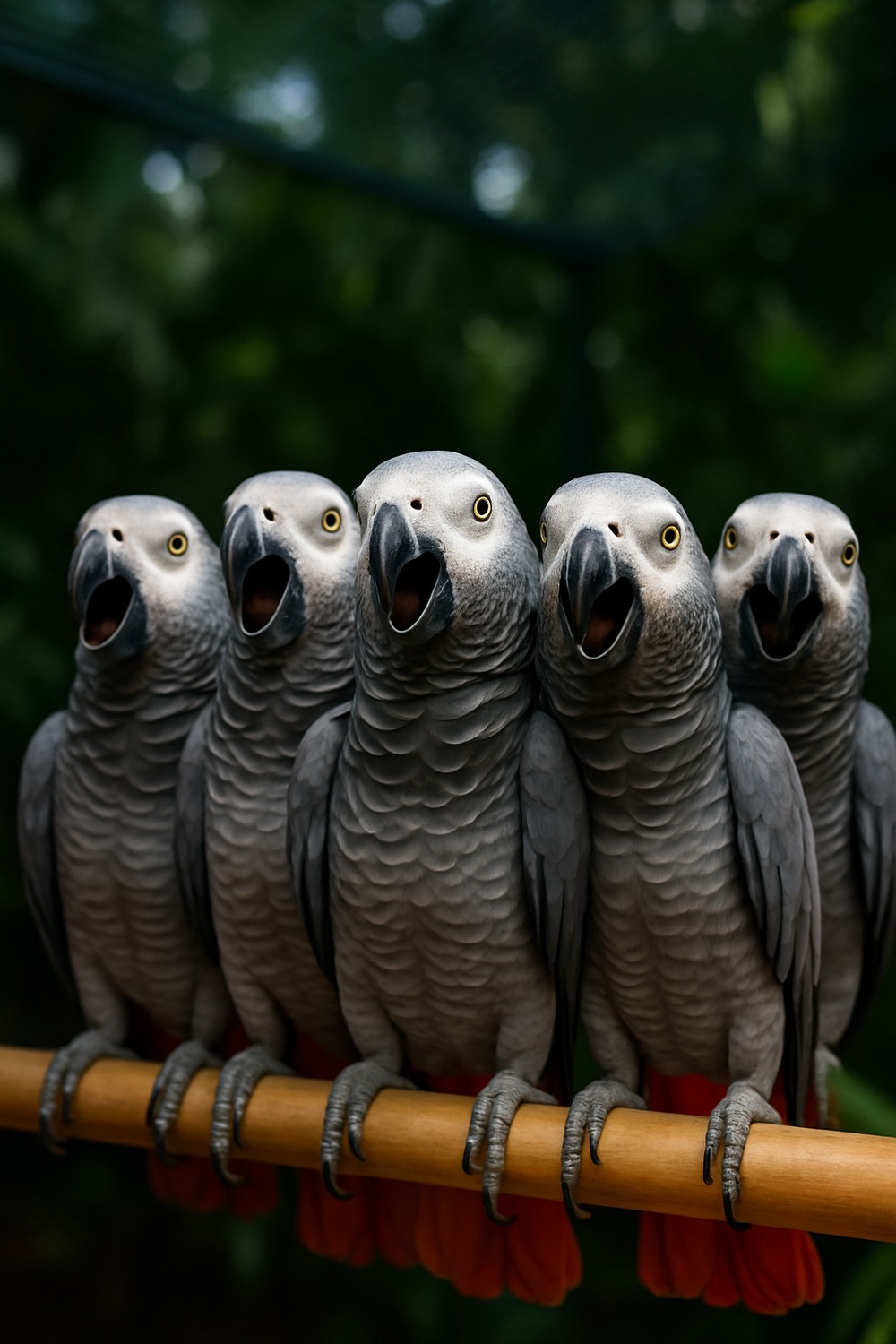
Five African grey parrots arrived at Lincolnshire Wildlife Park within weeks of one another during 2020. Each had spent years in a private home, picking up the kind of language their previous owners probably didn’t intend to teach. Housed together for the first time, they discovered something remarkable: an audience. Staff quickly realised the birds weren’t just repeating old habits — they were performing, adapting, improvising in real time. How does that happen, and what does it tell us about the minds behind the feathers?
Key Facts
- Five African grey parrots, Billy, Eric, Tyson, Jade, and Elsie, arrived at Lincolnshire Wildlife Park in Friskney, England, within weeks of one another during 2020.
- Within four to five days of sharing an enclosure in autumn 2020, the frequency of swearing had roughly doubled.
- Dr. Irene Pepperberg’s African grey Alex demonstrated a working vocabulary of about 100 words and could identify 50 distinct objects before his death in 2007.
- African grey parrots possess approximately 2 billion neurons in their pallium (Olkowicz et al., 2016, PNAS).
- Wild African grey parrot populations declined by an estimated 99 percent in Ghana between 1992 and 2015 (BirdLife International).
In short: African grey parrots swearing became famous when five birds at Lincolnshire Wildlife Park in 2020 competitively escalated their profanity to win laughs from visitors. Within four to five days of sharing an enclosure, swearing roughly doubled, demonstrating the social learning and intelligence of a species with around 2 billion pallium neurons.
The Mimics Who Rewrote Aviary Etiquette
African grey parrots — Psittacus erithacus — have earned their reputation as the most gifted vocal mimics in the animal kingdom, and the science backs that claim with precision. Research documented on grey parrots highlights that their vocal learning operates through a feedback loop strikingly similar to human language acquisition: they hear a sound, attempt it, refine it based on social response, and repeat. Dr. Irene Pepperberg at Harvard University spent more than three decades studying an African grey named Alex, demonstrating by 2007 that these birds could identify objects, count quantities up to six, and understand the concept of zero — cognitive tasks previously associated only with great apes. Their brains, though structured differently from mammalian cortex, achieve comparable processing through dense clusters of neurons in the pallium.
African grey parrots swearing in an enclosure isn’t random noise. It’s targeted communication, delivered with timing that any stand-up comedian would respect.
What makes the Lincolnshire five particularly striking is the escalation pattern. Billy, the first to arrive, had a small repertoire of colourful phrases. When Eric joined the group, Billy’s vocabulary got louder. By the time Jade, Tyson, and Elsie completed the quintet, the birds were actively competing. Each outburst triggered laughter from visitors — and that laughter, unpredictable and loud and socially rewarding (researchers actually call this positive social reinforcement feedback), became the engine driving the whole performance. In the wild, African grey parrots refine calls to strengthen flock cohesion. In Friskney, they refined profanity to maximise human reaction. The mechanism is identical. Only the content changed.
Steve Nichols, the park’s chief executive, described staff watching in genuine amazement as the birds riffed off one another in real time. “With the five, it just went ballistic,” he told reporters in late 2020. Short sentences followed by erupting laughter. That’s the rhythm these birds mastered. Fast. Relentless. Deliberate.
Social Learning: How One Bad Word Spreads
Why does this matter? Because social learning in parrots isn’t a quirk — it’s a survival strategy refined over millions of years. In the wild, African grey parrots live in flocks of hundreds across the rainforests of West and Central Africa, and younger birds learn which foods to eat, which predators to avoid, and how to navigate territory by watching and listening to experienced flock-mates. That same instinct — watch, copy, refine — operates identically in captivity. The Lincolnshire five didn’t need to be taught to swear. They needed an audience, and once they found one, the behaviour accelerated in exactly the way wildlife biologists would predict. It’s a dynamic that mirrors other animal social learning stories, including the way a baby monkey’s attachment behaviours develop through social cues and emotional reinforcement rather than instinct alone — proof that learned behaviour shapes more species than we comfortably admit.
Park staff estimated that within four to five days of the five birds sharing an enclosure in autumn 2020, the frequency of swearing had roughly doubled. Researchers studying cultural transmission in parrots at the University of Exeter have documented similar cascades, where a novel behaviour introduced to a captive group spreads to every individual within days. The Lincolnshire parrots weren’t anomalies. They were a textbook demonstration of avian cultural contagion.
And park staff weren’t entirely surprised. African grey parrots in captivity have a well-documented tendency to home in on whatever generates the strongest social reaction. Swearing works for a simple reason: human laughter is loud, sudden, and repeatable. From a parrot’s perspective, it’s the most reliable reward signal in the enclosure. You’d do it too, if you could.
Intelligence, Playfulness, and the Joke That Never Gets Old
There’s a persistent misconception that animal mimicry is mindless — that a parrot repeating a phrase is no different from a recording playing on loop. The evidence says otherwise, and it’s been accumulating for decades. A 2020 study published by researchers at the University of Vienna found that parrots engaged in object play displayed measurably higher problem-solving scores than those that didn’t, suggesting that playfulness and intelligence aren’t just correlated — they’re functionally linked. Smithsonian Magazine’s reporting on parrot cognition documents a growing body of research showing that African grey parrots understand cause and effect, read social cues, and adjust their behaviour based on the emotional state of the humans around them. African grey parrots swearing in front of a crowd isn’t slapstick accident — it’s applied social intelligence, deployed with awareness of outcome.
Calling this simple conditioning does a disservice to what actually happened in that aviary.
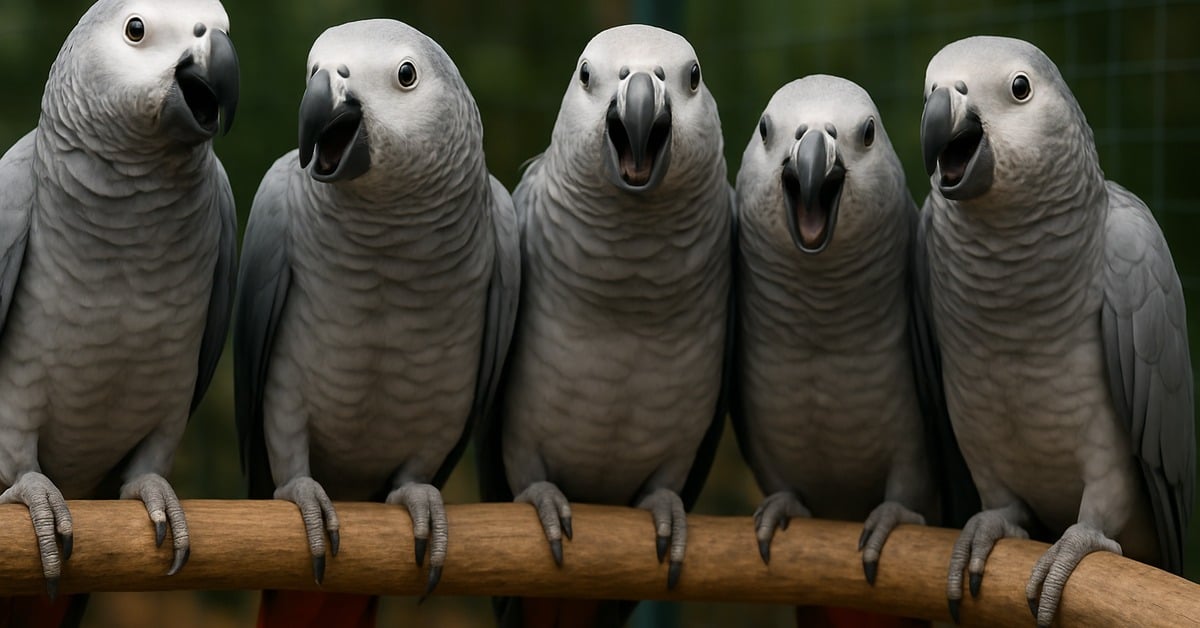
What the Lincolnshire birds demonstrated that’s genuinely unusual is the comedic timing. African grey parrots swearing once is an incident. Doing it again immediately after the laughter peaks — that’s a callback. In improv comedy, a callback is a sophisticated technique: you reintroduce a joke after the audience has had time to lower their guard. The fact that these five birds independently developed this pattern, reinforcing one another’s timing through competitive escalation, suggests something closer to collaborative play than simple conditioning. Alone, each bird had a repertoire. Together, they had a show.
Steve Nichols and his team faced a genuine management dilemma: the birds were happy, healthy, and wildly popular with visitors. But the language was becoming impossible to control. Separating them was the only practical answer — though staff noted that even in separate enclosures, each bird continued performing its material solo. The audience had changed. The instinct hadn’t.
African Grey Parrots Swearing and What Science Still Wants to Know
For all the comedic headlines, the Lincolnshire incident raised legitimate research questions that behaviourists are still working through. Dr. Pepperberg’s work at Harvard established that African greys don’t merely repeat — they categorise. Alex could identify a blue triangle as both blue and triangular and answer questions about either attribute independently, which requires holding two conceptual labels for a single object simultaneously. That’s a working memory task. The question posed by the Lincolnshire five is more nuanced: were they choosing their moments, or simply responding to stimuli? The distinction between conditioned response and intentional performance is one of the hardest lines to draw in animal cognition research, and the African grey parrot keeps landing exactly on that line.
The swearing itself isn’t the scientific story. It’s the competitive escalation that matters. When Billy swore and got a laugh, Eric’s next utterance was louder and more exaggerated — that’s comparison, evaluation, and one-upmanship, a social calculation that stimulus-response models struggle to account for. A 2019 paper from the University of Queensland documented that captive parrots could track the relative success of competing vocalisations within their social group and adjust output accordingly. The Lincolnshire birds, almost certainly without anyone intending it, created a live experiment in avian social dynamics that researchers would have struggled to design ethically in a lab. Any scientist watching that footage and calling it coincidence wasn’t watching closely enough.
Park management eventually rotated the five birds through different enclosures, introducing them to non-swearing parrots in the hope that cleaner vocabularies might dilute the act. Results were mixed. Billy remained committed to his material. So did Tyson. Some habits, turns out, are simply too well-rewarded to unlearn.
Where to See This
- Lincolnshire Wildlife Park, Friskney, Lincolnshire, England — home to Billy, Eric, Tyson, Jade, and Elsie; visiting hours and seasonal programmes listed on their official website. The parrots are housed in the African grey aviary complex, best visited on weekday mornings when crowds are smaller and the birds are most vocal.
- The Alex Foundation (alexfoundation.org) — the non-profit organisation continuing Dr. Pepperberg’s research into African grey parrot cognition at Harvard; their published papers and educational resources are freely accessible and provide the deepest scientific grounding for parrot intelligence research available to general readers.
- For a structured introduction to parrot cognition, Irene Pepperberg’s book Alex and Me (2008) remains the most readable entry point — part memoir, part landmark science, and genuinely hard to put down once the bird starts talking back.
By the Numbers
- African grey parrots can live 40 to 60 years in captivity, with some documented individuals exceeding 70 years (San Diego Zoo, 2022).
- Dr. Pepperberg’s subject, Alex, demonstrated a working vocabulary of approximately 100 words and could identify 50 distinct objects by name before his death in 2007.
- Wild African grey parrot populations declined by an estimated 99% in Ghana between 1992 and 2015, primarily due to trapping for the pet trade (BirdLife International).
- Lincolnshire Wildlife Park houses more than 1,000 parrots across 40 species — one of the largest parrot collections in the United Kingdom.
- African grey parrots possess approximately 2 billion neurons in their pallium — a density comparable to some primate brain regions involved in learning and memory (Olkowicz et al., 2016, PNAS).
Field Notes
- In 2011, researchers at the University of Vienna documented an African grey parrot spontaneously using the word “no” to refuse food it disliked — not as a trained response, but as a self-initiated communicative act observed across multiple unprompted sessions. The bird used the word differently depending on context, suggesting referential rather than rote usage.
- African grey parrots don’t just mimic voices — they mimic specific individuals. Multiple owners have reported their birds reproducing one family member’s voice exclusively when addressing that person, then switching to another’s voice when that person enters the room. The birds appear to track who they’re speaking to.
- The Lincolnshire five weren’t the first captive parrots to develop group swearing behaviour. A 2009 incident at a wildlife sanctuary in Florida involved three macaws who learned a single profane phrase from a parrot in an adjacent enclosure — through a wall, without ever seeing each other.
- Researchers still can’t fully explain why some African greys develop enormous active vocabularies while others in near-identical conditions remain largely silent. Social environment accounts for some of the variation, but individual personality — measured through standardised temperament assessments — appears to play a role that no study has yet quantified with confidence.
Frequently Asked Questions
Q: Why do African grey parrots swearing seem to do it more when people laugh?
African grey parrots are extraordinarily sensitive to social feedback. When a vocalisation produces a strong, consistent human reaction — particularly loud, sudden laughter — the bird registers that response as a social reward. In the same way wild African greys refine calls that strengthen flock bonds, captive birds refine the sounds that generate the biggest reactions from the humans around them. Swearing tends to produce the loudest and most reliable laughter, which makes it the most reinforced behaviour in the repertoire. By 2020, the Lincolnshire group had effectively trained their visitors to be their audience.
Q: Can African grey parrots actually understand the words they say?
The answer is more complicated than a simple yes or no. Dr. Pepperberg’s decades of research at Harvard demonstrated that African greys like Alex could use words referentially — associating specific sounds with specific objects, colours, and quantities — rather than repeating them without comprehension. Most captive parrots occupy a middle ground: they understand the social context of certain phrases better than their literal meaning. A parrot that swears when a stranger approaches may not know what the words mean, but it knows exactly when to use them for maximum effect. That’s a form of contextual intelligence.
Q: Is separating the birds the right approach when African grey parrots swearing becomes a problem?
A common misconception is that isolation will quickly eliminate an unwanted behaviour in parrots. It rarely does. By the time a phrase is deeply embedded in a bird’s repertoire — especially one that generated consistent positive reinforcement — it’s functionally permanent. Separation at Lincolnshire was primarily a management decision to stop the behaviour spreading further through social learning, not an attempt to erase it from individual birds. Behaviourists generally recommend replacing the behaviour with an alternative that generates similar reward, rather than attempting suppression alone. Billy and Tyson, for the record, kept their material regardless.
Editor’s Take — Alex Morgan
What stays with me about the Lincolnshire five isn’t the swearing — it’s the escalation. Each bird watched the others, measured the response, and went harder. That’s not mimicry. That’s competition, which requires a theory of what the other bird is doing and why. We spend a lot of time debating whether animals are conscious. Maybe the better question is whether they’re strategic. These five parrots suggest they are — and that they’ve been getting laughs at our expense the whole time.
A parrot that swears on cue is a curiosity. Five parrots who swear in sequence, track each other’s timing, and adjust their performance based on crowd reaction — that’s something harder to dismiss. It nudges the boundary of what we’re willing to call intention, play, and social awareness. The animals most likely to surprise us aren’t the ones in remote jungles or deep oceans. Sometimes they’re in a glass-fronted aviary in Lincolnshire, watching the crowd, waiting for exactly the right moment, and delivering the punchline with perfect timing. Who’s really studying whom?
Illustrations are AI-generated. Article fact-checked and human-edited. Our editorial standards.