Hippos Sweat Sunscreen — And It’s Genuinely Brilliant
Nobody set out to study hippo skin. The discovery happened sideways, the way a lot of the genuinely strange ones do — and what researchers eventually found there took another forty years to actually make sense of.
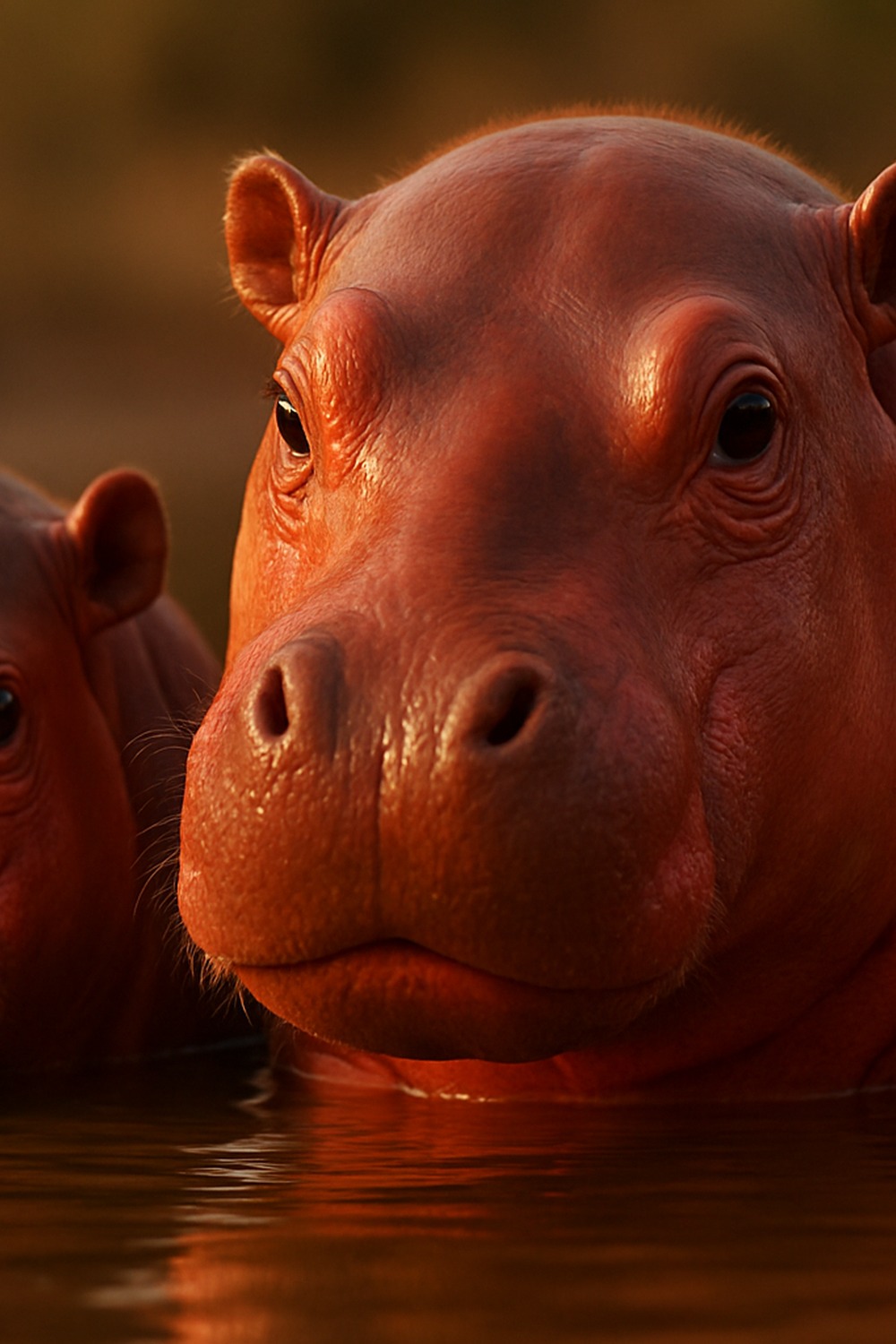
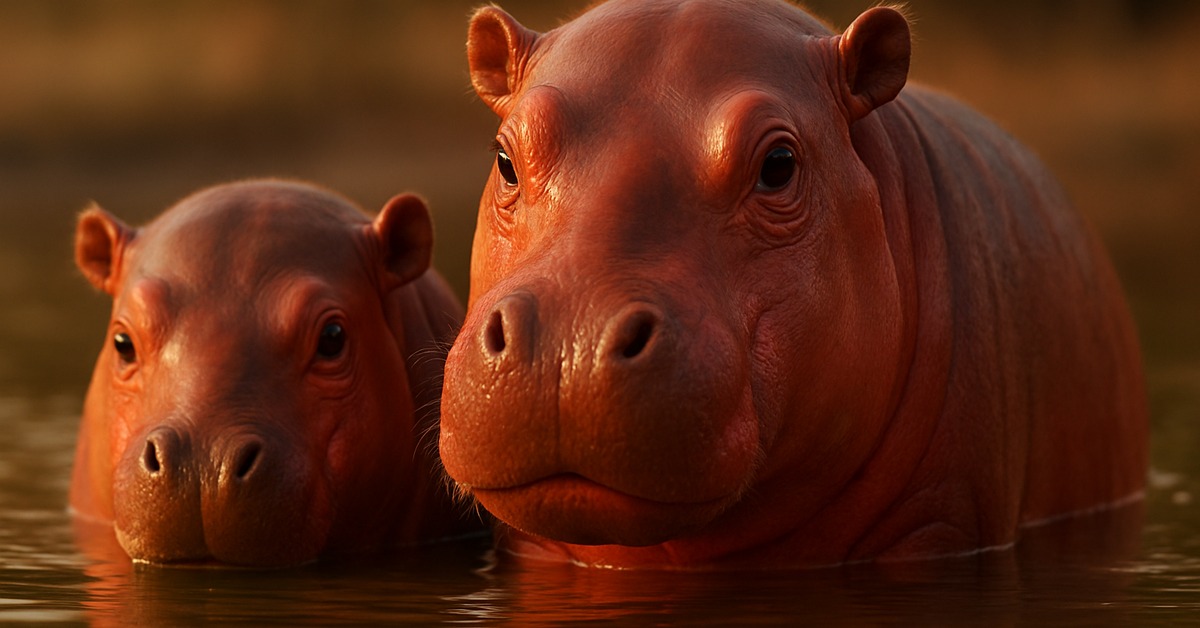
Every morning, as the African sun comes up fast over the riverbank, hippos haul themselves out of the water wearing something that looks faintly pink. It beads across their thick gray skin — oddly beautiful, if you stop to look — and it is doing about three different jobs at once. What’s actually happening on the surface of a hippo turns out to be one of the more quietly astonishing chemical tricks in vertebrate biology.
What Hippo Sunscreen Secretion Actually Is
It isn’t sweat. Not in any conventional sense. The fluid comes from specialized subdermal glands, and it contains two unusual acidic compounds: hipposudoric acid and norhipposudoric acid. Researchers first flagged these molecules in the 1960s, but the full chemical picture didn’t come together until a 2004 study led by Kimiko Hashimoto at Kyoto Pharmaceutical University. That’s when scientists properly characterized what they were looking at. Hipposudoric acid absorbs UV light across wavelengths from 230 to 600 nanometers — a range that covers the UV-A and UV-B bands responsible for most of the skin damage mammals experience under direct sun. Think of it like a built-in broadband filter, tuned specifically to the wavelengths that cause the most harm.
The hippo doesn’t need a drugstore. Its body handles the problem from the inside out, automatically, every single day.
The secretion builds fast. Within minutes of leaving the water, you can see the pale rose sheen forming across the skin. No application required. No bottles, no timing, no reapplication after swimming. Just biology, running quietly in the background.
Two Chemicals Doing the Work of Many
Here’s the part that kept me reading at an unreasonable hour: the same secretion that blocks UV light is also killing bacteria. Hipposudoric acid has demonstrated antimicrobial activity in lab conditions — specifically against Pseudomonas aeruginosa and Klebsiella pneumoniae, two bacteria well known for infecting open wounds. For an animal that wallows in shared water, rolls in mud, and regularly sustains deep gash wounds from territorial fights, that kind of dual-purpose chemistry is genuinely remarkable. Two serious biological problems, handled by one mechanism. Evolution doesn’t usually work this tidily.
And then there’s the moisture problem. Hippos have no true sweat glands. No fur. Their skin would lose moisture critically fast in direct heat — which is, of course, exactly the environment they live in. The secretion traps moisture at the surface, functioning as a thin biological sealant. So: sunscreen, antibiotic, and moisturizer. Simultaneously. From one set of glands.
Why This Goes Beyond a Fun Animal Fact
The hippo sunscreen secretion sits at a fairly unusual crossroads — dermatology, evolutionary biology, and organic chemistry all at once. When a single compound absorbs UV radiation across multiple wavelengths while also suppressing bacterial growth, researchers don’t just admire it. They start asking whether it can be replicated.
Scientists studying these acids have speculated openly about whether synthetic versions could inform better sunscreen formulations for humans. Particularly for people with sensitive skin or compromised immune systems, a compound that handles UV protection and antimicrobial defense together would be clinically useful in ways that current products simply aren’t.
The hippo has been running this experiment for millions of years. We’ve known about it since the 1960s. And we’re still, as of right now, catching up.
The Chemistry Is Stranger Than It Looks
The pink color itself is part of the story — it’s not incidental. Hipposudoric acid is red-orange in concentrated form. Norhipposudoric acid skews orange. When the two compounds mix and spread thinly across wet skin, they produce that pale rose flush that makes hippos look perpetually warm-blooded in a way other animals don’t. Both compounds are also mildly acidic, which likely contributes to the antimicrobial effect. Many bacteria simply can’t thrive in low-pH environments — the chemistry stacks against them.
Here’s the detail that struck me as genuinely weird: the secretion doesn’t wash off cleanly in water. Hippos spend up to 16 hours submerged. They should be losing this protection constantly. They’re not. After surfacing, the glands kick back in within minutes, and the skin starts coating itself again. The hippo doesn’t manage this process. It just happens, every day, for up to 40 years.
By the Numbers
- UV absorption range: 230 to 600 nanometers — covering both UV-A and UV-B, per Hashimoto et al.’s 2004 paper in Nature.
- Hippos can stay submerged up to 16 hours daily, yet unprotected their skin would lose moisture dangerously fast the moment they surface into open equatorial air — the secretion is the only thing standing between them and that outcome.
- Visible coating forms within minutes of air exposure.
- A single adult hippo can weigh up to 4,500 kg (nearly 10,000 lbs), and its entire sun protection system is a chemical film measurable in micrometers.
Field Notes
- It’s called “hippo sweat” in casual usage, but hippos have no conventional sweat glands — the fluid comes from a completely separate type of subdermal gland found only in this species.
- Lab testing confirmed antimicrobial activity against Pseudomonas aeruginosa and Klebsiella pneumoniae — both notorious for infecting open wounds in clinical settings.
- Hippos are among the most aggressive large animals on the continent and frequently sustain serious wounds during territorial disputes. Those wounds rarely become severely infected in the wild. The connection to the secretion’s antimicrobial properties is hard to dismiss, though researchers are careful to note it hasn’t been conclusively proven in field conditions — which is its own interesting gap in the literature.
What This Means For the Rest of Us
The deeper implication of hippo sunscreen secretion is what it suggests about everything we haven’t looked at closely enough yet.
This is a 3,000-pound animal. Every person on earth recognizes it. It’s been carrying a dual-action UV-blocking antimicrobial on its skin for millions of years — and we didn’t chemically understand that until 2004. Which raises the obvious question: what else is out there? What are beetles doing? What’s on the skin of deep-sea fish? What are frogs producing that we’ve catalogued but never properly characterized? The gap between what exists in nature and what we’ve actually examined is enormous, and it’s where discoveries like this one quietly wait.
Nature has been running experiments for hundreds of millions of years. We’ve been running them seriously for maybe two centuries.
The hippo didn’t evolve this to be interesting. It evolved it because surviving in direct equatorial sunlight — surrounded by bacteria, shared water, and rival hippos with territorial agendas — demanded a solution, and biology found one. The lesson isn’t really about hippos. It’s about the things already in front of us that we haven’t stopped to examine properly. There’s more at this-amazing-world.com, and some of it is even stranger than this.