How a Single Snowflake Can Stay Aloft for 60 Minutes
Here’s the thing about falling snow: it doesn’t actually fall — not in any straightforward sense. A single snowflake can spend close to 60 minutes suspended in a winter storm, riding updrafts, stalling, drifting sideways through temperature layers that keep rewriting its shape. That’s not a poetic exaggeration. That’s what the atmospheric data shows. How long a snowflake stays in the air is, it turns out, one of the stranger answers in meteorology.
That number — 60 minutes — comes from atmospheric research into the behavior of ice crystals inside winter storm systems. A snowflake doesn’t simply drop from cloud to earth. It tumbles, stalls, rides updrafts, drifts sideways, and sometimes climbs before it descends again. The question researchers kept asking wasn’t just how long this takes. It was what happens to the crystal while it’s up there — and the answer turned out to be stranger than anyone expected.
The Hidden Physics of a Snowflake’s Descent
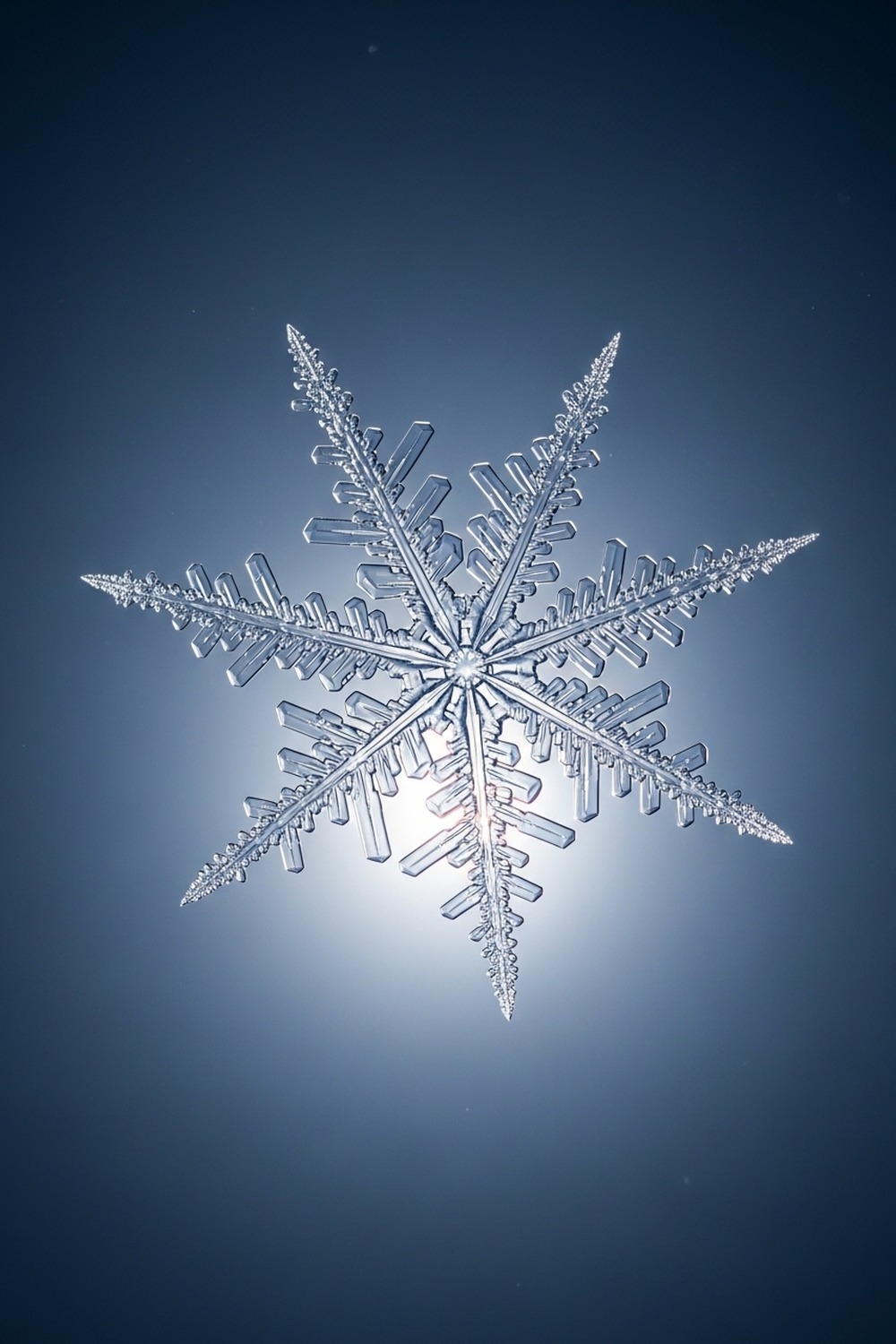
Snowflakes fall slowly — far more slowly than their weight should allow. A typical snow crystal falls at roughly 1 to 1.5 meters per second, compared to a raindrop’s 9 meters per second. That speed difference isn’t accidental. It’s geometry. The flat, branching arms of a dendrite snowflake act like a microscopic parachute, catching air resistance across a surface area that’s enormous relative to the crystal’s mass. The National Center for Atmospheric Research (NCAR) in Boulder, Colorado, has studied winter precipitation dynamics for decades, and their models consistently show that terminal velocity for complex snowflakes is dramatically reduced by their branching geometry. In 2009, NCAR researchers published detailed measurements showing that dendritic crystals — the classic six-armed star shapes — can have terminal velocities as low as 0.3 meters per second in calm air. That’s barely moving.
But calm air is rarely what a snowflake encounters. Inside a winter storm, the atmosphere is anything but still. Vertical air currents — updrafts and downdrafts — swirl through cloud layers with enough force to hold a crystal suspended, or even push it upward. These updrafts don’t need to be powerful. A current moving upward at just 0.3 meters per second is enough to stall a dendrite completely. Inside mature winter storm systems, updrafts of that magnitude are common, occurring in irregular pulses throughout the cloud layer.
A snowflake caught in one of these currents doesn’t know it’s supposed to be falling. It just drifts. Think about what that means in practice: a flake forming at the top of a storm cloud — typically between 2,000 and 4,000 meters above the ground in a mid-latitude winter system — falling at an average effective speed of just 0.5 meters per second while being periodically stalled by updrafts could take 45 to 60 minutes to complete its journey. That’s not an edge case. That’s a typical snowflake in a typical winter storm.
How Atmosphere Keeps Reshaping the Crystal Mid-Flight
A snowflake doesn’t finish forming when it leaves the cloud. It keeps changing throughout its entire descent — and the path it takes through the atmosphere determines what it looks like when it lands. Temperature and humidity vary significantly across different altitudes within a storm system, and ice crystals respond to those variables with surprising sensitivity. The crystal grows new branches when it passes through zones of high humidity near 0°C. It develops plates instead of needles when temperatures drop below -10°C. It can partially melt and refreeze if it passes through a warmer air layer on its way down.
Why does this matter? Because the final shape of a snowflake is essentially a flight log. Every branch, every notch, every asymmetry in the crystal’s arms records a specific atmospheric condition the flake passed through. In 2015, researchers at the University of Utah published a detailed study in the Journal of the Atmospheric Sciences showing that the complexity of dendritic snowflakes correlates directly with the humidity and temperature gradients the crystals encountered during descent (researchers actually call this the crystal’s “morphological biography”). Simpler shapes — plates, needles, columns — typically fell through more uniform air. The intricate, star-shaped crystals that catch your eye on a mitten had more complicated journeys.
That’s a remarkable thing to hold in your hand. Each snowflake that lands on your coat is carrying a record of atmosphere — a physical archive of temperature, humidity, and turbulence that no instrument could have measured at that exact point in space and time. The crystal itself is the data.
If you’re curious about how atmospheric phenomena shape the natural world at every scale, it’s worth exploring our coverage of Earth’s most extraordinary natural processes — because what happens to a single snowflake is, in miniature, exactly what drives planetary weather systems.
Wilson Bentley and the 46-Winter Archive
He wasn’t a university researcher or a meteorologist. Wilson Alwyn Bentley was a Vermont farmer who in 1885 — at age 19, working alone in a rural farmhouse in Jericho, Vermont — became the first person to successfully photograph individual snowflakes through a microscope. He called them “miracles of beauty.” Over the next 46 winters, Bentley photographed 5,381 individual snow crystals, developing a technique of catching flakes on black velvet and photographing them before they could melt. He worked in temperatures below freezing, wearing gloves with cut-off fingertips.
His entire archive, published in 1931 as Snow Crystals, remains a scientific reference today. Bentley’s obsessive methodology — rejected by mainstream science for years — eventually became foundational to atmospheric crystallography. No other single researcher has compiled a continuous field record of comparable length. He died in December 1931, just weeks after his book was published, having walked several miles through a blizzard.
Bentley never found two identical snowflakes.
Neither has anyone since. Scientists at Caltech and the University of Wisconsin have modeled the theoretical probability of duplicate snowflakes and concluded that while simple columnar crystals — the tiny hexagonal pillars that form at very cold temperatures — could theoretically be identical, the complex dendrite shapes are effectively unique in the same way fingerprints are. The number of possible arrangements of a fully developed dendrite snowflake, accounting for all branching decisions made during its atmospheric journey, exceeds 10 to the power of 158. For context, the number of atoms in the observable universe is estimated at roughly 10 to the power of 80. Understanding how long a snowflake stays in the air helps explain why: more time aloft means more decisions, more branching events, more atmospheric variation recorded in ice.
Browse Bentley’s photographs and you’re looking at 46 winters of Vermont sky — every intricate crystal a record of a specific hour-long journey through air that no longer exists.

How Long a Snowflake Stays in the Air Shapes Snowpack
The 60-minute figure isn’t just a curiosity. It has real consequences for how snow accumulates on the ground — and for the hydrology of entire mountain ranges. A 2018 study by the Swiss Federal Institute for Forest, Snow and Landscape Research (WSL) in Birmensdorf examined how crystal structure at the time of landing affects snowpack density and water retention. Crystals that had longer atmospheric transit times were more likely to have developed complex dendritic shapes, which interlock loosely when they land, creating low-density snowpacks with high air content. These snowpacks are critical in alpine regions: they insulate soil from frost, regulate meltwater release in spring, and support ecosystems that depend on gradual water availability through dry seasons.
The data left no room for ambiguity on this point — transit time isn’t a footnote in snowpack modeling, it’s a primary variable, and the field was slow to treat it that way.
Denser snow, composed of simpler crystals that fell faster through calmer air, releases meltwater rapidly when temperatures rise. Complex dendritic snow, product of turbulent, multi-hour descents, melts more gradually, releasing water over a longer period. The difference between these two snowpack types can determine whether a mountain river runs high in March or June. In drought-prone regions like the American West, where snowpack is the primary freshwater reservoir for millions of people, that distinction isn’t academic. The transit time — how long a snowflake stays in the air — turns out to be a variable that matters directly to hydrologists tracking water storage in mountain watersheds.
And hydrologists at the University of Colorado Boulder have been working since 2016 to incorporate crystal morphology data into snowpack models. The goal: use the shape of snowflakes to better predict meltwater timing. A snowflake’s biography, written in ice, turns out to have enormous practical value downstream — in every sense of the word.
How It Unfolded
- 1885 — Wilson Bentley of Jericho, Vermont, becomes the first person to successfully photograph an individual snowflake through a microscope, initiating 46 winters of systematic documentation.
- 1931 — Bentley’s Snow Crystals is published by McGraw-Hill, compiling 2,453 photographic plates and establishing the foundational visual catalog of snow crystal morphology still referenced by researchers today.
- 1954 — Japanese physicist Ukichiro Nakaya publishes Snow Crystals: Natural and Artificial, producing the first comprehensive scientific classification system for crystal types and linking specific shapes to temperature and humidity conditions.
- 2009 — NCAR researchers publish precise terminal velocity measurements for dendritic snowflakes, providing quantitative data that supports the 60-minute atmospheric transit model in mature winter storm systems.
- 2018 — The Swiss Federal Institute WSL links crystal morphology at landing to snowpack density, connecting atmospheric transit time directly to downstream hydrology and water-resource forecasting.
By the Numbers
- 0.3 m/s — minimum measured terminal velocity of a complex dendritic snowflake in calm air (NCAR, 2009), compared to 9 m/s for a typical raindrop.
- 5,381 — individual snowflake photographs taken by Wilson Bentley between 1885 and 1931; no two were identical.
- 10158 — estimated number of possible structural arrangements for a fully developed dendritic snowflake, based on Caltech crystallography modeling.
- 2,000–4,000 meters — typical altitude at which snowflakes form in mid-latitude winter storm clouds, the vertical distance each crystal must navigate before reaching the ground.
- 46 winters — the span of Bentley’s uninterrupted field documentation in Vermont, one of the longest continuous records of snow crystal morphology ever compiled by a single researcher.
Field Notes
- In 1988, Nancy Knight of NCAR reported finding two apparently identical snow crystals in a sample collected over Wausau, Wisconsin — but both were hollow columnar crystals, the simplest possible form, not the complex dendrites most people picture when they imagine a snowflake. The discovery confirmed that simple forms can duplicate; complex ones almost certainly can’t.
- A snowflake can gain or lose up to 30% of its mass through sublimation during descent — meaning the crystal that lands is measurably smaller than the one that formed at cloud level, even if it never touched anything.
- Fresh snowpack can reduce ambient sound levels by up to 10 decibels — which is why the world feels genuinely quieter after a significant snowfall. The interlocking air pockets in dendritic snow are what make it an effective sound insulator.
- Researchers still can’t reliably predict the exact shape a snowflake will have when it lands, even with full atmospheric data for the storm. The sensitivity to micro-scale humidity variations during growth is too fine-grained for current models to capture — which means snowflake morphology remains, technically, an unsolved problem in atmospheric physics.
Frequently Asked Questions
Q: Exactly how long does a snowflake stay in the air, and what determines that time?
How long a snowflake stays in the air depends on three main factors: formation altitude, crystal shape, and atmospheric turbulence. Most snowflakes form between 2,000 and 4,000 meters above ground. Complex dendritic crystals can fall as slowly as 0.3 meters per second in updraft-disrupted air, stretching a single descent to nearly 60 minutes. Simpler crystals — needles, columns, plates — fall faster and may reach the ground in 20 to 30 minutes under similar conditions.
Q: Why do snowflakes have six sides and not five or eight?
Six-fold symmetry in snowflakes comes directly from the molecular structure of water ice. When water freezes into the hexagonal ice Ih crystal lattice — the form that dominates at atmospheric temperatures — the hydrogen bonds between water molecules naturally arrange themselves at 60-degree angles. That geometry propagates outward as the crystal grows, producing six arms that branch from a shared center. The symmetry isn’t perfect in practice; each arm grows in slightly different microenvironments, which is why no two arms of a snowflake are truly identical under magnification.
Q: Is it really true that no two snowflakes are alike?
For complex dendritic snowflakes, the statement is functionally true — the number of possible structural arrangements exceeds the number of atoms in the observable universe, making duplication vanishingly unlikely. However, the claim is sometimes overstated. Simple crystal forms — tiny hexagonal prisms and columns that form at very cold temperatures — can be and have been nearly identical, as Nancy Knight’s 1988 NCAR sample demonstrated. The “no two alike” rule applies specifically to the intricate, branching forms, which are the product of longer, more turbulent atmospheric journeys.
Editor’s Take — Dr. James Carter
What gets me about this story isn’t the 60 minutes — it’s what that time means structurally. A snowflake isn’t a finished object when it leaves the cloud. It’s still in production. The atmosphere is still writing it. That reframes the whole picture: the shape you catch on your sleeve isn’t decoration, it’s a readout — a physical record of an hour spent moving through invisible layers of temperature and moisture. We’ve been looking at weather data on our sleeves for centuries without knowing how to read it.
Every winter storm that crosses a continent drops trillions of these tiny flight records to the ground, where they compress into snowpack, feed rivers, water crops, and eventually reach the sea. Most land where no human will ever see them — on mountain ridges, in arctic fields, on the surface of frozen lakes at 3 a.m. Each one is the end of a specific, unrepeatable hour-long journey through air. The next time snow begins to fall and the world goes quiet around you, look up before you look down. What’s descending toward you is still, in some sense, in motion. Still becoming what it is.