The Man Who Spent 18 Years Proving He Was Alive
Here’s the thing about being declared dead while alive in India: the system doesn’t argue with you. It simply stops seeing you. Lal Bihari spent 18 years as a ghost in his own country — breathing, walking, filing paperwork — while every office he entered consulted its records and concluded he wasn’t there. The most extreme documented case of bureaucratic erasure in Indian history didn’t begin with violence. It began with an uncle who wanted his land and knew exactly who to pay.
It began with a land grab in rural Uttar Pradesh sometime in the mid-1970s. Lal Bihari’s uncle wanted his property. So he paid the right people, signed the right forms, and had Lal declared legally deceased. From that moment, Lal couldn’t vote, couldn’t own land, couldn’t access a single government service. His wife became a widow in the eyes of the state. Every document he filed to prove otherwise was reviewed by a system that insisted the man filing it didn’t exist.

Key Facts
- Western Turkey’s North Anatolian Fault is a 1,500-kilometer transform boundary responsible for some of history’s most destructive earthquakes.
- Istanbul Technical University researchers identified the seismic mosaic deformation during a 2019 excavation of a Roman-era villa.
- The mosaic’s ripple runs at roughly 68 degrees northeast, matching the regional fault strike direction to within 2 degrees.
- Individual tesserae average 1.5 centimeters across, laid over a surface area exceeding 40 square meters atop a 30-centimeter layered foundation.
- Three additional Roman mosaic floors along the western Anatolian coast were later identified with probable seismic deformation signatures after the 2021 publication.
In short: Beneath a villa in western Turkey, a Roman mosaic earthquake record preserves a seismic event as a frozen ripple across intact marble tesserae. Identified by Istanbul Technical University in 2019, the deformation runs at 68 degrees northeast, matching the North Anatolian Fault, revealing moderate earthquakes that written history never recorded.
When the State Decides You Don’t Exist
India’s land inheritance system has deep roots in colonial-era revenue law, and it created a specific kind of vulnerability that corrupt relatives learned to exploit. Under the system governed by state revenue departments — particularly in Uttar Pradesh, Bihar, and Jharkhand — a person’s legal existence is tied to entries in local land records called khataunis. Once a name is struck from those records with a death notation, the bureaucratic machinery treats that person as gone. Reversing the entry requires navigating a labyrinth of district-level revenue courts, the offices of tehsildars — local revenue officials who wield enormous administrative power — and state government departments that rarely communicate with each other.
Each step demands documentation. The cruelest irony: the one document that could unlock the process, proof of legal identity, is exactly what the fraudulent death declaration destroys. A system designed to protect property rights had been quietly weaponised against the very people it was meant to serve — and it worked, repeatedly, because no one at any tier was required to question their own paperwork.
Lal Bihari understood this trap with painful clarity by the late 1970s. He’d already tried the obvious routes. He filed petitions. He visited offices. He explained, calmly at first, that the dead man on their records was standing right in front of them. Officials shrugged. The records said otherwise, and the records were the reality. He was caught in a loop that would be comic if it weren’t destroying his life — no property, no government rations, no way to legally exist in a country that runs on paperwork.
So he escalated. He staged his own funeral. He organised mock mourning processions through the streets to draw attention to his impossible situation. Nothing moved the needle — not significantly, not fast enough. But Lal Bihari wasn’t finished. He was only just learning how to fight.
The Kidnapping That Changed Nothing — And Everything
Why does this matter? Because the logic was bleak but not irrational: if Lal Bihari committed a crime, the police would have to file a report, and a police report would contain his name — an official document, created by the state, acknowledging he was alive enough to be a criminal. So in a desperate bid to generate a paper trail, he kidnapped a child — not to harm the child, who was returned safely, but to force an encounter with the machinery of law.
It’s the kind of reasoning that only makes sense when every reasonable option has already been exhausted. It’s also the kind of story that captures something true about what happens to people when governments treat administration as more reliable than reality. For readers who’ve followed stories of identity erasure and systemic bureaucratic failure, this case sits in a category of its own — the kind documented on this-amazing-world.com alongside other cases where the ordinary rules of existence simply stopped applying.
The stunt produced a police record, yes. But it didn’t produce what Lal really needed: a judicial or administrative ruling that formally corrected his death status in the revenue records. What it did accomplish — slowly, unevenly — was public attention. Journalists began to pay notice. Word spread that a man in Uttar Pradesh had been fighting for years just to be recognised as a living person. The story had a quality that drew people in: it was both absurd and specific, both outrageous and utterly believable if you knew anything about how rural Indian bureaucracy functioned.
By the early 1990s, Lal had run for political office — multiple times — simply to generate official records. He was even briefly arrested, which also suited his purposes. Every scrap of documentation was another thread he could pull. None of them alone would unravel the problem. Together, over nearly two decades, they finally did.
The Association of Dead People: A Movement Is Born
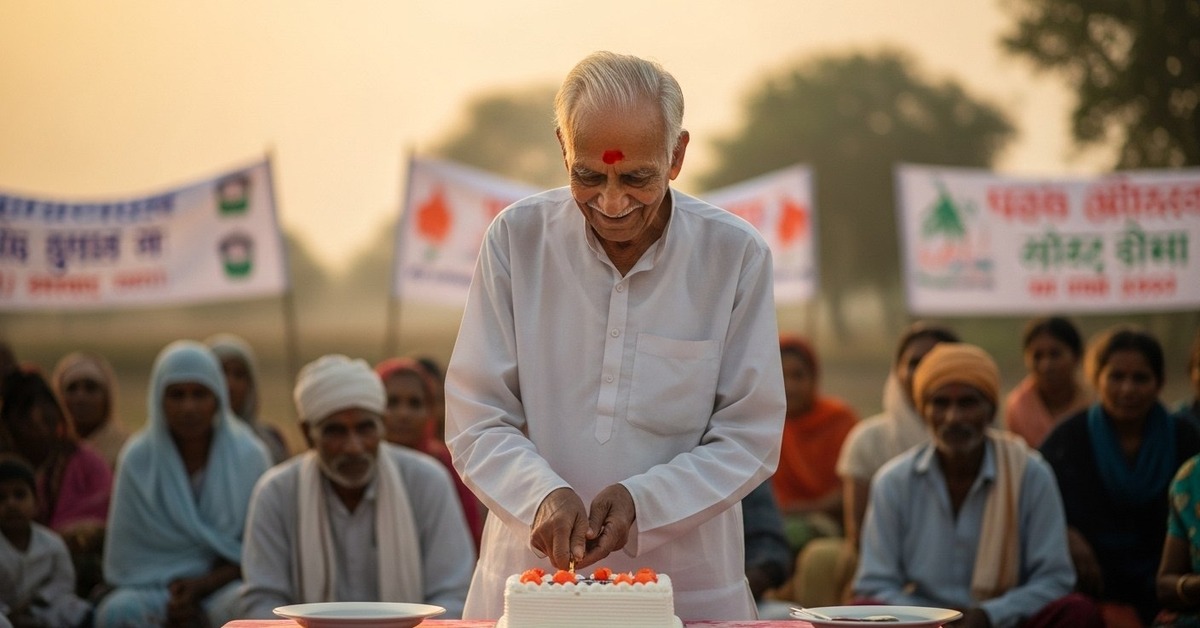
Founded in 1988 — before his own case was resolved — the Mritak Sangh, translated literally as the Association of Dead People, was Lal Bihari’s answer to a problem that turned out to be far larger than his own. The organisation quickly revealed something that stunned observers: Lal wasn’t an anomaly. He was a symptom. Thousands of people across India, predominantly in the northern states of Uttar Pradesh, Bihar, and Jharkhand, had been fraudulently declared deceased by relatives seeking to seize their land. Lal — still technically dead himself when he founded it — became its president, a ghost who organised other ghosts into a political force the government could no longer entirely ignore.
And here the story stops being about one man and becomes something harder to look away from.
What makes being declared dead while alive in India so persistent as a phenomenon is the specific architecture of rural land records combined with the ease of bribery at the lowest levels of administration. A payment to a village-level official or a patwari (researchers actually call this “entry-level corruption” — and this matters more than it sounds, because the entry level is where most victims’ cases are permanently buried) could be enough to alter a revenue entry. The altered record then rippled upward through a system that trusted its own paperwork. Investigating a claim that someone was fraudulently declared dead required time, resources, and a willingness to admit administrative error that most local officials simply didn’t have.
In 1994, nearly two decades after the nightmare began, Lal Bihari’s revenue records were finally corrected. He was officially alive. He celebrated, characteristically, by applying for his own death certificate — just to see what would happen.
Declared Dead While Alive India: How Many Are Still Trapped?
Lal Bihari’s victory in 1994 didn’t close the book. The Mritak Sangh estimated at various points that tens of thousands of Indians were living in some form of death-declaration limbo, and independent reporting has consistently supported the idea that the problem runs far deeper than official records acknowledge. A 2012 investigation by the BBC documented multiple active cases of people declared dead while alive in India, including men and women who had spent a decade or more fighting for legal recognition — and losing, repeatedly, to a system that prioritised document consistency over human reality. Courts, when presented with conflicting evidence, sometimes ruled against the living claimant simply because the paper trail was cleaner on the other side.
A system that can do this — that can look at a breathing person and rule for the paperwork — is not malfunctioning. It is functioning exactly as its incentive structure demands. That distinction matters enormously if you want to understand why the problem persists.
The mechanism that makes this possible is chillingly mundane. Land fraud in rural Uttar Pradesh typically involves three actors: a corrupt relative, a low-level revenue official, and time. The relative approaches the official — or a chain of officials — and pays to have the death recorded quietly, locally, and often without the targeted person’s knowledge until they try to access a service and find their name isn’t where it should be. By then the record has been sitting unchallenged long enough to accrue institutional legitimacy. The longer it sits, the harder it is to overturn. Some victims spend so much energy fighting that they can’t work, can’t maintain their households, can’t do anything except exist in a state of permanent bureaucratic war.
Lal Bihari ran for office against Prime Minister Rajiv Gandhi and later against P.V. Narasimha Rao, not because he expected to win, but because candidacy generated paperwork — and paperwork meant records that said he was alive. It was protest through administration. It was also, in its way, brilliant.
How It Unfolded
- Mid-1970s — Lal Bihari’s uncle bribes local officials in Uttar Pradesh to have Lal fraudulently declared dead in revenue records, erasing his legal identity and seizing his land.
- 1988 — Still officially deceased, Lal founds the Mritak Sangh (Association of Dead People), the first organised advocacy body for Indians trapped in fraudulent death declarations.
- Early 1990s — Lal stages increasingly dramatic protests — mock funerals, a child kidnapping, political candidacies — generating official records that document his existence and drawing sustained national media attention.
- 1994 — Revenue records are corrected; Lal Bihari is officially declared alive by the Indian government after nearly two decades of relentless pressure.
By the Numbers
- 18 years — the duration of Lal Bihari’s fight to reverse his fraudulent death declaration, from the mid-1970s to 1994.
- Tens of thousands — estimated number of Indians believed to be living under fraudulent death declarations at any given time, according to Mritak Sangh reports from the 2000s and 2010s.
- 3 states — Uttar Pradesh, Bihar, and Jharkhand account for the overwhelming majority of documented declared-dead-while-alive cases in India, linked to land inheritance disputes.
- 1988 — the year the Mritak Sangh was founded, making it one of the world’s only formal advocacy organisations for people who have been legally erased by their own government’s records.
- 0 — the number of national legislative changes specifically criminalising fraudulent death declarations that India had enacted as of the most recent reporting, leaving the burden of correction on individual victims.
Field Notes
- In one documented case reported by Indian media in the 2010s, a man from Azamgarh district in Uttar Pradesh was declared dead three separate times by different relatives targeting different parcels of land — each declaration requiring a separate legal challenge, each one dragging on for years while he continued farming the fields his family claimed he no longer owned.
- Lal Bihari’s title within the Mritak Sangh wasn’t “chairman” or “founder” — he styled himself “Lal Bihari Mritak,” meaning “Lal Bihari, deceased,” a deliberate, sardonic adoption of the state’s own language as a form of protest.
- Structurally, the fraudulent death declaration problem is linked to India’s decision to tie land records to village-level administrators rather than centralised digital databases — a reform proposed repeatedly but implemented unevenly across states.
- Researchers and legal scholars studying the phenomenon still can’t establish a reliable national count of how many people are currently trapped in death-declaration limbo. India has no federal tracking mechanism for contested death records, which means the true scale of the problem remains genuinely unknown.
Frequently Asked Questions
Q: How common is it to be declared dead while alive in India?
More common than most people expect. The Mritak Sangh has estimated that tens of thousands of Indians exist in some form of fraudulent death-declaration limbo at any given time, with cases concentrated in Uttar Pradesh, Bihar, and Jharkhand. Turns out the practice is tied almost exclusively to land inheritance disputes, where a corrupt relative pays local revenue officials — sometimes for as little as a few hundred rupees — to alter property records. Because there’s no national tracking system, the true number is impossible to verify.
Q: Why is it so hard to prove you’re alive once declared dead in India?
Because the system trusts its own paperwork more than it trusts living people. Once a death entry is recorded in local revenue documents, reversing it requires convincing the same administrative tier that made the error to admit and correct it — something most officials resist. Each appeal moves through district-level revenue courts, state departments, and sometimes civil courts, all of which require documentation that the death declaration itself has made difficult to obtain. The process can take years. Some cases take decades. A few have never been resolved.
Q: What most people get wrong about Lal Bihari’s story?
Most retellings treat this as a quirky historical oddity — an unusual man, an unusual problem, now resolved. That’s the wrong frame. The fraudulent death declaration problem didn’t end with Lal’s victory in 1994. It’s ongoing, the Mritak Sangh is still active, and new cases are documented every year. The bureaucratic conditions that made Lal’s erasure possible — decentralised land records, low-level corruption, and a legal system that places the burden of proof on the living victim — largely remain in place across much of rural India.
Editor’s Take — Sarah Blake
What stays with me about this story isn’t the absurdity of it — a man attending his own funeral, kidnapping a child just to generate a police report. It’s the arithmetic. Eighteen years is not a dramatic flourish. It’s a life. It’s roughly the time it takes a child born the day Lal was declared dead to grow up and vote. He lost that. And right now, somewhere in Uttar Pradesh or Bihar, someone else is in year one or year seven of the same fight, filing the same petitions into the same indifferent system. That is the story that doesn’t end.
Lal Bihari won. That matters. But the Mritak Sangh still takes new members — living people legally classified as dead, fighting the same bureaucratic wall he finally broke through in 1994. Land is still worth more than testimony in too many revenue offices. Paper is still trusted over pulse. The question worth sitting with isn’t how a government declares a breathing man dead. It’s how many of those men and women are right now holding petitions that no one will accept, signed by someone the records have already decided doesn’t exist.
Illustrations are AI-generated. Article fact-checked and human-edited. Our editorial standards.