The Siberian Unicorn Was Real — And Humans Saw It
So there was this five-ton rhinoceros with a horn longer than your arm, and it was still alive when humans were painting caves. That’s the thing nobody tells you about the Siberian unicorn — it’s not some ancient myth. It’s a creature that probably watched our ancestors.
Roll back to 36,000 years ago. Central Asia. Frozen grasslands that stretch until they dissolve into white. A massive animal — call it Elasmotherium sibiricum if you want to be scientific about it — is using that enormous horn to smash through ice crust, looking for vegetation. And somewhere not that far away, geologically speaking, a human being is sitting by a fire. Telling stories. Drawing on walls. Living a life that would’ve felt very far away from that creature, except for one problem: they weren’t far away at all.
Key Facts
- Elasmotherium sibiricum, the Siberian unicorn, was a roughly five-ton rhinoceros that survived in Central Asia until about 36,000 years ago, into the Upper Paleolithic.
- In 2016, Andrei Shpanski and his team at Tomsk State University published radiocarbon-dated fossil evidence from Kazakhstan that shifted the extinction date from around 200,000 years ago to about 36,000 years ago.
- Radiocarbon dating works reliably out to roughly 50,000 years, which is why an Elasmotherium that died 36,000 years ago could be dated directly from bone collagen.
- Elasmotherium’s horn, made of keratin, could reach about 1.5 meters in length and was anchored on a massive horn boss of bone preserved on the skull.
- The animal had high-crowned, ever-growing molars adapted to grinding the abrasive, silica-laden grasses of the mammoth steppe, a cold, dry grassland that stretched from Western Europe deep into Siberia.
In short: Elasmotherium sibiricum, the Siberian unicorn, was a roughly five-ton Ice Age rhinoceros with a horn up to about 1.5 meters long. A 2016 Tomsk State University study using radiocarbon dating on Kazakh fossils moved its extinction from around 200,000 years ago to about 36,000 years ago, overlapping with Upper Paleolithic humans.
What Changed Our Understanding (And When)
For the longest time, scientists figured the Siberian unicorn real timeline put it safely in deep prehistory — a creature that vanished long before humans even thought about crossing into Siberia and Central Asia. Then in 2016, Andrei Shpanski and his team at Tomsk State University published something that messed with that comfortable narrative. They’d dated new fossil evidence from Kazakhstan. The extinction wasn’t 200,000 years ago. It was 36,000.
Let that sink in for a second.
That last fact kept me reading for another hour. Because 36,000 years ago isn’t some incomprehensible deep time. It’s the Upper Paleolithic. It’s when humans were already producing sophisticated art, developing complex social structures, spreading across continents. It’s when our species was doing things. And Elasmotherium was still here.
How Scientists Actually Read a Bone’s Age
The jump from 200,000 years to 36,000 wasn’t a guess or a hunch. It came from a method most people have heard of but few really understand: radiocarbon dating. Every living thing on Earth absorbs a tiny, steady fraction of radioactive carbon-14 while it’s alive. The moment it dies, that intake stops and the carbon-14 begins to decay at a fixed, predictable rate. Measure how much is left in a fossil bone, and you can read off, with a margin of error, how long ago that animal stopped breathing. The technique works reliably out to roughly 50,000 years — which is exactly why an Elasmotherium that died 36,000 years ago could be dated at all. An animal from 200,000 years ago would be far beyond radiocarbon’s reach.
That detail matters. The old “200,000 years” figure was an estimate built on indirect reasoning and a thin scattering of fossils. When the Tomsk team obtained well-preserved bone collagen from later sites and ran it through modern dating, the result fell squarely inside the window where radiocarbon delivers a hard number. The Siberian unicorn didn’t slowly retreat into the mists of deep time. It survived right up to the edge of the last great freeze — and the lab work proved it. This is how paleontology corrects itself: not by storytelling, but by squeezing a precise signal out of the chemistry locked inside old bone.
The Horn: Practical, Terrifying, Real
People get hung up on the horn because it sounds mythical. It wasn’t. Think of it like this: you’re looking at a five-ton animal with a weapon that could stretch to 1.5 meters — longer than a golf club, attached to something that weighed as much as an elephant and a half combined. That wasn’t decoration. That was a tool built for scraping through frozen ground to find buried grass and roots. It was also a battering ram. A dominance marker. A reason for anything with sense to stay out of its way.
Modern white rhinos top out around 2.3 tons and we classify them among the most dangerous animals on the planet.
Elasmotherium was more than double that.
- The horn itself was keratin — same material as your fingernails. It didn’t fossilize. What scientists found was the horn boss, a dome of bone on the skull so massive it could only have anchored something extraordinary.
- High-crowned molars. Elasmotherium had them, which meant it was built for grinding down gritty steppe grasses, not browsing soft leaves. This creature was hyper-specialized for one ecosystem. When that ecosystem changed, Elasmotherium couldn’t adapt.
- It’s not actually a unicorn. It was a rhinoceros. Part of Rhinocerotidae, the same family tree as the animals we know today — just several tons heavier and infinitely more dangerous.
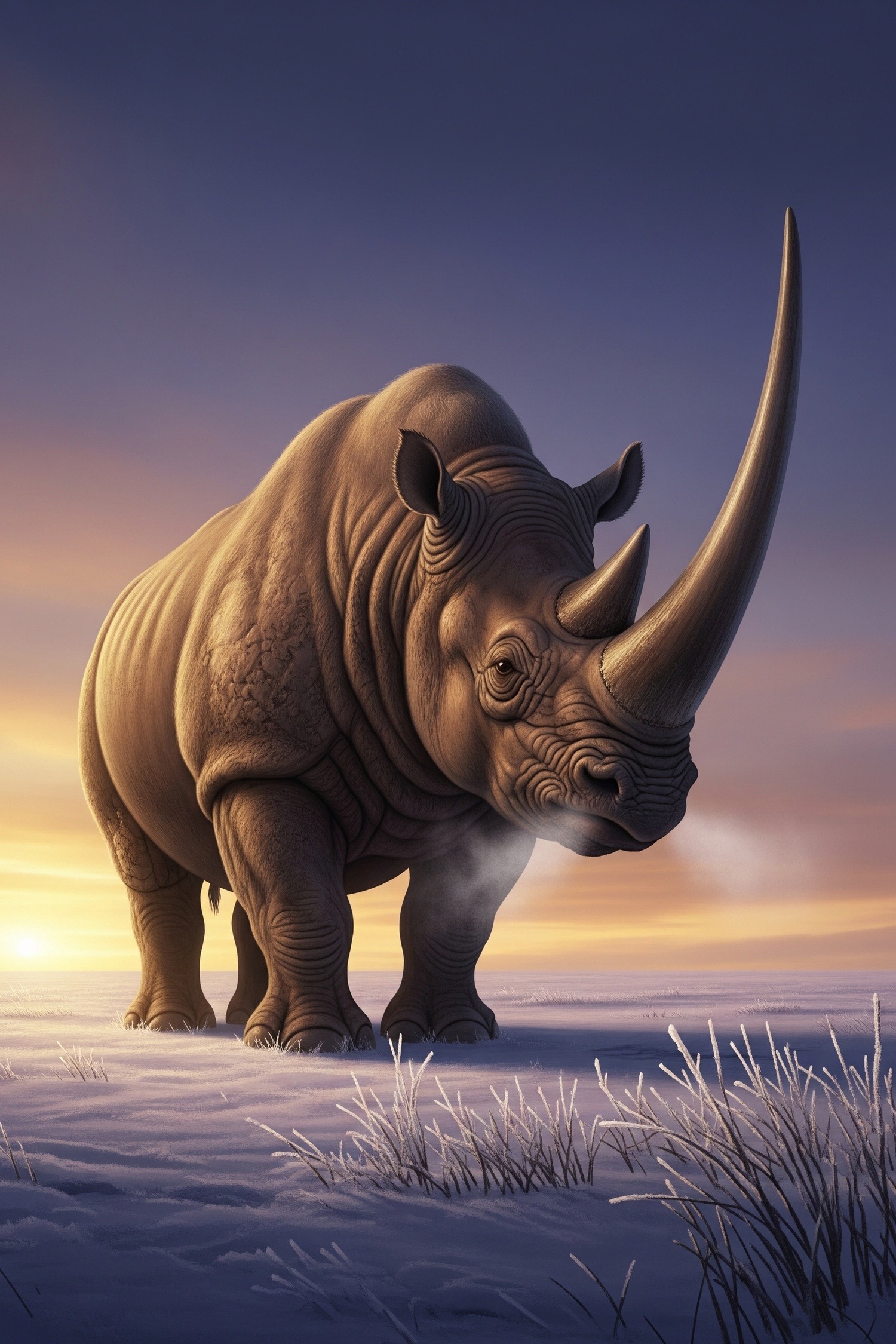
Built for a World That Was Disappearing
To understand why Elasmotherium mattered — and why it vanished — you have to picture the world it ruled. During the Ice Age, vast stretches of Eurasia were covered not by snowbound tundra but by the mammoth steppe: a cold, dry, grass-dominated landscape that ran from Western Europe deep into Siberia. It was one of the largest single ecosystems the planet has ever known, and it teemed with giants. Woolly mammoths. Woolly rhinos. Steppe bison. Giant deer. Cave lions stalking the herds. Elasmotherium was a heavyweight even among that crowd, a grazing specialist tuned to crop the tough, silica-laden grasses that carpeted the open plains.
Those high-crowned molars tell the whole story of its lifestyle. Grass is abrasive — it wears teeth down fast — so animals that eat it tend to evolve tall, hard-wearing teeth that keep grinding for a lifetime. Elasmotherium took this to an extreme, with ever-growing molars and a low-slung skull posture suited to feeding close to the ground. Some researchers suspect the great horn doubled as a snow-plow and a digging tool, sweeping frozen crust aside to expose the buried forage beneath. That is the paradox of specialization: the very traits that made Elasmotherium unbeatable on the open steppe also chained it to that single habitat. A generalist can switch foods when the menu changes. A specialist this committed had nowhere else to go.
The Question That Nobody’s Quite Answered
Here’s where things get complicated. Across Eurasia — from Central Asia to Europe — there are petroglyphs and cave paintings depicting large animals with single horns. Researchers have occasionally suggested, in careful, footnoted language, that some of these might represent Elasmotherium rather than stylized creatures or purely mythological beasts.
It’s not mainstream. There’s no confirmed identification in peer-reviewed literature.
But it’s also not impossible.
Humans in this era weren’t passive. They observed. They recorded. They drew mammoths on cave walls and carved aurochs into stone. If a human hunter — even once — saw that horn breaking the horizon, saw those hoofbeats crossing frozen ground, it would’ve registered. It would’ve meant something. That image could travel. Through stories told around fires. Through generations. Through the slow, strange evolution of oral tradition into myth. Somewhere in the cultural memory of dozens of societies — ancient Persia, medieval Europe, cultures across the steppes — there’s a narrative about a single-horned beast of tremendous power.
Coincidence?
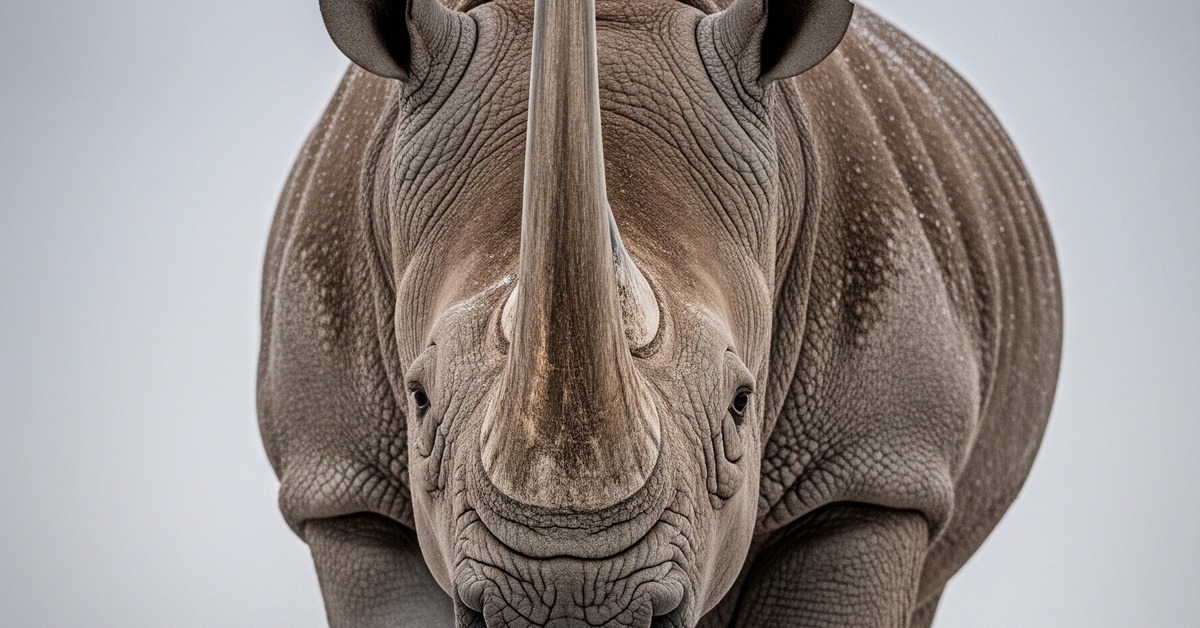
How a Real Animal Becomes a Legend
It’s worth being honest about how cautious the science has to be here, because this is exactly the kind of idea that gets twisted in the retelling. There is no proven link between Elasmotherium and the unicorn of European heraldry, the medieval bestiaries, or the single-horned creatures of Persian and Chinese tradition. The classical unicorn most likely grew from a tangle of older sources — secondhand accounts of the Indian rhinoceros, misread translations of ancient texts, and the universal human habit of embellishing a good story.
And yet the deeper point survives the skepticism. We know that real animals seed real myths. The narwhal’s spiral tusk, traded across medieval Europe, was sold for fortunes as genuine “unicorn horn.” Fossilized mammoth and elephant skulls — with their single large central nasal cavity — almost certainly helped inspire the one-eyed Cyclops of Greek legend. Dragon lore across China and Europe tracks suspiciously well with places where dinosaur bones eroded out of the ground. The mechanism is real and repeatable: people encounter something enormous and strange, they cannot explain it, and the explanation that survives is a story. Whether or not Elasmotherium is the specific ancestor of any unicorn tale, it belongs to a world where Ice Age humans walked among megafauna so improbable that myth was almost the rational response. The unicorn legend may have many fathers. The Siberian unicorn simply proves that a real one-horned monster did, in fact, exist.
The Numbers That Matter
- 36,000 years ago — the extinction date confirmed by fossil evidence from Kazakhstan in 2016. This places Elasmotherium firmly in the era when modern humans were actively migrating and establishing themselves across Eurasia. This is recent. In geological terms, this is yesterday.
- 5 metric tons maximum body weight. More than double a modern white rhino. One of the heaviest land mammals of the Pleistocene.
- 1 to 1.5 meters — the estimated horn length, derived from the size of the horn boss on fossilized skulls.
- 200,000 years. The old extinction estimate. Scientists were off by more than 160,000 years, meaning everything about this creature’s story had to be rewritten.
Why It Disappeared (We Think)
The extinction of the Siberian unicorn real population happened during one of the most chaotic periods in recent Earth history. The Last Glacial Maximum was bearing down. Steppe ecosystems were fragmenting. Temperatures were dropping. And modern humans — increasingly sophisticated, increasingly organized — were expanding across the same territories where Elasmotherium had thrived for millions of years.
It probably wasn’t one thing. Climate change, habitat loss, human predation — the kind of cascading collapse that knocked out dozens of megafauna species in rapid succession. Elasmotherium simply couldn’t adapt fast enough.
What stays with you, though, isn’t the power of the animal or the strangeness of its size. It’s the speed of the ending. Something so ancient, so deeply adapted to its world, erased in what amounts to a geological blink. And there were humans there to see it happen — even if they didn’t understand what they were witnessing. Even if the memory of it got twisted into something unrecognizable as it passed through thousands of years of retelling.
Maybe what we’ve been calling myth is older than we thought.
Maybe it’s a memory.
Frequently Asked Questions
Q: Was the Siberian unicorn actually a unicorn? No. Elasmotherium sibiricum was a true rhinoceros — a member of the family Rhinocerotidae, the same group that includes today’s living rhinos. The “unicorn” nickname comes from its single, enormous horn, mounted high on the forehead rather than on the snout. It was a heavyset, grass-eating mammal, not a slender horse-like creature of fantasy.
Q: How do we know it lived only 36,000 years ago? A 2016 study led by Andrei Shpanski at Tomsk State University radiocarbon-dated well-preserved fossil material from Kazakhstan. Radiocarbon dating reliably measures ages out to roughly 50,000 years, and the Elasmotherium bones fell well inside that window — placing the animal’s survival firmly in the Upper Paleolithic, overlapping with modern humans across Eurasia.
Q: Could ancient humans really have seen one alive? Geographically and chronologically, yes — it’s plausible. Elasmotherium and modern humans shared the same Central Asian steppe at roughly the same time. There is no confirmed cave painting that definitively depicts the species, so any direct artistic record remains speculative. But the overlap is genuine, and that alone makes the encounter possible.
The Siberian unicorn wasn’t magic. It was real, it was five tons of adapted muscle and bone, and it shared a continent with creatures who painted what they saw on cave walls. We may never know if Elasmotherium made it into those images. But the timeline says it’s possible. And that’s the kind of possibility that changes how you think about everything else we think we know about prehistoric life. If you’re curious about what else is hiding in the fossil record, there’s more waiting at this-amazing-world.com.
Illustrations are AI-generated. Article fact-checked and human-edited.