The Palm That Fruits Underground: Borneo’s Hidden Secret
Here’s the thing about Pinanga subterranea — the underground palm of Borneo — it doesn’t break a rule here or there. It breaks the foundational assumption that palms reach upward to reproduce. Flowers in the soil. Fruits in the dark. A palm that has inverted the entire logic of its family, and did so quietly enough that formal science took until 2023 to notice what Penan and Kelabit foragers had known for generations.
Botanists have studied palms for centuries. They’ve catalogued nearly 2,700 species, traced their genetics, mapped their ranges across tropical forests from Madagascar to Malaysia. And yet a palm hiding its entire reproductive life below the leaf litter of Borneo’s rainforest floor went formally undescribed until 2023. How does something that defies the basic logic of plant reproduction stay hidden that long — in plain sight of the people who ate its fruit?
The Palm That Buries Its Own Future
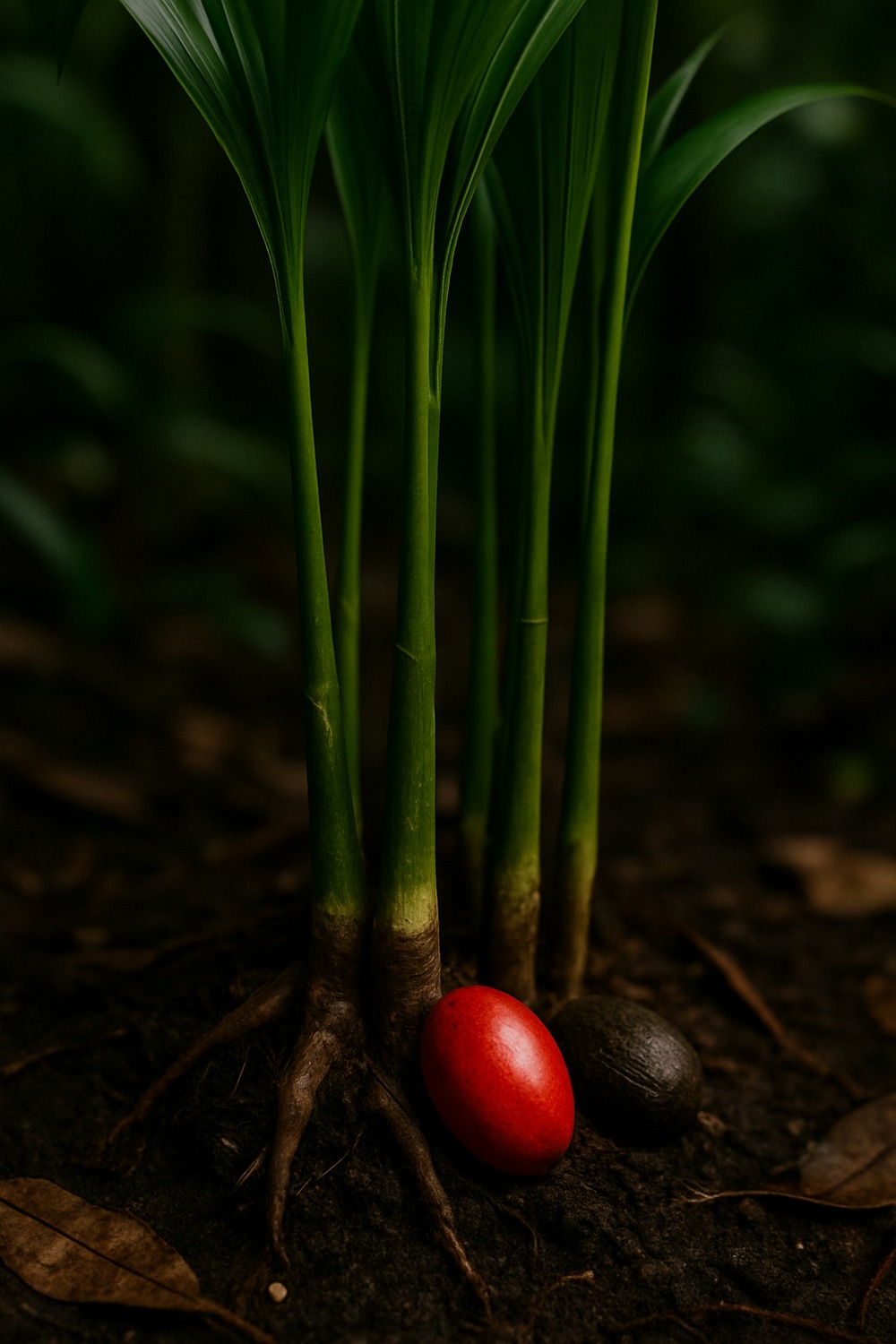
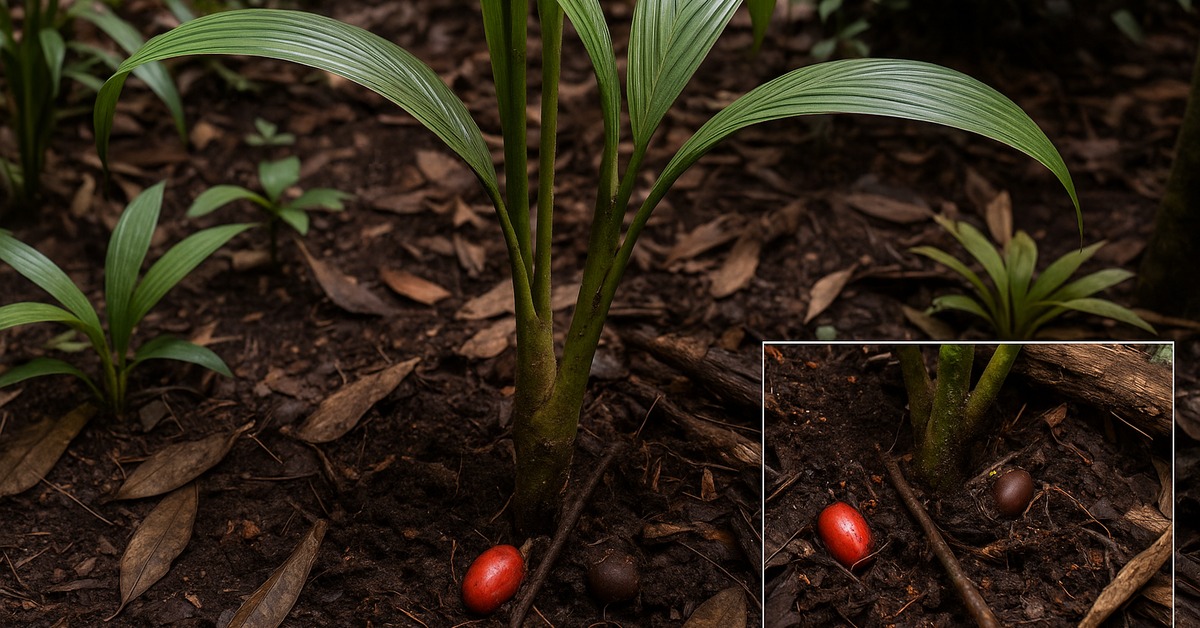
When researchers from the Royal Botanic Gardens, Kew formally described Pinanga subterranea in 2023, they were documenting something genuinely without precedent in the palm family. Published in the journal Palms, the species description confirmed what local Penan and Kelabit communities in the Malaysian state of Sarawak had long understood: this squat, understory palm produces its flowers and fruits not on aerial stalks, as virtually every other palm does, but directly from underground stems, buried beneath the forest floor. The process is called geocarpy — from the Greek for “earth fruit” — and it’s vanishingly rare in flowering plants. A handful of legumes do it. The peanut does it. No other palm had ever been confirmed to do it before this species was described.
Above ground, the plant is visually unassuming — slender stems rarely taller than a metre, modest pinnate leaves, nothing that announces anything unusual. But dig into the soil around its base, carefully, the way Penan foragers have done for generations, and you find clusters of dark, olive-sized fruits nestled against the root mass, hidden completely from view. No protruding stalk. No visible inflorescence. The reproductive apparatus of this palm is entirely subterranean, a structural arrangement that challenges the core assumptions plant anatomists bring to the family Arecaceae.
It’s the kind of discovery that forces a reassessment of what “well-studied” actually means. Palms are not obscure — they’re economically vital, ecologically dominant across the tropics, intensively researched. Yet this one kept its most defining characteristic concealed, literally underground, until the twenty-first century.
Indigenous Knowledge Led Where Science Hadn’t Looked
There’s a pattern worth paying attention to here. Across Southeast Asia, indigenous forest communities carry detailed, practical knowledge of species that formal botany has yet to name. The Sunda flying lemur — a gliding mammal of the same regional forests — offers a parallel: a creature so ecologically specific that understanding how it actually moves through the canopy required going beyond textbook assumptions and into the lived forest itself.
Penan and Kelabit communities in Sarawak harvested the fruits of Pinanga subterranea as food long before any herbarium specimen existed. Reportedly eaten raw or cooked — starchy, mild, slightly astringent — the fruit had been named in local languages, integrated into subsistence systems, and passed down across generations with no corresponding entry in the scientific literature. That culinary tradition represents a form of taxonomic recognition (researchers actually call this ethnobotanical pre-description), and it predated the Kew publication by decades, possibly longer.
The formal scientific description came in part because researchers took that traditional knowledge seriously enough to follow it into the field. Fieldwork in Lambir Hills National Park and surrounding forest areas in Sarawak — a biodiversity hotspot that holds one of the highest tree species densities recorded anywhere on Earth — revealed multiple P. subterranea individuals whose underground fruiting had been systematically overlooked in previous botanical surveys. Standard survey methodology, which typically involves observing aerial reproductive structures, would have recorded these plants as sterile or non-reproductive.
Scientists were simply looking in the wrong direction.
That detail is uncomfortable, and it should be. It raises a direct question about how many other species the discipline has miscategorised — not because they’re rare, but because the methods used assumed a behaviour this palm simply doesn’t share. History has a way of treating the people who designed those methods unkindly once the evidence catches up.
Geocarpy’s Deeper Evolutionary Logic
Why does geocarpy evolve at all? Geocarpy is genuinely strange, and its rarity in flowering plants makes the question worth pressing. The most studied geocarpic plant is the peanut (Arachis hypogaea), which pushes its fertilised ovaries into the soil to develop. Several species of Cardamine and Amphicarpaea also produce subterranean seeds as part of a dual reproductive strategy. According to a 2021 analysis published by the Smithsonian Tropical Research Institute, geocarpy tends to evolve in environments where above-ground seed dispersal is unreliable, or where soil-level protection offers a survival advantage — particularly in dense forest understories where seed predation pressure is intense. The Smithsonian Tropical Research Institute has documented analogous underground reproductive strategies across Neotropical plant families, suggesting the trait can emerge independently under convergent selective pressures.
What makes Pinanga subterranea exceptional is that geocarpy appears to be its only reproductive strategy — it doesn’t also produce aerial fruits as a backup. The entire reproductive investment goes underground. Burying fruits may shield them from the birds, civets, and rodents that readily consume above-ground palm fruits. It may reduce desiccation risk during localised dry periods, or facilitate germination in the stable temperature and moisture conditions of topsoil. Researchers also noted that seeds appeared to germinate in close proximity to the parent plant — which could point to a strategy less about dispersal and more about dense, localised colonisation of favourable microsites.
None of this is confirmed. Scientists don’t yet know why this palm does what it does, and that gap in understanding is itself significant — it marks a species whose ecology has barely been touched.
What Pinanga subterranea Underground Palm Borneo Tells Us About Unknown Diversity
Published by Willem Barfod and colleagues, the 2023 formal description drew on specimen data from herbaria including the Forest Research Centre in Sandakan, Sabah, alongside field collections from Sarawak. Barfod placed the species within the large and taxonomically complex genus Pinanga — over 130 described species across tropical Asia, many of them understory palms with overlapping morphologies that make identification genuinely difficult. That a geocarpic member of this genus existed without formal description as recently as two years ago suggests Pinanga diversity in Borneo is still being actively worked out. Borneo is the third-largest island on Earth and holds a disproportionate share of global palm diversity, yet large areas of its interior forest remain under-surveyed, with several Pinanga species known from fewer than ten herbarium specimens.
And the implication isn’t subtle. If a palm with such a visually dramatic and botanically unprecedented reproductive strategy went undescribed until 2023, the understory flora of Borneo almost certainly contains additional undescribed species with more conventionally hidden traits — minor morphological differences, restricted ranges, habitats that field teams rarely access. The Pinanga subterranea underground palm of Borneo isn’t an anomaly in the history of discovery. It’s a data point in a pattern.
Conservationists tracking forest loss in Borneo have documented that over 50% of the island’s lowland forest has been converted since 1973, primarily for oil palm plantations and logging. Species that haven’t been described can’t be protected. That’s not a rhetorical point — it’s a structural problem in conservation law, and it compounds with every year that interior surveys don’t happen.
How It Unfolded
- Pre-2023: Penan and Kelabit communities in Sarawak harvest and consume the subterranean fruits of an unnamed palm across multiple generations, integrating it into local food systems with no corresponding entry in the scientific literature.
- Early 2020s: Botanical fieldwork in Lambir Hills National Park and surrounding Sarawak forests, informed partly by local ethnobotanical knowledge, produces the first herbarium-quality specimens of the plant with documented subterranean fruiting structures.
- 2023: Willem Barfod and collaborators formally describe Pinanga subterranea in the journal Palms, making it the first confirmed geocarpic palm species in the scientific record — a description that immediately draws global botanical attention.
- 2023–present: Researchers flag that the species’ ecology, pollination mechanism, and population size remain almost entirely unknown, and call for targeted surveys across Borneo’s remaining interior forests.
By the Numbers
- 2,700+: approximate number of described palm species in the family Arecaceae (Royal Botanic Gardens, Kew, 2023) — only one confirmed geocarpic among them.
- 130+: species currently recognised in the genus Pinanga across tropical Asia, with new descriptions added nearly every year.
- 50%+: proportion of Borneo’s lowland forest estimated lost to conversion since 1973, according to Global Forest Watch data.
- 1 metre: maximum recorded above-ground height of Pinanga subterranea — making it one of the most diminutive members of an already small-statured understory genus.
- ~15 years: estimated average lag between a tropical plant species’ first collection and its formal scientific description, according to a 2019 study in Nature Plants.
Field Notes
- When botanists from Kew first examined specimens collected in Sarawak, the subterranean infructescences were initially suspected to be a pathological growth — an unusual gall or fungal structure — rather than a normal reproductive feature. Multiple specimens showing the same structure were needed before underground fruiting was confirmed as standard for this species, not an aberration.
- Pinanga subterranea doesn’t just fruit underground — it flowers underground too. The entire sequence from bud to ripe fruit occurs below the soil surface, meaning no pollinator has ever been observed visiting its flowers. How pollination actually works in this species is completely unknown.
- The peanut, one of the world’s most commercially important crops, is also geocarpic — it pushes its flower stalks into the soil after fertilisation to develop pods underground. The evolutionary parallel with an unrelated tropical palm is striking evidence for convergent adaptation under similar selection pressures.
- Researchers don’t yet know whether Pinanga subterranea is genuinely rare or simply overlooked due to its hidden reproduction. Standard botanical survey methods would routinely miss it entirely, raising the uncomfortable possibility that its population is far larger — or smaller — than current evidence suggests.
Frequently Asked Questions
Q: What exactly is Pinanga subterranea, the underground palm of Borneo?
Pinanga subterranea is a small palm species native to the rainforests of Borneo — specifically documented from Sarawak, Malaysian Borneo — that produces its flowers and fruits entirely beneath the soil surface. Formally described in 2023, it’s the only known palm species confirmed to practise geocarpy, the development of fruits underground. It reaches roughly one metre in height above ground and belongs to the diverse understory genus Pinanga.
Q: Why would a palm tree fruit underground instead of producing visible fruit?
Scientists don’t fully know yet — and that uncertainty is genuine, not false modesty. Leading hypotheses centre on protection: burying fruits shields them from the birds, rodents, and mammals that heavily predate above-ground palm fruits in dense rainforest understories. Underground development also offers stable moisture and temperature, potentially improving germination success. What’s clear is that this isn’t accidental. The plant’s anatomy is structured specifically to support subterranean reproduction, meaning it evolved this way deliberately rather than by chance.
Q: Didn’t indigenous communities already know about this palm? Why does a 2023 scientific description matter?
Yes — Penan and Kelabit communities in Sarawak had incorporated the palm’s fruits into their food systems long before 2023. The formal scientific description matters for different reasons: it creates a verifiable, internationally accessible taxonomic record, enables legal protections under conservation frameworks, and opens the species to ecological and genetic research. Crucially, it doesn’t invalidate indigenous knowledge — it catches up to it. The 2023 description is better understood as science acknowledging what local expertise already knew rather than discovering something previously unknown to all humans.
Editor’s Take — Alex Morgan
What unsettles me about Pinanga subterranea isn’t that it fruits underground. It’s that it was eaten for generations before a botanist formally named it. That gap — between a community’s working ecological knowledge and the scientific record — isn’t a curiosity. It’s a measurement of what gets missed when surveys assume that plants behave the way plants are supposed to behave. The forest doesn’t follow the methodology. The methodology has to follow the forest. That lesson still hasn’t fully landed in how tropical biodiversity surveys are designed.
Somewhere beneath the leaf litter of Borneo’s interior forest, clusters of dark fruits are ripening right now in total darkness — unobserved by any researcher, untouched by any field team, unknown to any database. The discovery of the Pinanga subterranea underground palm of Borneo doesn’t close a chapter in tropical botany. It opens one. And it asks a question worth sitting with: if a geocarpic palm went undescribed in a family studied for centuries, what else is growing quietly out of sight — patient, fruitful, and waiting for someone to simply look down?