The Shrimp Mother Who Never Puts Her Eggs Down
She holds them without letting go. For weeks — sometimes months in cold water — a female shrimp maintains an unbroken grip on her eggs, her body curved around the clutch like a question mark asking whether devotion requires a mind to feel it. This is shrimp carrying eggs behavior, and it’s one of nature’s most relentless acts of parental commitment, happening right now in Atlantic estuaries, Indo-Pacific shallows, and mountain stream beds across hundreds of species. What looks like stillness from the surface is actually constant motion: fanning, adjusting, guarding, a metabolic labor that costs her in ways marine biologists are only beginning to measure.
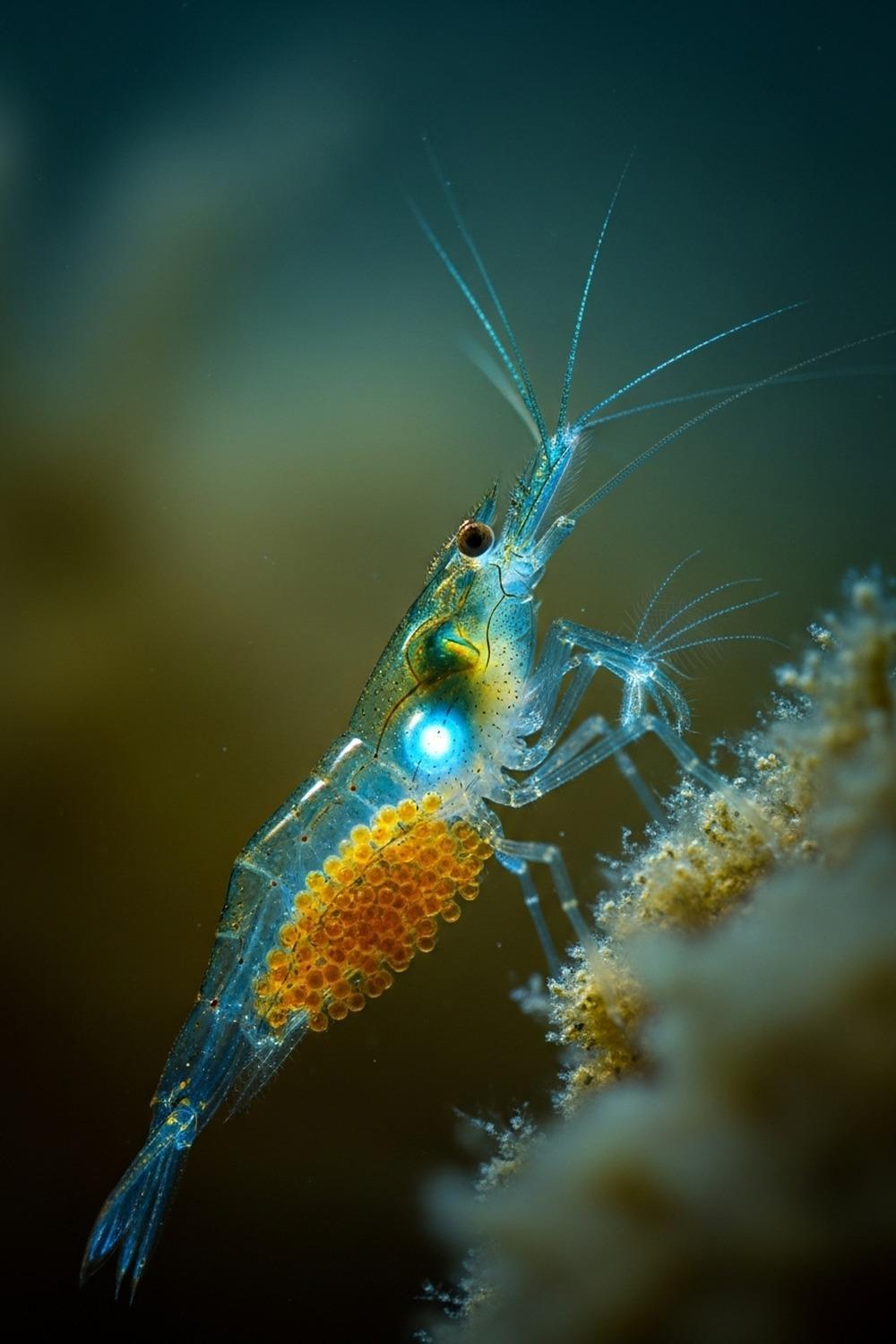
The mechanics of shrimp carrying eggs behavior begin with anatomy. Female shrimp possess a set of modified swimming legs on their underside called pleopods — feathery, paddle-shaped appendages that line the abdomen and serve double duty as both locomotion tools and cradles. Within hours of fertilization, the eggs attach to these pleopods via sticky threads. From that moment, they don’t leave.
Researchers at the Smithsonian Marine Station at Fort Pierce documented as early as 2003 that in grass shrimp (*Palaemonetes pugio*), individual females can carry clutches of up to 2,000 eggs at a time. The pleopods continuously undulate to push oxygenated water across the mass. But here’s the thing: the fanning isn’t random. It scales in frequency with ambient water temperature and dissolved oxygen levels — a feedback loop operating below conscious thought, if shrimp can be said to have conscious thought at all.
Key Facts
- Female shrimp carry eggs on modified swimming legs called pleopods, fanning them to push oxygenated water across the clutch.
- Atlantic grass shrimp (Palaemonetes pugio) can carry clutches of up to 2,000 eggs at a time (Smithsonian Marine Station).
- Brooded shrimp larvae showed survival rates up to 340% higher in the first 48 hours versus broadcast-spawned ones (Cambridge, 2014).
- Acute thermal stress of +4 degrees C above baseline caused 30% clutch abandonment in Palaemon serratus (IFREMER, 2017).
- More than 700 coastal dead zones were recorded globally as of 2023 (NOAA), overlapping key shrimp brooding habitat.
In short: The shrimp carrying eggs behavior involves a female fanning a clutch of up to 2,000 eggs on her pleopods for weeks, suppressing her own immunity and growth to keep them oxygenated. This brooding boosts larval survival up to 340%, but warming waters and over 700 coastal dead zones now threaten the process worldwide.
What Her Body Actually Does
What makes this arrangement striking is how completely the female’s body commits to it. She eats less during brooding. She moves less. Her metabolic priorities shift visibly — less foraging energy, more circulatory effort directed toward maintaining that constant water current over a clutch that can represent a significant fraction of her own body weight. It’s a physiological trade-off written into the species over millions of years.
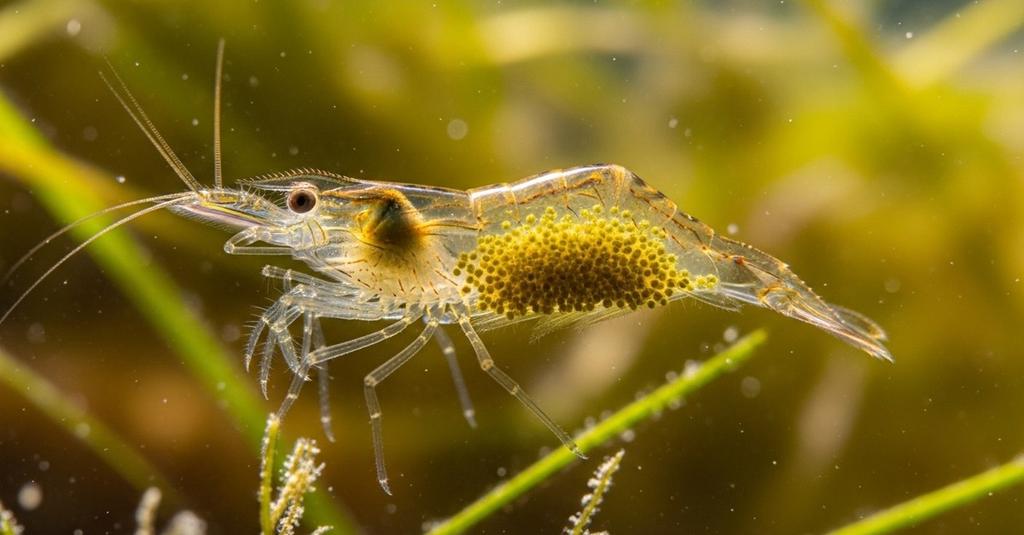
Watch a brooding grass shrimp in a tank and you’ll notice her posture changes. Her abdomen curves inward, curling slightly around the egg mass the way a hand cups a flame. The eggs hang in a translucent cluster, shifting color from pale yellow to deep orange-grey as development progresses.
It’s one of those things that, once you’ve seen it up close, you can’t unsee.
Why She Fans Them — And What Stops Her
The fanning behavior isn’t decorative. Without it, the eggs suffocate. Dissolved oxygen in still water depletes rapidly around a dense biological mass — the embryos consume it faster than passive diffusion can replace it. Researchers at the University of Maine’s Darling Marine Center have tracked this dynamic in several decapod crustaceans. In warm water, clutches deprived of maternal fanning show dramatically elevated embryo mortality within as little as 24 hours. The mother’s body is functioning as a life-support system.
What’s remarkable is how responsive the fanning rhythm is — not a fixed metronome but a dynamic response to environmental conditions. It tightens in hypoxic water. It slows in well-oxygenated flow. It’s the kind of behavioral fine-tuning we tend to attribute to animals with much more complex nervous systems. Why does this responsiveness matter? Because it suggests that complexity doesn’t require a neocortex — the shrimp has something that works just as well for this specific problem, and that distinction challenges how we think about devotion across the animal kingdom.
What actually stops the fanning is what stops most things in nature: death, predation, or extreme stress. Studies conducted on *Palaemon serratus* in 2017 at France’s IFREMER institute found that females exposed to acute thermal stress — water temperatures rising more than 4°C above baseline — showed erratic fanning behavior followed by partial clutch abandonment in roughly 30% of test subjects. That 30% figure matters. It suggests the behavior has a threshold, a breaking point past which the cost to the mother outweighs the evolutionary logic of continuing.
It also raises uncomfortable questions about what warming coastal waters mean for shrimp reproduction at scale.
Field researchers describe watching a stressed brooding shrimp as quietly distressing. She fans faster initially, as if compensating. Then the rhythm becomes irregular. Then, sometimes, she simply stops. The eggs she drops don’t survive. She usually doesn’t try again that season.
The Cost Paid in Silence — Shrimp Carrying Eggs Behavior Under Threat
A 2019 study published in the journal *Marine Biology* — drawing on long-term population data from estuarine systems along the Gulf of Mexico — found that brooding female grass shrimp show a measurable reduction in somatic growth during the brooding period. Meaning their own bodies essentially pause development so the eggs can develop instead. Their immune responses also show suppression, likely a consequence of redistributed energy budgets. It’s an immunological sacrifice in miniature, and the numbers have been quantified with increasing precision over the past two decades.
According to researchers at Louisiana State University’s Department of Oceanography and Coastal Sciences, females that successfully brood multiple clutches in a single season show statistically significant reductions in lifespan compared to females that brood once or not at all. The body keeps score.
Watching an animal with no cortex, no emotion as we understand it, pay a biological cost that measurable — that reframes what we even mean when we talk about parental care. The mother shrimp doesn’t dial down her immune defenses by choice. She’s engineered that way across millions of years. And yet: the cost is real. The sacrifice is documented. The price is paid in cellular currency.
The shrimp carrying eggs behavior takes on additional weight when you consider the environmental pressures now stacking against it. Coastal hypoxia — dead zones created by agricultural runoff and warming seas — directly undermines the oxygen gradient that makes maternal fanning effective. In a well-oxygenated estuary, a mother shrimp’s fanning provides meaningful supplemental circulation. In a hypoxic zone, she’s working against physics. The water simply doesn’t hold enough oxygen for the fanning to compensate, no matter how fast her pleopods move.
Dead zones now affect more than 700 coastal systems worldwide, according to NOAA data updated in 2023. Many of those systems are the same estuaries where grass shrimp and their relatives have been brooding eggs for millions of years. The overlap isn’t subtle. It’s a map of compounding pressure.
What Shrimp Egg-Carrying Reveals About Parental Evolution
Parental care in invertebrates was, for a long time, treated as an exception rather than a rule in evolutionary biology. The dominant assumption held that complex parental behavior required complex nervous systems — brains big enough to form attachment, to calculate risk, to remember offspring. Shrimp pushed back on that assumption, and they weren’t alone.
A landmark 2014 meta-analysis by researchers at the University of Cambridge’s Department of Zoology examined parental investment strategies across more than 1,200 invertebrate species. Brooding behaviors — including egg-carrying, guarding, and active ventilation — appeared independently in at least 21 separate lineages of crustaceans alone. Evolution discovered the brooding solution over and over again. That kind of convergent repetition doesn’t happen by accident. It happens when a behavior is so effective that selection keeps reinventing it. The shrimp didn’t stumble into this. Her pleopods, her fanning rhythm, her immunological sacrifice — these are the products of a solution refined across geological time.
What the Cambridge analysis also found was that species with brooding behaviors tended to produce fewer, larger, more developed offspring at hatching than broadcast spawners — shrimp that simply release eggs into the water column and move on. Fewer eggs, higher survival rate per egg. It’s a classic evolutionary trade-off between quantity and quality, and shrimp carrying eggs behavior sits firmly at the quality end of that spectrum. The data showed brooded larvae had survival rates up to 340% higher in the first 48 hours post-hatch compared to broadcast-spawned equivalents in similar environments.
Biologists call this r/K selection theory in its most tangible form. But when you’re watching an actual brooding female in an aquarium, adjusting her posture around an actual clutch, the theory gets very concrete. Every beat of those pleopods is a wager that her presence makes the difference. In most conditions, it does.
Where to See This
- Atlantic coast estuaries from Nova Scotia to Florida, USA — particularly in salt marsh habitats dominated by cordgrass (*Spartina alterniflora*) — offer some of the best opportunities to observe grass shrimp brooding in the wild, with late spring through summer representing peak brooding season.
- The Smithsonian Environmental Research Center in Edgewater, Maryland, conducts ongoing research into estuarine invertebrate ecology, including decapod crustacean reproduction, and periodically opens public education programs tied to their field work.
- For home observation, freshwater ornamental shrimp — particularly Cherry Shrimp (*Neocaridina davidi*) — display identical brooding behavior in aquarium settings and are one of the most accessible ways to watch shrimp carrying eggs behavior up close, in your own living room, for weeks at a time.
By the Numbers
- Up to 2,000 eggs carried in a single clutch by the Atlantic grass shrimp (*Palaemonetes pugio*), per Smithsonian Marine Station documentation.
- 2 to 4 weeks — average brooding duration across temperate shrimp species, varying with water temperature.
- 340% higher survival rate in first 48 hours post-hatch for brooded shrimp larvae vs. broadcast-spawned equivalents (University of Cambridge, 2014).
- 30% clutch abandonment rate observed in *Palaemon serratus* females exposed to acute thermal stress of +4°C above baseline (IFREMER, 2017).
- 700+ coastal dead zones recorded globally as of 2023 (NOAA), directly overlapping with key shrimp brooding habitat worldwide.
Field Notes
- In 2011, researchers observing harlequin shrimp (*Hymenocera picta*) in the Coral Triangle noted that brooding females would selectively reposition individual eggs within the clutch using their chelipeds — tiny claws — apparently moving less-oxygenated eggs from the interior of the mass toward the edges. It was the first documented evidence of within-clutch egg management in this species.
- Some shrimp species practice what’s known as “clutch cleaning” — the female uses her mouthparts to remove fungal growth and debris from egg surfaces during brooding, a behavior that goes largely unseen because it happens in low-light, sheltered environments.
- The color change in shrimp eggs during development — from pale yellow through orange and into dark grey-brown — directly reflects the growing density of pigment in the embryo’s developing eyes. By the time the eggs are nearly black, the larvae inside are essentially ready to hatch.
- Researchers still can’t fully explain how a brooding female shrimp detects when individual eggs within her clutch have died and need to be removed. She does remove them — selectively and quickly — but the sensory mechanism behind that detection remains poorly understood as of 2024.
Frequently Asked Questions
Q: How long does shrimp carrying eggs behavior typically last, and does it vary by species?
In most temperate species, shrimp carrying eggs behavior lasts between two and four weeks from fertilization to hatching. Tropical species in warmer water tend to brood for shorter periods — sometimes as little as 10 days — because higher temperatures accelerate embryonic development. Cold-water species, by contrast, can brood for up to eight weeks. The grass shrimp of the Atlantic estuary typically lands in the two-to-three-week range under normal summer conditions.
Q: Does the mother shrimp eat while she’s carrying her eggs?
She does eat, but significantly less than usual. The metabolic demands of continuous pleopod fanning and the postural constraints of carrying a clutch reduce her foraging efficiency considerably. Studies from Louisiana State University’s coastal sciences department found measurable reductions in somatic growth in brooding females, meaning her body effectively redirects resources away from her own development and toward maintaining the conditions her eggs need to survive. It’s a temporary but real physiological sacrifice.
Q: Is it true that shrimp are just acting on instinct — there’s no real “care” involved?
This is the most common misconception about shrimp carrying eggs behavior, and it’s worth unpacking. The behavior is instinctual in the sense that it’s genetically encoded — she doesn’t decide to fan the eggs the way a human decides to feed a child. But the behavior is also dynamically responsive: it adjusts to oxygen levels, temperature changes, and the physical condition of individual eggs. The University of Cambridge’s 2014 invertebrate parental care meta-analysis specifically argued against dismissing crustacean brooding as “mere instinct,” noting that the adaptive responsiveness of the behavior meets functional definitions of active parental care regardless of the cognitive substrate behind it.
Editor’s Take — Alex Morgan
What I keep returning to is the immunological suppression finding. The mother shrimp doesn’t just carry the eggs — she dials down her own immune defenses to do it, making herself more vulnerable to infection for the duration of brooding. That’s not metaphorical sacrifice. That’s measurable, biological sacrifice, built into the species’ survival strategy. We spend a lot of time marveling at mammalian parental devotion, at its warmth and complexity. But there’s something clarifying about watching an animal with no cortex, no emotion as we understand it, paying the same price.
The estuary at dusk doesn’t look like much from a distance. Brown water, reed grass bending in the salt wind, the distant sound of a highway. But beneath the surface, in the tangle of roots and silt, female shrimp are doing what they’ve been doing for millions of years — holding on, fanning, waiting. The eggs turn darker by the day. The larvae inside are almost ready. She doesn’t know that. She doesn’t need to. The question worth sitting with isn’t whether what she’s doing counts as care. It’s whether the category even matters when the cost is this real.
Illustrations are AI-generated. Article fact-checked and human-edited. Our editorial standards.