This Insect Is a Thorn — And It Fights to Protect Its Kids
You know what’s wild? A thorn bug can sit on a branch for weeks and a trained entomologist will walk right past it. But here’s the part that actually stopped me scrolling — it’s not hiding alone.
Somewhere on a tropical shrub, a twig is standing guard. It’s a mother. Umbonia crassicornis — the thorn bug — has a body shaped exactly like the plant it lives on. Hooked tip. Woody color. Everything. And she’s not up there by accident. She’s protecting eggs. Dozens of them. And if a wasp shows up, she kicks.
Key Facts
- Umbonia crassicornis, the thorn bug, mimics a plant thorn using a pronotal horn and belongs to the family Membracidae.
- The family Membracidae contains over 3,200 described species globally, with new ones found yearly.
- Female thorn bugs guard their egg clutches for 6 to 8 weeks, half or more of their adult lifespan.
- Maternal response time to nymph distress vibrations is under two seconds.
- Pronotal horns can extend up to 150% of body length in some treehopper species.
In short: The thorn bug camouflage of Umbonia crassicornis is structural, with a pronotal horn mimicking a plant thorn so perfectly that entomologists walk past it. Beyond hiding, the mother guards her eggs for 6 to 8 weeks, kicking at predators and responding to nymph vibration signals in under two seconds, among over 3,200 Membracidae species.
Thorn Bug Camouflage That Fools the Sharpest Eyes
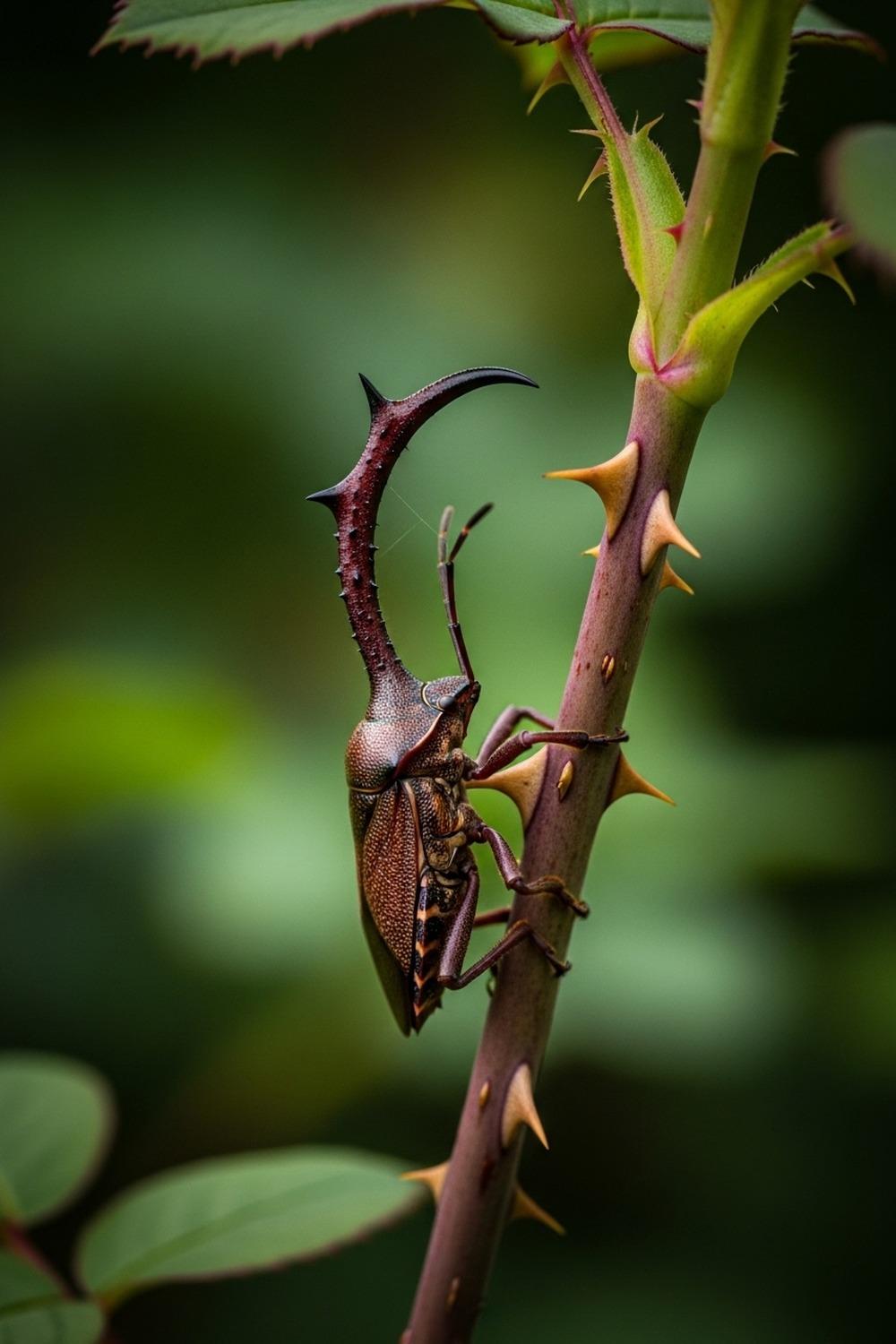
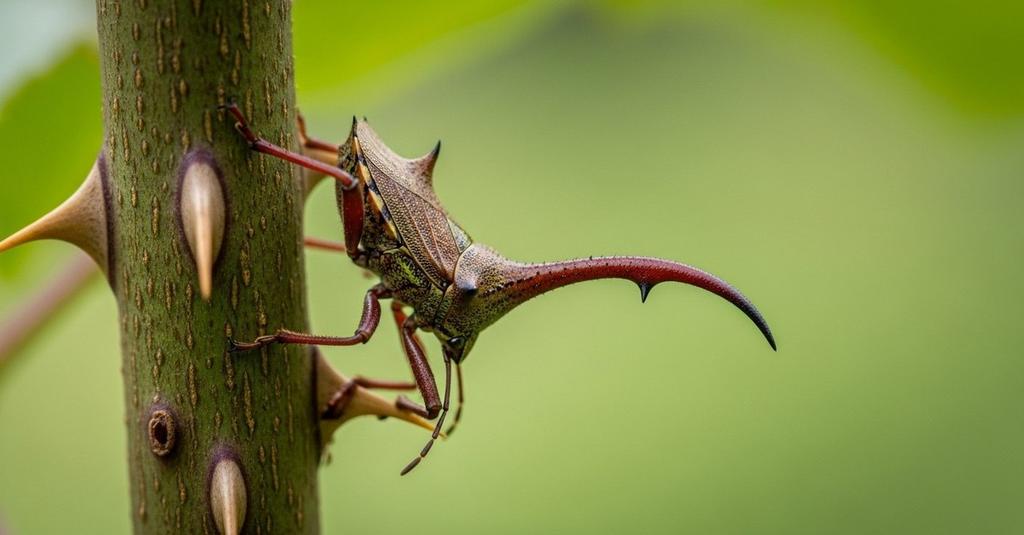
The disguise is structural, not just visual. That dramatic spike on the insect’s back — the pronotal horn — mimics a plant thorn so perfectly that field researchers have actually reached down to touch what they thought was bark and had it move. Thomas Wood at the University of Dayton spent decades studying treehoppers and documented how disorienting this gets in real conditions. Umbonia crassicornis belongs to the family Membracidae, a lineage that’s been refining these disguises for tens of millions of years.
But who’s it hiding from?
Wasps, mostly. Birds too. Anything with eyes sharp enough to spot a soft body on a stem. The camouflage buys time. Time to feed. Time to breed. Time to stay.
A Mother Bug Who Refuses to Walk Away
After mating, a female thorn bug slices into living twig bark with her ovipositor and deposits eggs inside. Then she does something almost no other insect does: she stays there. For weeks. She positions herself directly over the egg cluster, wings fanned slightly outward like a shield. When a predator approaches, she doesn’t flee.
She rears up and kicks.
Rapid, targeted hind-leg strikes. Delivered by an insect that weighs almost nothing. An insect with everything to lose, fighting something ten times its size. You can read more about devoted insect parents and the wild strategies they use over at this-amazing-world.com.
There’s something unsettling about watching it. A creature a few millimeters long. Standing its ground. Not because it has to. Because it will not move.
Where Thorn Bug Camouflage Meets Family Strategy
Thorn bugs are treehoppers — family Membracidae. Over 3,200 known species globally. Most have some kind of pronotal ornamentation — that spike on the back. But Umbonia crassicornis turned it into something else entirely.
A survival system. A family becoming invisible together. Because when nymphs hatch, they cluster. Dozens of tiny, spiky juveniles line up along the stem next to their mother. From a distance, it looks like a thorny branch. Nothing remarkable. Nothing worth eating.
Up close, it’s one of nature’s cleverest tricks.
The Nymphs Don’t Hide — They Communicate
Here’s the thing — thorn bug nymphs don’t just sit there looking like plant matter. They actively signal. Research into treehopper communication found something unexpected: these insects use vibrational signals transmitted through plant stems. When danger approaches, nymphs produce substrate-borne vibrations — they tremble the twig — and the mother responds. She moves toward the threat. It’s a two-way alarm system. Passive camouflage turns active. The colony coordinates.
That last fact kept me reading for another hour.
This isn’t blind instinct. There’s communication. Response. Something that functions a lot like care — even if we’re still figuring out the neuroscience.
By the Numbers
- Over 3,200 described species in family Membracidae, with new ones discovered every year in tropical regions.
- Female thorn bugs guard egg clutches for 6–8 weeks — an extraordinary investment for an insect with an adult lifespan measured in months, meaning she’s spending half or more of her existence standing guard.
- Pronotal horns can extend 150% of body length in some species.
- Maternal response time to nymph distress signals: under two seconds — faster than most vertebrate maternal responses at comparable scales.
Field Notes
- Thorn bugs feed by piercing plant tissue and extracting sap. Dozens of nymphs clustering together can actually stress the host plant over time.
- The pronotal horn is hollow. Structural efficiency — lightweight but still convincing from every angle, including directly above where birds hunt.
- Some populations host mutualistic relationships with ants, who harvest honeydew and provide predator deterrence in return — giving the colony a literal bodyguard service.
Why This Small Bug Tells a Bigger Story
Thorn bug camouflage is evolutionary economics in miniature. Every joule of energy — growing that horn, staying on guard, kicking at wasps, trembling signals through stems — represents a trade-off that natural selection validated millions of years ago. The insect world gets treated like a backdrop. A buzzing blur. Beneath our notice.
But Umbonia crassicornis reminds us that every square centimeter of a tropical shrub is a theater of decisions, adaptations, and something that functions remarkably like devotion.
And once you start noticing? You can’t stop. Walk past a twig now and you’ll wonder. Is it just bark? Or is something living there? Is something protecting something else?
A wasp moves in. The twig fights back. Camouflage and courage in a body smaller than your thumbnail. It’s been doing this for tens of millions of years, long before anyone was around to notice. The strange part? There are thousands of insects just like this. Living double lives in plain sight. If this keeps you up at night, there’s more at this-amazing-world.com — and the next story is even weirder.
“
Frequently Asked Questions
Q: How does thorn bug camouflage actually work?
The thorn bug’s camouflage is structural, not just visual. Umbonia crassicornis has a spike on its back called the pronotal horn that, in some treehoppers, extends up to 150% of body length and mimics a plant thorn so perfectly that researchers have reached to touch what they thought was bark and had it move. The hollow horn, woody coloring, and hooked tip make it look like part of the plant. Clustered nymphs complete the thorny-branch illusion.
Q: Why does the mother thorn bug guard her eggs?
After mating, a female thorn bug slices into living twig bark with her ovipositor and deposits eggs inside, then stays to protect them for 6 to 8 weeks, half or more of her adult lifespan. She positions herself directly over the egg cluster with wings fanned outward like a shield. When a predator such as a wasp approaches, she does not flee; she rears up and delivers rapid, targeted hind-leg kicks at threats often ten times her size.
Q: How do thorn bug nymphs communicate with their mother?
Thorn bug nymphs use vibrational signals transmitted through plant stems. When danger approaches, the nymphs tremble the twig, producing substrate-borne vibrations, and the mother responds by moving toward the threat. It functions as a 2-way alarm system that turns passive camouflage into active, coordinated defense. The mother’s response time to these nymph distress signals is under 2 seconds, faster than most vertebrate maternal responses at comparable scales.
Q: How many treehopper species exist like the thorn bug?
The thorn bug belongs to the family Membracidae, which contains over 3,200 described species globally, with new ones discovered every year in tropical regions. Most have some kind of pronotal ornamentation, the spike on the back, but Umbonia crassicornis turned it into a complete survival system combining camouflage with maternal defense. Some populations also form mutualistic relationships with ants, who harvest honeydew and provide predator deterrence in return.
Illustrations are AI-generated. Article fact-checked and human-edited. Our editorial standards.