He Carried a Gas Cylinder Across the Graduation Stage
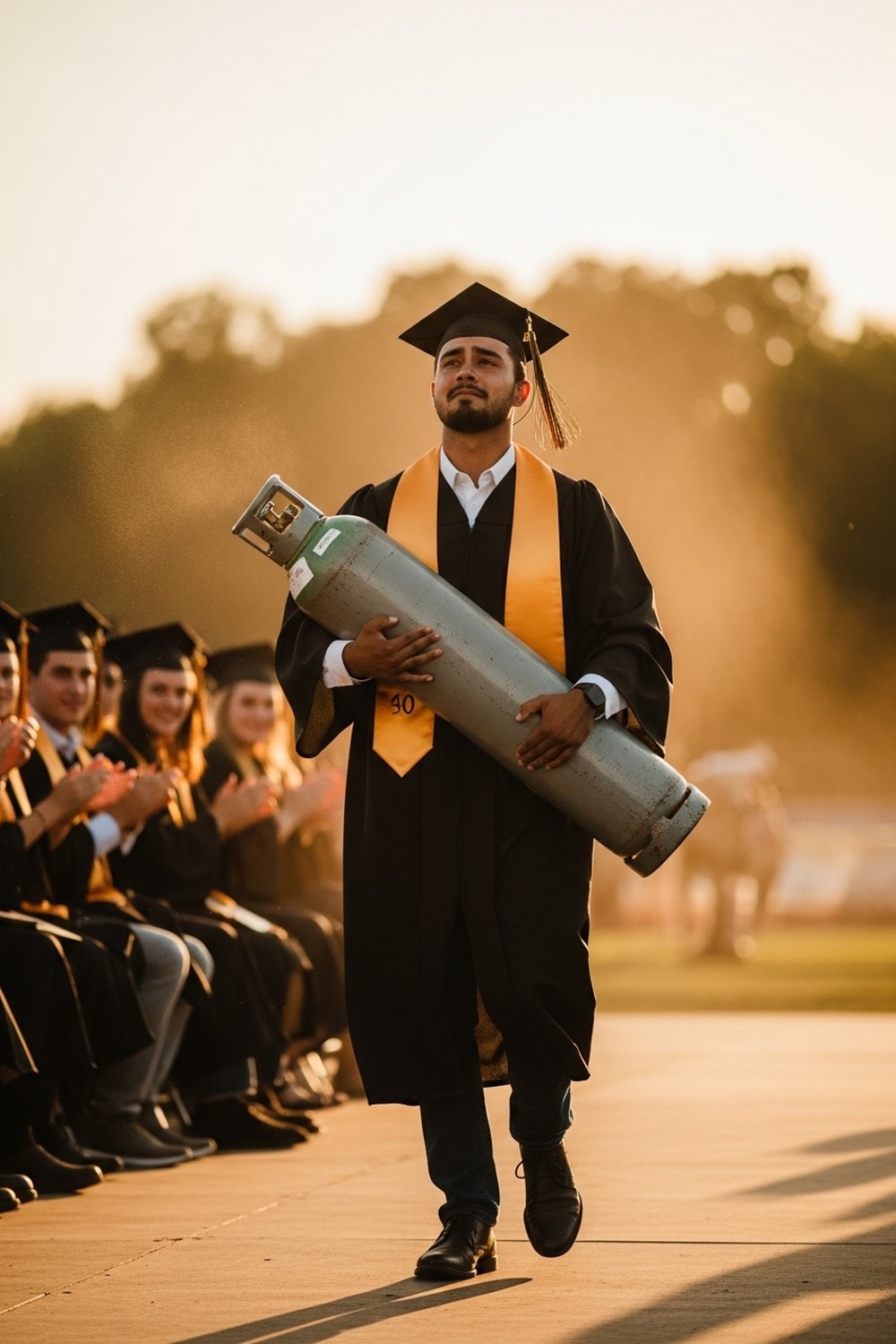
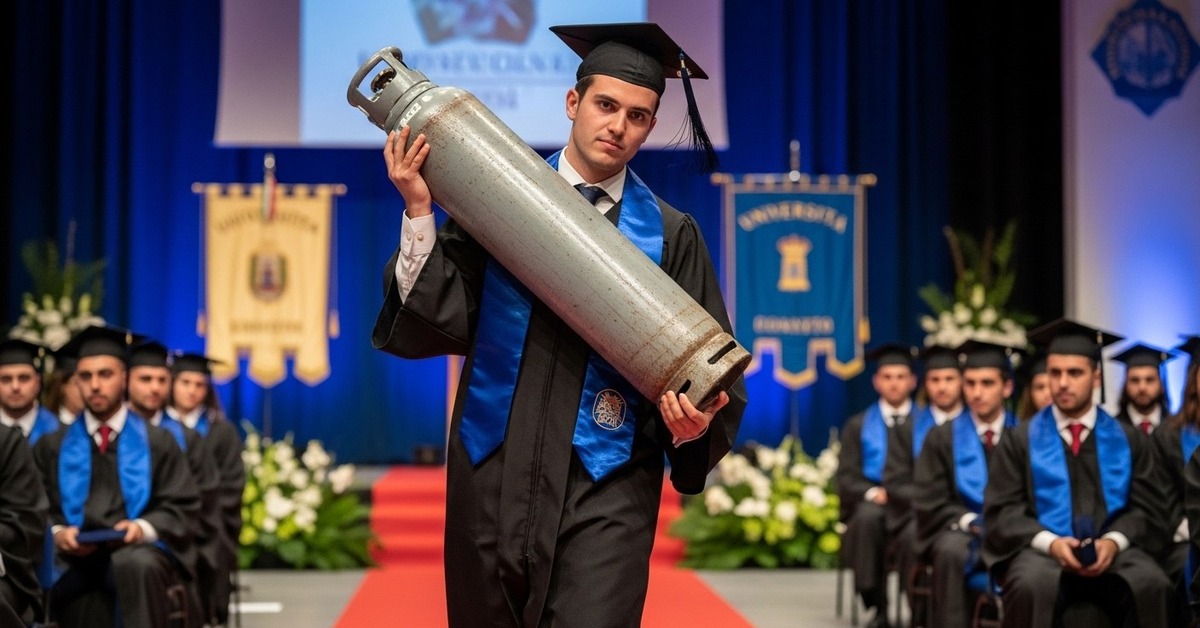
He didn’t carry flowers. He didn’t carry a sign. Lorenzo Monfardini walked across his university graduation stage carrying a gas cylinder — the kind his father had been hauling up strangers’ staircases since before Lorenzo was old enough to understand what work actually costs.
The auditorium went quiet first. Then it didn’t. People in the crowd started filming before they fully understood what they were seeing, which is maybe the most honest reaction possible. Something registers before language catches up. That’s what happened in that room in Italy, and it’s what happened to millions of people who watched the video days later from places Lorenzo had never been.
Key Facts
- Lorenzo Monfardini walked across his Italian university graduation stage carrying a gas cylinder to honor his father, a longtime LPG delivery worker.
- His father worked as a gas delivery man for 26 years, loading and carrying cylinders before dawn through every season.
- The cylinder Lorenzo carried weighed between 15 and 33 kilograms when full.
- The video earned over 4 million shares in the first week across six continents.
- A 2022 Pew Research Center study found 62% of adults in lower-income households report a family member’s financial sacrifice directly enabled their education.
In short: This graduation tribute father sacrifice story follows Lorenzo Monfardini, who crossed his Italian graduation stage carrying a gas cylinder to honor his father’s 26 years of LPG delivery work. Drawing on research into gratitude and moral elevation, it explains why the 15-to-33-kilogram symbol went viral with over 4 million shares.
The Graduation Tribute and Father Sacrifice Nobody Saw Coming
Here’s what makes it land differently than other viral moments. It’s not a speech. It’s not a sign with text on it. It’s a heavy, industrial, completely out-of-place object being carried somewhere it has absolutely no business being. And that wrongness is exactly the point.
Dr. Sara Algoe at the University of North Carolina has spent years studying what gratitude actually does — not just to the person feeling it, but to everyone who witnesses it. Her research found that public expressions of gratitude don’t just strengthen the relationship between two people. They broadcast something to everyone in the room: here is what this person values most. Lorenzo wasn’t just thanking his father. He was telling hundreds of people in that auditorium — and eventually millions more — what his degree was actually made of. You can follow the thread on the psychology behind this on Wikipedia’s gratitude page, though fair warning, it pulls you somewhere unexpected.
Most graduation ceremonies are interchangeable. Gowns, handshakes, the same song. Lorenzo broke the pattern with 15 kilograms of liquefied petroleum gas infrastructure.
What His Father Actually Did Every Single Day
For 26 years, the alarm went off early. Not metaphorically early. Actually, physically, before-dawn early. Lorenzo’s father loaded cylinders onto a truck and drove routes through neighborhoods, carrying the tanks up stairs, through narrow hallways, into kitchens where other families made breakfast without thinking much about where the gas came from or who brought it.
It’s the kind of work that keeps other people’s lives running while staying completely invisible. No one reviews the gas delivery man on social media. No one writes about him in the industry newsletter. He just shows up, in every season, in every weather pattern, with a bad back or without one, and does it again. That last part — the “again” — is what 26 years actually means. You can find more stories about the people whose labor quietly holds everything else up over at this-amazing-world.com.
Lorenzo knew exactly what that cylinder represented. Not just a job. A choice, made repeatedly, so his son wouldn’t have to make the same one.
Why This Moment Spread Across the Entire World
The video moved fast. Brazil, India, the Philippines, Nigeria, the United States — all within days. Comments filled with people describing their own version of the same story. Mothers who cleaned other people’s houses. Fathers on factory floors. The graduation tribute and father sacrifice framing resonated not because it was unusual, but because it was almost unbearably common. Almost every family has a version of this. Most of those versions never get filmed.
A gas cylinder shouldn’t make you cry.
But context is the whole thing. The weight of that object in Lorenzo’s arms, on the proudest day of his life, in a room full of people in academic robes — it transformed. It stopped being industrial equipment and became something else. A symbol, yes. But more specifically: a mirror. You look at it and you think about what you’ve been holding, and what you’ve been letting other people hold for you without saying anything about it.
The Science Behind Why This Hits So Differently
Psychologist Jonathan Haidt at New York University coined the term “moral elevation” to describe the specific feeling people get when they witness genuine virtue — not performed virtue, not aspirational virtue, but the real thing caught in the act. It’s that warm, slightly aching sensation in the chest. Haidt’s research shows it isn’t just emotional. It’s physical. People feel it in their bodies. And critically, it makes them want to do something good shortly afterward. Not in a vague, inspirational-poster way. Measurably, behaviorally. They call their parents. They tip better. They write the message they’d been putting off.
That last fact kept me reading for another hour. The idea that watching someone else acknowledge a sacrifice creates an almost involuntary urge to acknowledge your own — it’s uncomfortable in a very specific way. It surfaces things you’ve been successfully not thinking about.
The graduation tribute and father sacrifice story didn’t go viral because it was sad. It went viral because it was true, and truth that specific has a way of bypassing every defense you’ve built.
By the Numbers
- 62% of adults in lower-income households report that a family member’s financial sacrifice directly enabled their education, according to a 2022 Pew Research Center study — which means Lorenzo’s story isn’t exceptional. It’s just the one that got filmed.
- Over 4 million shares in the first week, across six continents.
- LPG delivery workers in Italy average 8 to 10 hours of physical labor per shift, with winter routes running longer and the cylinders running heavier.
- Harvard’s Graduate School of Education found that first-generation college graduates are 40% more likely to report feeling something researchers call “survivor’s guilt” about their own success — a complicated emotional tax that most people navigate entirely alone, without a name for what they’re experiencing.
Field Notes
- The cylinder Lorenzo carried weighed somewhere between 15 and 33 kilograms when full. He walked across that stage carrying the equivalent of a large child, in formal academic dress, in front of hundreds of people.
- Essential service classification meant his father worked through every Italian lockdown, every winter surge, every economic contraction of the past 26 years. No pause.
- Moral elevation, per Haidt’s research, is one of the only emotional states that produces simultaneous humility and inspiration — which explains something specific about the comment sections on Lorenzo’s video: people weren’t just crying. They were immediately making plans.
What This Graduation Tribute Teaches Us About Success
The story we tell about success is almost always a solo story. The individual who studied hard, applied harder, earned their place through discipline and sacrifice. It’s a compelling story. It’s also, structurally, a lie — or at least an omission so large it functions like one.
Lorenzo’s graduation tribute to his father’s sacrifice doesn’t argue with that story. It just shows you what was behind it the whole time. His degree didn’t come only from a library. It came from a truck route. From a man who lifted heavy things in the dark so his son could spend his days lifting ideas instead. The cylinder is the degree’s other half — the part that doesn’t get framed and hung on the wall.
And for anyone who has ever felt the strange, tangled feeling underneath their own achievements — proud but unsettled, grateful but not sure how to say it or to whom — that feeling has a shape now. Lorenzo gave it one. It’s gratitude layered over grief layered over love. It’s what happens when you stop moving forward for long enough to actually look back.
Lorenzo Monfardini crossed that stage and gave a room full of strangers a moment they didn’t know they were waiting for. Every diploma has a second story. The one lived by people who never wore the cap and gown, who got up early instead, who carried heavy things up narrow staircases while their kids sat in lecture halls. The graduation tribute and father sacrifice he staged lasted about thirty seconds. What it pointed at has been going on for decades — in his family, and in yours. If you want more stories about the people history forgets to mention, there’s more waiting at this-amazing-world.com.
Frequently Asked Questions
Q: What did Lorenzo Monfardini do at his graduation as a tribute to his father?
Lorenzo Monfardini walked across his Italian university graduation stage carrying a gas cylinder, the same type of industrial LPG tank his father had hauled up strangers’ staircases for 26 years as a delivery worker. The full cylinder weighed between 15 and 33 kilograms. People in the auditorium began filming before fully understanding the gesture, and the video went viral with over 4 million shares in the first week across six continents.
Q: Why did the graduation tribute father sacrifice video spread so widely?
Psychologist Dr. Sara Algoe at the University of North Carolina has shown that public gratitude broadcasts what a person values most to everyone watching. NYU psychologist Jonathan Haidt’s concept of moral elevation explains the warm, aching chest sensation people feel witnessing genuine virtue, which measurably prompts good behavior afterward. The story resonated because nearly every family has a version of it, and a 2022 Pew study found 62% of lower-income adults credit a family member’s sacrifice for their education.
Q: How much did the gas cylinder weigh and what did Lorenzo’s father do?
The gas cylinder Lorenzo carried weighed somewhere between 15 and 33 kilograms when full, roughly the equivalent of a large child, carried in formal academic dress. His father spent 26 years as an LPG delivery worker, waking before dawn to load cylinders onto a truck and carry them up stairs and through hallways. LPG delivery workers in Italy average 8 to 10 hours of physical labor per shift, with winter routes running longer and heavier.
Illustrations are AI-generated. Article fact-checked and human-edited. Our editorial standards.