The Bougainvillea on That Wall Is Older Than You Think
Walk past a bougainvillea that’s been climbing the same wall for fifty years and you’re looking at something most people mistake for decoration. Turns out it’s closer to architecture — and it’s been there longer than anyone realized.
Somewhere in a sunbaked courtyard in southern Spain, or draped across a crumbling wall in Rio de Janeiro, there’s a bougainvillea that’s been quietly growing since before you were born. Nobody planted a sign next to it. Nobody marked the date. And most people who pass it every single day have absolutely no idea what they’re actually looking at. The pink explosion isn’t seasonal. It’s a record.
Key Facts
- Bougainvillea was first documented in Brazil in the 1760s by French botanist Philibert Commerson, traveling with explorer Louis-Antoine de Bougainville, after whom the plant is named.
- The genus includes around 18 species native to South America, all evolved for hot, dry conditions.
- Specimens in California and southern Spain have been verified at over 50 years old, with informal records suggesting 60 to 70 year lifespans.
- The largest bougainvillea on record, in the Balboa Park area of San Diego, has limbs spanning over 30 meters horizontally and an estimated age over 80 years.
- Bougainvillea requires as little as 300mm of annual rainfall to thrive, roughly a third of what most flowering garden plants need.
In short: Tracking bougainvillea age growth shows a thin vine becoming a woody, gnarled structure over decades that never truly stops. Documented in Brazil in the 1760s, verified specimens exceed 50 years old, and the largest on record in San Diego spans over 30 meters and is over 80 years old. The vivid color comes from bracts, not petals.
Bougainvillea Age Growth Starts Deceptively Slow
The plant was first documented in Brazil in the 1760s by French botanist Philibert Commerson, who was traveling with explorer Louis-Antoine de Bougainville — the man the plant was eventually named after. According to Wikipedia’s entry on Bougainvillea, the genus includes around 18 species native to South America, all evolved for hot, dry, brutal conditions. Here’s the thing — a plant built to survive in those conditions doesn’t behave like your average garden flower. It operates on a completely different timeline, and it doesn’t just last. It persists.
In its first few years, a bougainvillea looks almost harmless. A thin climbing vine. A few bright bracts in summer. Easy to underestimate.
But underneath the surface, something else entirely is happening.
It doesn’t stop for decades.
These Plants Don’t Grow — They Consume
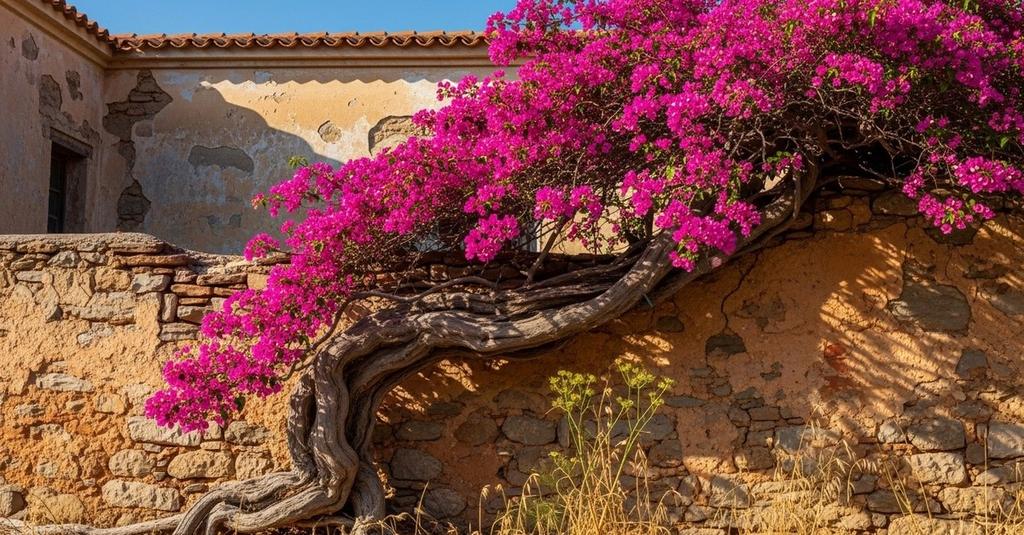
Given enough time and the right climate, a bougainvillea stops looking like a vine and starts looking like something permanent. The base thickens into a gnarled, woody trunk. The limbs spread horizontally across walls, fences, and rooftops, sometimes spanning several meters without any support at all. Researchers studying long-established specimens in Mediterranean and subtropical regions have documented root systems so deep and established they’ve actually outlasted the buildings the plants were originally attached to. That last fact kept me reading for another hour — the idea that a plant could outlive the structure holding it up.
Think about that for a second. The wall is gone. The bougainvillea is still there. It didn’t need the wall to survive. The wall was just something to hold onto while it got started.
What a Mature Specimen Actually Looks Like
Most people picture bougainvillea as a soft, seasonal splash of color. Something you prune back in autumn. Something manageable. But bougainvillea age growth tells a radically different story when you look at specimens that have been left alone long enough.
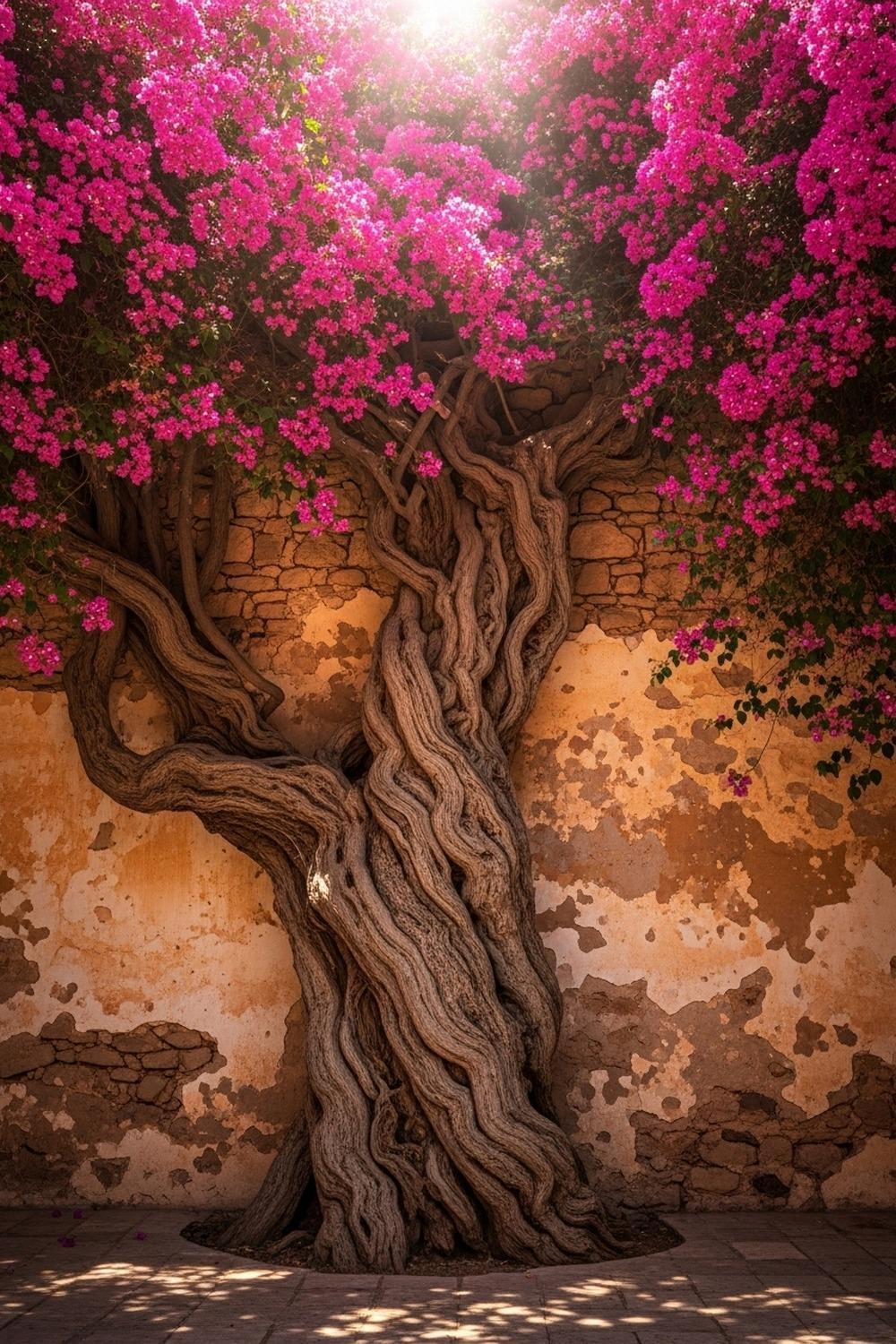
In California’s older neighborhoods, in the hillside villages of southern Spain, in the colonial architecture of coastal Brazil, you’ll find examples with trunks thirty centimeters across — thick enough to require both hands to wrap around. These aren’t vines anymore. They’re structures. And the older they get, the more color they produce.
A dry summer that would stress most plants into dormancy just makes a mature bougainvillea bloom harder. Stress is its fuel.
The Hidden Reason They’re Built to Last
Here’s the thing — bougainvillea doesn’t actually flower in the traditional sense. Those vivid pink, orange, red, and violet “petals” you’re seeing? They’re not petals at all. They’re modified leaves called bracts, and they surround the actual flowers, which are tiny and white and almost invisible at the center. Evolution gave the plant this trick to attract pollinators with color that doesn’t wilt the way true petals do. Bracts are tougher. Longer-lasting. Far more resilient to heat. The whole plant is basically designed around the same principle: look spectacular, waste nothing, outlast everything.
That design philosophy extends into how it handles damage, drought, and neglect. Cut a mature bougainvillea back hard — the kind of pruning that would kill most ornamental plants — and it responds with explosive new growth within weeks. The root system is simply too established, too deep, too committed to stop. Some gardeners describe trying to remove a decades-old specimen as one of the most physically demanding tasks they’ve ever attempted in a garden. It doesn’t want to leave.
By the Numbers
- Specimens in California and southern Spain have been verified at over 50 years old. Some informal records suggest 60-70 year lifespans in undisturbed coastal climates, with roots outlasting the original structures they were planted beside.
- A mature trunk reaches 10–30 cm in diameter — comparable to a small hardwood tree, despite the plant being classified botanically as a woody shrub or liana.
- The largest bougainvillea on record is located at the Balboa Park area of San Diego, with limbs spanning over 30 meters horizontally and estimated age over 80 years.
- Bougainvillea requires as little as 300mm of annual rainfall to thrive in warm climates. That’s roughly a third of what most flowering garden plants need.
Field Notes
- Bougainvillea thorns aren’t just defensive — they’re structural. The hooked thorns anchor the plant to rough surfaces and other vegetation, essentially using the environment as scaffolding.
- Most people assume bougainvillea is tropical, but it actually thrives in Mediterranean climates with cool, dry winters. That’s why it dominates Spain, Greece, Portugal, and California as much as Brazil or Thailand.
- The plant arrived in Europe as a botanical specimen for scientific study, not as a garden ornamental. It took nearly a century after Commerson’s documentation before it became widespread as decoration — meaning much of what we consider “timeless Mediterranean style” is actually a relatively recent aesthetic built on a 250-year-old discovery.
Why This Changes How You See Every Old Wall
There’s something quietly profound about bougainvillea age growth when you really sit with it. Every time you walk past one of these plants — cascading over a hotel entrance, swallowing a garden gate, filling an entire courtyard with color — you’re potentially looking at something that has been growing since before the internet, before the people who live there were born, before the last renovation of the building it’s attached to.
It’s not decoration. It’s a living record of time passing in a place.
And unlike a tree, which signals its age through obvious size and presence, a bougainvillea hides its history behind beauty. The older it gets, the more spectacular it looks. The evidence of decades is wrapped in color so vivid that most people never think to ask how long it’s been there. The next time you see one — really stop. Look at the base. Look at how thick the trunk has gotten. Look at how far the limbs have wandered across the stone. That plant has probably been watching that street longer than anyone who lives on it.
It doesn’t need you to notice. But it rewards you when you do.
“
Frequently Asked Questions
Q: How does bougainvillea age growth change the plant over decades?
In its first few years a bougainvillea looks like a thin climbing vine with a few bright bracts. Given enough time and a warm climate, the base thickens into a gnarled woody trunk, and limbs spread horizontally across walls and rooftops, sometimes spanning several meters unsupported. Mature trunks reach 10 to 30 cm in diameter, comparable to a small hardwood tree, even though it is botanically a woody shrub or liana.
Q: How old can a bougainvillea get?
Specimens in California and southern Spain have been verified at over 50 years old, with informal records suggesting 60 to 70 year lifespans in undisturbed coastal climates. The largest bougainvillea on record, in the Balboa Park area of San Diego, has limbs spanning over 30 meters and an estimated age over 80 years. Root systems have been documented outlasting the original buildings the plants were attached to.
Q: Are the colorful parts of bougainvillea actually flowers?
No. The vivid pink, orange, red, and violet structures are not petals at all. They are modified leaves called bracts, and they surround the actual flowers, which are tiny, white, and almost invisible at the center. Evolution favored bracts because they attract pollinators with color that does not wilt the way true petals do, being tougher and far more resilient to heat.
Q: Why is bougainvillea so hard to kill or remove?
Bougainvillea evolved for hot, dry, brutal conditions and requires as little as 300mm of annual rainfall to thrive, about a third of what most garden plants need. A dry summer that would stress other plants into dormancy makes a mature bougainvillea bloom harder, because stress is its fuel. Cut one back hard and it responds with explosive new growth within weeks, since the deep, established root system is too committed to stop.
Illustrations are AI-generated. Article fact-checked and human-edited. Our editorial standards.