The Turtle Frog: Australia’s Headfirst Desert Burrower
Pink, grape-sized, and built like nothing else that hops — the turtle frog Australia has engineered itself into a corner of the planet where almost nothing else survives. It burrows headfirst through desert sand, eats only termites, and raises its young in complete darkness, underground, with zero trips to any pond. Four inches of biological commitment to a single way of living.
Meet Myobatrachus gouldii, the sole member of its family, found only in the sandplains of southwestern Australia. It’s roughly the size of a large grape, buries itself nearly four feet underground, and raises its young without ever visiting a pond. Most people have never heard of it.
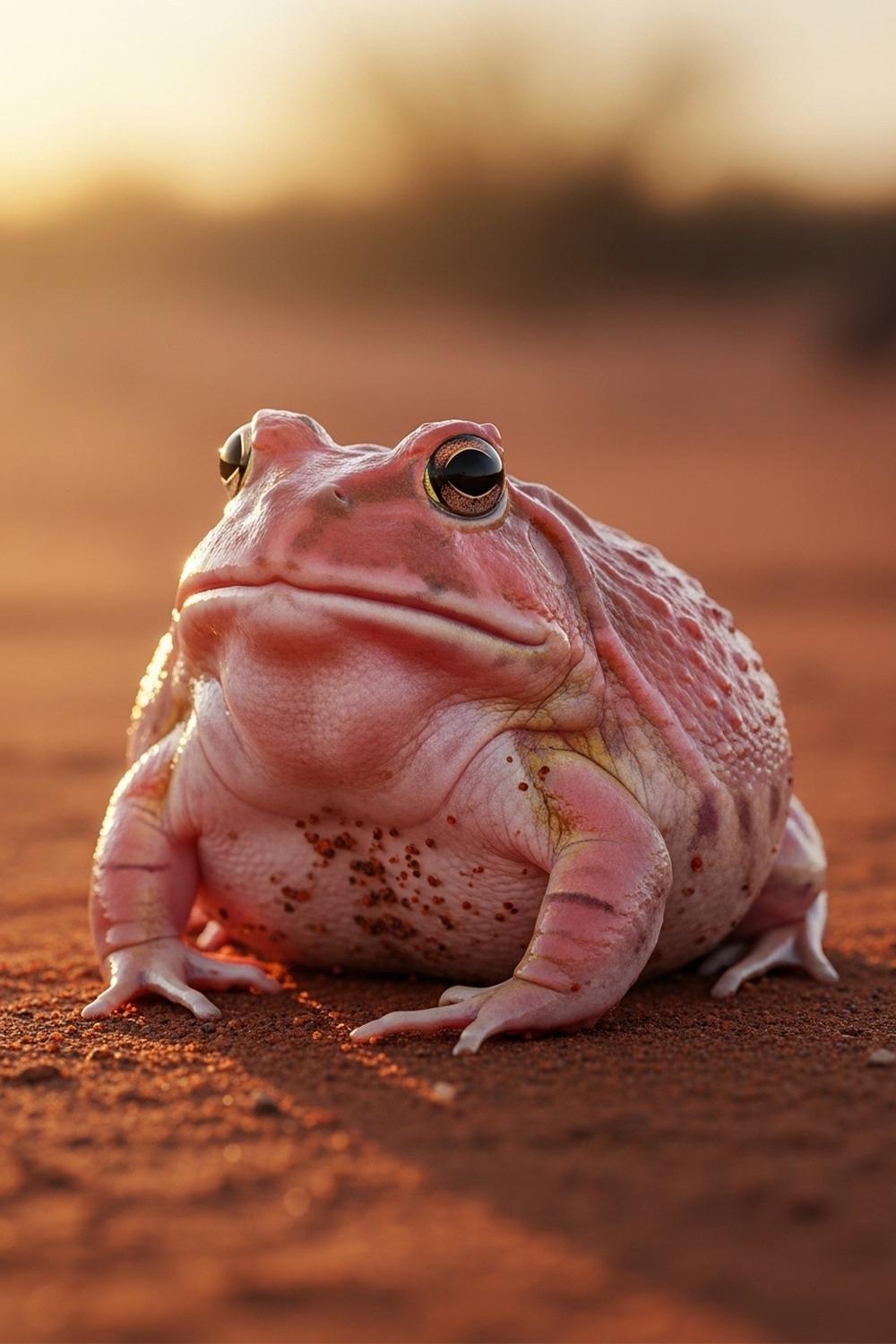
Herpetologists who have encountered it tend to describe the species with a kind of reverent bewilderment. How does something so improbable survive so well in one of the continent’s harshest environments?
Key Facts
- Myobatrachus gouldii, the turtle frog, is the sole species in its genus, found only in southwestern Australia’s sandplains.
- Adults measure roughly 4.5 to 5 centimeters and can dig burrows up to 1.2 meters deep, about 24 times their body length.
- The turtle frog burrows headfirst using massive forelimbs, unlike most frogs that excavate backward.
- It eats only termites and reproduces via direct development, with froglets hatching underground without a tadpole stage.
- The Swan Coastal Plain has lost more than 70% of its native vegetation since European settlement (DBCA WA, 2021).
In short: The turtle frog Australia, Myobatrachus gouldii, is a pink, grape-sized amphibian and the only species in its genus. It burrows headfirst up to 1.2 meters deep, eats only termites, and breeds via direct development with no tadpole stage. Endemic to southwestern Australia’s sandplains, it faces habitat loss exceeding 70% on the Swan Coastal Plain.
The Desert Architect: How Turtle Frogs Burrow Headfirst
Most burrowing frogs use a technique called backward excavation — they reverse themselves into the soil, using their hind feet to scoop earth behind them, descending tail-first into the ground. Myobatrachus gouldii does the opposite. It goes in headfirst, using its short, heavily muscled forelimbs to push sand aside in a drilling motion. Researchers at the Western Australian Museum documented this behavior extensively during field surveys in the 1970s and 1980s, noting that no other frog genus on the continent had evolved quite the same forward-entry technique.
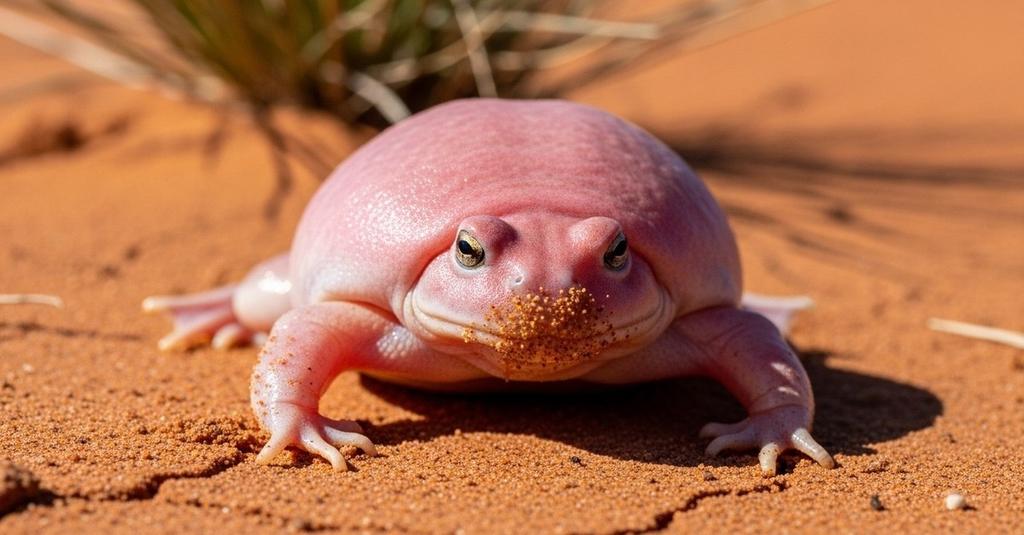
The family Myobatrachidae, which includes many of Australia’s endemic frog species, contains some remarkable burrowers. But the turtle frog Australia sits apart even within that group. Its skull is more heavily ossified than its relatives’, reinforcing the front of the head against the mechanical stress of pushing through compacted sand year after year.
Why does this physics matter? Because sand isn’t simply soft material waiting to be pushed aside. Dry, compact sandplain — the kind found across the Swan Coastal Plain and the Geraldton Sandplains — offers real resistance, especially at depth. A five-centimeter frog generating enough force to sink over a meter into that substrate has to produce extraordinary torque relative to its body mass. Its forelimbs are proportionally massive, almost comically oversized compared to the rest of its body. That’s not a design flaw.
That’s the whole point.
Watch one begin to dig and it looks less like a frog and more like a small, determined machine. The head goes down. The forelimbs rotate. The body disappears. Within minutes, it’s gone — swallowed by the earth as efficiently as anything the desert produces.
A Single Food Source, Found Four Feet Down
The turtle frog doesn’t hedge its dietary bets. It eats termites — specifically, the subterranean colonies of Mastotermes darwiniensis and related species — and nothing else. This kind of dietary specialization is called myrmecophage when applied to ants, but termite-eating in frogs is rare enough globally that it still draws scientific attention when documented in detail.
Here’s the thing: the relationship between the turtle frog Australia’s habitat and its food source is not coincidental. The sandplains of southwestern Australia host vast underground termite networks, and the turtle frog has essentially built its entire lifestyle around accessing them. This mirrors strategies seen in other extreme-specialist desert survivors: much like the antelope jackrabbit’s outsized ears represent a single-minded evolutionary solution to the problem of heat in an arid landscape, the turtle frog’s headfirst drilling is the only answer evolution landed on for reaching food no competitor can touch.
The termite colonies themselves can extend to 1.2 meters below the surface, sometimes deeper. Following them down, the turtle frog maintains burrow systems of corresponding depth. Adults measuring roughly 4.5 to 5 centimeters in length routinely excavate tunnels stretching 24 times their own body length — a ratio that, scaled to a six-foot human, would mean digging a burrow 144 feet deep with your bare hands.
Studies conducted by researchers at the University of Western Australia through the 1990s confirmed that individual frogs return to the same termite colonies repeatedly, suggesting they may maintain semi-permanent relationships with specific nest sites rather than roaming between food sources. That kind of site fidelity is unusual in small amphibians. It implies spatial memory. It implies something more deliberate than simple opportunism.
Skipping the Pond: Direct Development in a Waterless World
Here’s where the turtle frog Australia stops being merely unusual and becomes genuinely extraordinary. Most frogs require standing water to reproduce. Eggs are laid in ponds, streams, or temporary pools. Tadpoles hatch and develop in that water before metamorphosing into juvenile frogs. But the turtle frog has abandoned that anchor completely. It reproduces through a process called direct development — eggs are laid underground in a nest chamber excavated by the adults, and miniature, fully formed froglets hatch directly from the eggs, skipping the tadpole stage entirely.
There is no pond. There is no tadpole. The embryo develops all the way through metamorphosis inside the egg, emerging as a tiny but complete frog. This adaptation is documented in detail by the Australian Museum and represents one of the more dramatic departures from standard anuran reproduction on record. Research published in Nature Ecology & Evolution examining direct development across frog lineages has established that this strategy, while rare globally, tends to evolve in environments where reliable surface water is absent — making the dry sandplains of southwestern Australia a textbook candidate.
Breeding happens during the cooler, wetter months between May and August, when soil moisture rises just enough to support egg development without desiccating the nest chamber. The female lays a clutch of large, yolk-rich eggs — far fewer in number than a water-breeding frog would produce (and this matters more than it sounds), but each one is energetically loaded with everything a developing embryo needs to reach hatching as a fully functional froglet.
That’s an enormous metabolic investment per egg. It’s the difference between broadcasting a thousand cheap lottery tickets and buying twenty carefully selected ones. Conservation-wise, direct developers are often more vulnerable to habitat disruption than species with aquatic larvae, because their reproductive output is lower and each breeding event represents a significant parental investment. Lose the habitat and you don’t just remove the adults — you collapse the entire reproductive cycle at once.
The Turtle Frog Australia Can’t Afford to Lose
Least Concern. That’s the current IUCN classification for the turtle frog Australia, a designation that sits inside a conservation landscape changing faster than the assessments that describe it. The Swan Coastal Plain, which forms the southern core of the turtle frog’s range, is also one of the most rapidly urbanizing regions in Australia. Perth’s metropolitan sprawl has consumed enormous areas of the banksia woodland and sandplain heath that the species depends on.
A 2021 report from the Department of Biodiversity, Conservation and Attractions in Western Australia documented what was already suspected: the Swan Coastal Plain had lost more than 70 percent of its native vegetation since European settlement. That’s the context any species confined to that corridor must survive within. The turtle frog Australia, unlike migratory or wide-ranging animals, cannot simply relocate. It has no anywhere else to go. Its food source, its breeding substrate, and its microclimate requirements are all tightly bound to the sandy soils of a specific region of a specific continent.
What makes this species’ situation particularly precarious is precisely the trait that makes it remarkable: extreme specialization. The headfirst burrow, the termite-only diet, the direct development — each of these is a solution to a very specific problem in a very specific environment. Change that environment and the solutions stop working.
Watching a species designed for brilliance in a single narrow niche face habitat collapse, you understand how elegance and fragility become the same thing.
A turtle frog dropped into disturbed habitat with compacted clay soil and fragmented termite networks isn’t a resilient survivor. It’s a specialist without a specialty. The same depth of adaptation that lets it thrive undisturbed becomes a liability the moment the ground shifts. Researchers at Murdoch University’s School of Veterinary and Life Sciences have been tracking population density in remaining sandplain patches since the early 2010s, using pitfall trap surveys conducted during breeding season. Their data suggest that intact banksia woodland correlates strongly with higher turtle frog encounter rates — a finding that’s obvious in retrospect but took years of systematic fieldwork to confirm with the kind of specificity that informs land management decisions.
Where to See This
- Yanchep National Park, north of Perth in Western Australia, sits within core turtle frog territory and preserves intact banksia woodland. The best chance of encountering one is during the May–August breeding season, when animals are more active near the surface after rain events.
- The Western Australian Museum in Perth maintains specimen collections and has published key research on Myobatrachus gouldii biology — their herpetology department is one of the primary institutional resources for anyone researching this species.
- The FrogID project run by the Australian Museum allows citizen scientists to record and submit frog call data; while the turtle frog’s call is subtle, the project’s database has expanded geographic knowledge of the species’ range in recent years and is freely accessible online.
By the Numbers
- 4.5–5 cm: maximum adult body length of Myobatrachus gouldii, making it one of the smallest specialist burrowing frogs in Australia
- 1.2 meters: maximum recorded burrow depth, approximately 24 times the animal’s own body length
- 70%+: proportion of native vegetation lost from the Swan Coastal Plain since European settlement (Department of Biodiversity, Conservation and Attractions WA, 2021)
- 1: the number of species in the genus Myobatrachus — the turtle frog has no close living relatives
- 0: the number of times a turtle frog visits open water to breed — direct development means the entire reproductive cycle happens underground
Field Notes
- During a 1983 field survey in the Gnangara area north of Perth, Western Australian Museum researchers observed a turtle frog emerging from a burrow headfirst — the same orientation it uses to descend — suggesting it may reverse direction underground to exit, or that its tunnels are wide enough to turn around in. The exact mechanics of exit behavior remain poorly documented.
- The turtle frog’s skin is unusually thick and waxy compared to most frogs, reducing water loss in a way that makes it far more tolerant of dry conditions than its amphibian classification might suggest. It’s not waterproof, but it’s closer than most.
- Despite being the only species in its genus, Myobatrachus gouldii is the sole surviving member of a lineage that diverged from other myobatrachids early enough that its exact phylogenetic position was debated for decades.
- Researchers still can’t fully explain how turtle frogs locate termite colonies at depth. Whether they use chemical cues, vibration detection, or some combination of senses isn’t yet established — and given how difficult it is to observe underground behavior in real time, an answer may be years away.
Frequently Asked Questions
Q: Is the turtle frog Australia a real frog or a different type of amphibian?
It’s a genuine frog — a member of the order Anura and the family Myobatrachidae, which is endemic to Australia and New Guinea. Despite its turtle-like appearance and completely atypical body plan, Myobatrachus gouldii is biologically classified as a frog. Its unusual proportions are the result of millions of years of adaptation to subterranean desert life, not a sign that it belongs to a different amphibian group.
Q: Why does the turtle frog burrow headfirst when other frogs go in backward?
Most burrowing frogs use their powerful hind limbs to push themselves backward into soil, essentially reversing down into the earth. The turtle frog’s hind limbs are relatively weak, while its forelimbs are massively developed — so it evolved a forward-entry technique that uses the strength it actually has. Going headfirst also allows it to navigate directly toward termite colonies with its sensory organs leading the way, which may improve its ability to locate food during descent.
Q: Does the turtle frog really never need water to survive or breed?
This is a common misconception. The turtle frog doesn’t need surface water to breed — it uses direct development, laying eggs underground that hatch as fully formed froglets. But it isn’t completely water-independent. It absorbs moisture through its skin from damp soil during the breeding season, and its eggs require sufficient soil humidity to develop successfully. The May–August wet season in southwestern Australia provides that moisture. Prolonged drought years can affect breeding success significantly.
Editor’s Take — Alex Morgan
What gets me about the turtle frog isn’t the headfirst burrowing or the tadpole-free reproduction — it’s the ruthless specificity of the whole package. Every single adaptation this animal has points at one narrow target: surviving in this sandplain, eating these termites, breeding in this exact soil. It’s not versatile. It’s not hedging anything. And that works brilliantly right up until the moment the sand gets scraped away for a suburb. Extreme elegance and extreme fragility, wrapped in the same five centimeters of pink skin.
The turtle frog Australia has spent an unknowable number of generations perfecting a solution to a very specific problem, in a very specific place, with tools no other frog developed. It asks almost nothing of the surface world — no pond, no rain puddle, no open sky. Just intact sand, intact termites, and enough undisturbed ground to disappear into. As Perth’s urban edge creeps northward across the sandplain, the question isn’t whether this animal can adapt. It spent millions of years becoming unadaptable, by design. The question is whether we leave enough sand for it to keep drilling down into the dark.
Illustrations are AI-generated. Article fact-checked and human-edited. Our editorial standards.