How Far Can You See a Candle Flame? The Real Answer
How far can you see a candle flame in the dark? A single candle — one ordinary wax candle, one small teardrop of orange light — stays visible to the naked eye out to about 2.76 kilometres, roughly 1.7 miles, on a perfectly dark, moonless night. That is the headline number, and it is worth pausing on, because almost everything the internet told you before now was wrong. The viral figure — 30 miles, sometimes softened to 14 — has been quietly dead since 2015. What replaced it is stranger and far more beautiful: the real limit isn’t set by the flame at all. It’s set by your own retina, working at the very floor of what light can do.
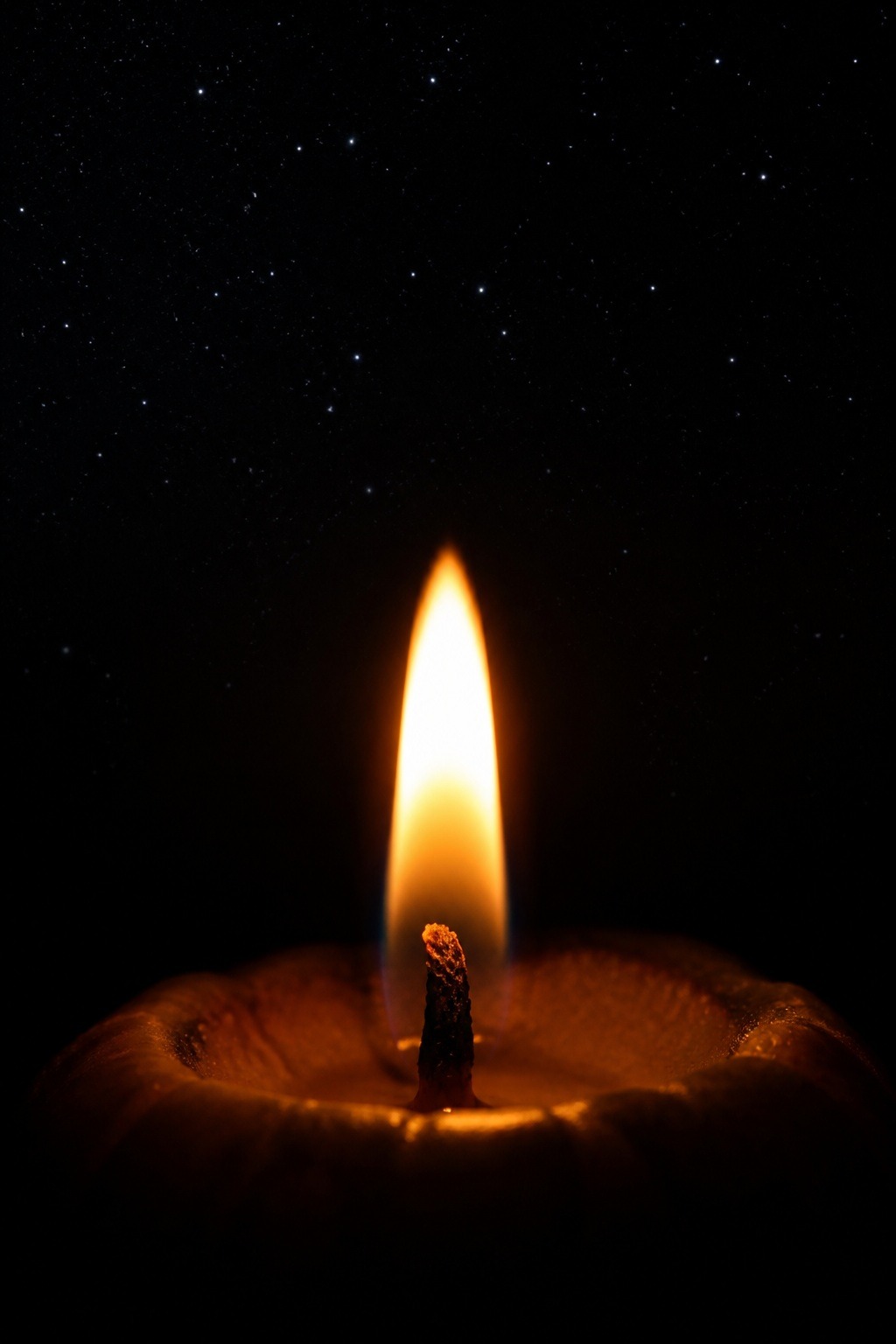
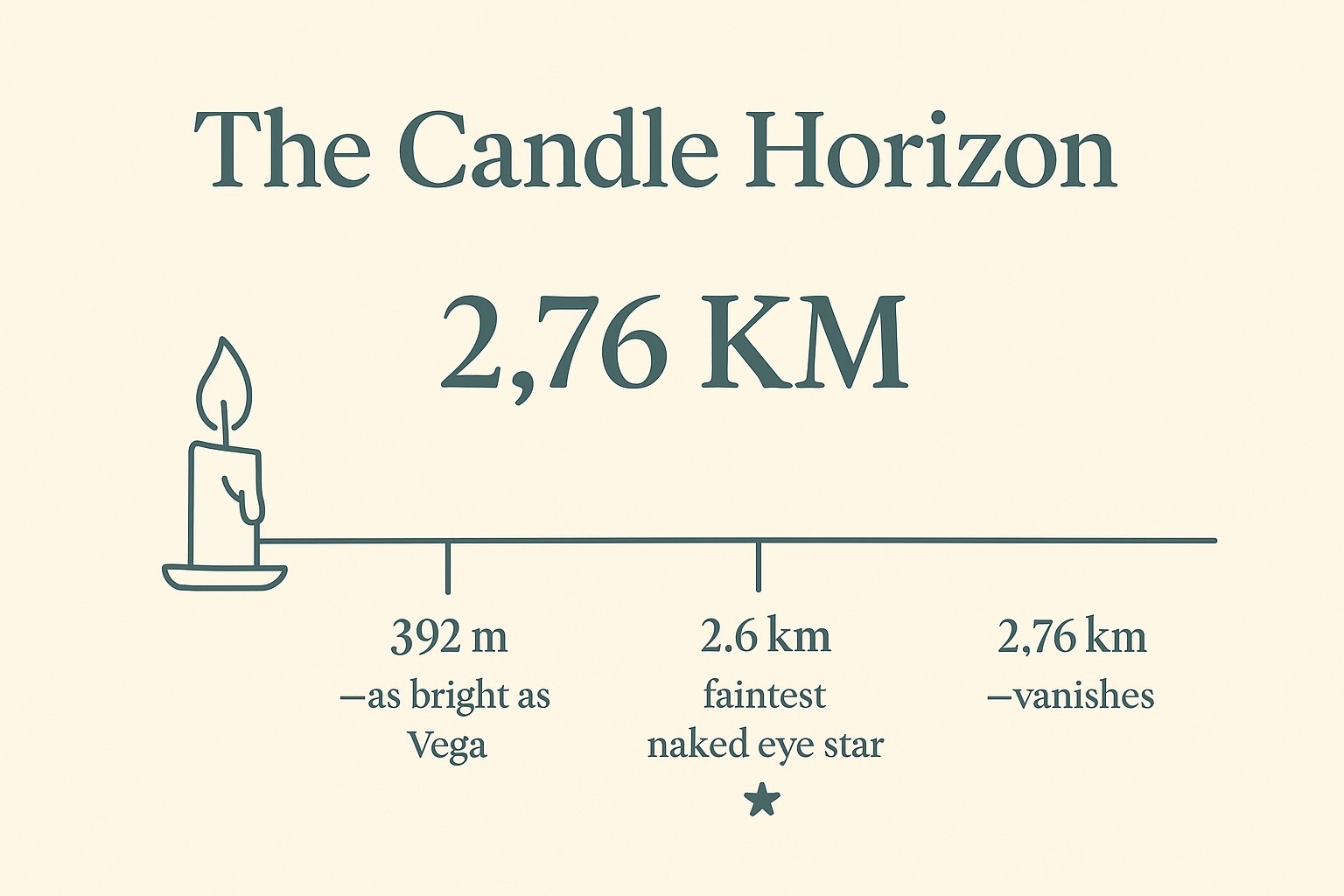
- Maximum detection distance: ~2.76 km (1.7 miles) on a dark, moonless night
- As bright as Vega: a candle equals a magnitude-0 star at 392 metres
- Vanishing point: fades to a magnitude-6 star — the faintest a bare eye can see — at ~2.6 km
- The debunked myth: the old “14 to 30 miles” claim ignores sky-glow entirely
- The source: Krisciunas & Carona, Texas A&M University, 2015 (arXiv:1507.06270)
Key Facts
- A single candle stays visible to the naked eye out to about 2.76 kilometres (1.7 miles) on a dark, moonless night.
- A candle equals a magnitude-0 star (as bright as Vega) at 392 metres, fading to magnitude 6 — the bare-eye limit — at about 2.6 km.
- The figure comes from a 2015 study by Kevin Krisciunas and Don Carona of Texas A&M University (arXiv:1507.06270).
- A 1942 Columbia experiment (Hecht, Shlaer, Pirenne) showed a dark-adapted eye can register as few as 5-9 photons.
- A moonless, starlit night provides light on the order of 0.0001 lux, versus about 100,000 lux in direct summer sunlight.
In short: A single candle is visible to the naked eye out to about 2.76 kilometres on a dark, moonless night, per a 2015 Texas A&M study — not the viral 14 to 30 miles, which ignores sky-glow. The real limit is set by your retina, which can respond to a single photon. A candle is effectively a portable, magnitude-0 star.
How far can you see a candle flame? The 2.76-kilometre answer
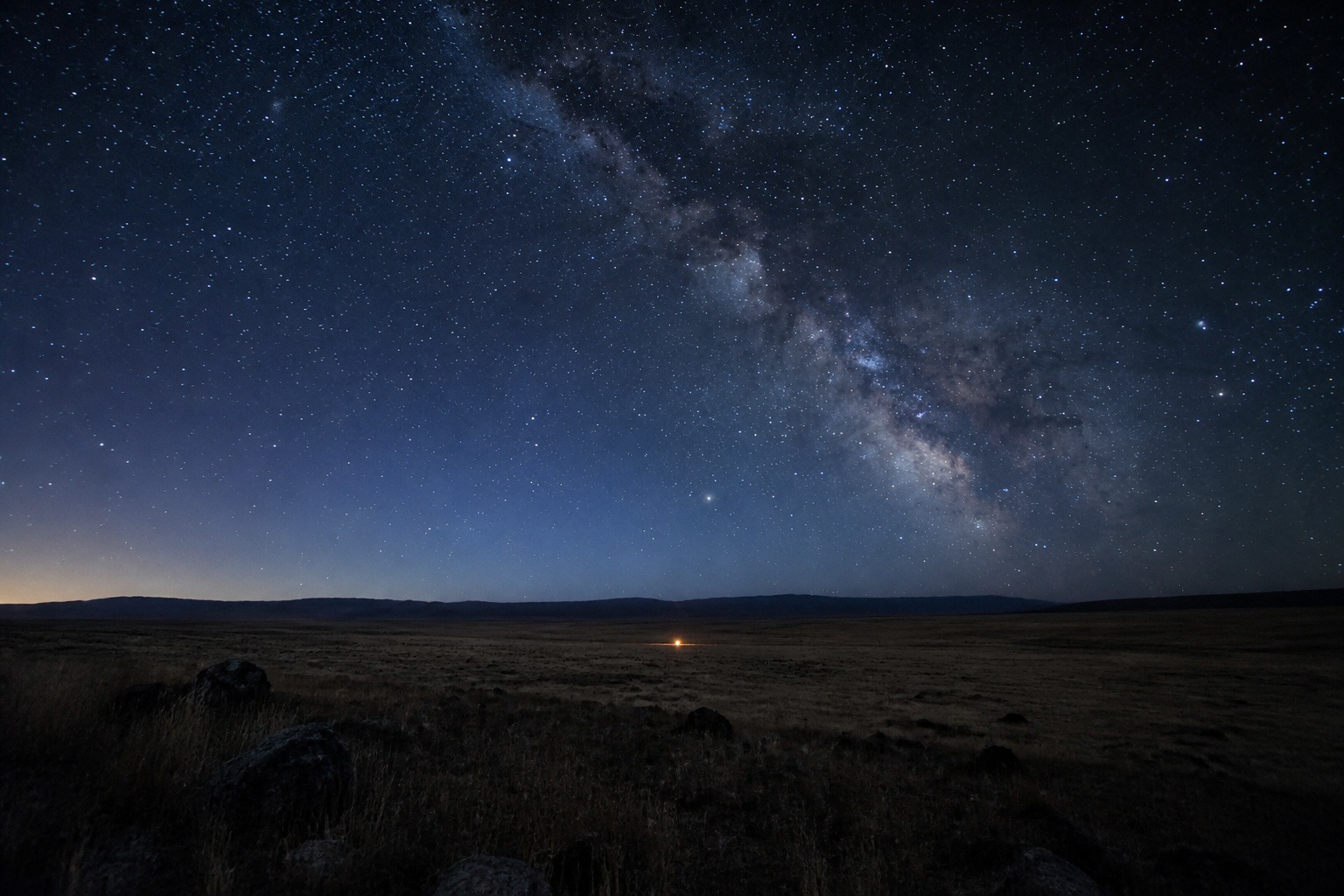
The definitive number comes from two astronomers at Texas A&M University, Kevin Krisciunas and Don Carona, who did something disarmingly practical. Rather than argue about it, they measured it. They set a real candle out at a measured distance of 338 metres and photographed it with an SBIG CCD camera — the same kind of light-metering instrument astronomers point at stars — calibrated against Vega, the zero-point of the brightness scale. Then they did the arithmetic that light obeys everywhere: brightness falls off with the square of distance.
Their result reframes the whole question. A candle flame, they found, shines as brightly as a magnitude-0 star — as bright as Vega itself — when you stand 392 metres away. Keep walking. By about 2.6 kilometres the flame has dimmed to magnitude 6, which is the textbook limit of the unaided human eye. Push a little further, into ideal dark-adapted conditions, and detection finally gives out near 2.76 kilometres.
Here’s the useful mental model the study hands you: a candle is not really “a light.” It is a portable star. And like a star, whether you can see it depends less on the object than on the sky behind it and the eye in front of it.
Why “30 miles” is a myth (the sky-glow problem)
So where did 30 miles come from? It’s an old campfire figure, endlessly repeated in listicles and, more recently, in slickly produced videos — including popular ones still circulating in 2024. The trouble is that it treats the night as if it were a perfect vacuum, a black void with a single candle floating in it. The real night sky is nothing of the kind.
Even on a moonless night, far from any city, the sky is not truly black. Starlight, faint airglow high in the atmosphere, and scattered light all add up to a dim, even background glow. Against that glow, a distant candle isn’t competing with darkness — it’s competing with a lit sky. Krisciunas and Carona showed that long before you reach 14 or 30 miles, the flame has faded to something like magnitude 10: an object several times fainter than anything a human eye can pull out of the background. A telescope would catch it. You will not.
That is the single most important correction this study makes, and it’s the part every viral explainer skips. The myth isn’t off by a rounding error. It’s off by a factor of roughly ten in distance, because it forgot that the sky itself is faintly on fire.
{IMAGE_2}
Your eye as a photon counter
Now for the part that turns a trivia answer into genuine wonder. To see a candle at 2.76 kilometres, your eye has to detect an almost absurdly small trickle of light. How small? Small enough that we have to talk about individual particles of light.
Back in 1942, three researchers — Selig Hecht, Simon Shlaer and Maurice Pirenne, working at Columbia University — ran one of the most elegant experiments in the history of vision science. Published in the Journal of General Physiology as “Energy, Quanta and Vision,” it showed that a fully dark-adapted human eye can register a flash containing as few as about five to nine photons. And because those photons scatter across many cells, the inescapable implication was that a single rod cell — one of the ~120 million rod photoreceptors in your retina — fires in response to just one photon. One particle of light. That is the physical limit; you cannot build a detector more sensitive, because there is nothing smaller than one photon to detect.
For decades that “single photon” claim lived as an inference. Then in 2016 a team led by physicist Alipasha Vaziri, working across the Research Institute of Molecular Pathology in Vienna and Rockefeller University in New York, closed the gap. Using a quantum light source that could emit exactly one photon at a time, they reported in Nature Communications that people could, above chance, tell when a single photon had arrived at the eye. The candle at 2 kilometres suddenly makes sense: your retina is not merely good at seeing in the dark. It is, quite literally, a photon counter operating at the edge of physics.
0.0001 lux — the light budget of a moonless night
It helps to put real numbers on how little light we’re talking about. Illuminance — light falling on a surface — is measured in lux, and the range that human vision spans is staggering.
| Setting | Approximate illuminance |
|---|---|
| Direct summer sunlight | ~100,000 lux |
| Overcast daylight | ~1,000 lux |
| Full moon, clear night | ~0.25 lux |
| Moonless night, starlight only | on the order of 0.0001 lux |
Sit with that bottom row. Between a sunlit field and a starlit one there is a gap of about a billion to one, and your eye handles both — not at once, but by shifting gears. The candle problem lives in that last, faintest row, and it explains why the flame is detectable at all: on a truly dark night there is almost nothing to drown it out. Turn on a distant porch light, and the reach collapses.
The conditions tax: dark adaptation, 8-mm pupils and averted vision
None of this happens for free. Your eye has to earn the ability, and it charges a tax in time and technique.
First, dark adaptation. Step outside from a lit room and you’re nearly blind; give it 30 to 45 minutes and your sensitivity climbs by a factor of thousands. Two things are happening. Your pupil widens — up to roughly 7 or 8 millimetres in a young eye — letting in more light. More importantly, your rod cells rebuild a light-sensitive pigment called rhodopsin, which bright light bleaches away. That chemical regeneration is the slow part, and it’s why one glance at a phone screen resets the clock and costs you the candle.
Then comes the trick almost nobody knows. To see the faintest object, don’t look straight at it — look about 15 to 20 degrees to the side. The center of your gaze, the fovea, is packed with cone cells for daylight detail and has almost no rods. Point it at a dim candle and the flame simply disappears. Slide your gaze off to one side, onto the rod-rich periphery, and it pops back into view. Astronomers call this averted vision, and it is the difference between seeing a magnitude-6 star and swearing it isn’t there. It feels wrong the first time you do it. It works every time.
The curvature catch: why you’d need a hill
There’s a catch the physics-in-a-vacuum crowd forgets: the Earth is round, and 2.76 kilometres is far enough for that to matter. For an observer with eyes at ground level, the horizon on a flat plain sits only about 5 kilometres away — so a candle sitting on the ground at 2.76 km is still (just) above the geometric horizon. But drop the candle into a dip, or stand it and the observer both at ankle height across gently rolling farmland, and the bulge of the planet quietly swallows the flame long before its light gives out.
This is why the honest version of the answer comes with a footnote: 2.76 km is the optical limit, the distance at which the light itself becomes too faint. To actually collect on it, you want a clear, unobstructed line of sight — a candle on one hilltop, an eye on another, and dead-flat dark air in between. In the real world, terrain, not photons, usually calls time first.
Try it yourself: a backyard dark-sky test
You don’t need a CCD camera to feel the edges of this. On the next clear, moonless night, get well away from streetlights — a rural field, a dark park, anywhere the stars come out in force. Let your eyes adapt for a full half hour, and be ruthless: no phone, no torch, no glancing at a car dashboard.
Have a friend carry a single candle or a steady flame away from you in a straight line while you stand still. Watch how the flame behaves as it shrinks — how looking slightly to one side keeps it alive after a direct stare loses it, and how the faintest, most distant version of it seems to flicker in and out as your eye works at its limit. You almost certainly won’t reach 2.76 km on foot in a backyard, and that’s fine. The point isn’t the record. It’s the visceral proof that the number in the studies is describing something your own body can do.
Frequently Asked Questions
Can you really see a candle from 30 miles away?
No. That figure is a long-standing myth. The 2015 Texas A&M measurement showed that sky-background glow drowns a candle into roughly a magnitude-10 object — far too faint for the eye — long before 30 miles. The real naked-eye limit is about 2.76 km (1.7 miles) in ideal darkness.
How far can the human eye see light in general?
It depends entirely on how bright the source is and how dark the background. A candle tops out near 2.76 km. A far brighter source, like a star, can be “seen” across trillions of kilometres — the Andromeda Galaxy, visible to the naked eye, is about 2.5 million light-years away. Distance isn’t the barrier; apparent brightness against the sky is.
Can the human eye really detect a single photon?
Essentially, yes. A dark-adapted rod cell responds to a single photon, and a 2016 study in Nature Communications found that people can sense a single photon arriving at the eye at slightly above chance levels. The full experience of “seeing” typically takes a handful of photons arriving close together.
Why do I need to look off to the side to see faint things?
Because the rod cells that handle dim light sit in the periphery of your retina, not the center. The central fovea is built for daylight sharpness and has almost no rods, so faint objects vanish when you stare straight at them and reappear with averted vision.
Sources and Notes
- Krisciunas, K. & Carona, D. (2015). “At What Distance Can the Human Eye Detect a Candle Flame?” Texas A&M University (arXiv:1507.06270).
- Hecht, S., Shlaer, S. & Pirenne, M. H. (1942). “Energy, Quanta and Vision.” Journal of General Physiology.
- Tinsley, J. N., Molodtsov, M. I., Vaziri, A. et al. (2016). “Direct detection of a single photon by humans.” Nature Communications 7:12172.
- MIT Technology Review (2015). Coverage of the Krisciunas & Carona candle-flame study and its CCD/Vega methodology.
The tidy answer is 2.76 kilometres. The better answer is that the limit was never really about the candle. It was about the moment a few particles of light complete a journey that ends inside a single cell in your eye — the smallest signal the universe allows, arriving just often enough to notice. What remains genuinely open is how much of that faint signal each of us actually catches: dark-adaptation, age, and the particular wiring of an individual retina vary more than the textbooks like to admit, which means your personal candle horizon may not be quite anyone else’s. The only way to know yours is to go somewhere truly dark and look.
Illustrations are AI-generated. Article fact-checked and human-edited. Our editorial standards.