Corpse Flower Titan Arum Bloom: Why It’s So Rare
A corpse flower titan arum bloom is not scheduled by a calendar — it is paid for out of a single underground battery, and that battery has to reach roughly 18 to 23 kilograms before the plant will even attempt one. For scale, the heaviest corm ever put on a scale, at the Royal Botanic Garden Edinburgh in 2010, weighed 153.9 kilograms. Most plants spend seven to ten years getting anywhere near the minimum, then spend the entire reserve in about 36 hours.
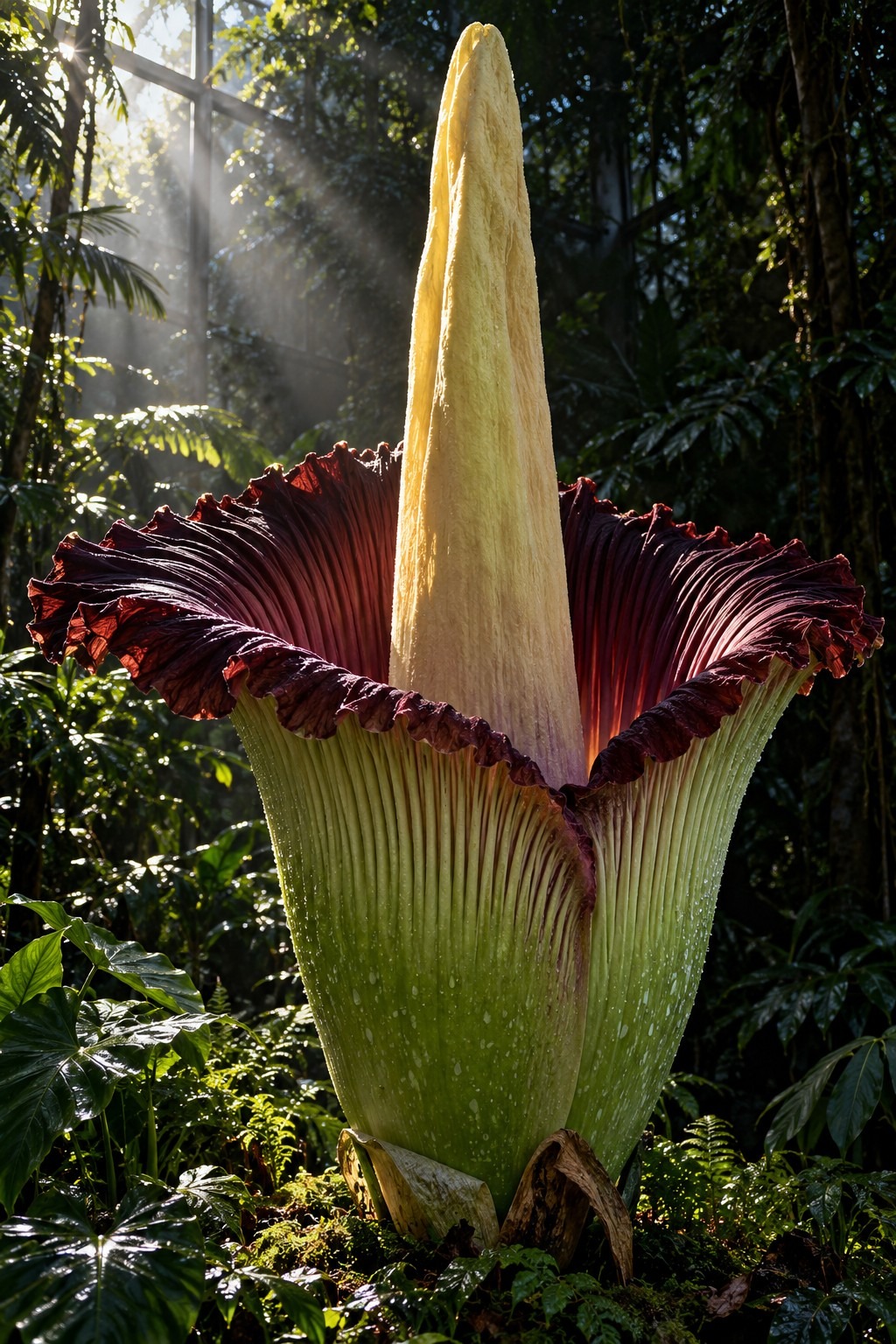
In short: Amorphophallus titanum blooms rarely because flowering is triggered by stored mass, not by age — the corm needs years of single-leaf photosynthesis to bank enough energy, and one bloom drains most of it.
- 7–10 years — typical wait from seed to a first bloom
- 18–23 kg — approximate corm mass needed before flowering is possible
- 153.9 kg — heaviest corm on record (Royal Botanic Garden Edinburgh, 2010)
- 3.225 m — tallest inflorescence on record (Meise Botanic Garden, Belgium, 13 August 2024)
- 24–36 hours — how long the open bloom lasts
- ~162 — wild individuals actually documented in Sumatra, per a 2025 study
Key Facts
- A titan arum corm must reach roughly 18–23 kg before it can flower; the record corm weighed 153.9 kg (Royal Botanic Garden Edinburgh, 2010).
- First bloom typically takes 7–10 years from seed, per Chicago Botanic Garden.
- The tallest recorded inflorescence measured 3.225 m, at Meise Botanic Garden, Belgium, on 13 August 2024.
- A bloom opens and closes within 24–36 hours, with bud elongation of 10–15 cm per day.
- During bloom, male florets heat to 35.9°C versus ~26°C ambient air, measured by Wilhelm Barthlott’s team at Bonn and published in Plant Biology, 2009.
In short: The titan arum flowers only after its underground corm stores roughly 18–23 kg of mass, a process taking 7–10 years for a first bloom. The open flower lasts 24–36 hours, heating itself to nearly human body temperature and releasing sulfur-based odors to attract pollinators, as documented by botanic garden researchers.
Twenty kilograms of underground savings
Strip the theatre away and Amorphophallus titanum is a storage problem with a flower attached. Underground sits a corm — a swollen stem base, not a bulb, not a potato — and everything the plant will ever spend comes out of it. Growers at botanic gardens literally weigh theirs. That sounds absurd until you realise the weight is the only honest forecast anyone has.
By the time a corm clears somewhere around 18 to 23 kilograms, flowering becomes possible. Below that, the plant keeps saving. Chicago Botanic Garden puts the first-bloom window at seven to ten years from seed, and most other collections quote the same range. Those years are not a waiting period. They are a deposit schedule.
Here’s the thing most bloom-watch coverage skips: the plant is not counting birthdays. A seedling that is fed well, potted up as it swells, and kept warm, humid and bright can reach threshold years ahead of a neglected sibling of identical age. Same species, same genetics, wildly different timetable.
One leaf a year, and then a decision
Between blooms, the titan arum does something that looks almost modest. It sends up one leaf. One — but a single leaf the size of a small tree, reaching up to 4.7 metres, carried on a petiole about as thick as a human thigh and splitting into a canopy of leaflets that runs as a solar array for nine to twelve months.
Then the leaf yellows and collapses, the corm sits dormant for a few months, and the plant chooses again: another leaf, or a flower. Nobody has found a reliable way to read that choice in advance. Gardens notice the difference only once the new shoot starts to swell — a flower bud is fat and blunt, a leaf spike is slimmer — and experienced growers have announced a bloom and got a leaf.
When it is a bud, the pace changes completely. Elongation of 10 to 15 centimetres a day is routine, which is how a dormant pot in a greenhouse corner becomes a three-metre event in a matter of weeks. On 13 August 2024 a plant at Meise Botanic Garden in Belgium was measured at 3.225 metres — the tallest inflorescence ever recorded for the species.
{IMAGE_2}
Why one garden says ten years and another says three
Read five botanic-garden pages and you will collect five different intervals: ten years, seven to ten, three to seven, two to three, and occasionally “it flowered again last summer”. All of them are true. They describe different plants at different points on the same curve.
So which number should a visitor trust? Whichever one matches the corm in that particular greenhouse — because a first bloom and a sixth bloom are not the same event. A first bloom has to build the machine; later ones only have to refuel it, and a corm already carrying 40 or 50 kilograms rebuilds a flowering budget far faster than a 20-kilogram one. Bonn’s much-photographed 117-kilogram corm pushed out three inflorescences simultaneously in May 2006.
| Stage of the plant | Typical interval to a bloom | What sets the limit |
|---|---|---|
| Seed to first flowering | 7–10 years, sometimes longer | Corm must be built from nothing to roughly 20 kg |
| Established corm, ordinary care | 3–7 years | Replacing the mass burned by the previous bloom |
| Large corm, intensive cultivation | 2–3 years | Surplus reserves; one leaf cycle can be enough |
| Wild plants in Sumatra | Not reliably documented | Too few known individuals to track over time |
Which leaves that last row as the embarrassing one. For a plant this famous, no proper field study of titan arum pollination in Sumatra has yet been published, and wild flowering intervals are essentially unrecorded. Every confident number we have comes from pots.
35.9 °C: the plant that heats itself
A bloom opens, usually in the late afternoon, and is done inside 24 to 36 hours. Into that window the plant packs two separate performances, and both cost energy.
Heat comes first. Working on a flowering specimen at the Botanical Gardens in Bonn, Wilhelm Barthlott and colleagues at the University of Bonn published measurements in Plant Biology in 2009 showing male florets reaching 35.9 °C while the surrounding air sat near 26 °C, with peak metabolic output of about 1.6 watts.
Roughly human body temperature, generated deliberately, by a plant. Warm air rises and rising air carries scent, so the heated spadix acts as a chimney for its own stench, lofting the signal out of the dense, still air near the forest floor where it would otherwise pool. Barthlott’s team titled their paper “A torch in the rain forest”, which is about right.
A landfill’s worth of sulfur, for two nights
Then there is the smell — and in 2025 it was finally measured properly. When a plant named Cosmo bloomed at Colorado State University in May 2024, atmospheric chemists Rose Rossell, Mj Riches and Delphine Farmer sampled the air around it continuously and published the results in Geophysical Research Letters in September 2025. Methanethiol dominated, with dimethyl disulfide, dimethyl sulfide and dimethyl trisulfide close behind. At peak, that one plant was releasing sulfur compounds at concentrations an order of magnitude above a small landfill.
For two nights. From a single plant. In a greenhouse.
Total emissions came to roughly 0.4% of the plant’s biomass — not a rounding error, but a genuine withdrawal from that hard-won corm. The team also found the female flowers doing most of the emitting, and shutting off abruptly by morning, which fits a mechanism known from related arums: floral trapping. Insects lured in on the first night are held inside the chamber through the day, then released into the second night, when the pollen is ready.
That pairing — a two-night chemical broadcast plus a daytime detention cell — is why a bloom this expensive can still work with only a handful of visitors.
What a corpse flower titan arum bloom is actually for
Everything above serves one transaction: pollen, moved between two different plants. Titan arums are strictly dichogamous, with female flowers receptive on the first evening and pollen shed only on the following night, so a single bloom cannot easily fertilise itself. Elegant design — and, for a species with roughly 162 documented wild relatives, brutal.
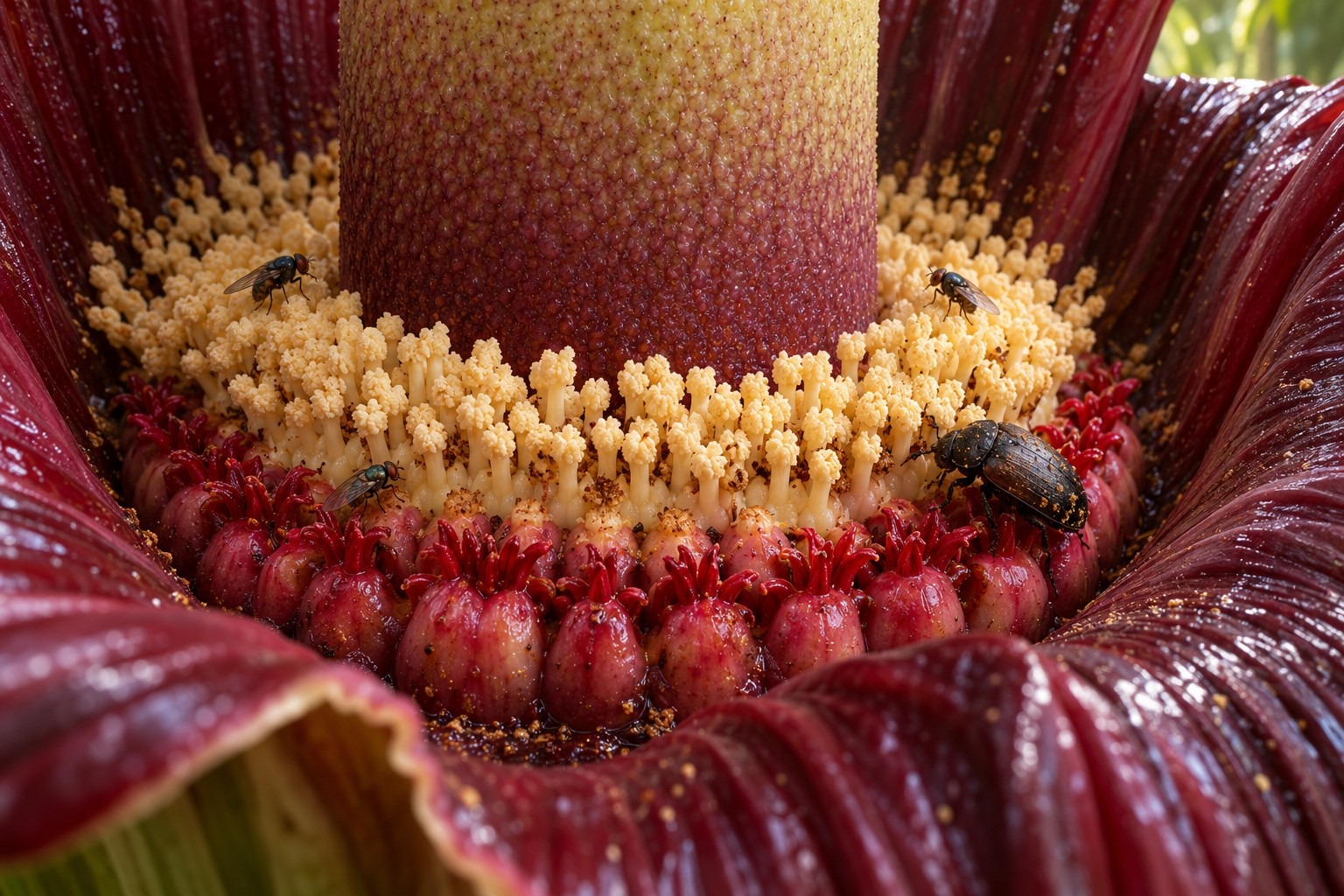
In Sumatra the visitors are carrion beetles and flesh flies, insects that make a living locating dead animals; the beetle Diamesus osculans is among those reported at blooms. They arrive expecting a corpse. If pollination succeeds, the spathe collapses and the spadix matures over about nine months into a column of bright red-orange fruits, which rhinoceros hornbills eat and carry away.
Two corrections worth making here. This is not the world’s largest flower; it is the largest unbranched inflorescence — a crowd of hundreds to thousands of tiny flowers (450 to 5,000 male florets alone) wrapped in a single modified leaf, the spathe. The single-flower record belongs to Rafflesia arnoldii, also Sumatran. And the plant does not die after flowering: it normally goes straight back to making leaves, and saving.
162 plants, 111 institutions: the rarity that counts
Which brings us to a number that deserves more attention than the bloom interval. In April 2025, Annals of Botany published a pedigree study of nearly 1,200 cultivated titan arums held by 111 institutions across four continents, led by Olivia Murrell of Northwestern University and the Chicago Botanic Garden. Twenty-four per cent of those plants were clones. A further 27% were offspring of close relatives. Fewer than a third of all recorded crosses were between unrelated individuals.
Record-keeping is as much to blame as biology. Parentage is routinely lost when corms change hands between gardens, so a curator pollinating a once-a-decade bloom often cannot tell whether they are crossing strangers or siblings. “If nothing changes, it could inbreed itself into extinction,” Murrell warned when the paper appeared. Wild numbers, meanwhile, keep falling: the IUCN lists the species as Endangered, estimates a population decline of more than 50% over roughly 150 years — driven by logging and the conversion of Sumatran forest — and puts the likely total at fewer than 1,000 individuals. Only about 162 have actually been documented, which is why the two figures differ.
The honest verdict is that the botanic-garden world has become superb at growing this plant and remains careless about recording who its parents were, and the second failure will outlast the first success. A fix is under way, and it is unglamorous: pollen banking. Chicago Botanic Garden and others now collect, dry and store pollen from blooms, keeping it viable for close to a year, so a flower opening in Illinois can be crossed with one that finished months earlier on another continent. Shared studbooks plus shared pollen is, right now, the entire plan.
Common Questions
How long does a corpse flower titan arum bloom last? Usually 24 to 36 hours from the spathe unfurling to collapse. Female flowers are receptive on the first evening and night, pollen is released the next night, and by the second or third day the whole structure is sagging. Queues at botanic gardens are long for a reason.
Can anyone predict when one will bloom? Not accurately. Growers track corm mass between cycles, which tells them a bloom is plausible, but the shoot itself gives only days to a couple of weeks of warning — and until it thickens, a bud and a leaf spike look much the same. Gardens announce “any day now” because that is genuinely all they know.
Does the plant die after it flowers? No. That myth borrows from agaves. A titan arum that has flowered normally returns to its leaf-and-dormancy cycle and rebuilds the corm, which is why the same named plants reappear in the news years apart.
Why does it smell like rotting meat? Because it is imitating one. Its dominant volatiles are sulfur compounds from the same chemical family responsible for rotten eggs and old cabbage, and the heated spadix volatilises and lofts them. Its target audience is carrion beetles and flesh flies hunting for a carcass to breed in — the flower offers the smell without the meal.
Sources and Notes
- Annals of Botany — Murrell et al., pedigree tracking of the ex situ metacollection of Amorphophallus titanum (April 2025)
- Geophysical Research Letters — Rossell, Riches and Farmer, Colorado State University, on corpse flower emissions and floral trapping (September 2025)
- Plant Biology — Barthlott, Szarzynski, Vlek, Lobin and Korotkova, “A torch in the rain forest: thermogenesis of the Titan arum” (2009)
- Chicago Botanic Garden — Titan Arum collection pages, FAQ and pollen-bank notes
- IUCN Red List of Threatened Species — Amorphophallus titanum assessment
Somewhere right now — in Illinois, in Belgium, in a glasshouse at Kew — a corm is a few kilograms short. It will push up one more enormous leaf, bank one more year of sunlight, and then, on no notice anyone can give you, spend the lot over a single weekend. Whether the species still has a future depends less on that weekend than on whether someone bothered to write down who its parents were.
Frequently Asked Questions
Q: Why does the corpse flower bloom so rarely?
Flowering depends on stored energy, not age. The underground corm must accumulate roughly 18 to 23 kilograms before a bloom is possible, and reaching that threshold typically takes seven to ten years from seed. Between blooms the plant grows only a single large leaf for nine to twelve months, storing energy, then goes dormant before deciding whether to produce another leaf or attempt a flower, which drains most of the reserve.
Q: How long does a titan arum bloom last?
A bloom opens, usually in the late afternoon, and lasts only 24 to 36 hours before closing. During that short window the plant performs two energy-costly feats: it heats its male florets to about 35.9°C, well above the surrounding air temperature of roughly 26°C, and it releases a strong sulfur-based odor to attract pollinators from the forest floor. Researchers at the University of Bonn documented the heating effect in 2009.
Q: What is the largest titan arum corm ever recorded?
The heaviest corm ever weighed 153.9 kilograms, belonging to a plant at the Royal Botanic Garden Edinburgh in 2010. Larger corms rebuild flowering reserves faster than smaller ones; Bonn’s 117-kilogram corm, for example, produced three separate inflorescences at once in May 2006. By contrast, a first-time bloomer must build its corm from nothing to around 18 to 23 kilograms, which is why initial flowerings take so much longer than later ones.
Q: Why does the corpse flower smell so bad, and has the smell been studied?
The odor comes from sulfur-based compounds released during the short bloom window. In 2025, atmospheric chemists Rose Rossell, Mj Riches, and Delphine Farmer sampled the air around a blooming plant named Cosmo at Colorado State University in May 2024 and published their findings in Geophysical Research Letters that September. Methanethiol was found to dominate the scent’s chemical makeup, part of why the smell carries so far from the flower.
Illustrations are AI-generated. Article fact-checked and human-edited. Our editorial standards.