Herculaneum Scrolls AI: Reading the Unopened Library
The Herculaneum scrolls AI breakthrough sounds like a magic trick: a computer read a book that no human hand can open, a book charred into a lump of carbon when Vesuvius buried the town in 79 AD. For nearly three centuries the story people told about these scrolls was simple and wrong — that the eruption destroyed a Roman library, and that whatever survived was a hopeless cinder. The truth is stranger. The scrolls survived because they burned. And the reason no one could read them for 1,944 years was not damage at all. It was that the writing had become invisible.
Key Facts
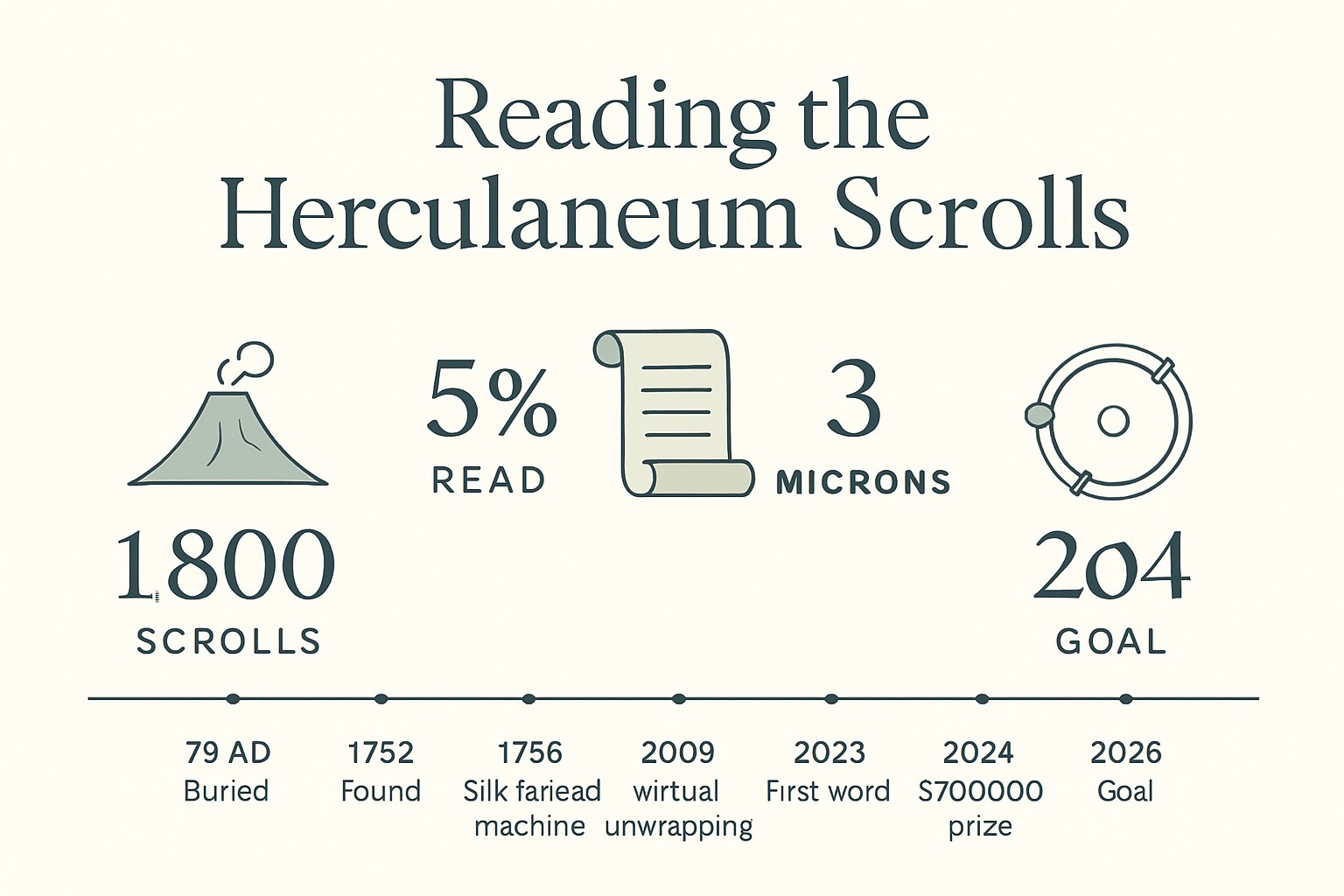
- Vesuvius buried Herculaneum in 79 AD under a pyroclastic surge of roughly 400°C and about 20 metres of volcanic material
- Well-diggers found the Villa of the Papyri in 1752, and over following years workers recovered more than 1,800 carbonised scrolls (~340 sealed and complete, ~970 partly decayed, ~500 fragments)
- Dr. Brent Seales of the University of Kentucky proved virtual unwrapping in 2015 on a charred En-Gedi scroll, recovering the opening chapters of the Book of Leviticus
- Nat Friedman and Daniel Gross launched the Vesuvius Challenge in March 2023, releasing raw scan data publicly; the $700,000 Grand Prize was awarded 5 February 2024
- The winning team was Luke Farritor (21, SpaceX intern), Youssef Nader (Egyptian graduate student in Berlin) and Julian Schilliger (robotics student at ETH Zurich); about 2,000 characters, roughly 5% of one scroll, were read
In short: The Herculaneum scrolls, carbonised by Vesuvius in 79 AD, could not be read because carbon ink on carbon papyrus is invisible. Brent Seales developed virtual unwrapping, and the 2023 Vesuvius Challenge crowdsourced the ink-detection breakthrough. On 5 February 2024 a $700,000 prize was awarded for reading about 2,000 characters.
The library a volcano saved by destroying it
Start with the misconception, because it’s the one almost everyone carries. When Vesuvius erupted, a pyroclastic surge — a fast wall of gas and ash estimated at roughly 400°C — swept through the seaside town of Herculaneum. You would expect fire that hot to reduce a papyrus library to nothing.
It did the opposite. The heat drove out the moisture and oxygen and turned the scrolls to carbon before they could rot, then packed them under twenty metres of volcanic material that set as hard as rock. Deprived of air and water — the two things that destroy old paper — the books simply stopped decaying. They were cremated and preserved in the same instant. That single villa, the Villa of the Papyri, is still the only library to reach us intact from the ancient world.
Well-diggers stumbled onto it in 1752. Over the following years workers pulled out more than 1,800 scrolls, most of them looking like blackened chunks of firewood. Nobody standing in that tunnel could have guessed they were holding the last surviving books of a lost civilisation.
Why nobody could just unroll them
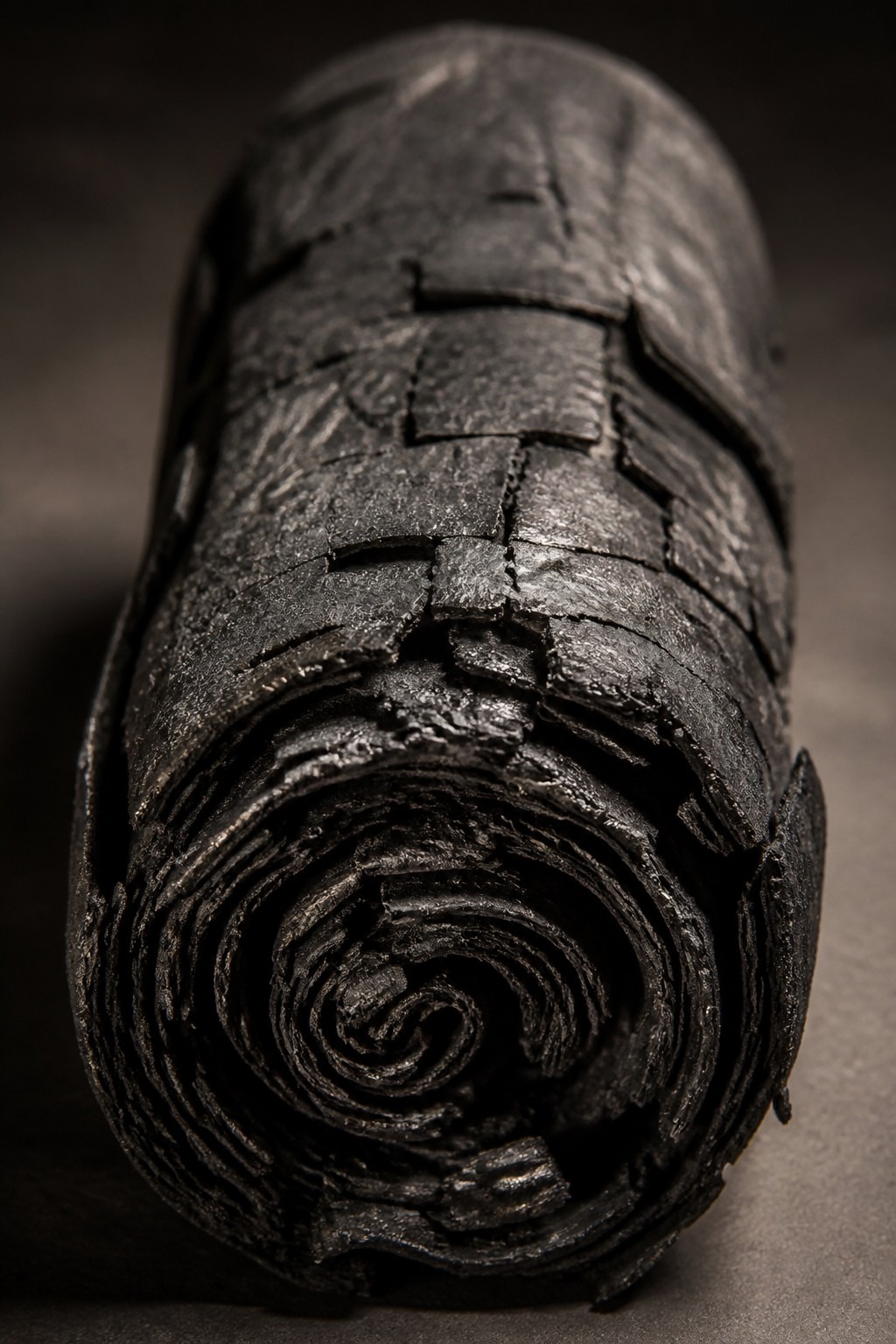
So why not open one and read it? Here’s the thing: the scrolls are not fragile in the way old books are fragile. They are fused. Two thousand years of heat and pressure welded each roll into a solid carbonised cylinder, layers of papyrus crushed together like the rings of a burnt log.
Worse, even a perfectly flattened sheet would look blank. Ancient scribes wrote with carbon-based ink — soot mixed with gum and water. Carbon ink sitting on carbon papyrus has almost exactly the same density and colour. To the naked eye, and to an ordinary X-ray, the letters are the same black as the page beneath them. The words were there the whole time. They were just hiding in plain sight.
Nearly three centuries of failed rescue attempts
The early rescuers were not fools; they were simply trying to solve the wrong problem. They kept trying to open the scroll.
In 1756 the Vatican conservator Antonio Piaggio built a machine of silk threads and weights that peeled a scroll apart a hair’s breadth at a time — a process so painstaking it could take four years to unwind a single roll, and it shredded many of them. Between 1802 and 1806 the Englishman John Hayter unrolled around two hundred papyri, salvaging some and ruining others. In 1819 the chemist Humphry Davy tried dissolving the layers apart with chlorine gas and other reagents; the chemicals ate the papyrus. Much later, in 1969, the Italian scholar Marcello Gigante founded a dedicated research centre in Naples to study what remained. Every generation threw its best technology at the problem, and every generation left a trail of destroyed books behind it.
Frame it that way and the modern AI result stops looking like a lone eureka moment. It’s the punchline to a 270-year engineering struggle — the first method that finally refused to touch the scroll.
{IMAGE_2}
- 79 AD — Vesuvius buries Herculaneum under a surge of roughly 400°C
- ~1,800 carbonised scrolls recovered from 1752 onward
- ~340 sealed & complete · ~970 partly decayed · ~500 fragments
- $700,000 Grand Prize awarded 5 February 2024
- ~2,000 characters read so far — about 5% of one scroll
- ~8 TB of scan data generated per scroll
- End of 2026 — the challenge’s stated goal to read every sealed scroll
Brent Seales and the idea of not opening the scroll at all
The change in thinking came from Dr. Brent Seales, a computer scientist at the University of Kentucky who had spent years digitally restoring damaged manuscripts. His insight, developed through his EduceLab and Digital Restoration Initiative from around 2009, was to stop treating the scroll as an object to be unrolled and start treating it as a puzzle to be solved in software.
The method is called virtual unwrapping. You scan the intact, sealed scroll in extremely high-resolution 3-D using a particle accelerator, then a computer traces each wound-up layer of papyrus through the scan, digitally flattens it into a flat sheet, and searches that surface for ink. Seales proved the concept in 2015 on a charred Hebrew scroll from En-Gedi, recovering the opening chapters of the Book of Leviticus from what looked like a piece of charcoal.
Herculaneum was the far harder test. The En-Gedi ink contained metal, so it glowed on a scan. The carbon ink of Herculaneum did not. Seales could unwrap the scroll in software — but the flattened page still came back blank.
How the Vesuvius Challenge turned prize money into a Discord server
By 2023 the pieces existed but the last problem — actually detecting the invisible ink — was stuck. The unlock was not a bigger lab. It was a competition.
Nat Friedman, the former head of GitHub, and the investor Daniel Gross put up a prize pot and launched the Vesuvius Challenge in March 2023, built on Seales’ scans and software. They did something academia rarely does: they released the raw scan data publicly and invited anyone on Earth to try. Thousands of coders, students and hobbyists poured into a Discord server, sharing code and half-solutions in the open.
The people who cracked it were not senior professors. Luke Farritor was a 21-year-old SpaceX intern from Nebraska. Youssef Nader was an Egyptian graduate student in Berlin. Julian Schilliger was a robotics student at ETH Zürich in Switzerland. Three strangers, coordinating over chat across three continents, out-solved a problem that had beaten every institution for 270 years.
The Herculaneum scrolls AI trick: reading ink you cannot see
This is the part almost every headline skipped, and it’s the most beautiful detail in the whole story. The AI does not find the ink by looking for something darker. It finds it by looking for something higher.
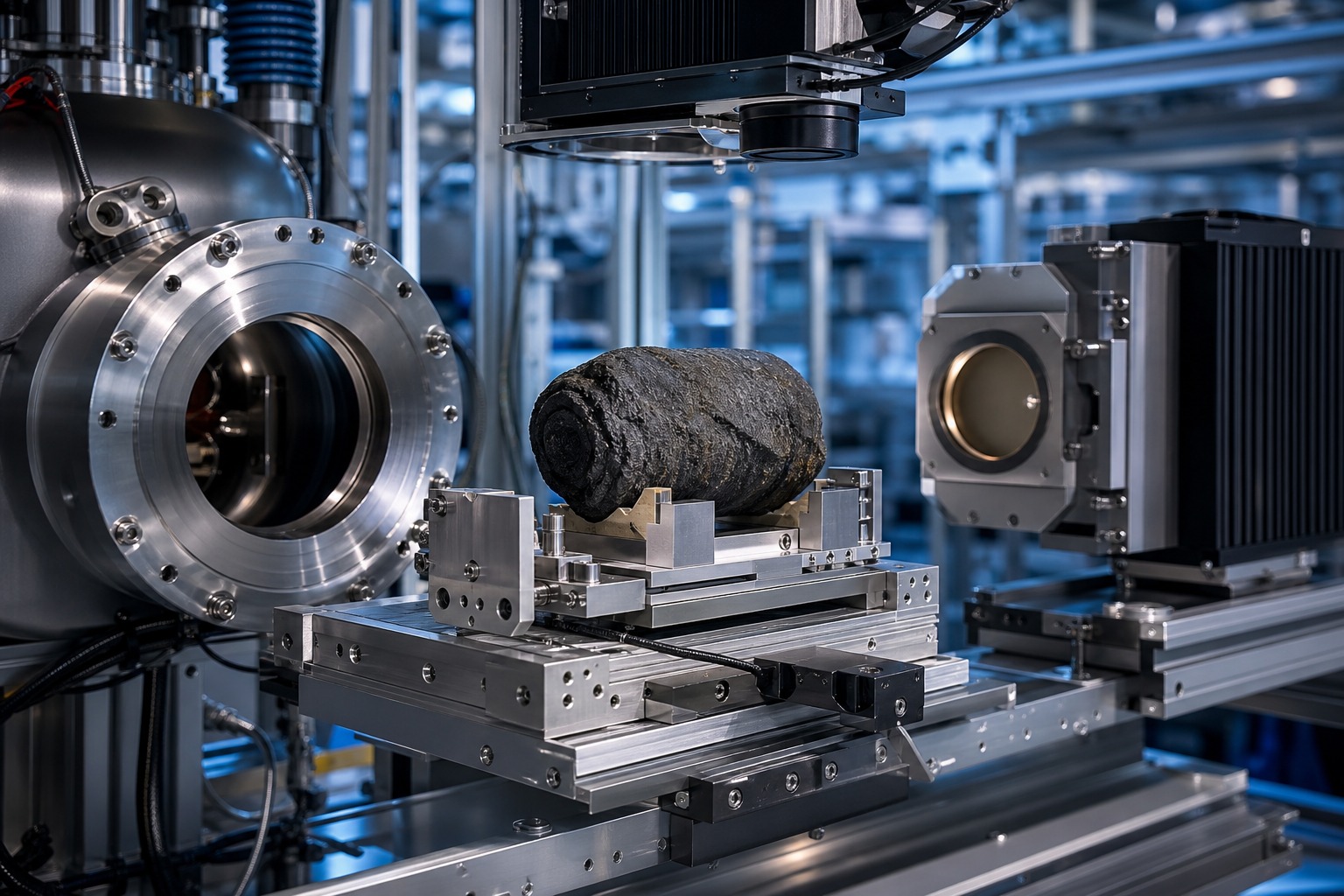
When a scribe brushed ink onto papyrus, the dried ink sat a few microns above the surface of the sheet, like the faintest raised varnish. Scanned at high enough resolution at the Diamond Light Source synchrotron in Harwell, England, that microscopic bump shows up as a subtle change in texture — a topography — even though the ink and the page are the same density and colour. Farritor and the others trained machine-learning models to spot that faint “crackle” pattern of raised ink across a flattened page, then reveal the letters hiding in the texture.
That detail — that the writing was never hidden by darkness but by flatness — is the single most quietly astonishing fact about the project, and it is exactly the part the news cycle waved away as a black box. The ink was never gone. It was three microns too subtle for two thousand years of human eyes.
Porphyras, the Grand Prize, and a philosopher named Philodemus
In October 2023 Luke Farritor became the first person in nearly two millennia to read a word from inside a sealed Herculaneum scroll: porphyras — the Greek πορφύρας, meaning “purple.” It won him the challenge’s $40,000 First Letters Prize.
They read it without opening it.
Months later, on 5 February 2024, Nader, Farritor and Schilliger shared the $700,000 Grand Prize for extracting around 2,000 legible Greek characters — roughly fifteen columns, about 5% of a single scroll. The text turned out to be Epicurean philosophy: a meditation on pleasure, scarcity and whether things we enjoy in abundance are worth less than rare ones. One translated passage runs, in effect, that in the case of food we do not immediately assume the scarce is more pleasant than the plentiful.
The author, it later emerged, was Philodemus of Gadara, an Epicurean philosopher whose books filled the villa (44 of his works have been identified among the papyri). In May 2025 researchers went further: for the first time they read a scroll’s title. A separate sealed roll catalogued as PHerc. 172 — scanned at Diamond Light Source in July 2024 and held at the Bodleian Library in Oxford — was identified as Philodemus’ treatise On Vices. The title was spotted by Sean Johnson of the Vesuvius Challenge and, independently, by Marcel Roth and Micha Nowak of the University of Würzburg. Its subject is ancient ethics: arrogance, flattery, and how to run a household virtuously — a Roman self-help book, sealed since Nero was alive.
What is still buried beneath the villa — and the 2026 deadline
Now the sobering part. For all the noise, only a sliver of one scroll has been fully published. Of the roughly 1,800 recovered rolls, around 340 are still sealed and complete — the real prizes — while some 970 are partly decayed and about 500 survive only as fragments. Reading them all is a matter of grinding automation, not one more miracle.
And the villa itself is mostly still underground. Only part of the Villa of the Papyri has ever been excavated. Classicists including Richard Janko and Robert Fowler have argued that its lower floors — never dug out — may hold a second, larger library, quite possibly of Latin works. If they are right, buried beneath Herculaneum could be lost dialogues of Aristotle, poems of Sappho or Ennius, plays we know only as titles. That is speculation, and it should be labelled as such: no one has seen those rooms. But it is speculation from serious scholars, not fantasists.
There is also a clock. The scrolls are still physically fragile, and Nat Friedman has said publicly that the goal is now to read every sealed scroll by the end of 2026. The challenge has shifted from proving it’s possible to automating it at scale — turning a heroic one-off decipherment into an assembly line for resurrecting a lost library.
Belief vs evidence
Because this story is so easy to garble, here is what people commonly assume set against what the evidence actually shows.
| Common belief | What the evidence shows |
|---|---|
| Vesuvius destroyed the library. | The ~400°C surge carbonised and sealed the scrolls from air and water — which is the only reason they still exist. |
| The AI sees the ink because it is darker. | Carbon ink on carbon papyrus is the same density and colour; the model reads a few microns of raised texture, not contrast. |
| They unrolled the scroll to read it. | It was scanned intact at a synchrotron and “virtually unwrapped” in software — never physically opened. |
| We’ve basically read them all now. | Only about 5% of one scroll is published; hundreds of sealed rolls — and possibly a buried Latin library — remain. |
The short answer: AI didn’t magically restore ruined books — it detected microscopically raised ink inside intact, scanned scrolls that human eyes and ordinary X-rays could never resolve. The first words are Epicurean philosophy by Philodemus, and the vast majority of the library is still waiting to be read.
Sources
- Vesuvius Challenge (scrollprize.org) — official First Letters and Grand Prize announcements
- University of Oxford, Bodleian Libraries — press release on PHerc. 172, February 2025
- EduceLab / University of Kentucky — Dr. Brent Seales, Digital Restoration Initiative
- Diamond Light Source, Harwell, UK — synchrotron scanning of the Herculaneum papyri
- University of Würzburg — Marcel Roth and Micha Nowak, title identification
- CNN Science reporting on the decipherment, 2024–2025
Two thousand years ago a librarian in a Roman villa shelved a book about how to live well, and then the mountain came. The book survived every catastrophe the ancient world could throw at it — fire, burial, four centuries of well-meaning scholars trying to pry it open — only to be read, at last, by a 21-year-old and a laptop who never touched it. Somewhere under Herculaneum, the rest of the library is still down there in the dark, waiting for its turn.
Frequently Asked Questions
Q: Why did the Herculaneum scrolls survive the eruption of Vesuvius?
The scrolls survived because they burned. When Vesuvius erupted in 79 AD, a pyroclastic surge of roughly 400°C swept through Herculaneum, driving out moisture and oxygen and turning the scrolls to carbon before they could rot. The volcanic material then packed them under about 20 metres of debris that set as hard as rock. Deprived of air and water, the two things that destroy old paper, the books simply stopped decaying, cremated and preserved in the same instant.
Q: Why couldn’t anyone just unroll and read the scrolls?
Two thousand years of heat and pressure fused each roll into a solid carbonised cylinder, with layers of papyrus welded together like the rings of a burnt log. Even a flattened sheet looked blank, because ancient scribes wrote with carbon-based ink of soot, gum and water. Carbon ink on carbon papyrus has almost the same density and colour, so to the naked eye and to ordinary X-rays the letters were the same black as the page beneath them.
Q: What is virtual unwrapping and who invented it?
Virtual unwrapping is a software method developed by Dr. Brent Seales, a computer scientist at the University of Kentucky, through his EduceLab and Digital Restoration Initiative from around 2009. Instead of physically opening the scroll, a machine scans the sealed roll in high-resolution 3-D using a particle accelerator, traces each wound-up layer of papyrus, digitally flattens it into a sheet, and searches that surface for ink. Seales proved the concept in 2015 on a charred En-Gedi scroll.
Q: Who actually cracked the code to read the scrolls?
The people who cracked it were not senior professors but young coders drawn to the Vesuvius Challenge. Luke Farritor was a 21-year-old SpaceX intern from Nebraska, Youssef Nader was an Egyptian graduate student in Berlin, and Julian Schilliger was a robotics student at ETH Zurich in Switzerland. Coordinating over a Discord server where thousands shared code openly, these three strangers combined their work to detect the invisible carbon ink and win the $700,000 Grand Prize on 5 February 2024.
Illustrations are AI-generated. Article fact-checked and human-edited. Our editorial standards.