Bearded Vulture Red Feathers: Why It Bathes in Mud
Bearded vulture red feathers are mud. Not pigment, not genetics, not diet — iron-rich ochre that the bird finds in a mountain spring, lowers itself into, and then works through its own plumage with beak and feet. Every bearded vulture hatches and grows up in creamy white. The rust-orange head, neck and belly you see on an adult Gypaetus barbatus is applied from the outside, deliberately, by the bird wearing it. No other European bird does anything comparable, and after three decades of research nobody can say for certain why this one does.
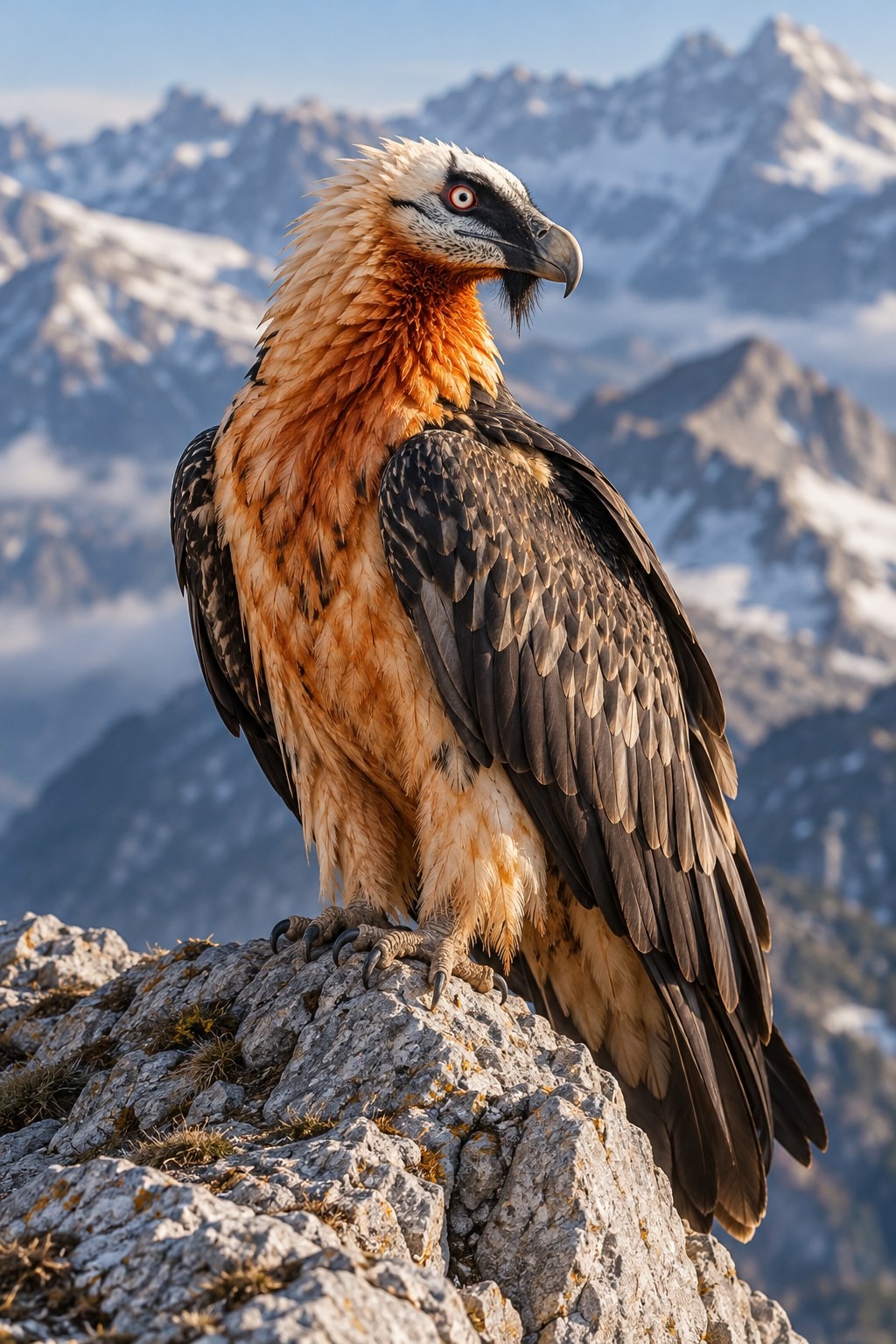
- The bird: bearded vulture (Gypaetus barbatus), wingspan roughly 2.3–2.8 m, globally listed as Near Threatened since 2014.
- The paint: iron oxide particles — ochre — sitting on the outside of the feather, not produced inside it.
- The diet it goes with: around 85% bone, cracked open by dropping it from 50–150 m onto rock slabs.
- How common is deep red: among 162 Pyrenean adults scored between 2016 and 2020 — white 2%, pale 22%, medium 67%, dark 9%.
- It bathes alone: 93.5% of 33 recorded visits to one monitored spring involved a single bird, and bathing only ever happened when a bird was by itself.
Key Facts
- Bearded vulture (Gypaetus barbatus) has a wingspan of roughly 2.3-2.8 m and has been listed as Near Threatened since 2014.
- The red colour is iron oxide (ochre) sitting on the outside of the feathers, identified by Juan Jose Negro and colleagues in a 1999 Animal Behaviour study.
- About 85% of the bird’s diet is bone, cracked open by dropping it from 50-150 m onto rock slabs.
- Among 162 Pyrenean adults scored between 2016 and 2020, feather colour broke down as white 2%, pale 22%, medium 67%, dark 9%.
- A camera-trap study at a Spanish Pyrenees spring found that of 24 identifiable visiting birds, only 10 were adults; the other 14 were juveniles, immatures or subadults.
In short: Bearded vultures are not born red – they deliberately bathe in iron-rich ochre mud at remote mountain springs, staining their white head, neck and belly feathers orange. Confirmed as iron oxide by researchers in 1999, the colouring is mostly solo behaviour and may be more than just a badge of adult status.
The ochre: bearded vulture red feathers, mud and iron
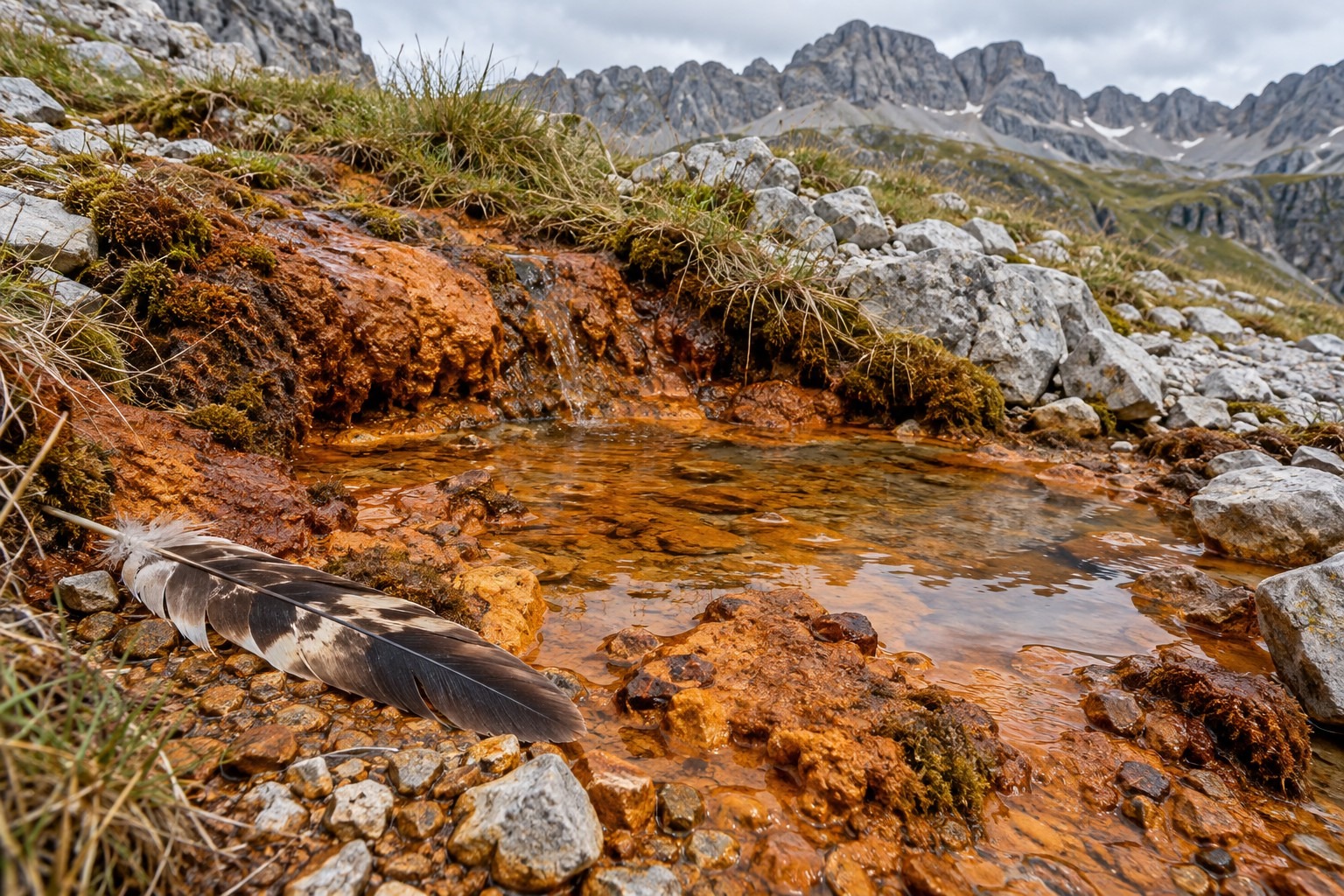
Pull a stained feather off a Pyrenean cliff ledge and look closely and the colour is obviously external. It coats. It sits in and between the barbs like dust on a windowsill, and it can be worked loose. Analyses of stained plumage by Juan José Negro and colleagues, published in Animal Behaviour in 1999, identified the responsible material as iron oxides — the same family of compounds that makes rust orange, makes Mars red, and gave prehistoric painters their ochre.
That distinction matters more than it first appears. Birds produce a long list of their own pigments: melanins for black and brown, carotenoids from food for the flamingo’s pink and the goldfinch’s yellow, porphyrins, even structural blues built from the microscopic architecture of the feather itself. A bird that borrows a mineral from the landscape and wears it belongs to none of those categories. Ornithologists call this adventitious colouration — colour the animal acquires rather than grows.
And because it is acquired, it is also temporary. The stain rides on the feather until that feather is replaced, which in a slow-moulting giant can take years for some tracts. One satellite-tagged bird in the Spanish Pyrenees was logged returning to the same spring seven times in a single year. Topping up, in other words.
The spring: where the red water comes from
The ochre does not come from ordinary soil. These birds seek out ferruginous springs — seeps where groundwater that has moved through iron-bearing rock surfaces and meets the air. Underground, with little oxygen available, iron travels dissolved and invisible. At the surface it oxidises within minutes and drops out of solution as a slurry of iron oxides and hydroxides, coating pebbles, moss and the lip of the pool in that unmistakable orange-brown sludge.
Such springs are small, scattered, and often tucked into exactly the kind of remote high ground a bearded vulture already patrols. That geography fed one of the earliest ideas about the behaviour: a bird wearing strong colour has proved it knows where a hidden chemical resource is, and has the range and the confidence to use it. The colour, on that reading, is a résumé.
Deliberate bathing in such pools was finally documented in wild birds in the Pyrenees in 1995 and again in 1998 — late, for a bird this large and this watched, which tells you how rarely anyone gets to see it happen.
The application: how a vulture paints itself
Captive birds gave researchers the clearest view of the mechanics. Offered damp red soil, bearded vultures went for it immediately — pressing the belly and neck into it, then using the beak and the talons to drag and smear the material up over the chest, the shoulders and the upper back. It is not a passive wallow. It is grooming, run in reverse.
Targeting is specific, too. Head, throat, breast and belly go orange; the back and wings stay dark grey-black. Those are precisely the surfaces another bird sees when a bearded vulture turns to face it head-on, or sails past at eye level along a ridge.
Turns out the urge is strong enough to produce substitutes when the real thing is missing. In a paper on ochre bathing published in 2016, Helmut Tributsch recounts a bearded vulture at Basel Zoo that, with no red mud available, gathered red autumn leaves and worked them against its plumage instead. Make of that what you will — it is a single zoo anecdote, not an experiment — but it is hard to read as anything other than a bird trying to get a job done.
{IMAGE_2}
The timing: a colour that arrives late
Bearded vultures take a long time to grow up. A fledgling is dark and scruffy; full adult plumage, with the pale head and the black bandit mask and the long bristles under the chin that give the species its name, arrives only at around five to seven years old. Accounts of the staining habit have traditionally lined it up with that milestone — an adult accessory, picked up on the threshold of breeding.
Recent field data complicates that neat story. When Antoni Margalida, Ivan Almirall and Juan J. Negro put camera traps on a ferruginous spring in the Spanish Pyrenees and left them running, half of the 24 identifiable birds that turned up were not adults at all: four juveniles, three immatures and six subadults, against ten adults. The authors read that mix as a reason to doubt the simplest dominance story — if ochre were purely a badge of rank, young subordinate birds would have little reason to queue for it.
Their alternative is subtler: the colour may work as an attenuating signal, something that softens how aggressively a bird is treated rather than broadcasting raw superiority. Useful, in that case, to a subordinate as well as to a boss.
Four explanations, one scoreboard
Popular accounts of this bird usually present two theories and leave it there — makeup or medicine, take your pick. The actual literature has four candidates and a quarter-century of results that have narrowed them unevenly. Here is where each one stands.
| Hypothesis | What it predicts | What the evidence shows |
|---|---|---|
| Status signal (Negro et al., 1999) |
Older, larger, dominant birds should be the reddest | Partly supported. Females — the larger sex — averaged darker than males across 162 Pyrenean adults; dominant males in trios trended darker but not significantly, and the overlap between groups was wide |
| Antibacterial feather protection (Arlettaz et al., 2002) |
Ochre-coated feathers should resist bacterial degradation | Not supported. Published experimental tests have found no protective or antibacterial effect of iron oxides on feathers |
| Embryo protection (transfer from brood patch to egg) |
Redder parents should hatch and fledge more young | Not supported. Breeding success did not differ between territories held by pale birds and those held by orange ones |
| Hygiene and odour control (Tributsch, 2016) |
Sunlit ochre should break down odour compounds and microbes on plumage | Untested in wild birds. Chemically plausible — haematite does generate reactive hydroxyl radicals in visible light — but no field test of the effect on living vultures exists |
So does a redder bird raise more chicks? No. The 2019 study that asked that question directly — Antoni Margalida with colleagues including Michael Wink of Heidelberg University, published in PeerJ — found breeding success was indistinguishable between pale and orange territory holders, which removed the most testable version of the medicinal argument. A separate analysis of Pyrenean breeding units, led by Duchateau with Pascual López-López of the Cavanilles Institute of Biodiversity and Evolutionary Biology at the University of Valencia, reached the same conclusion from the other direction: territory tenure and mating system predicted productivity, colour did not.
After thirty years and a shelf of papers, the honest reading is that the signalling explanation is the last one still standing, and that it is standing largely because its rivals fell — a weaker kind of victory than it sounds.
The solo ritual: what 207 camera-trap days showed
Camera traps have since added something no amount of theorising could, and almost none of it has reached general readers. Over 207 days of camera operation between October 2021 and February 2023, the spring drew bearded vultures on 33 days. Twenty-four individuals were identified. Visits averaged just over ten minutes, clustered between 09:00 and 16:00, and 80.9% of the birds showed up exactly once.
Then the detail that reframes everything: of those 33 visits, 93.5% involved a single bird — and across 15 recorded bathing events, not one happened with another vulture present. The spring was shared, but sequentially, one bird at a time.
Never together.
That is a strange thing for a pure advertisement to be. Signals are normally produced in company; this one is manufactured in private, like a stage costume. Whether the secrecy protects a scarce resource, avoids conflict at a vulnerable moment, or means something else entirely, the camera traps cannot say — but any explanation of ochre bathing now has to account for a bird that will not do it while being watched.
The claim that should be retired: not the only bird
Almost every popular article on this species — and you will find the line repeated on wildlife sites, in listicles and in otherwise careful books — states that the bearded vulture is the only bird known to decorate itself. That claim was accurate for a long time. It has been out of date since 2017.
In that year, Thijs van Overveld, Manuel de la Riva and José Antonio Donázar reported in the journal Ecology that Egyptian vultures on Fuerteventura, in the Canary Islands, do the same thing: dipping head, neck and chest into red soil until their white plumage turns rusty. They tested it, too. Offered two bowls side by side — one clean water, one tinted with red earth — 18 of 91 visiting birds chose the tinted bath, while a single bird chose the clean one. The authors concluded the function was most likely visual, given how dramatically the treatment changes a bird that is otherwise white.
Two unrelated vultures, well separated on the family tree, arriving at the same solution with the same material. That convergence is the piece the popular write-ups are still missing — and it is a better story than uniqueness ever was.
Common Questions
Does the red colour wash off in the rain? It is a surface deposit, so it fades and wears rather than being locked in, and it disappears for good when the stained feathers are moulted. That is almost certainly why birds return — the GPS-tracked individual that visited one spring seven times in a year was, functionally, reapplying.
Are males or females redder? On average, females. Across 162 adults scored in the Pyrenees, females were darker than males, which fits the status-signal idea because females are the larger sex in this species. The overlap is large, though — you cannot sex a bearded vulture by eye from its colour.
Do the young birds do it as well? Camera traps found juveniles, immatures and subadults at a ferruginous spring alongside adults, with non-adults making up half the identified visitors. Older accounts that describe the habit as strictly adult look too tidy in light of that.
Is the iron oxide actually good for the bird? Nobody has shown that it is. The antibacterial and embryo-protection versions of that idea have both failed their tests, and the odour-and-hygiene version has never been tested on wild birds at all. Honest answer: unknown, and currently unsupported.
Sources and Notes
- Margalida, Almirall & Negro, Animals (2023) — camera-trap and GPS study of a ferruginous spring in the Spanish Pyrenees
- Margalida, Braun, Negro, Schulze-Hagen & Wink, PeerJ (2019) — test of the antibacterial function of cosmetic colouring
- Duchateau, Chéliz, Gil & López-López, Ibis (2022) — adult colouration, sex, mating system and productivity in the Pyrenees
- van Overveld, de la Riva & Donázar, Ecology (2017) — cosmetic colouration and mud bathing in Egyptian vultures
- Negro et al., Animal Behaviour (1999) and Arlettaz et al., Animal Behaviour (2002) — the original status-signal and medicinal hypotheses; Tributsch, Animals (2016) — the ochre hygiene hypothesis; Vulture Conservation Foundation and BirdLife International for population and status figures
What stays open is not really what ochre does. It is why one bird in Europe, and one in the Canaries, found a mineral in a spring and decided it belonged on their chests — and why the bearded vulture will only put it on when nothing else is looking. Until someone catches that moment often enough to test it, the reddest bird on the ridge keeps its reason to itself.
Frequently Asked Questions
Q: Why do bearded vultures have red feathers?
The red colour is not a natural pigment but iron-oxide (ochre) mud that the bird gathers from ferruginous mountain springs and works into its own feathers with its beak and feet. Every bearded vulture hatches and grows up creamy white; the rust-orange tone on the head, neck and belly is applied deliberately from the outside. Analysis published in Animal Behaviour in 1999 by Juan Jose Negro and colleagues confirmed the staining material is iron oxide, not a pigment the bird produces internally.
Q: How does a bearded vulture apply the ochre to its feathers?
Captive birds press their belly and neck into damp red soil, then use their beak and talons to drag and smear the material over the chest, shoulders and upper back, leaving the back and wings dark grey-black. In one recorded case at Basel Zoo, a bird with no mud available instead gathered red autumn leaves and worked them against its plumage, suggesting a strong drive to acquire the colour even when the preferred material is missing.
Q: Is red colouring found only on adult bearded vultures?
No. A camera-trap study at a ferruginous spring in the Spanish Pyrenees recorded 24 identifiable birds, and only 10 were adults – the rest were four juveniles, three immatures and six subadults. This mix suggests the ochre may act as a more nuanced, attenuating signal rather than simply a badge of adult dominance, since young and subordinate birds sought it out too.
Q: Do bearded vultures bathe in these springs together?
Rarely. Of 33 recorded visits to one monitored spring, 93.5% involved just a single bird, and bathing only ever happened when a bird was alone. One satellite-tagged bird in the Spanish Pyrenees returned to the same spring seven times in a single year, indicating individual birds revisit known springs repeatedly to top up their colouring over time rather than bathing in groups.
Illustrations are AI-generated. Article fact-checked and human-edited. Our editorial standards.