The Hachiko Real Story: Who Ueno Actually Was
Strip away the films, and the Hachiko real story, Ueno included, is smaller, stranger and far better documented than the version printed on Shibuya souvenir tins. On 15 January 1924, a wooden crate came off a freight train at Ueno Station in Tokyo. Inside, reportedly in poor shape after a day and a night on the rails from a farm near Ōdate in Akita Prefecture, was a cream-coloured Akita puppy. The man who had sent for it was Hidesaburō Ueno — days short of his 52nd birthday, professor of agricultural engineering at Tokyo Imperial University, and the reason the dog ended up in bronze is that he had sixteen months left to live.

Key Facts
- The Akita puppy arrived by rail at Ueno Station on 15 January 1924, shipped from a farm near Ōdate, Akita Prefecture.
- Professor Hidesaburō Ueno died on 21 May 1925 at age 53, meaning he and Hachikō lived together for about sixteen months, not the two years shown in films.
- Ueno, born 19 January 1872 in Hisai, Mie Prefecture, founded Japan’s agricultural civil engineering discipline and trained more than 3,000 engineers.
- Journalist Saitō Hirokichi’s article in the Asahi Shimbun on 4 October 1932 turned Hachikō from a tolerated station fixture into a national sensation.
- The bronze statue at Shibuya Station, sculpted by Teru Andō, was unveiled on 21 April 1934 with Hachikō present; the dog died on 8 March 1935, aged 11.
In short: Hachikō was a real Akita dog owned by Tokyo University professor Hidesaburō Ueno for roughly sixteen months before Ueno’s death in 1925. A 1932 newspaper article about the dog’s station vigil made him a national sensation, leading to a 1934 bronze statue at Shibuya Station.
January 1924: a crate from Ōdate and a name nobody agrees on
Ueno had been asking around for a purebred Akita. A former student, Chiyomatsu Mase, found him one and arranged the shipment. Records kept by the Akita breeders and later compiled by Japanese dog historians put the puppy’s birth in mid-November 1923, which made him about two months old on arrival.
Where the name came from is genuinely unsettled, and the two competing explanations are both plausible. One holds that he was the eighth pup of his litter — hachi is Japanese for eight. The other says Ueno noticed that when the dog stood with his forelegs splayed, the gap between them traced the character 八, which also reads hachi. The honorific -kō, the suffix that turns a pet name into something closer to “Sir Hachi,” was attached later by admirers, not by his owner.
The household he joined was a quiet one. Ueno lived near Shibuya with Yaeko Sakano, his partner of roughly a decade. They never married — a detail that sounds like trivia and turns out, ninety years later, to matter enormously.
The Hachiko real story starts with Ueno, not the dog
Here’s the thing almost every retelling skips: the professor was not a minor character who happened to own a famous animal. Hidesaburō Ueno was the founding figure of an entire Japanese discipline.
Born in Hisai, in what is now Tsu, Mie Prefecture, on 19 January 1872, he graduated from Tokyo Imperial University’s agriculture faculty in 1895 and spent the next five years on farm-implement research. By 1916 he held a full professorship. His field was nōgyō doboku — agricultural civil engineering, the unglamorous science of irrigation channels, drainage, and the reshaping of fragmented paddy fields into workable farmland. His 1905 lecture volume on land consolidation became a foundational text, and the reclamation methods he developed were pressed into service during reconstruction after the Great Kantō earthquake flattened the region in September 1923 — four months before his dog arrived. By one count he trained more than 3,000 engineers.
And the University of Tokyo, in its own feature marking the centenary of Hachikō’s birth in 2023, made the awkward admission out loud: the dog is known worldwide, while the man is barely recognised even by faculty walking past his memorial. Scholars in the Land Environmental Engineering lineage he founded still occupy his laboratory’s descendant today.
21 May 1925: the lecture that ended early
He collapsed at work. Accounts of the medical cause differ in wording — a cerebral haemorrhage in most Japanese sources, a ruptured aneurysm in others, both describing bleeding in the brain — and he died in a colleague’s room on the university grounds at the age of 53.
{IMAGE_2}
Note the arithmetic, because popular versions get it wrong. Ueno and Hachikō shared a house for about sixteen months, not “two years,” and certainly not the long companionship the movies imply. The dog was roughly eighteen months old when his owner stopped coming home.
What followed was unsentimental. Hachikō was handed to relatives in Nihonbashi, then to another household in Asakusa, then finally to Kozaburō Kobayashi, Ueno’s former gardener, who lived in Tomigaya — a short walk from Shibuya Station. From there the dog started turning up at the station, in the afternoons, among the commuters.
4 October 1932: the article that turned a dog into a nation’s mascot
For seven years nobody outside Shibuya cared. Station staff tolerated him; some did worse. He was shoved, swatted and, on at least one occasion, badly injured — one ear never stood straight again, which is why the statue shows a dog with a drooping left ear.
Then Saitō Hirokichi noticed him. Saitō had founded the Society for the Preservation of the Japanese Dog and was conducting a census of surviving purebred Akitas; his count came back at roughly thirty animals nationwide, Hachikō among them. He followed the dog home to Kobayashi’s house, learned the whole history, and wrote it up for the newspaper that became today’s Asahi Shimbun. The piece ran on 4 October 1932.
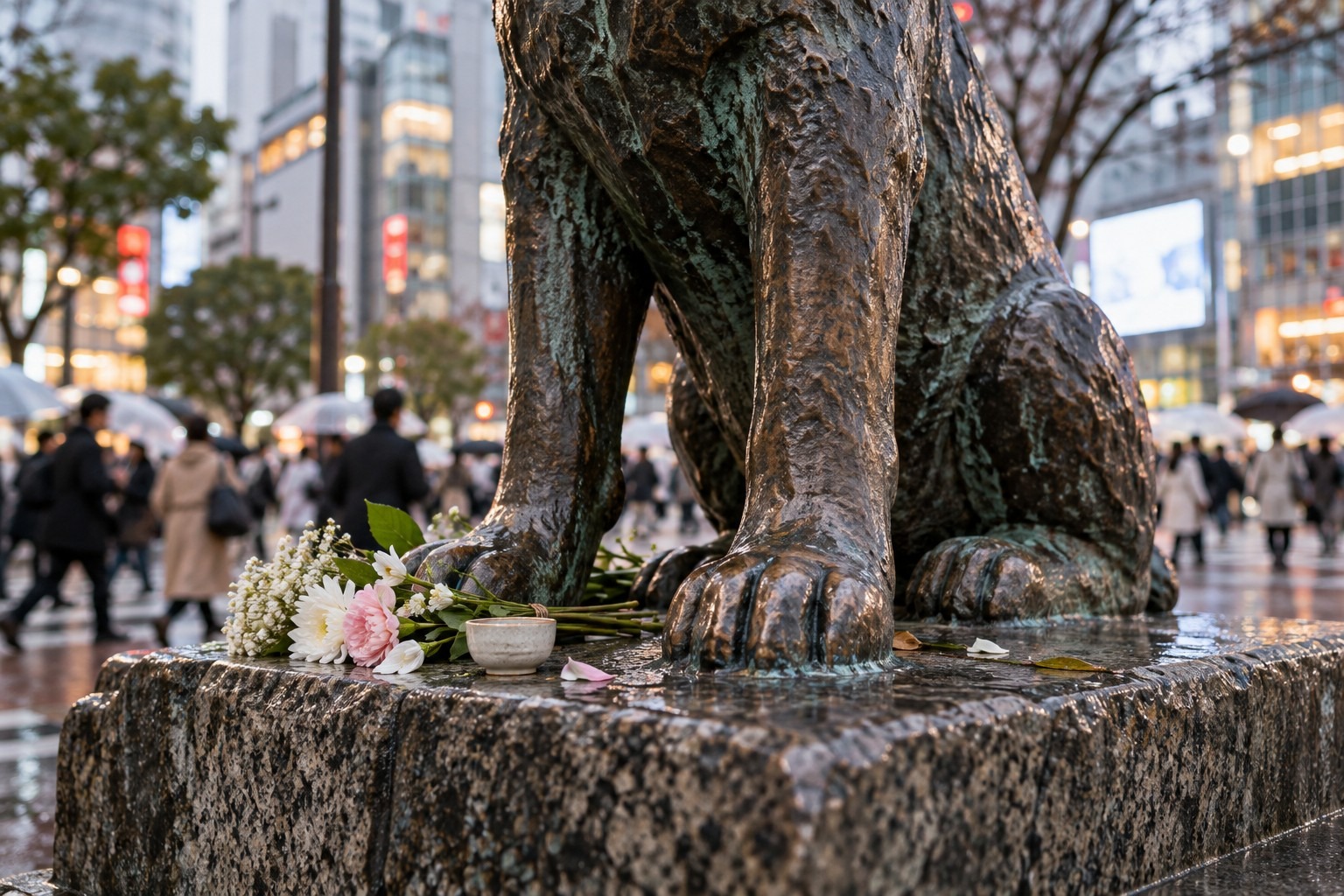
Everything changed that week. Readers sent food and letters. Vendors at the station fed him. A public subscription raised money for a bronze, sculpted by Teru Andō and unveiled outside Shibuya Station on 21 April 1934 in front of a large crowd — with the dog himself present at his own monument. Within the year he was in school readers, held up to Japanese children as a lesson in devotion.
- 19 Jan 1872 · Hidesaburō Ueno born, Hisai, Mie Prefecture
- 15 Jan 1924 · Akita puppy arrives by rail at Ueno Station
- 21 May 1925 · Ueno dies at the university, aged 53
- 4 Oct 1932 · Saitō Hirokichi’s article runs in the Asahi Shimbun
- 21 Apr 1934 · Shibuya statue unveiled; Hachikō attends
- 8 Mar 1935 · Hachikō dies, aged 11 — 9 years, 9 months, 15 days after Ueno
- Aug 1945 · Original statue melted down for wartime metal
- 15 Aug 1948 · Replacement unveiled, cast by the sculptor’s son
- Mar 2011 · Preserved organs re-examined; cause of death settled
- Mar 2015 · Statue of Ueno and Hachikō reunited, University of Tokyo
Loyalty, and the uses a country found for it
Timing is the uncomfortable part. Hachikō became a national symbol between 1932 and 1935 — precisely the years Japan was building the ideological machinery of empire, and precisely when a story about wordless fidelity to a dead master was most useful to the state.
Aaron Herald Skabelund, a historian at Brigham Young University, examines this directly in Empire of Dogs: Canines, Japan, and the Making of the Modern Imperial World, published by Cornell University Press in 2011. His argument, in short: the invention of the “Japanese dog” as a pure national breed, with Hachikō as its paragon, became one building block of a culture that venerated the nation, prized purity and demanded self-sacrifice. The dog was real. The moral lesson draped over him was manufactured, and it was taught in classrooms.
It is the same mechanism that buries a real person under a legend — the pattern behind stories like the real man remembered as Charlie No-Face, where the myth travels and the human being does not.
And then the state collected its own symbol. The 1934 bronze was taken down in October 1944 and melted in August 1945 for war material; a replacement went up on 15 August 1948, cast by Takeshi Andō, son of the man who made the first one. That second statue is the one millions of people photograph today.
The monument to loyalty was scrapped by the country that had taught it.
So why did he actually keep coming back?
Because something kept rewarding him — and there is no honest way to say how much of it was grief. Dogs navigate by routine and place, not by calendars or funerals. Hachikō had walked that route with Ueno for over a year; after 1932 the station became, quite literally, where the food was, as readers of the newspaper arrived with gifts. He also lived minutes away for most of those years.
Several historians have made the obvious point: an animal fed daily at a specific spot for the better part of a decade has every practical reason to return to it. Given the record, the maximalist reading — a dog consciously keeping a nine-year appointment with a man he knew was gone — probably cannot survive the evidence, and the story loses nothing worth keeping when you let it go.
What remains is still remarkable, and it is still unexplained. Hundreds of dogs lost owners in 1925 Tokyo. One of them attached himself to a railway exit and stayed. The oft-quoted “9 years, 9 months and 15 days” is arithmetically exact from Ueno’s death to Hachikō’s own — but it implies an unbroken daily vigil that the surviving records do not actually document.
8 March 1935: the autopsy that had to wait 76 years
He was found dead on a street near Shibuya, aged 11 — not 13, as several widely-read English sources still state; the November 1923 birth and March 1935 death allow no other answer. His funeral was held on 12 March, attended by station staff and by Yaeko Sakano. His pelt was mounted and is displayed at the National Museum of Nature and Science in Ueno, which means the dog of Professor Ueno, delivered as a puppy to Ueno Station, now spends his afterlife in Ueno. His internal organs went to the Faculty of Agriculture, where they were preserved in formalin and kept on the Yayoi campus.
For three generations the folk explanation for his death was a yakitori skewer, swallowed at the station, puncturing his stomach. In March 2011, researchers at the University of Tokyo examined those preserved organs properly. Veterinary pathologist Kazuyuki Uchida, one of the team, reported the findings publicly: terminal cancer — a carcinosarcoma — alongside a heavy infection of Dirofilaria immitis, the canine heartworm, with microfilariae concentrated around the heart and lungs.
Four yakitori skewers were indeed in his stomach. They had damaged nothing. The skewer story, retold for seventy-six years, was wrong; the dog was dying of cancer and parasites, both of them ordinary and both, in 1935 Tokyo, untreatable.
Where it all stands in 2026
Ueno is buried at Aoyama Cemetery, and Hachikō’s remains lie beside him. Yaeko Sakano, who had asked to be buried with the man she lived with for ten years, was not — she died in 1961 and was interred elsewhere, because she had never legally been his wife. Her request surfaced again in 2013, and after family consent and municipal paperwork, a portion of her ashes was finally placed with Ueno and the dog in 2016.
Nine decades late, the household was back together. In March 2015 — sources differ on whether the ceremony fell on the 8th or the 9th — the Faculty of Agriculture unveiled a second kind of reunion on its Yayoi campus: a bronze by Tsutomu Ueda showing Ueno home at last, bag in hand, with Hachikō leaping at his chest. Among the guests was an elderly woman who, as a child, had petted the actual dog.
Four places now hold a piece of this: the Shibuya statue (the 1948 recast), the grave at Aoyama, the reunion bronze at Yayoi, and the mounted hide in Ueno. Visit them in that order and you get the version that the plaques, individually, do not tell.
Quick Answers
How long were Hachikō and Ueno actually together? About sixteen months — from 15 January 1924 to 21 May 1925. The dog then outlived his owner by nearly ten years.
How old was Hachikō when he died, and of what? Eleven years and roughly four months. The 2011 re-examination of his preserved organs found terminal carcinosarcoma and a severe heartworm infection — not the swallowed skewer of legend.
Sources and Notes
- The University of Tokyo — official feature on Hachikō, Hidesaburō Ueno and the Faculty of Agriculture (centenary, 2023)
- The Japan Times — reporting on the March 2011 re-examination of Hachikō’s preserved organs
- Nippon.com (Nippon Communications Foundation) — Hachikō, the Faithful Dog
- Aaron Herald Skabelund, Empire of Dogs: Canines, Japan, and the Making of the Modern Imperial World, Cornell University Press, 2011
- National Museum of Nature and Science, Tokyo — Hachikō taxidermy specimen
What makes this story durable is not that a dog was faithful. It is that two reputations traded places: an engineer who reshaped Japanese farmland for 3,000 students vanished into a footnote, while his unremarkable Akita became the most photographed animal in Asia. Both of them are in the ground at Aoyama now, under the same stone, and the man finally got his statue — ninety years later, with the dog jumping up to meet him.
Frequently Asked Questions
Q: How long did Hachikō actually live with Ueno before he died?
The puppy arrived at Ueno Station on 15 January 1924, and Professor Hidesaburō Ueno died on 21 May 1925 — meaning the two shared a household for about sixteen months, not the two years often shown in films. Hachikō was roughly eighteen months old when his owner stopped coming home, far short of the long companionship popular retellings imply.
Q: Why is the dog named Hachikō?
The origin is genuinely unsettled between two plausible stories. One holds he was the eighth pup of his litter — hachi means ‘eight’ in Japanese. The other says Ueno noticed that the dog’s splayed forelegs traced the character 八, also read hachi. The honorific suffix ‘-kō’, turning the name into something like ‘Sir Hachi’, was added later by admirers, not by Ueno.
Q: What happened to Hachikō after Ueno died?
Hachikō was passed between households — first relatives in Nihonbashi, then a family in Asakusa, and finally Kozaburō Kobayashi, Ueno’s former gardener, in Tomigaya near Shibuya Station. From there he began appearing at the station among commuters, where staff and others often mistreated him, until a 1932 newspaper article changed his fortunes entirely.
Q: What was Hidesaburō Ueno known for besides owning Hachikō?
Ueno was a professor of agricultural civil engineering (nōgyō doboku) at Tokyo Imperial University, specializing in irrigation, drainage, and land consolidation. He trained more than 3,000 engineers, wrote a foundational 1905 text on land reclamation, and his methods were used in reconstruction after the 1923 Great Kantō earthquake, which struck four months before his dog arrived.
Illustrations are AI-generated. Article fact-checked and human-edited. Our editorial standards.