How Vesuvius Turned a Man’s Brain to Glass
To understand how Vesuvius turned a man’s brain to glass, start in a small room in Herculaneum on a night in 79 CE, where a young man lies face-down on a wooden bed as the sky comes apart. He is roughly twenty. He is, most likely, the caretaker of the building above him — the College of the Augustales, a hall dedicated to the cult of the emperor. He does not run. Whether he was asleep, trapped, or already overcome, we cannot know. What we do know is that in the seconds around his death, something happened inside his skull that has never been reliably documented anywhere else on Earth: a piece of his brain became glass.
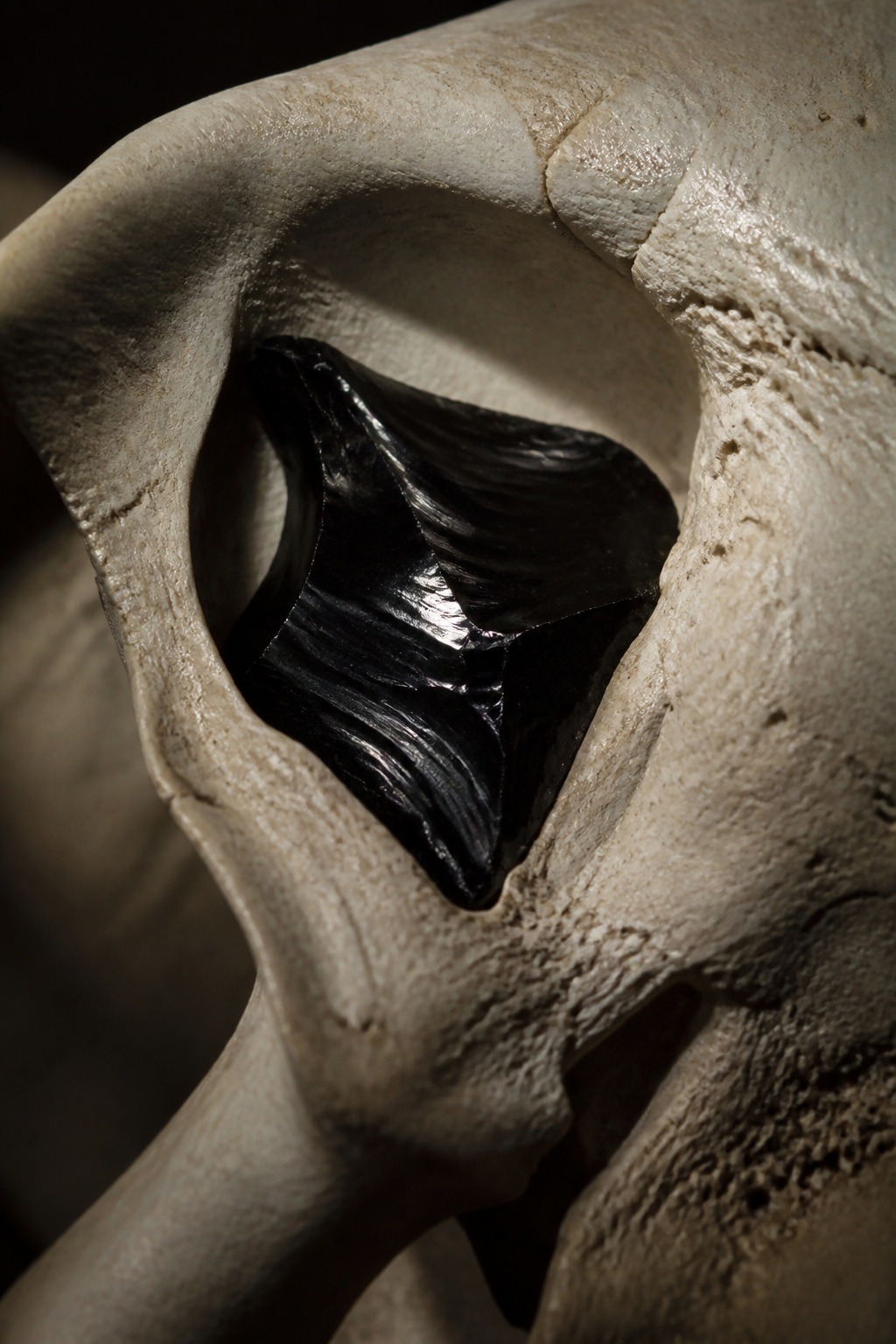
Not ash. Not bone. Glass — a shiny, black, brittle solid, chips of it later prised from inside the cranium like obsidian. That single detail is why a forgotten skeleton, excavated in the 1960s and shelved for sixty years, is now the center of one of archaeology’s liveliest scientific fights.
Key Facts
- The victim was a man of about 20, likely the custodian of the College of the Augustales in Herculaneum, killed in the 79 CE eruption.
- His skeleton was excavated in 1961 by Amedeo Maiuri; the glassy black fragments were identified in 2020 (Petrone et al.).
- The vitrification mechanism was published in February 2025 in Scientific Reports (Giordano, Petrone et al.).
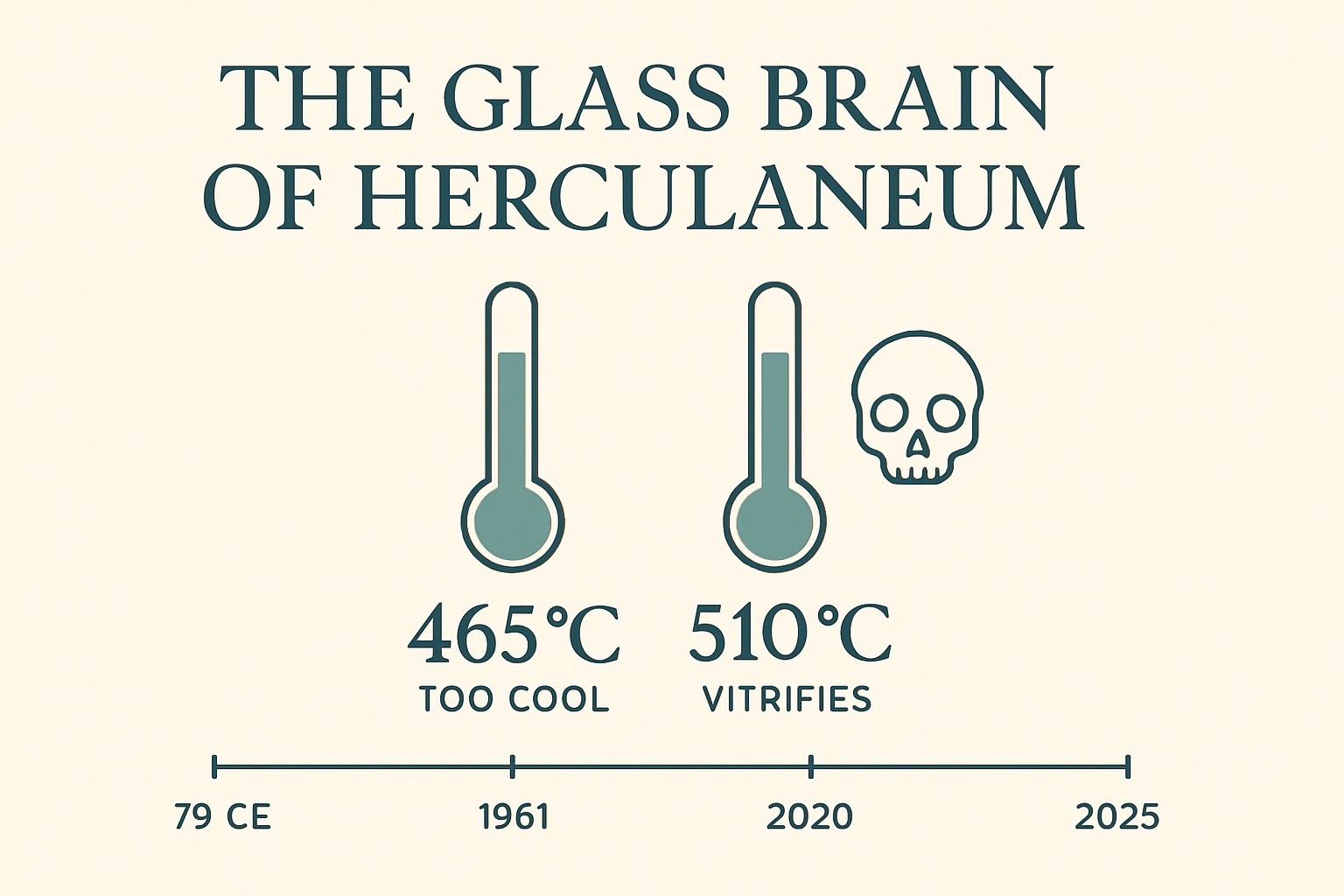
- Vitrifying the tissue required heating above 510 C then rapid cooling; the pyroclastic flows only reached about 465 C, too cool and slow-cooling.
- A transient super-heated ash cloud spiking above 510 C and dissipating within minutes is the proposed cause.
In short: A young man in Herculaneum had part of his brain turned to black glass during the 79 CE Vesuvius eruption. His skeleton was found in 1961, the glass identified in 2020, and the mechanism published in 2025: a brief ash-cloud spike above 510 C followed by rapid cooling vitrified the tissue rather than burning it.
The black glass inside a Roman skull
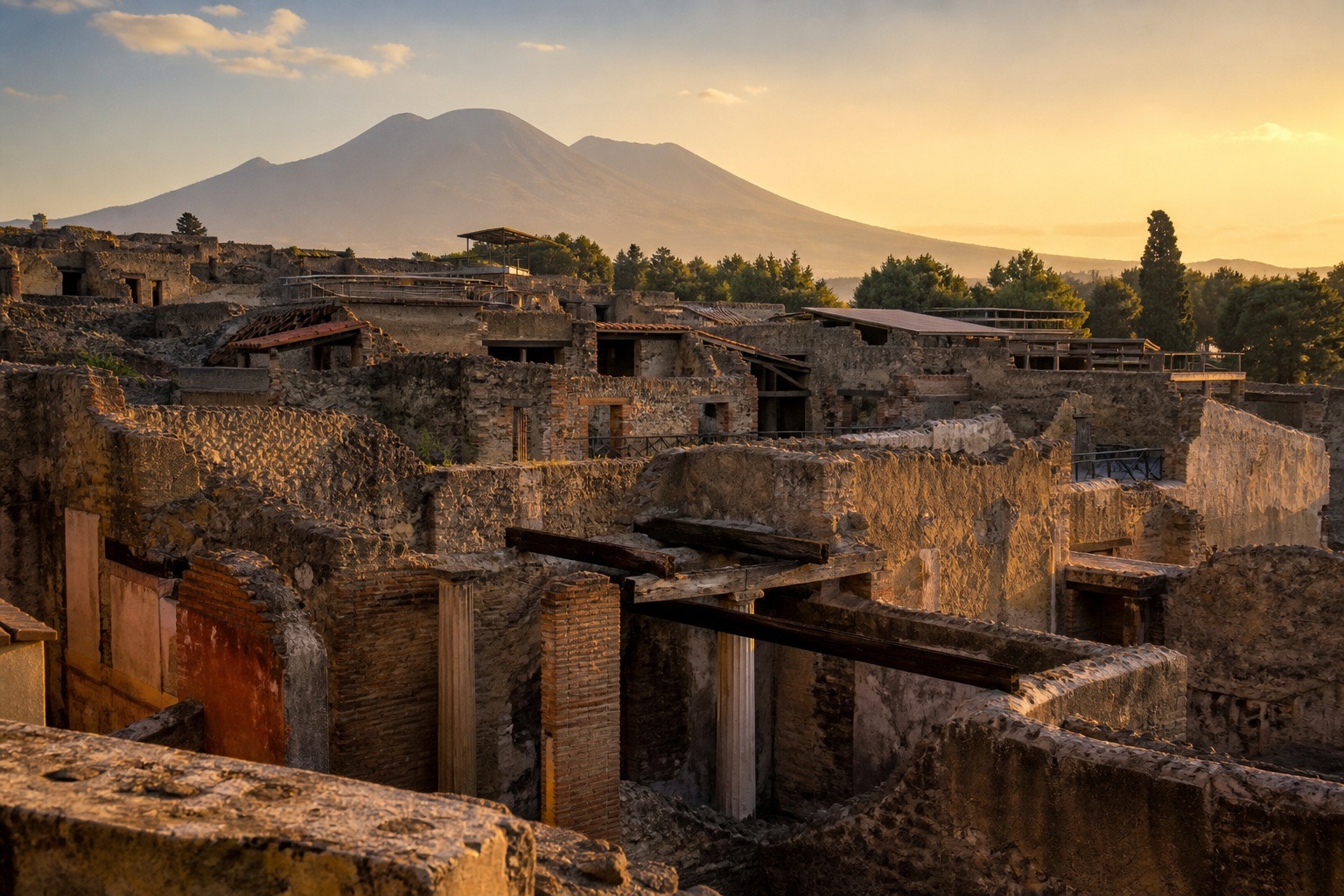
The remains were unearthed in 1961 by the Italian archaeologist Amedeo Maiuri, who led the excavation of Herculaneum for decades. The charred body lay prone on a bed, part wood and part masonry, in a back room of the Augustales complex. Maiuri recorded it and moved on. For sixty years, nobody looked closely at what was inside the head.
Then, in 2020, a team led by forensic anthropologist Pier Paolo Petrone of the University of Naples Federico II noticed something odd glinting in the skull cavity — glossy black fragments unlike anything a normal cremation leaves behind. Analysis suggested they were organic in origin and that they had, in effect, been quenched into glass. Herculaneum had preserved a great deal over the centuries: carbonized bread, wooden furniture, a papyrus library. But this was different. A city that swallowed a Roman town whole had, it seemed, kept one man’s thoughts in solid form.
A young man face-down, and a discovery that waited a lifetime
Here’s the part that rarely makes the headlines: the science took longer than the man’s whole life. Maiuri pulled the skeleton from the volcanic rock in 1961. The glass wasn’t understood until 2020. The mechanism behind it — the actual physics — wasn’t published until February 2025. A discovery made under one government sat unread through the Cold War, the space age, and the arrival of the internet before anyone realized what it was.
The building matters too. The College of the Augustales was a public, semi-religious hall, and the young man’s room sat tucked behind it — a caretaker’s quarters. He is one of the very few Herculaneum victims found indoors and in bed rather than huddled in the seafront boat chambers where hundreds sheltered and died together. That isolation may be part of why his remains behaved so strangely.
{IMAGE_2}
The physics of how Vesuvius turned a man’s brain to glass
Glass is a trick of speed. Most solids, as they cool, arrange their atoms into an orderly, repeating crystal lattice — that’s what turns water into ice or molten rock into grainy stone. Glass is what you get when you cheat that process: heat a material hot enough to become fluid at the molecular level, then cool it so fast the atoms freeze in place before they can line up. No crystals. Just a rigid, disordered solid — a liquid caught mid-thought.
That is why the “how” here is so counterintuitive. To vitrify soft tissue, you need to push it past a threshold — the 2025 study puts it above 510°C (around 950°F) — and then drop the temperature fast. Turns out the killer of a body and the preserver of a brain can be the same event, separated by a matter of minutes.
The 2025 mechanism paper, led by volcanologist Guido Giordano of Roma Tre University alongside Petrone, argued that the young man’s brain was flash-heated and then cooled quickly enough for the tissue’s organic compounds to set into glass rather than burn to ash or rot to nothing. It is the volcanic equivalent of tempering steel — except the material was a person.
The ash-cloud paradox: too hot to survive, too cool to preserve
So why did this happen to exactly one victim and no other? The answer is the strangest twist in the whole story, and it hinges on which part of the eruption reached Herculaneum first.
The pyroclastic flows — the dense, ground-hugging avalanches of gas and rock that buried the town under roughly 20 meters of material — were murderously hot, but by the study’s reckoning they topped out around 465°C. Hot enough to kill instantly. Not hot enough to vitrify. Crucially, they also cooled slowly, blanketing the town and holding their heat for a long time. Slow cooling is the enemy of glass.
What the researchers propose did the job was something that arrived before the flows: a transient super-heated ash cloud, a dilute pulse of volcanic gas that spiked above 510°C and then dissipated within minutes. Hotter than the flows, but gone almost as fast as it came. That brief, extreme spike followed by rapid cooling is the exact recipe glass requires. In a grim way, the young man in his bed may have been vitrified precisely because he was somewhere the killing flow reached differently than it reached the crowds on the shore.
- 79 CE — Vesuvius erupts, burying Herculaneum under ~20 m of volcanic material
- ~20 years old — the victim’s estimated age; likely the custodian of the College of the Augustales
- 1961 — skeleton excavated by archaeologist Amedeo Maiuri
- 2020 — glassy fragments identified; neurons, axons and myelin reported inside (Petrone et al.)
- Feb 2025 — vitrification mechanism published in Scientific Reports (Giordano, Petrone et al.)
- ~465°C — pyroclastic flow temperature: lethal, but too cool and too slow-cooling to make glass
- >510°C — transient ash-cloud spike that vitrified the tissue, then dissipated in minutes
- 7 vs 1,000+ — proteins recovered from the sample versus a typical well-preserved ancient brain
What the microscope found in the glass
Under electron microscopy, the fragments held a shock. The 2020 team reported preserved neural structures — the tubular networks of neurons, the long thread-like axons that carry signals, and traces of myelin, the fatty sheath that insulates them. Structures measured in billionths of a meter, apparently frozen in place. The findings were published in the New England Journal of Medicine and later detailed in PLOS ONE.
If that reading holds, it is astonishing. We are not talking about the shape of a brain pressed into rock, the way a leaf leaves an impression. We are talking about the microscopic wiring of the central nervous system, surviving as glass, in a body that died two thousand years ago. It would make this the only known case of vitrified brain tissue — human or animal — in the scientific record.
The argument scientists are having right now
And this is where honesty matters more than a clean story. Several respected researchers are not convinced, and their objections are not trivial.
Alexandra Morton-Hayward, a molecular archaeologist at the University of Oxford who studies preserved ancient brains, points out a basic problem of physics: biological soft tissue, which is mostly water, does not naturally form stable glass at ordinary temperatures. In the lab, vitrifying cells means cooling them to well below freezing, fast — the opposite of a volcano. She also flags the chemistry. The sample yielded only about seven proteins; a genuinely well-preserved ancient brain typically contains more than a thousand. Worse, those seven turn up in over 200 cell types across the body — none of them uniquely brain. And proteins tend to break down at temperatures far below the proposed ash-cloud heat.
John Mauro, a materials scientist at Pennsylvania State University, has argued that tissue heated past roughly 950°F should suffer irreversible damage, which sits awkwardly with claims of pristine neurons. Matthew Collins, a biomolecular archaeologist at the University of Cambridge, draws a pointed parallel to the early days of ancient-DNA research, where extraordinary claims collapsed once outside labs demanded the raw data. His ask is simple: release the full protein extraction methods so other teams can reproduce the result independently.
The study’s authors have pushed back plainly. “The material is compositionally and unequivocally organic in origin,” Giordano told National Geographic, adding the blunt rhetorical challenge: what organic tissue fills the skull of a man, if not a brain? On the evidence public so far, the cautious reading is the honest one — something genuinely extraordinary is in that skull, but “the world’s only glass brain” is a headline the data has not yet fully earned. That is not a knock on the science. It is how science is supposed to sound while it’s still being done.
From Vesuvius to the cryo-lab
There’s a reason this obscure fight is worth a layperson’s attention, and it isn’t just the horror-movie image. Vitrification — turning a fragile biological material into a stable, non-crystalline solid — is not only a freak of ancient catastrophe. It is a tool modern medicine leans on every day.
When laboratories bank embryos, egg cells, or delicate tissue samples, they often use a technique literally called vitrification: flooding the cells with cryoprotectants and plunging them into temperatures so cold, so fast, that no ice crystals form. Ice crystals are jagged; they shred cell membranes. Glass is smooth and inert, so it holds structure without destroying it. That’s why a vitrified embryo can be thawed years later and still develop.
The Herculaneum case, if it stands, is the same principle run in reverse — extreme heat instead of extreme cold — arriving at the same destination: a living structure locked in a glassy, disordered solid. Whether or not every claim about the neurons survives peer scrutiny, the physics linking a Roman caretaker’s skull to a fertility clinic’s freezer is real, and genuinely worth knowing.
Questions Readers Ask
How hot was the ash cloud that made the glass? The 2025 study estimates the vitrifying pulse exceeded 510°C (about 950°F), then cooled within minutes. By contrast, the slower pyroclastic flows that buried the town reached roughly 465°C — lethal, but too cool and too slow-cooling to form glass.
Is the glass brain real, or is it disputed? Both, honestly. The fragments are real and organic. Whether they are definitively brain tissue with preserved neurons is contested: researchers at Oxford, Cambridge and Penn State have questioned the identification and asked for the raw data to be released for independent testing. The original team stands by its findings.
How was the victim discovered? The skeleton was excavated in 1961 by archaeologist Amedeo Maiuri, found face-down on a bed in a room behind the College of the Augustales. The glassy material inside the skull wasn’t recognized as unusual until researchers re-examined the remains in 2020.
Why did it happen to only one person? That’s the open question. The leading hypothesis is that his location and a brief, unusually hot ash cloud combined to deliver the exact heat-then-quench sequence glass needs — conditions the other victims, sheltering elsewhere, didn’t experience.
Sources and Notes
- Giordano, Petrone et al., “Unique formation of organic glass from a human brain in the Vesuvius eruption of 79 CE,” Scientific Reports (Nature), 2025 — Roma Tre University and University of Naples Federico II
- Petrone et al., “Heat-Induced Brain Vitrification from the Vesuvius Eruption in c.e. 79,” New England Journal of Medicine, 2020; and related findings in PLOS ONE
- National Geographic, “Did Mount Vesuvius’ ash cloud really transform a brain into glass?” (2025) — skeptic responses from Alexandra Morton-Hayward (University of Oxford), John Mauro (Pennsylvania State University) and Matthew Collins (University of Cambridge)
- Smithsonian Magazine and Chemistry World, reporting on the 2025 vitrification study
A young man in a back room, unnamed, unremarkable in his own time, ended up carrying one of archaeology’s rarest artifacts inside his own head — and we may spend years arguing over exactly what it is. That argument is not a failure of the science; it is the science, working out loud. Either way, the lesson holds: sometimes the most ordinary person in the room becomes the one thing the catastrophe could not erase.
Frequently Asked Questions
Q: How did Vesuvius turn a brain to glass?
Glass forms when a material is heated hot enough to become fluid at the molecular level, then cooled so fast the atoms freeze before they can crystallise. The 2025 study argues a transient super-heated ash cloud spiked the young man’s brain above 510 C and then dissipated within minutes, quenching the tissue’s organic compounds into glass instead of ash.
Q: Who was the Herculaneum victim?
He was a man of roughly twenty, most likely the caretaker of the College of the Augustales, a hall dedicated to the emperor’s cult in Herculaneum. He was found face-down on a wooden bed in a back room, one of the very few Herculaneum victims found indoors and in bed rather than sheltering in the seafront boat chambers where hundreds died together.
Q: Why did it happen to only one victim?
The pyroclastic flows that buried Herculaneum under about 20 metres of material were lethal but topped out near 465 C and cooled slowly, too cool and too slow to make glass. Researchers propose a separate, brief ash cloud that spiked above 510 C reached his indoor location differently, giving the rapid heating and cooling that glass requires.
Q: When was the glass brain discovered?
The timeline spans decades. Archaeologist Amedeo Maiuri excavated the skeleton in 1961. The glassy fragments were only recognised in 2020 by a team led by Pier Paolo Petrone at the University of Naples Federico II. The physical mechanism behind the vitrification was not published until February 2025, in Scientific Reports, alongside volcanologist Guido Giordano.
Illustrations are AI-generated. Article fact-checked and human-edited. Our editorial standards.