Takahē: The Extinct Bird That Returns to the Wild
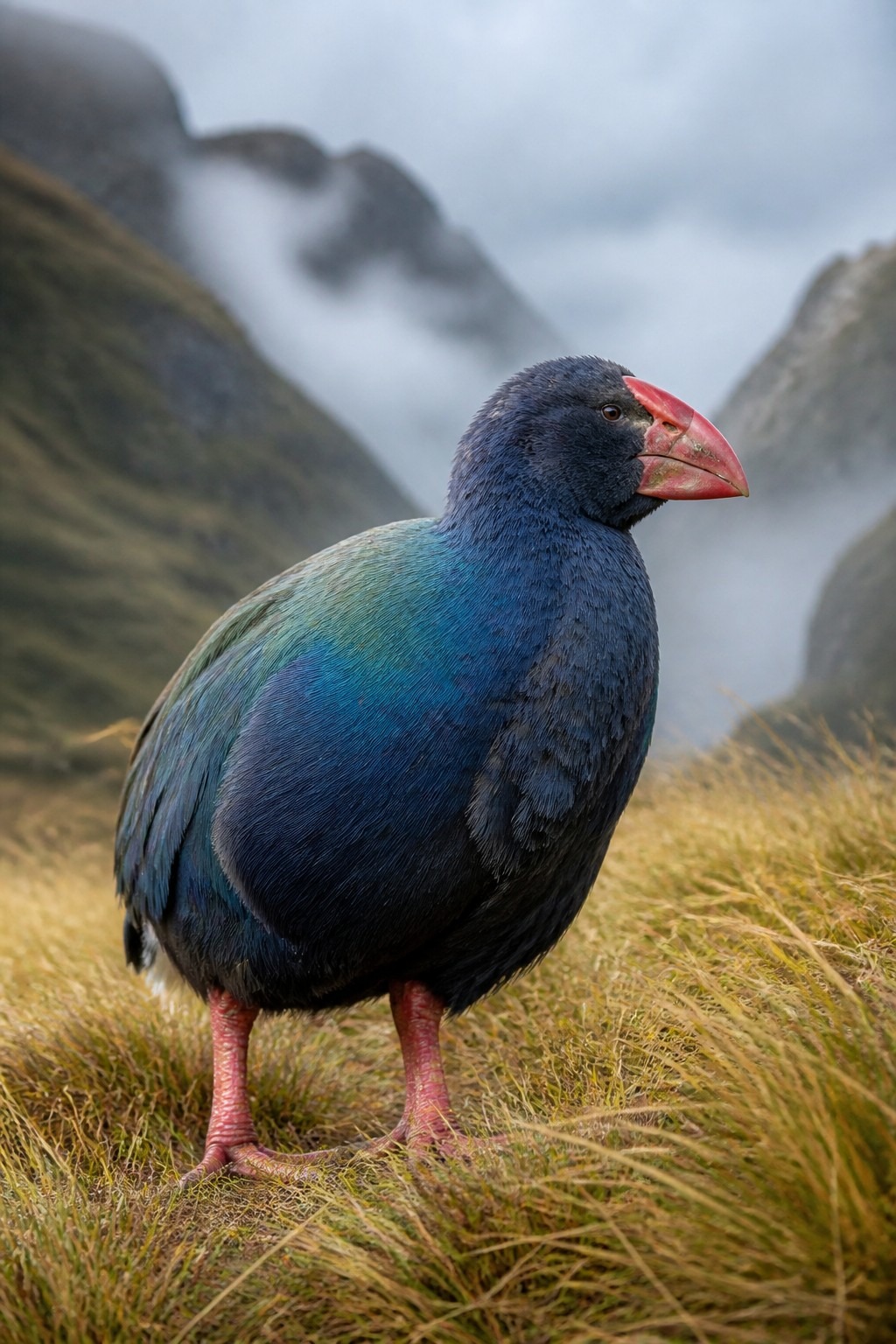
The takahē — the extinct bird that returns to the wild — has just crossed a line no one alive had seen: 252 of roughly 528 birds now live free, the first time since its rediscovery that most of the species is wild rather than captive. Picture a fat, indignant, turkey-sized rail in electric navy and turquoise, with a beak like a red enamel axe, stomping through alpine snow tussock on legs the colour of a fire engine. It cannot fly. It was written off in 1898. And in 2026 it is walking back into valleys it last owned a century ago.
Key Facts
- The takahe (Porphyrio hochstetteri) is the world’s largest living rail, flightless, about 63 cm tall and 2.3-2.7 kg.
- It was declared extinct in 1898 and rediscovered on 20 November 1948 by physician Geoffrey Orbell in the Murchison Mountains.
- There are about 528 birds today, growing roughly 5% a year, and 252 (about 52%) now live wild for the first time since rediscovery.
- The Burwood Takahe Centre opened in 1985; puppet-rearing gave way to parent-rearing around 2010 for better breeders.
- The bird’s ancestors flew from Australia roughly 1.5-4 million years ago and lost flight; it once lived in lowland forests, not the alpine zone.
In short: The takahe is a large flightless New Zealand rail declared extinct in 1898 and rediscovered in 1948 by Dr Geoffrey Orbell. Careful captive rearing and predator-free islands rebuilt the population to about 528 birds, and most of the species, 252 birds, now lives wild for the first time since rediscovery.
The takahē: an extinct bird that returns to the wild
- What it is: the world’s largest living rail — flightless, ground-dwelling, and stubbornly alive
- Size: about 63 cm tall, 2.3–2.7 kg — heavier than most house cats
- Colours: deep navy-blue and turquoise plumage, scarlet beak and legs
- Diet: a strict herbivore, living on snow tussock and the starchy bases of its leaves
- Status: ~528 birds, growing about 5% a year; 52% now live wild (2024)
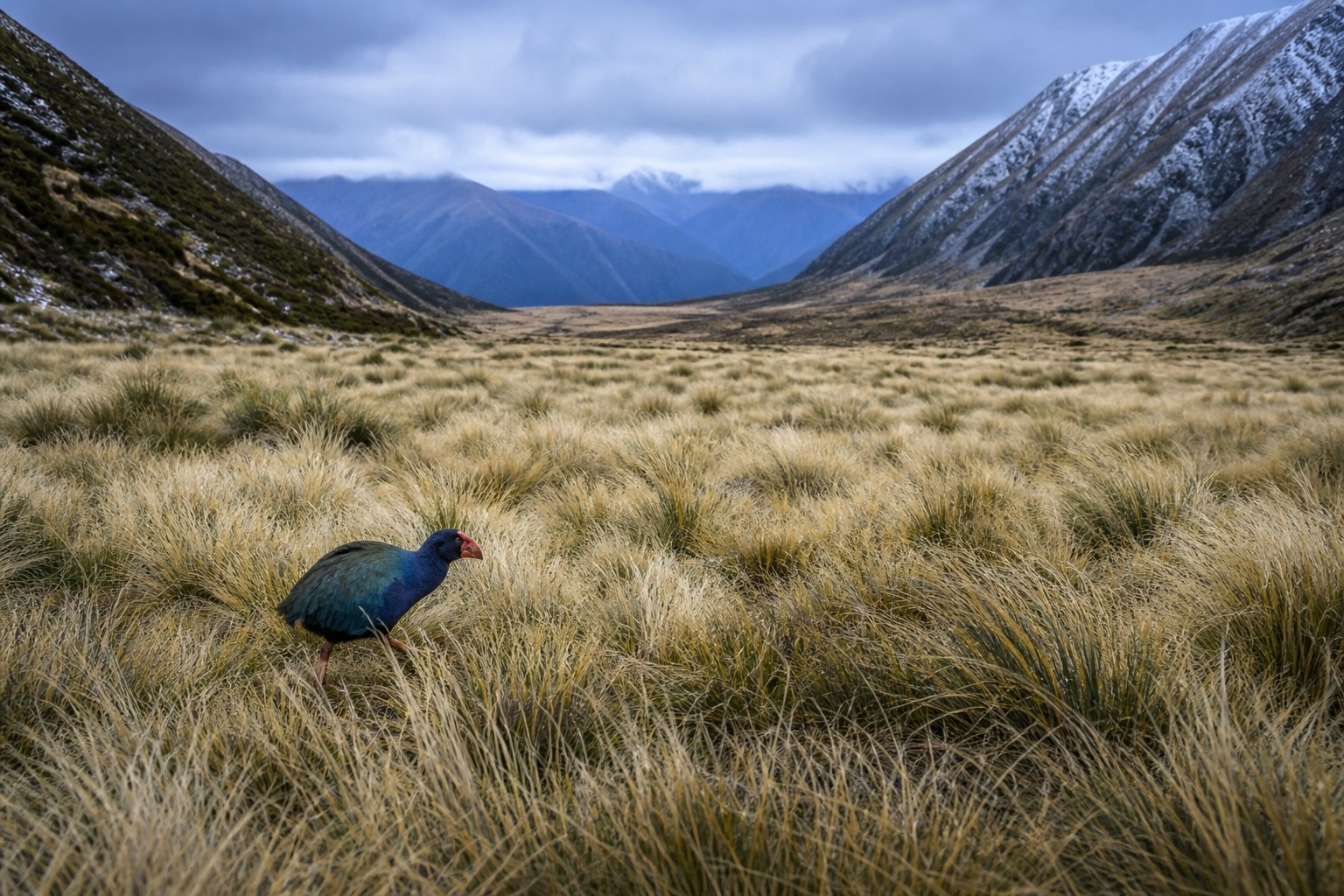
Rails are usually small, skulking marsh birds you hear more than see. The takahe went the other way entirely: it grew large, lost the power of flight, and settled into cold tussock country where little else competes for the grass. (There were once two takahē — the North Island bird, the moho, really is gone; everything here is about the South Island survivor.) Its size is the whole plot. Being big and slow is what let one stubborn population cling to a single mountain range — and it is also what made the bird helpless the moment stoats and cats arrived.
Here’s the thing about the word “extinct”: it is a verdict handed down on incomplete evidence. For fifty years the takahē was a museum drawer of skins and a scatter of bones. Then a country doctor decided the verdict was wrong.
Declared extinct — and then a ghost (1898–1948)
By 1898 only four takahē had been caught by Europeans since the 1840s, and after the last of them the sightings simply stopped. Naturalists closed the book. The bird had been scarce even in Māori memory — hunted for feathers and meat, squeezed out of the lowlands — and now it read as another entry on New Zealand’s grim list of things that vanished once people and their animals arrived.
But “gone” never quite stuck. Trampers and deer cullers in Fiordland kept reporting an odd, heavy, blue bird and enormous three-toed prints in the snow. No specimen, no photograph, nothing a scientist could file. For half a century the takahē lived in that uncomfortable space between rumour and record — extinct on paper, whispered about in the hills.
{IMAGE_2}
20 November 1948: a country doctor in a hidden valley
Geoffrey Orbell is not a professional zoologist. He is a physician from Invercargill with an obsession, and obsession is the operative qualification here. He studies old takahē skins, listens to the tramper rumours, and spreads maps of the Murchison Mountains above Lake Te Anau across a table, reasoning about where a shy alpine bird could still hide. Two expeditions in early 1948 turn up tracks and a call he cannot place.
On 20 November 1948 he goes back. In a tussock valley beside a small lake — later named Lake Orbell — his party corners two takahē, photographs them, holds them, and lets them go. Fifty years of “extinct” collapse in an afternoon. The story travels the world: a bird written off before anyone alive was born is standing there, blinking, entirely real.
What Orbell had actually found was the last redoubt — a single relic population clinging to one valley system, the final few hundred of a species that once ranged across the South Island. Rediscovery was the easy part. Keeping them alive would take the next seventy years.
Why a flightless bird lives in the mountains at all
Reframe the whole story with one fact: the takahē is not naturally an alpine bird. Sub-fossil bones show it once living in lowland forests and grasslands across both main islands. The Murchison Mountains were never its chosen home. They were its last hiding place.
Lowland New Zealand filled up with predators and competitors — first with human arrival, then with the stoats, cats and red deer that Europeans brought. Pushed off the easy ground, the takahē survived only where winters ran hard enough to keep some of those enemies thin: high, cold, above the treeline. Think of it less as a mountain specialist and more as a refugee that ran uphill until the map ran out.
And the flightlessness? That is older and stranger. The takahē’s ancestors flew here — swamphen-like birds that crossed from Australia somewhere between roughly 1.5 and 4 million years ago. Landing in a country with no ground-hunting mammals, they had no reason to keep the expensive machinery of flight, and over generations they grew heavier while their wings shrank to useless stubs. It is one of the cleanest textbook cases of island flightlessness anywhere — a bird that gave up the sky because, for a few million years, nothing on the ground could catch it. Then the ground changed.
Puppets, islands, and the long rescue (1985–2018)
Saving them meant industrialising takahē reproduction. In 1985 the Burwood Takahē Centre opened near Te Anau to rear chicks from eggs collected in the wild. Early on, keepers fed hatchlings using hand puppets shaped like an adult takahē’s head — red bill and all — so the chicks would bond to “birds” instead of imprinting on the humans holding them.
Turns out the puppets worked too well at raising bodies and not well enough at raising birds. Puppet-reared takahē tended to become poor breeders as adults, socially clumsy in ways that mattered at mating time. Around 2010 the programme pivoted to parent-rearing wherever it could — letting real takahē raise their own young — and the results improved. It is a quiet, honest lesson in conservation: the birds do better when their own parents raise them.
The other half of the rescue was geography. Managers seeded insurance populations onto predator-free islands — Tiritiri Matangi, Kapiti, Mana, Maud and Motutapu — so no single disaster could take the whole species, and in 2018 released birds into Kahurangi National Park. (Those same fenced and island refuges have quietly rebuilt other lost natives, among them the little spotted kiwi.) Every island bird was a backup copy; every backup copy bought time for the real goal, which was always to get takahē back onto the mainland for good.
The tipping point: when most takahe went wild (2023–2026)
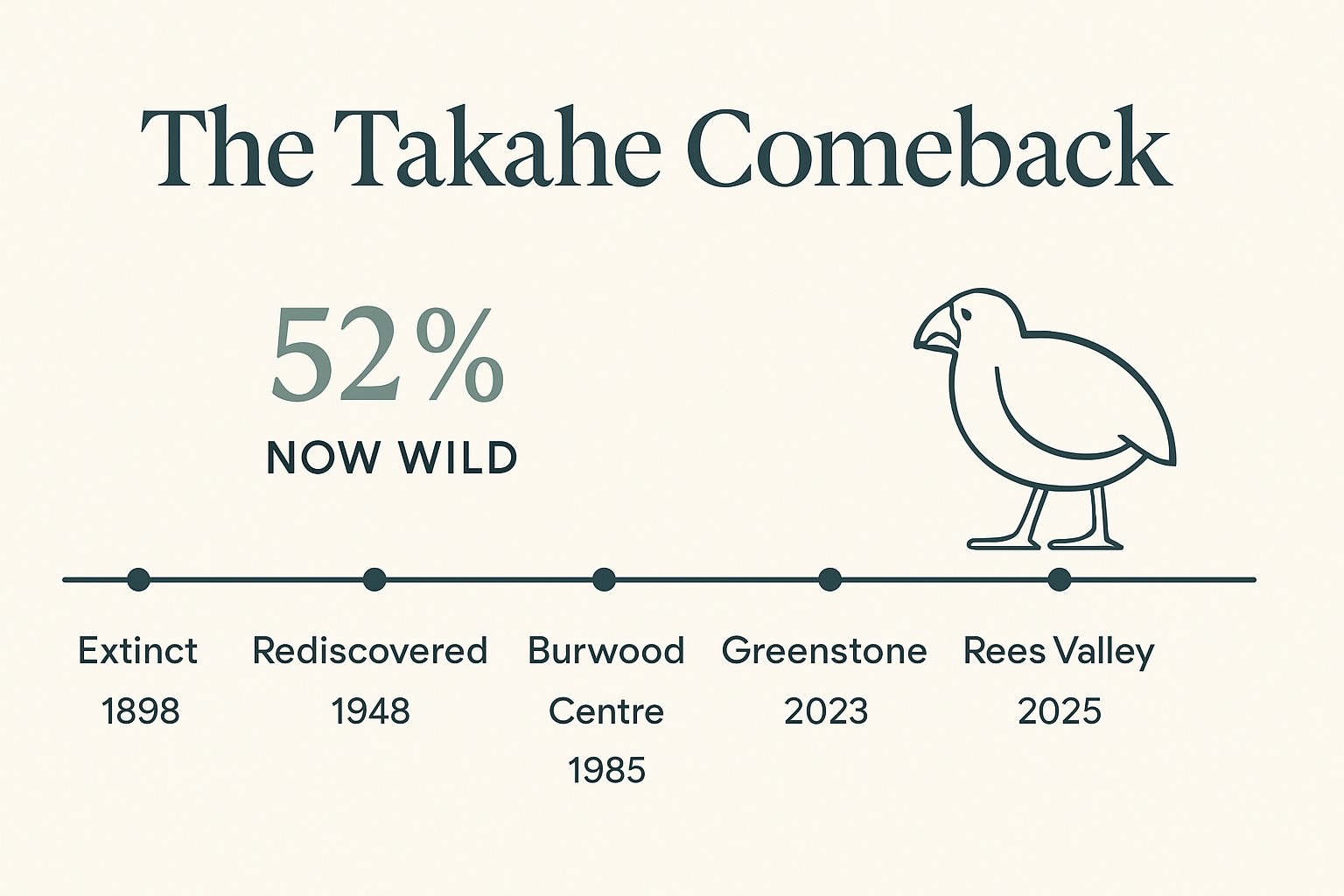
- 1898: last confirmed sighting → declared extinct
- 1948: rediscovered — a few hundred birds in one valley
- Aug 2023: 18 released at Greenstone Station — first wild alpine flock in ~100 years
- Feb 2025: 18 more released into the Rees Valley
- 2024: 52% of ~528 birds now wild (~252) — the majority, for the first time
In August 2023, eighteen takahē are released at Greenstone Station on Ngāi Tahu whenua near Lake Whakatipu Waimāori — the first wild population in those alpine valleys in roughly a century. In February 2025, eighteen more go into the neighbouring Rees Valley. These are not zoo birds set loose to sink or swim; each release sits inside a landscape of trap lines and monitoring, run in partnership between the Department of Conservation, Ngāi Tahu and local sanctuary trusts.
By 2024, according to the Department of Conservation’s Takahē Recovery Programme, about 52% of the roughly 528 living takahē were wild — some 252 birds outside captivity. For a species kept alive for decades mostly in pens and on island arks, that flip is the real headline. Gail Thompson of the Takahē Recovery Group has framed these mainland releases as the whole point of the endeavour — getting the birds back into the wild places they belong, not simply raising the count.
By June 2026 the Rees Valley flock had grown into the largest wild population outside Fiordland — the takahē’s original refuge no longer its only stronghold.
The two villains everyone forgets
Ask who nearly finished the takahē and most people say “stoats,” and they are half right. Stoats — fast, fearless weasels released in the 1880s to control rabbits — are lethal to a ground-nesting bird. In 2007 a stoat plague tore through the Murchison Mountains and roughly halved the core population in a single season. One bad year erased years of gains. That is the fact that should sit beside every feel-good headline: this recovery is fragile, not finished.
A second villain wears antlers. Red deer, brought to New Zealand for sport hunting, graze the same snow tussock and dig the same rhizomes the takahē depends on — direct competition for a slow bird’s entire food supply. Aerial deer culling in takahē country is not incidental to the recovery; it is part of it. Stoats get the blame, but the deer quietly starve the survivors, and both problems trace back to animals that people turned loose on purpose.
Farewell Spit, 2026 — the newest frontier
On 27 May 2026, eight takahē walk out of their crates at Onetahua / Farewell Spit in Golden Bay — the first of their kind at the top of the South Island in about a hundred years. What made it possible is a four-kilometre predator-proof fence, built coast to coast across the base of the spit to seal off some 2,000 hectares from stoats, rats, possums and feral pigs. The fence cost around NZ$400,000 and was completed by the community group Pest Free Onetahua alongside the Department of Conservation, Manawhenua ki Mohua and the HealthPost Nature Trust.
It is a small release with an outsized meaning. Every new predator-free site is another basket for a species that came within a whisker of having none at all. And it points straight at the thing still not solved: takahē thrive today almost only where humans hold predators back by force — behind fences, along trap lines, under aerial culls. Take that effort away, and the mountains would go quiet again.
Questions readers ask
Is the takahē still endangered? Yes. At roughly 528 birds it remains threatened, though it has been eased down from “nationally critical” as numbers climb about 5% a year. Rare and recovering — not yet safe.
How is a takahē different from a pūkeko? They look like cousins because they are — both are swamphens — but the pūkeko flies, is slimmer, and is common. The takahē is far heavier, flightless and mountain-dwelling. (Search “takahe” without the macron and you land on the same bird.)
Why can’t takahē fly? Their ancestors flew to New Zealand, then lost flight over millions of years because the islands held no ground predators to escape. Flight is costly to maintain; where it is not needed, evolution tends to drop it.
Where can you see one? Wild takahē live in remote, protected valleys, but several accessible island and mainland sanctuaries run under the recovery programme let visitors meet them. They are not roadside birds.
Sources and notes
- New Zealand Department of Conservation — Takahē Recovery Programme (media releases, 25 August 2023 and 12 February 2025)
- Te Rūnanga o Ngāi Tahu — statements on the Greenstone and Rees Valley releases (Gail Thompson, Takahē Recovery Group)
- Royal Society of New Zealand — historical record of Geoffrey Orbell’s 20 November 1948 rediscovery
- Radio New Zealand (RNZ) and NewsWire NZ — reporting on the Rees Valley (June 2026) and Onetahua / Farewell Spit (May 2026) milestones
- bioGraphic (California Academy of Sciences) — background on takahē evolution, ecology and culture
So the takahē — an extinct bird that returns to the wild — is winning, with 252 of 528 now free, and it is winning entirely because thousands of traps stay set and the deer keep being culled. The honest open question isn’t whether we can bring the bird back; we already have. It’s whether a species can truly be called wild if it survives only inside a fence we all agree to keep standing.
Frequently Asked Questions
Q: What is a takahe?
The takahe (Porphyrio hochstetteri) is the world’s largest living rail: a flightless, ground-dwelling bird about 63 cm tall and 2.3-2.7 kg, with deep navy-blue and turquoise plumage and a scarlet beak and legs. A strict herbivore, it lives on snow tussock. Its size let a relic population cling to one mountain range but left it helpless when stoats and cats arrived.
Q: Wasn’t the takahe extinct?
It was declared extinct in 1898 after the last known birds vanished. But trampers and deer cullers in Fiordland kept reporting a heavy blue bird and huge three-toed prints. On 20 November 1948, Invercargill physician Geoffrey Orbell cornered and photographed two takahe in a hidden valley beside a lake later named after him, collapsing fifty years of extinct in an afternoon.
Q: How many takahe are there now?
Around 528 birds, growing about 5% a year. In a milestone reached recently, 252 of them, roughly 52%, live free rather than in captivity, the first time since rediscovery that most of the species is wild. The recovery relied on the Burwood Takahe Centre, opened in 1985, and predator-free insurance islands seeded with birds.
Q: Why does a flightless bird live in the mountains?
It does not naturally. Sub-fossil bones show the takahe once lived in lowland forests and grasslands across both main islands. Predators and competitors that arrived with humans pushed it off the easy ground until it survived only in high, cold country where hard winters kept enemies thin. Its flightlessness is far older, as its ancestors flew from Australia and lost flight over millions of years.
Illustrations are AI-generated. Article fact-checked and human-edited. Our editorial standards.