Christmas Island Crab Bridge and Tunnels, Explained
The Christmas Island crab bridge and tunnels only make sense once you have seen the thing they were built for: a red tide moving on legs. It is late October, the first heavy rain of the wet season has just soaked the plateau, and the forest floor begins to shift. Millions of palm-sized crabs, the colour of arterial blood, pour out of their burrows and start walking toward the sea — over roads, up cliffs, across golf courses, straight through the middle of a working island town. Nothing turns them. So the people of Christmas Island did the only sensible thing. They rebuilt the roads around the crabs.
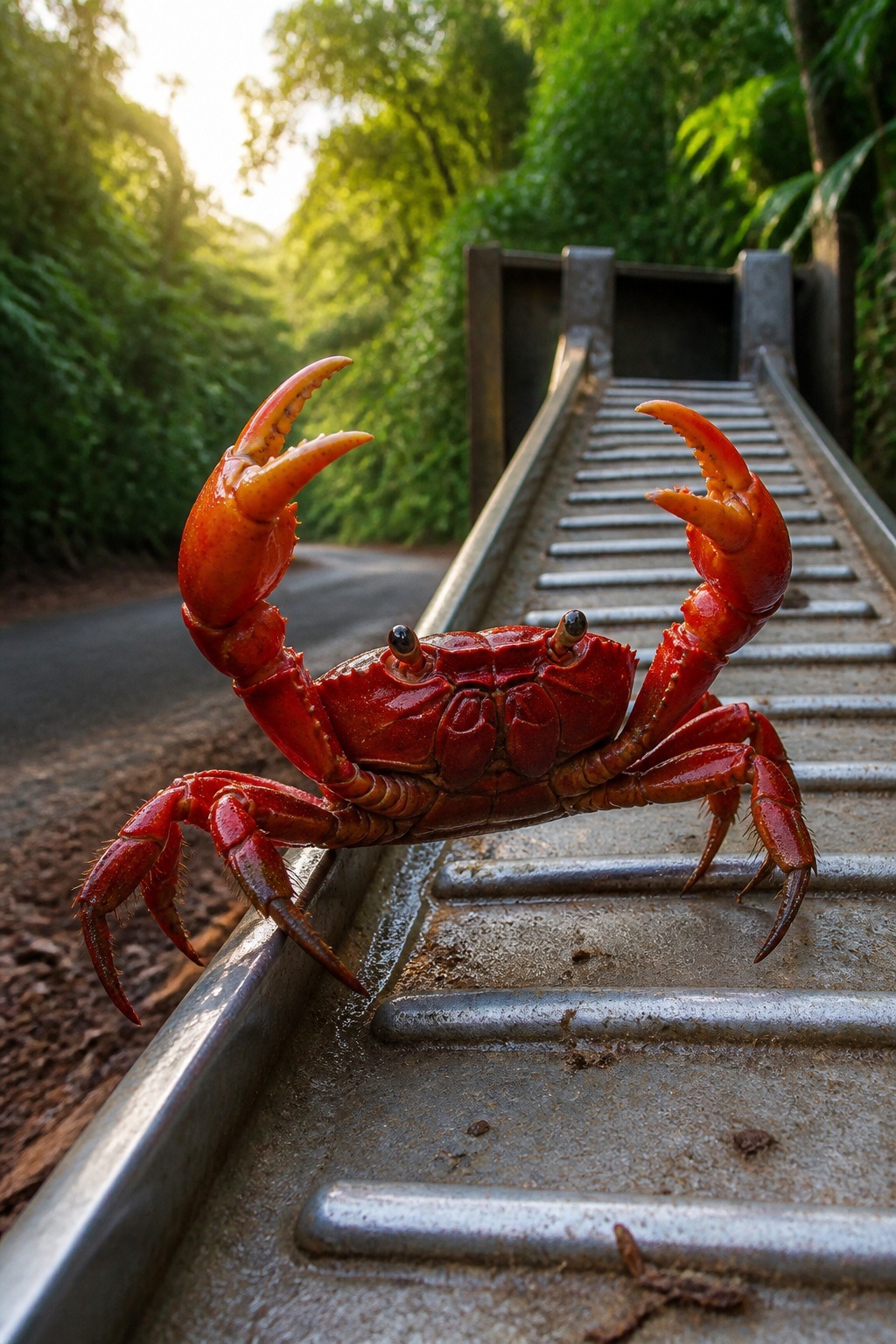
What they built is now unique on Earth: a single tall bridge and a network of concrete tunnels engineered for an animal most of the world has never heard of. This is the story of that infrastructure — the real numbers behind it, the trade-off nobody explains, and the two-millimetre wasp that quietly made the whole system matter again.
Key Facts
- Christmas Island runs 31 crab underpasses (tunnels) plus one purpose-built crab bridge on Murray Road, about 5 m / 16 ft tall, the only one on Earth.
- The system includes about 12 km of permanent funnelling fence and another 5 km of seasonal barrier rolled out each migration.
- Parks Australia uses a working figure of around 100 million red crabs (Gecarcoidea natalis), found nowhere else.
- The migration is triggered by the first heavy wet-season rain in October or November.
- Females release their eggs at the turn of the high tide during the last quarter of the moon, when the tidal range is smallest.
In short: Christmas Island built a unique network of 31 tunnels, one roughly 5 m bridge, and about 17 km of fencing to move its roughly 100 million migrating red crabs safely under and over the roads. The crabs march to the sea after the first wet-season rain and spawn on the last-quarter-moon high tide.
A single bridge, thirty-one tunnels, and a hundred million crabs
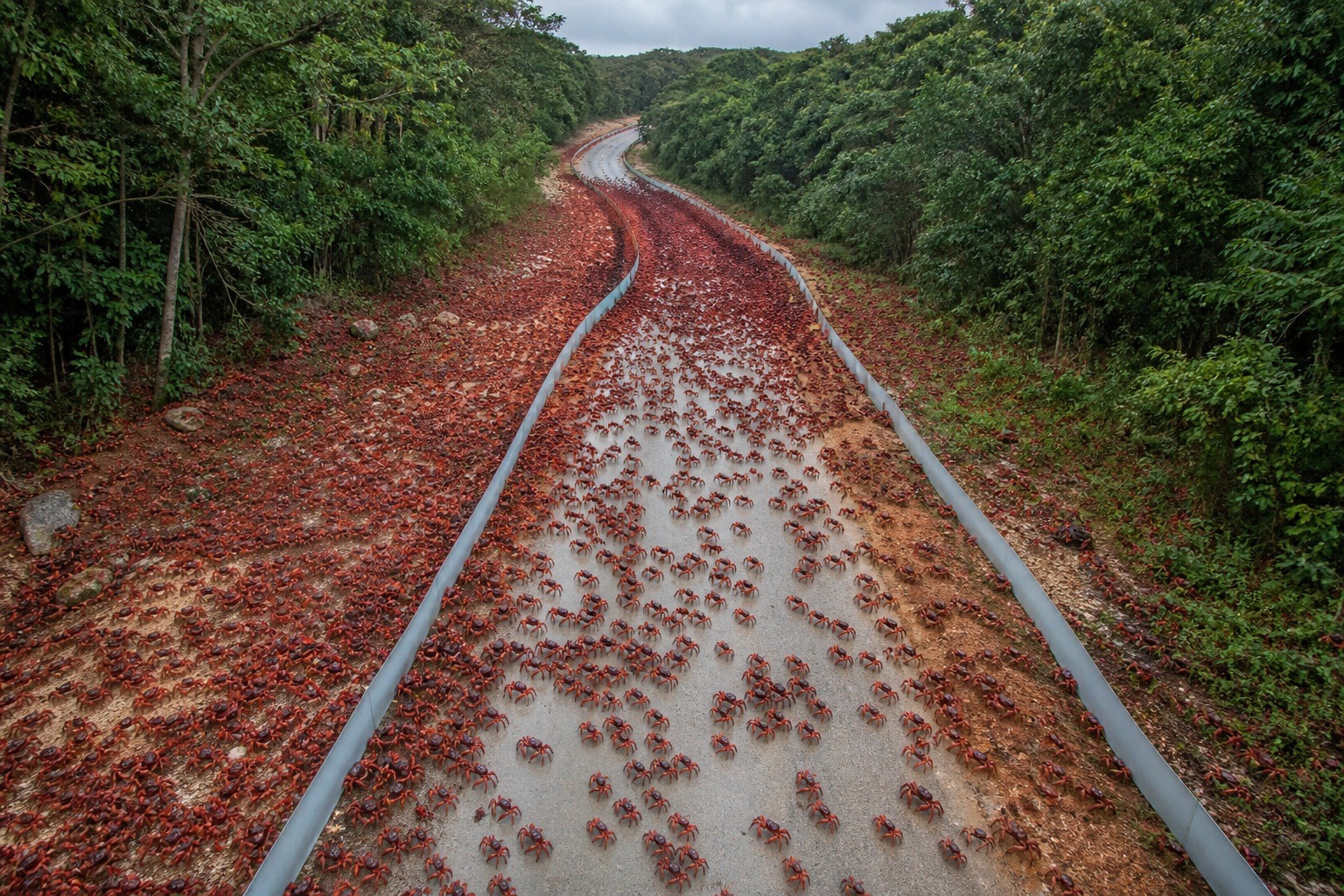
Christmas Island sits alone in the Indian Ocean, an Australian territory closer to Java than to the mainland. It is home to Gecarcoidea natalis, the Christmas Island red crab — a land crab found nowhere else on the planet. Estimates of how many live here vary wildly (more on that later), but the working figure Parks Australia uses is around 100 million. Once a year they all try to reach the coast at once.
For most of the twentieth century, that meant carnage. Crabs crushed by cars in their millions, roads slicked red, tyres punctured by carapaces jammed under the tread. The fix that emerged is deceptively simple in concept and genuinely clever in execution: funnel the crabs, then give them a way under or over the traffic. Today the island runs 31 crab underpasses, one purpose-built crab bridge on Murray Road, roughly 12 kilometres of permanent steel-and-aluminium fencing, and another 5 kilometres of temporary barrier rolled out each season.
That is the answer, in numbers, to a question most visitors ask backwards. They assume the bridge is the whole solution. It isn’t. The bridge is the exception. The tunnels do the heavy lifting.
The lunar code that fires the starting gun
The migration does not run on a calendar. It runs on the moon.
Red crabs spend most of the year alone in shaded rainforest burrows, plugged in during the dry season to keep from drying out. The wet season breaks the spell. The first serious downpour — usually October or November — triggers the males to emerge and begin walking, with females following days behind. But the departure date is only half the code. The arrival is timed to something far more precise.
Females must release their eggs into the sea at the turn of the high tide, during the last quarter of the moon, when the difference between high and low water is at its smallest. Spawn too early or on the wrong tide and the larvae are swept out or stranded. This is the science hook every account of the migration reaches for, and it is genuinely remarkable: a land animal syncing a multi-week overland journey to a lunar-tidal window measured in hours. The physiology behind that timing was mapped in detail by Australian researchers Agnieszka Adamczewska and Stephen Morris, whose 2001 study in The Biological Bulletin tracked how the crabs’ bodies cope with the brutal water and energy demands of the march.
What “Christmas Island crab bridge and tunnels” really means on the ground
Here is where almost every article hand-waves. You will read “tunnels and a bridge” and move on. But the system only works because of how the parts fit together, so it is worth naming the pieces.
The fences come first. Low aluminium and steel barriers run for kilometres along the busiest crab-crossing roads, angled to herd the incoming wall of crabs sideways rather than let them spill onto the tarmac. At intervals, the fence lines deliver the crabs to an opening — the mouth of an underpass, a bare concrete tunnel running beneath the road. Thirty-one of these are dug in at the island’s worst pinch points. Where the terrain or traffic makes a tunnel impractical, the crabs are sent up and over instead: the Murray Road bridge, a steel arch roughly five metres (about 16 feet) tall, the only structure of its kind anywhere.
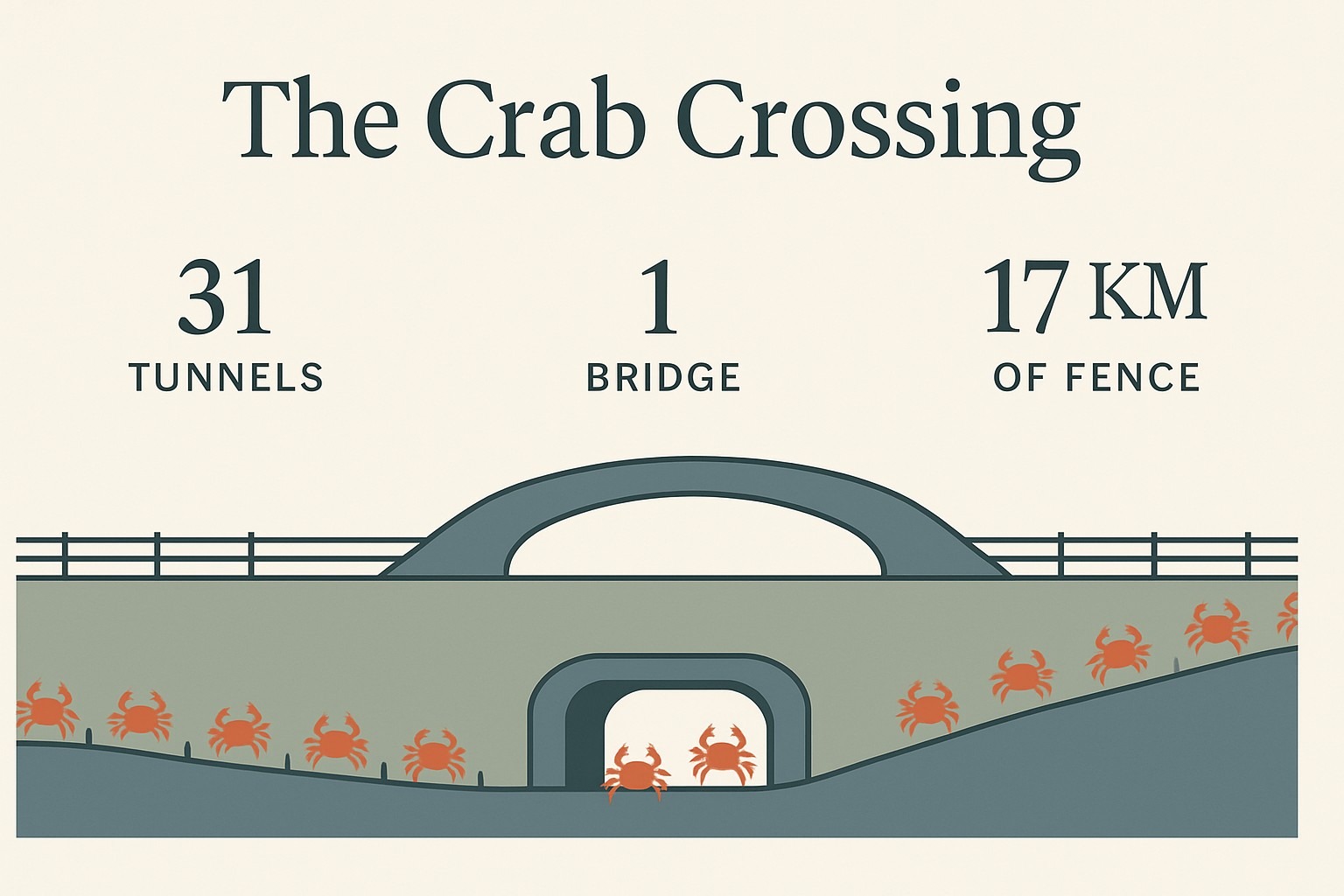
{IMAGE_2}
- 31 — crab underpasses (tunnels) under island roads
- 1 — crab bridge, on Murray Road, ~5 m / 16 ft tall (the world’s only one)
- 12 km — permanent funnelling fence
- 5 km — extra seasonal fence, rolled out each migration
- ~100 million — crabs on the move (Oct–Nov, after the first wet-season rain)
- Last quarter moon — the tidal window females spawn into
The bridge-versus-tunnel bargain
So why build one tall bridge when thirty-one tunnels already exist? Because tunnels have a flaw: leaves.
A rainforest floor sheds constantly, and a concrete tunnel is a perfect trap for wet leaf litter. Clog the entrance and the crabs pile up, refuse to enter, and detour back onto the road — the exact failure the tunnel was built to prevent. A raised bridge, by contrast, is largely self-clearing; rain and wind keep the deck open. The catch is cost. You can dig many tunnels for the price of one elevated span, which is precisely why the island has thirty-one of the former and one of the latter. The bridge is reserved for a single road where a tunnel simply wouldn’t hold up.
| The 31 underpasses | The Murray Road bridge | |
|---|---|---|
| How many | 31 | 1 (only one on Earth) |
| Cost each | Low — many can be built | High — reserved for one road |
| Main weakness | Clogs with wet leaf litter | Expensive to build |
| Upkeep | Raked clear before every migration | Largely self-clearing in rain |
That upkeep is not a footnote. Before each migration, rangers and volunteers walk the network and physically rake the leaf litter out of every underpass, clear the fence lines, and set up the seasonal barriers and road closures. It is slow, unglamorous, weeks-long work. And for all the drone footage of crabs streaming over the famous bridge, that rake is the real hero of this story — a clogged tunnel undoes a kilometre of fence in an afternoon.
Rough ramps and slippery walls
Look closely at the crossings and you notice a deliberate contradiction in the surfaces. The ramps and climbing faces the crabs are meant to use are rough; the funnel walls they are meant to avoid are smooth. That is not an accident of materials.
Red crabs climb with hooked tips on their walking legs — the dactyls — which need texture to grip. A roughened ramp gives those hooks something to catch, so a crab will happily haul itself up and over. A polished aluminium wall gives them nothing. The result is a one-way logic built into the metal: crabs can scale the surfaces we want them on and slide off the ones we don’t, so the whole moving mass gets steered toward the tunnel mouths and bridge ramps without a single ranger touching them. It is crowd control written in friction.
The ant war that almost ended it
None of this engineering would matter if there were no crabs left to cross. And for a stretch of the late 1990s and 2000s, that was a live fear.
The culprit was the yellow crazy ant, Anoplolepis gracilipes, an invasive species accidentally introduced to the island. On its own a small ant, but it forms vast “supercolonies” — densities that myrmecologist Kirsti Abbott, in her 2006 research on the island’s ant populations, documented reaching extraordinary levels across the forest floor. The ants don’t hunt the crabs so much as overwhelm them, spraying formic acid that blinds and eventually kills. In the worst-hit zones the crabs simply vanished. Tens of millions died. Underpasses in dead forest are just holes in the ground.
What made the crazy ants unstoppable was a hidden alliance. The ants farm another invader — the yellow lac scale insect — for its sugary honeydew. Well-fed on honeydew, the ant supercolonies exploded. Cut the sugar, and the whole system should starve. That was the idea, anyway. The question was how to cut it on a fragile island without dousing the rainforest in poison.
The two-millimetre assassin
The answer arrived in 2016 and 2017, and it is barely visible. Parks Australia, working with researchers at La Trobe University, imported a Malaysian micro-wasp called Tachardiaephagus somervillei — an insect about two millimetres long that does one thing with ruthless focus. It lays its eggs inside the lac scale insects. The larvae devour the scale from within, collapsing the honeydew supply that the crazy ants depend on.
Starve the scale, starve the ants, and the crabs get their island back. It is textbook biocontrol — a natural enemy dropped into a broken system to restore its balance, the same logic that lets a recovering keystone predator claw back a habitat elsewhere, as sea otters have done by eating invasive green crabs in California’s estuaries. On Christmas Island the effect was slow — biocontrol always is — but by the mid-2020s the combination of the wasp and targeted baiting had knocked back supercolonies across treated areas, and the crabs came surging back through fences and tunnels that had been waiting for them all along.
43 million, 100 million, maybe 200 — reading the numbers in 2026
Here is the thing you should know before you quote a population figure: nobody agrees on one, and the honest answer is that it depends on what and when you count.
The number you will still see repeated across the web is 43.7 million — a historic estimate of adult crabs, and the baseline against which the crazy-ant losses were measured. Parks Australia’s more commonly cited round figure for the total population is about 100 million. And in recent seasons, park managers have gone higher still: Alexia Jankowski, acting manager of Christmas Island National Park, told reporters during a 2024–25 migration that the island may now hold up to 200 million red crabs, with as many as 100 million making the walk to the coast.
Those numbers aren’t really in conflict — they are snapshots of different things (adults versus all crabs) at different points on a recovery curve. Read together, they tell the actual story that page-one search results still miss: a population knocked down by an invasive ant, held on life support by concrete and rakes, and then genuinely rebuilt once a two-millimetre wasp cut the ants’ food supply. The bridge and the tunnels didn’t save the red crab. They kept the door open long enough for the ecology to be fixed underneath it.
Questions Readers Ask
How tall is the Christmas Island crab bridge? The single crab bridge, on Murray Road, stands roughly five metres — about 16 feet — high. It is the only bridge of its kind in the world.
How many crab tunnels are on Christmas Island? There are 31 crab underpasses beneath the island’s roads, supported by around 12 kilometres of permanent fencing and 5 kilometres of seasonal fencing that funnel the crabs toward them.
Why do red crabs cross the road? They are migrating from their rainforest burrows to the sea to breed. The roads were built across ancient migration paths, so the crabs walk straight over (or now under) them — they cannot be diverted.
When is the red crab migration? Usually October or November, triggered by the first heavy rain of the wet season, with spawning timed to the turn of the high tide during the last quarter of the moon.
Sources and notes
- Parks Australia / Christmas Island National Park — Red Crab Migration and Yellow Crazy Ant Biocontrol materials (infrastructure figures, biocontrol programme, population estimates)
- Adamczewska, A. M. & Morris, S. (2001). “Ecology and Behavior of Gecarcoidea natalis, the Christmas Island Red Crab, During the Annual Breeding Migration.” The Biological Bulletin, 200(3): 305–320.
- Abbott, K. L. (2006). Research on supercolonies of the invasive yellow crazy ant (Anoplolepis gracilipes) on Christmas Island.
- La Trobe University — micro-wasp (Tachardiaephagus somervillei) biocontrol research, 2016–2017 release.
- Statement by Alexia Jankowski, acting manager, Christmas Island National Park, 2024–25 migration season (population estimate).
Strip away the drone shots and the famous bridge, and what Christmas Island really offers is a quiet lesson in patience: you build the crossings, you rake the leaves, you release the wasp, and then you wait for a hundred million crabs to decide the door is finally worth walking through.
Frequently Asked Questions
Q: What is the Christmas Island crab infrastructure?
It is a purpose-built system to protect the island’s annual red crab migration: 31 concrete underpasses beneath roads, one crab bridge on Murray Road about 5 metres tall, the only one on Earth, and roughly 12 km of permanent fencing plus 5 km of seasonal barrier that funnel the crabs sideways to the crossings rather than onto the tarmac.
Q: Why do the crabs migrate?
Once a year, after the first heavy rain of the wet season in October or November, roughly 100 million red crabs leave their forest burrows and walk to the coast to breed. The females must release their eggs into the sea at the turn of the high tide during the last quarter of the moon, when the difference between high and low water is smallest.
Q: Why one bridge but 31 tunnels?
Cost and clogging. Tunnels are cheap enough to build many, but a concrete tunnel traps wet leaf litter; clog the entrance and crabs pile up and detour back onto the road. A raised bridge is largely self-clearing in rain but expensive, so the island reserves its single bridge for one road where a tunnel simply would not hold up.
Q: How is the crab crossing maintained?
It takes weeks of unglamorous work. Before each migration, rangers and volunteers walk the network and physically rake the leaf litter out of every underpass, clear the fence lines, and set up the seasonal barriers and road closures. Without that upkeep the tunnels would clog and the funnelling fences would fail, sending crabs back onto the roads.
Illustrations are AI-generated. Article fact-checked and human-edited. Our editorial standards.