Welwitschia Mirabilis: The 1,000-Year Two-Leaf Plant
Welwitschia mirabilis is a desert gymnosperm from the Namib that grows exactly two leaves in its whole life, never sheds them, and keeps going for centuries — the biggest known individuals are credibly estimated at well over 1,000 years old, and a few at perhaps 2,000. That is the honest short answer. The longer answer is far more interesting, because much of what circulates about this plant — that it is 200 million years old, that it sips fog through its leaves, that it photosynthesises only at night — is either wrong or still unproven, while the verified facts are stranger than the folklore.
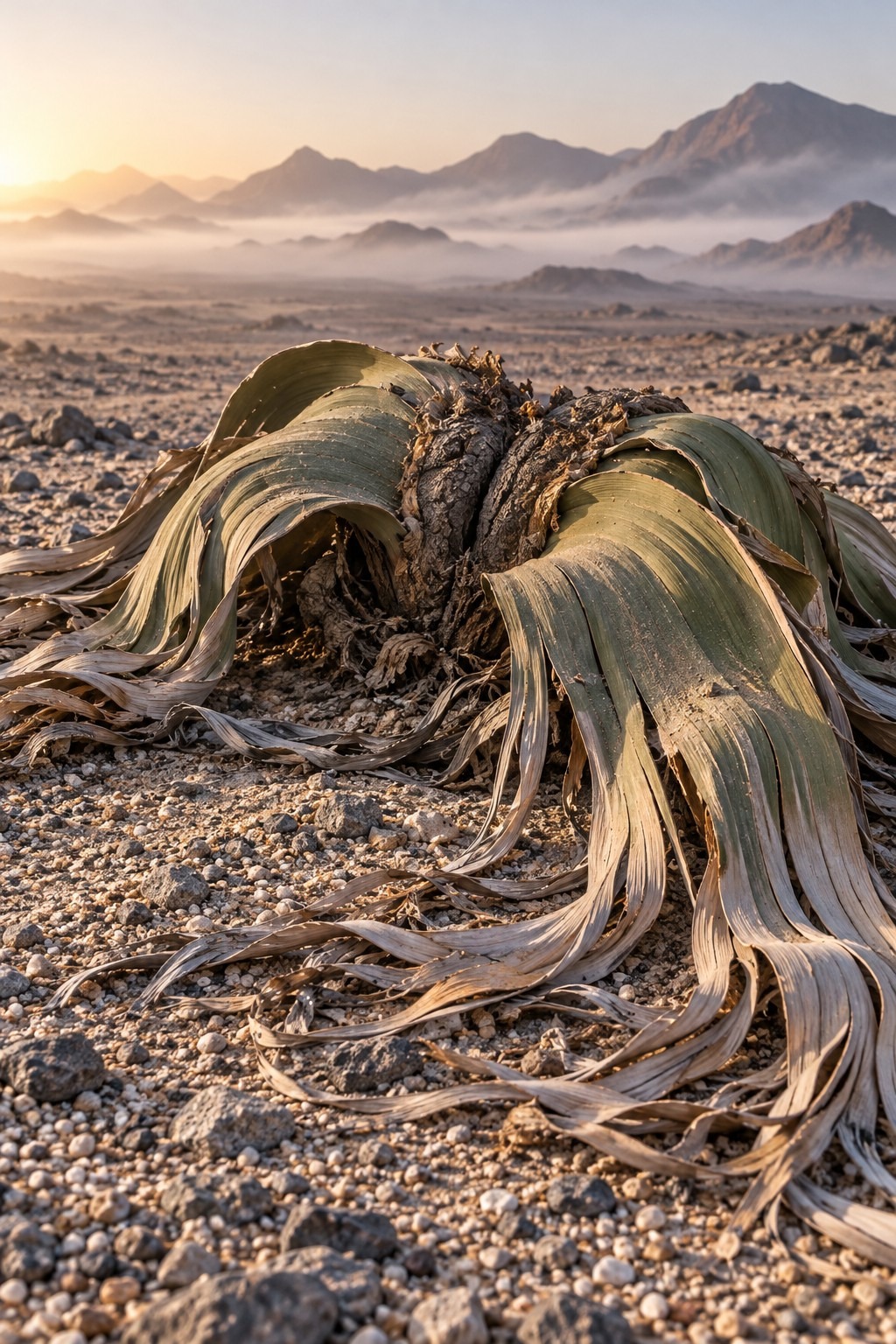
- Leaves: two, grown once and never replaced, reaching up to about 4 m before wind and age shred them into straps.
- Measured growth: roughly 0.37 mm of new leaf per day — about 13 cm a year — from monthly measurements of 21 wild plants near Gobabeb in the central Namib.
- Oldest radiocarbon date published so far: 531 ± 20 radiocarbon years, from the outer stem base of one mid-sized plant (Radiocarbon, January 2026).
- Range: a coastal strip of roughly 1,000 km from Angola’s Cabo Negro to central Namibia, nearly all of it inside the Atlantic fog belt within about 80 km of the sea.
- Genome: 6.8 gigabases across 21 chromosomes — more than twice the size of the human genome.
Key Facts
- Leaves: exactly two, grown once and never replaced, reaching up to about 4 m before wind and age shred them into straps
- Measured growth: roughly 0.37 mm of new leaf per day (about 13 cm a year), from monthly measurements of 21 wild plants near Gobabeb in the central Namib
- Oldest radiocarbon date published so far: 531 ± 20 radiocarbon years, from the outer stem base of one mid-sized plant (Radiocarbon, January 2026)
- Range: a coastal strip of roughly 1,000 km from Angola’s Cabo Negro to central Namibia, nearly all within about 80 km of the sea in the Atlantic fog belt
- Genome: 6.8 gigabases across 21 chromosomes — more than twice the size of the human genome
In short: Welwitschia mirabilis is a desert gymnosperm from Namibia’s Atlantic fog belt that grows only two leaves for its entire life, never shedding them. Individuals are credibly estimated to exceed 1,000 years old, with radiocarbon dating in 2026 confirming outer stem tissue at least 531 years old. Its genome is more than twice the size of the human genome.
What exactly is Welwitschia mirabilis?
Start with what it is not. Not a cactus, not a succulent, not a palm, and despite the sprawling green ribbons, not a seaweed stranded a hundred kilometres from the ocean. Welwitschia is a gymnosperm — a cone-bearing plant, closer kin to pines and cycads than to anything that flowers — and it sits in a tiny, strange group called the gnetophytes, alongside just two other surviving genera, Gnetum and Ephedra.
It is the only species in its genus, its family, and its entire order. One plant, alone on its branch of the tree of life, growing on gravel plains where rain may not fall for years at a stretch.
Austrian botanist Friedrich Welwitsch came across it in Angola in 1859 and, by his own account, could do nothing but kneel down and stare, half afraid that touching it would prove it imaginary. Joseph Dalton Hooker formally described the species in 1863 and named it for him. Namibians have their own names, older and better: tweeblaarkanniedood in Afrikaans — “two leaves, cannot die” — and onyanga in Herero, the onion of the desert. The plant appears on Namibia’s coat of arms, growing out of a dune.
Two leaves, one lifetime — how that actually works
Every seed plant you have ever met replaces its leaves. Welwitschia does not. It produces a single pair early in life and then simply keeps extending them from a growth zone at their base, year after year, for as long as it lives. Nothing is ever shed. What looks like a tangled heap of dozens of leaves is two leaves, split lengthwise by decades of wind and grit into fraying straps.
That makes these, by a wide margin, the longest-lived leaves in the plant kingdom.
Growth is measurable and slow. Joh Henschel and Mary Seely of the Desert Research Foundation of Namibia tracked 21 plants in a dry watercourse near Gobabeb, measuring them monthly and mapping a population of 110 individuals; their 2000 paper in Plant Ecology reported a mean leaf extension of about 0.37 mm per day — some 13 cm a year — but with growth varying twenty-two-fold within a single plant depending on humidity and rainfall. Run the arithmetic on a leaf 3 or 4 m long and you are looking at a very long time. The largest recorded specimen spans 2.77 m across with a circumference of 8.7 m, a crown that is essentially a low woody table with two enormous ribbons pouring off it.
So how old is the oldest Welwitschia?
Here the numbers in circulation diverge wildly: 500 to 600 years on average, “up to 1,500”, “over 2,000”, occasionally 3,000. All of these come from somewhere, and none of them is a measurement of a specific living plant you can go and visit. The reason is simple and rarely stated: Welwitschia lays down no annual growth rings. You cannot core it like a bristlecone pine and count. Estimates have mostly come from scaling measured growth rates up to observed plant size, which is reasonable but assumes the rate held steady for a millennium.
Which is why a paper published in Radiocarbon in January 2026 matters more than its modest numbers suggest. A team led by Sarah L. F. Martin and Michael D. Martin at the NTNU University Museum in Norway, working with Gillian Maggs-Kölling and Eugene Marais of the Gobabeb Namib Research Institute, radiocarbon-dated tissue through the woody stem of a single plant. The oldest sample came back at 531 ± 20 radiocarbon years — and crucially, it came from the outer stem surface near ground level, not the interior. Age increases downward and outward; the inside is younger. Their model implies the stem creeps upward at only 0.47 to 0.67 mm per year.
Turns out that geometry has a practical payoff: if the oldest tissue sits on the outside, researchers can date a living plant without drilling into it. The study’s own caveat is honest — on the largest, most eroded individuals those ancient outer layers may survive only in patches. So the fair statement today is that millennium-plus ages are a well-supported inference for the biggest plants, not yet a confirmed radiocarbon measurement.
{IMAGE_2}
Four claims about this plant that don’t survive a fact-check
Welwitschia attracts tall tales the way its leaves attract dust. Four in particular get repeated almost everywhere, including by sources that should know better.
| The popular claim | What the evidence says |
|---|---|
| “It’s 200 million years old and lived in the Jurassic.” | The oldest fossils of its family — Welwitschiophyllum leaves and the seedling Cratonia cotyledon, from Brazil’s Crato Formation — date to the Late Aptian, about 114–112 million years ago. That is Early Cretaceous, not Jurassic. It did share the world with dinosaurs; the “200 million” figure is not what the fossil record shows. |
| “It uses CAM photosynthesis and opens its pores only at night.” | Decades of Namib fieldwork by German plant ecophysiologist Dieter J. von Willert found the stomata open by day and by night, with nocturnal carbon fixation detected only around December and January and never exceeding roughly 4% of the daily total. It is a C3 plant carrying a CAM capacity it barely uses — his 2005 review was titled, pointedly, “CAM or not CAM — what is the answer?” |
| “The leaves absorb fog directly through their stomata.” | Widely assumed, not demonstrated for this species. The observed route is mechanical: condensation beads on the curved leaves, runs down to the stem, and soaks into the ground above a taproot reaching roughly 3 m. Foliar water uptake is proven in some other plants — just not confirmed here. |
| “You can age one by counting its rings.” | There are no annual growth rings to count. Ages come from growth-rate extrapolation and, since 2026, from radiocarbon dating of stem tissue. |
None of this makes the plant less remarkable. If anything the corrections sharpen the picture: a C3 gymnosperm with its stomata open in desert daylight is taking a genuinely risky metabolic bet, and it wins only because fog and the rare rain year arrive often enough.
Does it really drink the fog?
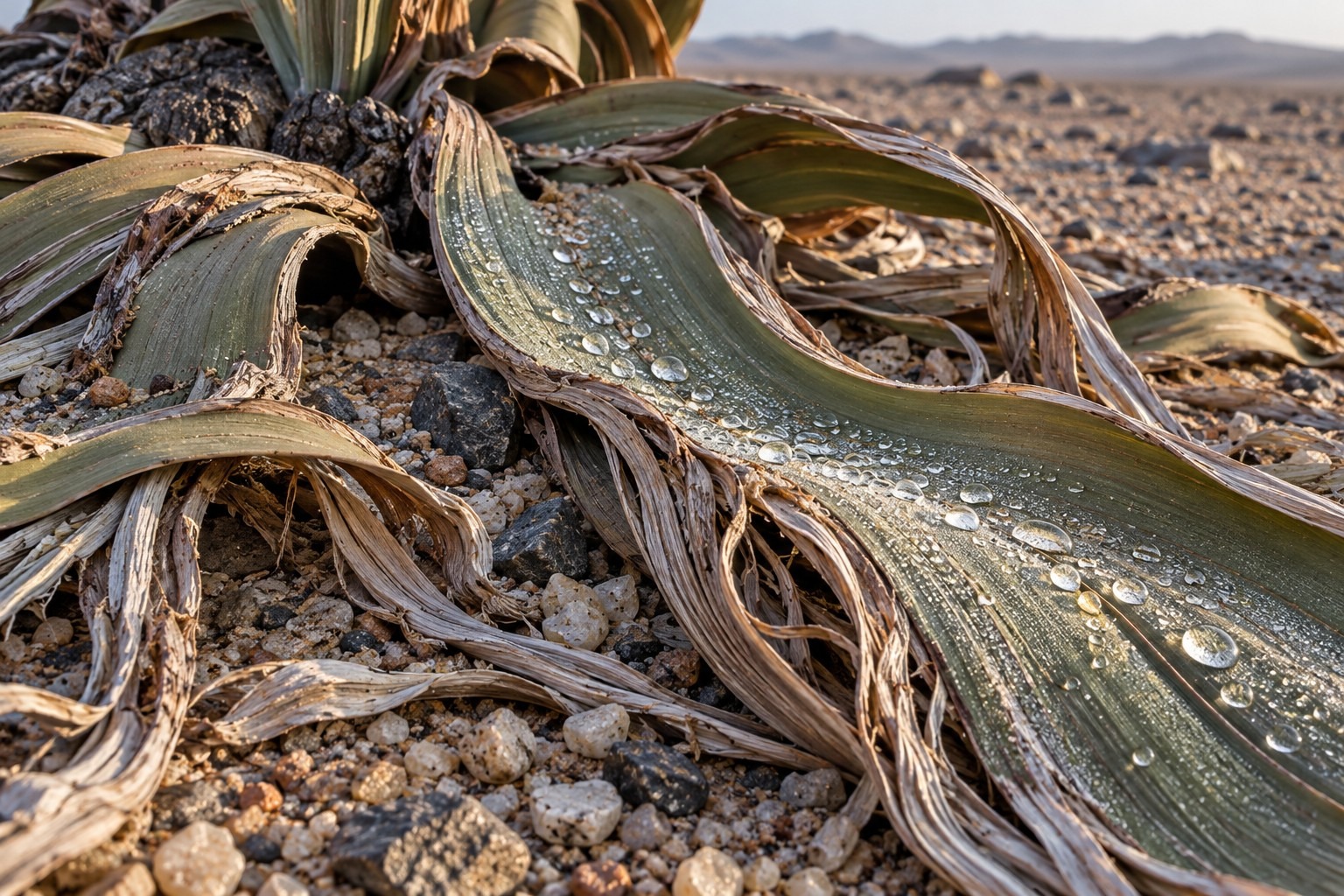
Yes and no — and the distinction is the whole survival strategy. Cold water welling up along the Namibian coast, driven by the Benguela Current, chills the air above it; that air drifts inland overnight as dense fog, sometimes tens of kilometres deep. On Welwitschia’s leaves the fog condenses, collects, and runs off.
Where does it go? Into the soil, not the leaf. Those enormous ribbons act as a condensation surface and a funnel, concentrating thin atmospheric moisture onto the patch of ground where the plant’s own roots are waiting. A deep taproot, reaching around 3 m, holds the position; a broad shallow network catches whatever the fog delivers.
Genetics has added a second layer to the story. In July 2021, in Nature Communications, an international team led by Tao Wan — with co-authors including genome-size specialist Ilia Leitch of the Royal Botanic Gardens, Kew — published a chromosome-level assembly of the 6.8-gigabase genome. They found an ancient whole-genome duplication around 86 million years ago, then bursts of self-copying retrotransposons within the last 1–2 million years, held in check by unusually heavy cytosine methylation. Alongside that sit shifts in gene families governing cell growth, nutrient handling and stress tolerance. In other words, the plant’s longevity looks less like a single clever trick and more like an entire genome reorganised around never stopping and never dying.
A keystone species quietly losing its climate
On the gravel plains, a Welwitschia is an island. It throws the only shade for metres around, raises local humidity, traps windblown seed and detritus, and hosts its own insect fauna, including the conspicuous pink-and-black Welwitschia bug that feeds on it (whether that bug also pollinates the plant is still argued over — the cones ooze nectar and draw mostly flies and wasps). Oryx and rhino chew the leaves for moisture in bad years. Remove the plant and you remove the habitat.
That is what makes the conservation data uncomfortable. Pierluigi Bombi of Italy’s National Research Council, with Titus Shuuya of the Gobabeb Namib Research Institute, Theo Wassenaar of the Namibia University of Science and Technology and colleagues, surveyed 1,330 individual plants across 12 stands in northern Namibia and published the results in PLOS ONE in November 2021. Seven percent of the plants were already dead. Thirty-two percent were in poor condition. Every stand they recorded faced a projected decline in climatic suitability, with annual mean temperature rising an estimated 1.5–2.5 °C by 2050 — enough, they concluded, that the thermal conditions the species has historically occupied will be “almost completely unavailable in the next 30 years” in that region. They proposed Welwitschia as a sentinel species for the whole desert ecosystem.
Internationally the species is listed on CITES Appendix II and often described as stable overall, which is true at the scale of the full range and misleading at the scale where extinction actually happens — calling a species secure while its northernmost populations lose their climate envelope is a bookkeeping answer to a biological question. Other pressures stack on top: black Aspergillus niger fungus destroys a large share of wild seed before it can germinate, recruitment happens only in rare wet years, off-road vehicles crush seedlings invisible against the gravel, and plants are still dug up for collectors. If you want to see one, the Welwitschia Plains and the Welwitschia Drive inside Namib-Naukluft National Park near Swakopmund are the accessible places, the largest protected specimen sitting behind a low fence — and the single most useful thing a visitor can do is stay on the existing tracks.
Frequently Asked Questions
How long does Welwitschia mirabilis live? Average individuals on the Namib plains are usually estimated at 500–600 years, with the largest plausibly exceeding 1,000 and possibly approaching 2,000. Those figures are extrapolations from measured growth, not direct measurements; the first published radiocarbon date on stem tissue, in 2026, returned 531 ± 20 years for a mid-sized plant.
Why does it only have two leaves? Because it never replaces them. Growth happens at a permanent zone at the leaf base, so the original pair simply elongates for the plant’s entire life instead of being shed and renewed — an adaptation to an environment where building a new leaf is an expense that may never be repaid.
Can you grow Welwitschia mirabilis at home? It is grown from seed in botanical collections, and seeds are traded legally under CITES rules, but it is genuinely difficult: the taproot resents disturbance, deep containers are essential, and wild-collected seed is frequently ruined by fungus. Removing a plant from the wild is illegal in Namibia.
Where does it grow? Only in the Namib, along roughly 1,000 km of coast from Angola’s Cabo Negro region south into central Namibia, almost entirely within the coastal fog belt. Nowhere else on Earth, and no close relatives anywhere.
Sources and Notes
- Henschel & Seely, “Long-term growth patterns of Welwitschia mirabilis“, Plant Ecology (2000)
- Martin et al., “Determining vertical growth patterns and tissue of maximum age using radiocarbon dating in Welwitschia mirabilis“, Radiocarbon (2026)
- Wan et al., “The Welwitschia genome reveals a unique biology underpinning extreme longevity in deserts”, Nature Communications (2021)
- Bombi et al., “Climate change effects on desert ecosystems: a case study on the keystone species of the Namib Desert Welwitschia mirabilis“, PLOS ONE (2021)
- von Willert, “Welwitschia mirabilis: CAM or not CAM — what is the answer?” (2005); South African National Biodiversity Institute species account; The Gymnosperm Database
If you ever stand in front of one, try this: find where the leaf disappears into the crown, and follow it outward with your eyes. Every centimetre you cross is roughly a month of this plant’s life, laid down at a third of a millimetre a day through fog, heat and decades without rain. By the time you reach the ragged tip, you have traced several human lifetimes — and the growth zone behind you is still, quietly, adding more.
Illustrations are AI-generated. Article fact-checked and human-edited. Our editorial standards.