Hoatzin Chick Wing Claws: Why They Climb, Then Lose Them
Hoatzin chick wing claws are two small, sharp, genuinely working claws on each wing — one on the thumb, one on the first finger — and a chick hatches with them already in place. They exist for one job: to haul the chick back up into a nest it has just thrown itself out of, because the nest hangs over water and the water is the only escape route from a snake. By roughly three months old the claws are gone, and the bird will never use them again.
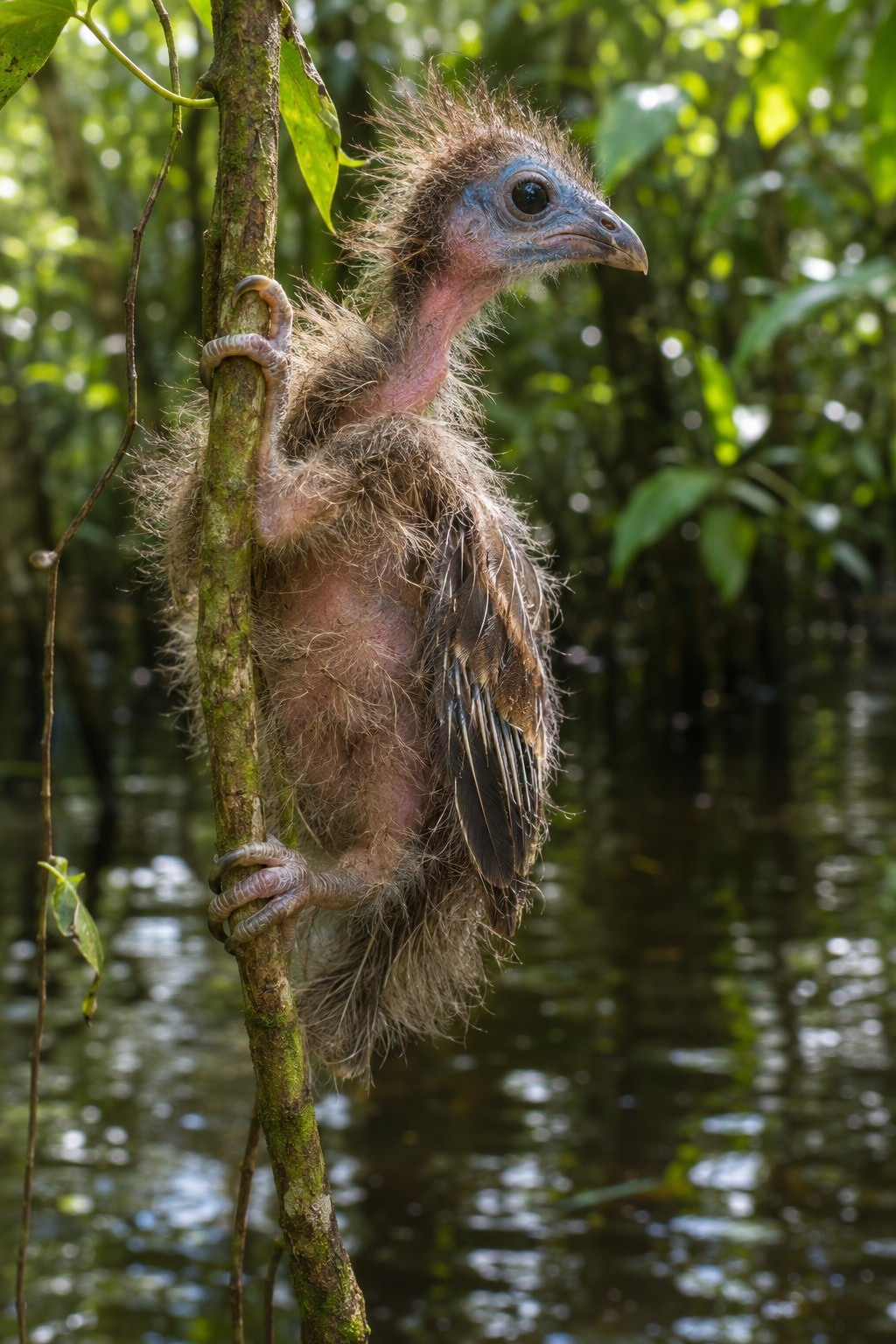
- How many: two claws per wing, on digit I (the thumb) and digit II (the first finger), present from the day of hatching.
- What they do: grip bark, vines and branches so a flightless chick can climb out of the river and back up to the nest.
- How long they last: commonly cited as 70–100 days, with the chick losing them around the time it starts to fly properly.
- The study that proved they work: Science Advances, 2019 — a team led by Anick Abourachid at the Muséum national d’Histoire naturelle in Paris filmed four nestlings climbing and swimming.
- Not a dinosaur leftover: the current reading is convergent evolution — a climbing tool reinvented recently, not handed down from Archaeopteryx.
Key Facts
- Hoatzin chicks have two working claws per wing, on digit I (the thumb) and digit II, present from the day of hatching.
- The claws are commonly cited as lasting about 70-100 days, with the chick losing them around the time it starts flying properly.
- A 2019 Science Advances study led by Anick Abourachid at the Muséum national d’Histoire naturelle in Paris filmed four nestlings along the Cojedes River in Venezuela.
- Incubation lasts around 32 days, according to nesting work by Andrea Müllner published in the Journal of Field Ornithology.
- An adult hoatzin is about 65 centimetres long and weighs roughly 700 grams; it is known locally as the “stinkbird.”
In short: Hoatzin chicks hatch with two working claws on each wing, used to climb back to nests built over water after escaping predators by dropping into the river. A 2019 study filmed this unique four-limbed climbing gait; the claws disappear within about 70-100 days as the chick matures and begins to fly.
What’s actually on a hoatzin chick’s wing?
Strip the down off a week-old hoatzin and you find something that looks wrong on a bird: a hand. Not a wing with a hand buried in it — a hand that still behaves like one. Two of the digits carry curved keratin claws, and the 2019 Paris study found the thing that matters most about them. They are attached to muscles and tendons that can actually close the digits. The claws grasp.
That distinction does a lot of work. Plenty of birds carry a hard little point at the end of a wing digit; almost none of them can do anything with it. A hoatzin chick can hook a claw over a vine and take its own weight on it (your own chickens, for comparison, often carry a small claw at the tip of the wing and have never once used it for anything).
Adults have nothing of the sort. An adult Opisthocomus hoazin is a 65-centimetre, roughly 700-gram leaf-eater with a blue bare face, maroon eyes, a ragged rufous crest and a famously bad smell — locals along the Amazon and Orinoco call it the stinkbird. Its wings are for short, laboured, crashing flights between branches, and even that is a struggle, because its enormous fermentation crop physically displaces the flight muscles and the keel of its breastbone. A wing built for grabbing vines is a long way from the engineering that lets a hummingbird beat its wings about fifty times a second.
Why hoatzin chick wing claws exist: a nest built over water
Follow the logic of the nest and the claws stop being strange.
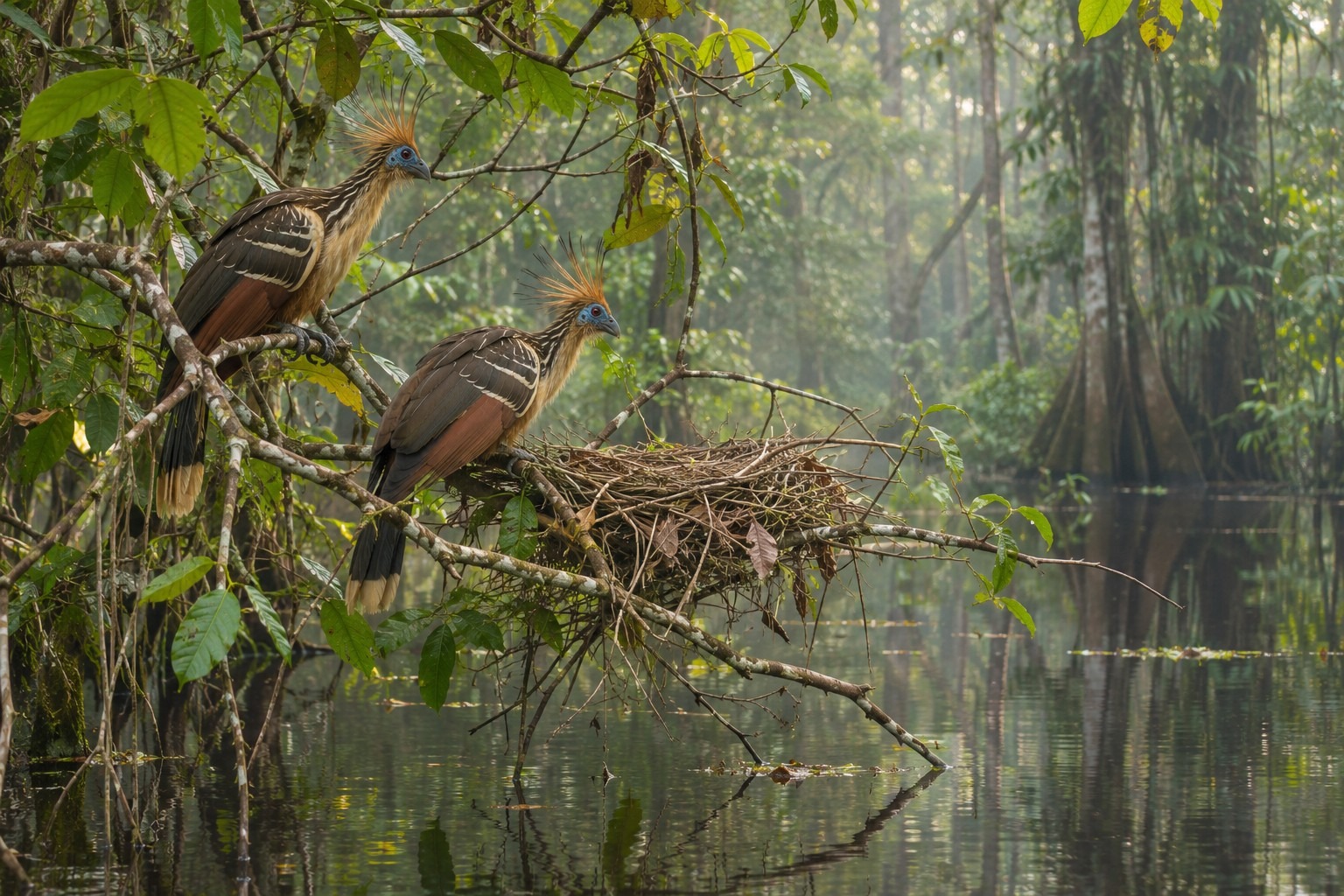
Hoatzins breed in small colonies in seasonally flooded forest, and they build a loose stick platform in branches that overhang open water. Two or three eggs. Around 32 days of incubation, according to nesting work published by Andrea Müllner in the Journal of Field Ornithology. Then two or three weeks of a chick sitting in a flimsy basket of twigs above a river, being fed regurgitated fermented leaf mash, in a forest full of tree-climbing snakes, tayras, capuchin monkeys and great black hawks.
When something comes along the branch, the adults explode outward in a noisy diversion display. The chick does the opposite. It lets go and drops — straight down, into the water — and swims, sometimes submerged, away from the commotion. Turns out that part has been known to naturalists for over a century. The hard part was never the escape.
The hard part is afterwards. A flightless chick is now in a river, in the Amazon, which is an even worse place to be than a nest. So it climbs: out of the water, up a trunk or a hanging liana, hand over hand, back to the nest it bailed out of. Without working claws on its wings, that climb is impossible, and the escape becomes a slower form of dying.
{IMAGE_2}
The gait no other bird has
This is where the 2019 research earned its place. Abourachid’s team collected four nestlings along the Cojedes River in Venezuela and filmed them, from several angles, doing the things hoatzin chicks do — climbing inclined surfaces, scrambling up towel-covered slopes, swimming in tanks.
What came back off the footage was a walk. Right wing, left foot, left wing, right foot: a true alternating four-limbed gait, the same diagonal pattern a lizard or a cat uses, and something never before documented in a bird. “It’s very strange for a bird,” Abourachid told reporters at the time. “There is no other bird that moves the wings in such a way, because all the other birds flap.”
Birds are supposed to have lost that option. Flight demanded that the two wings be welded into one synchronised unit while the legs kept alternating — forelimbs and hindlimbs decoupled, permanently. A hoatzin chick, for about two months, runs the ancestral four-legged software instead, then grows up and switches to the bird version. In the water the chicks changed modes again, moving both wings together rather than alternately.
Are they really dinosaur claws?
Half the internet will tell you the hoatzin is a living Archaeopteryx. The comparison isn’t baseless — and it also isn’t what it sounds like.
The real finding is a measurement. When the Paris team CT-scanned a hoatzin embryo close to hatching, the proportions of the claws and the finger bones came out strikingly similar to those of Archaeopteryx, the 150-million-year-old Jurassic bird from Bavaria. That is a genuinely useful result, but it runs in the opposite direction from the clickbait: because a living animal with those proportions demonstrably climbs with them, palaeontologists can now argue more confidently that Archaeopteryx had the same option available. The chick is a working model, not an heirloom.
Genetics is blunt about the rest. Hoatzins are no more closely related to Archaeopteryx than a pigeon is. The lineage sits alone in its own order, Opisthocomiformes, and the claws are read as a secondary, relatively recent re-evolution — a trait lost across birds and then switched back on in one Amazonian folivore whose chicks had a very specific problem to solve. Gerald Mayr, an ornithologist at the Senckenberg Research Institute in Frankfurt, has cautioned that the hoatzin’s skeleton differs substantially from those of early birds, so the analogy has limits.
Calling the hoatzin a living Archaeopteryx is the laziest thing ever written about this bird, and it undersells the far better story — that evolution can rebuild a discarded hand when a riverbank makes it worth having.
And the honest footnote: nobody is certain where hoatzins belong on the bird family tree at all. A 2014 genomic study placed them as a sister group near the shorebird and crane radiation; a 2024 analysis pushed them toward a very different neighbourhood. The claws are better understood than the ancestry.
Which other birds have claws on their wings?
Wing claws are not actually rare. Functional ones are. This is the distinction almost every page on the topic skips, so here it is laid out — and note that wing spurs, the bony weapons carried by screamers and some jacanas, are a different structure altogether, not claws at all.
| Bird | What’s on the wing | Used for climbing? |
|---|---|---|
| Hoatzin chick | Two grasping claws, thumb + first finger, with working muscles and tendons | Yes — documented in detail |
| Turaco chick | A small wing claw | Yes, but limited |
| Ostrich, emu | Claws on the wing digits, kept into adulthood | No |
| Ducks, geese, swans, kiwis | A small claw or nail hidden under the feathers at the end of the hand | No known locomotor use |
| Domestic chicken | Often a tiny claw at the tip of the alula; variable between birds | No |
So the claw itself isn’t the miracle. The miracle is the wiring behind it — and, so far, only hoatzin and turaco chicks are known to climb with one.
When do the claws disappear?
Here’s the thing about the timeline: it is looser in the literature than most articles admit. The figure you’ll see repeated is that the claws are shed or regress at around 70 to 100 days old, and other sources simply say “the first three months.” Both describe the same rough window; neither comes from a tightly controlled developmental study, and the honest answer is that the exact day a hoatzin loses its wing claws has not been pinned down for wild birds.
What the window lines up with is more informative than the number. Hoatzin chicks leave the nest at two to three weeks old but cannot fly properly until somewhere around 60 to 70 days, and they stay dependent on adults for food for two to three months after that. Slot the claws into that sequence and the function becomes obvious.
Why would a chick carry climbing gear for exactly that long, and not longer? Because the claws cover the gap — the weeks when the bird is out of the nest, over water, and still cannot get airborne. Once the wing becomes a wing, the hand on it is dead weight, and it goes.
The quiet threat to a clawed chick
Hoatzins are listed as Least Concern by the IUCN, which flatters the situation slightly; the population is thought to be declining with the loss of flooded forest, and the species is tied to exactly the riverside habitat that gets cleared, drained and dammed first.
There’s a subtler finding worth knowing, and it comes from Andrea Müllner, Karl Eduard Linsenmair and Martin Wikelski, published in Biological Conservation in 2004. Working in the Cuyabeno Reserve in Ecuador, they compared hoatzin nests exposed to tourist boat traffic with undisturbed ones. Hatching success was similar in both groups. Chick survival was not — it was markedly lower at the tourist-exposed nests, and those chicks showed elevated stress-induced corticosterone and lower body mass.
Read that against everything above and it fits. Every disturbance that makes a chick bail out of the nest costs it a swim, a climb and a meal it didn’t get. The claws are a brilliant piece of equipment, and they are not free to use.
Questions Readers Ask
Do adult hoatzins have wing claws?
No. They’re gone well before the bird is a year old, and adults show no trace of a functional claw. The claws belong to one short, specific, flightless chapter of the bird’s life.
Can hoatzin chicks actually swim?
Yes, and they do it readily — the 2019 study filmed nestlings swimming in tanks, moving both wings together rather than alternately, a different pattern from their climbing gait. In the wild they drop from the nest into the river and can swim below the surface before resurfacing to climb back.
Are hoatzin chick wing claws the same as the claws on Archaeopteryx?
Similar in proportion, not inherited. CT scans of a near-hatching hoatzin showed claw and finger-bone proportions close to those of Archaeopteryx, which is why the chick is useful as a living functional model — but the hoatzin’s claws evolved independently, long after the Jurassic.
Do any other baby birds climb with their wings?
Turaco chicks are the one other group known to, with a smaller claw and less dramatic use of it. A number of nestlings scramble with bare wing wrists and flapping assistance; what makes the hoatzin unique is a claw with grasping muscles behind it and a coordinated four-limbed gait to use it.
Sources and Notes
- Abourachid et al., “Hoatzin nestling locomotion: Acquisition of quadrupedal limb coordination in birds,” Science Advances, 2019 (Muséum national d’Histoire naturelle, Paris)
- Müllner, Linsenmair & Wikelski, “Exposure to ecotourism reduces survival and affects stress response in hoatzin chicks,” Biological Conservation, 2004
- Müllner, “Nesting behavior and breeding success of Hoatzins,” Journal of Field Ornithology, 2007
- American Institute of Physics, Inside Science — reporting and researcher interviews on the 2019 hoatzin study
- IUCN Red List and Animal Diversity Web, species accounts for Opisthocomus hoazin
If you ever get to a blackwater creek in Cuyabeno or along the Cojedes and see a hoatzin nest leaning over the water, the useful thing to do is nothing: stay in the boat, keep your distance, and let the chick stay where it is — the Ecuador work shows that a chick forced to bail out pays for it. And if you never get there, keep the better souvenir anyway. For about ten weeks, somewhere in the Amazon right now, a bird is walking on its hands, using a tool the rest of its family tree threw away — proof that “vestigial” and “gone” are not the same word.
Frequently Asked Questions
Q: Why do hoatzin chicks have claws on their wings?
The claws let a flightless chick climb back up to its nest after escaping a predator by dropping into the water below. Hoatzins build loose stick nests over seasonally flooded forest water; when a predator approaches, the chick drops into the river and swims away, then must climb branches or vines back up using the two claws on each wing.
Q: How long do hoatzin chicks keep their wing claws?
The claws are commonly cited as lasting about 70 to 100 days, with the chick losing them around the time it starts flying properly. Adult hoatzins have no trace of the claws; the feature exists only during the flightless nestling stage, when climbing ability matters more than flight.
Q: What did the 2019 study on hoatzin chicks discover?
A team led by Anick Abourachid at the Muséum national d’Histoire naturelle in Paris filmed four nestlings along Venezuela’s Cojedes River climbing and swimming. The footage revealed a true alternating four-limbed gait — right wing with left foot, left wing with right foot — a movement pattern never before documented in any bird.
Q: Are hoatzin wing claws proof of direct dinosaur ancestry?
Not directly. CT scans show the claw and finger-bone proportions of a hoatzin embryo closely resemble those of Archaeopteryx, the Jurassic-era bird, but genetically hoatzins are no more closely related to Archaeopteryx than a pigeon is. Researchers read the claws as a separate, more recent re-evolution of a climbing trait rather than an inherited leftover.
Illustrations are AI-generated. Article fact-checked and human-edited. Our editorial standards.