Brazil’s Most Tattooed Man Is Erasing His Past
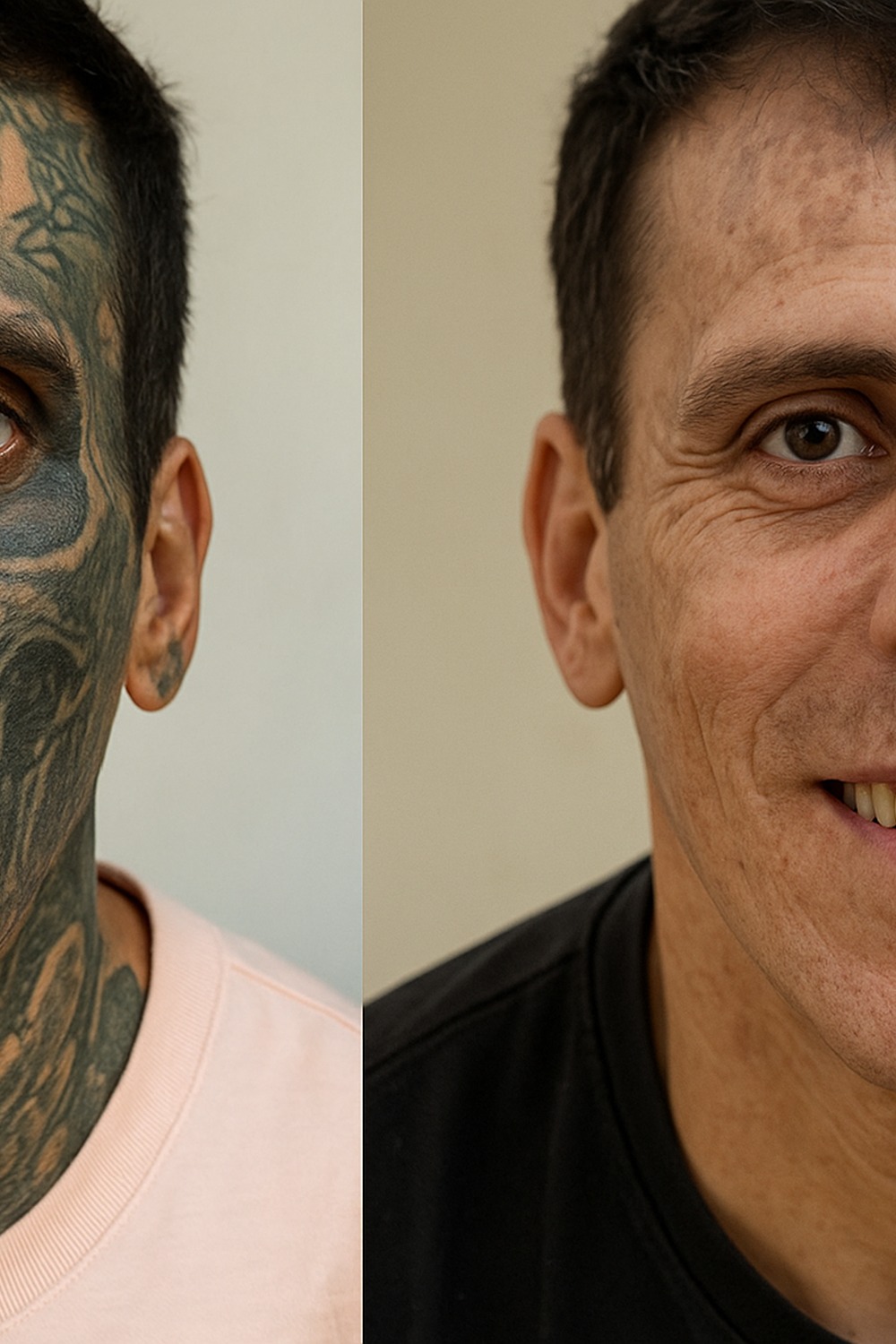
Here’s the thing about tattoo removal transformation: it starts long before the laser does. Leandro de Souza has 170 tattoos covering 95% of his body, and he’s erasing all of them — not because someone made him, not as punishment, but because the person who put them there no longer exists. The beam scorches through 27 years of ink, layer by layer. He doesn’t flinch.
By his mid-thirties, that ink had earned him a spotlight at Santa Rosa’s International Tattoo Expo in southern Brazil. What that stage didn’t show: the divorce, the substance abuse, the nights sleeping rough under São Paulo’s grey rain. Beneath the ink was a life in pieces. Now, Leandro is making a different kind of mark — or rather, unmaking one.
Key Facts
- Leandro de Souza had 170 tattoos covering 95% of his body and is undergoing full laser removal
- His removal plan spans eight major sessions, each requiring general anesthesia and weeks of healing
- A 2016 British Association of Dermatologists study found about 17% of tattooed UK adults reported regret, rising to nearly 28% for those tattooed before age 18
- 74% of surveyed small business hiring managers in Sao Paulo said they were less likely to interview candidates with facial or neck tattoos (UNIFESP)
- Picosecond laser technology fires pulses measured in trillionths of a second to shatter ink particles
In short: Leandro de Souza, once Brazil’s most tattooed man with 170 tattoos covering 95% of his body, is undergoing a tattoo removal transformation across eight anesthesia-requiring laser sessions. After conversion, addiction recovery, and homelessness, he documents each painful session as testimony, illustrating why removal is rarely about vanity alone.
When the Ink Went Deeper Than Skin
Leandro’s story doesn’t start with rebellion. It starts with curiosity — a 13-year-old in Rio Grande do Sul, Brazil, drawn to the idea that skin could be a story. The first tattoo was small, a dragon sketched in blue on his forearm. Then another. Then script, then portraits, then full sleeves, then chest panels, then his face. By the time he was competing at the International Tattoo Expo in Santa Rosa in the early 2010s, he had more ink than bare skin. According to the history of tattooing, the practice has served as rite of passage, status marker, and spiritual declaration across cultures for thousands of years. For Leandro, it was all three simultaneously — and none of them cleanly. The audience stared. He understood, even then, that he’d made himself into a spectacle.
The tattoos didn’t cause his unraveling, but they followed it closely. His divorce at 25 cut something loose in him. Substance abuse followed. Then prison. Then the streets. São Paulo is a city of 22 million people and very few soft places to land. He slept where he could, wearing his history on his skin, visible to everyone who passed. Strangers would stop and stare — not the admiring looks of an expo audience, but something colder. Fear. Pity. The kind of gaze that makes a person feel less like a human being and more like a warning sign.
He kept getting tattooed through all of it. That’s the part people find hardest to understand. The ink wasn’t a cry for help. It was the one thing that still felt like a choice.
The Conversion That Changed Everything
Two years ago, something shifted. Leandro de Souza walked into an evangelical Christian congregation in São Paulo, and whatever he was carrying, he left a portion of it there. Religious conversion has always been one of the most profound and least predictable forces in human life — it can happen slowly, over decades, or all at once, the way a bone breaks cleanly. For Leandro, it was the latter. This wasn’t passive belief. It was restructuring. The stories of transformation he heard at that congregation mirrored something he’d been circling for years, and they raised an immediate, physical problem: 170 tattoos, most of which he now associated with a version of himself he no longer recognized. The question of whether skin can be rewritten is one that cuts deeper than aesthetics — it’s something explored throughout human history, from the extraordinary ways medicine rewrites a person’s story before they’re even born to the quieter revisions we make to our own bodies across a lifetime.
The removal process began almost immediately after his conversion. Laser tattoo removal — specifically Q-switched and picosecond laser technology — works by firing pulses of concentrated light into the dermis at speeds measured in trillionths of a second. The laser shatters ink particles into fragments small enough for the body’s lymphatic system to gradually clear away. The Brazilian Society of Dermatology estimates that a heavily tattooed individual may require 10 to 15 sessions per area, with professional black ink responding faster than amateur blues and reds. Leandro’s case requires general anesthesia. His full removal plan spans eight major sessions — each one several hours long, each one followed by weeks of raw, peeling healing.
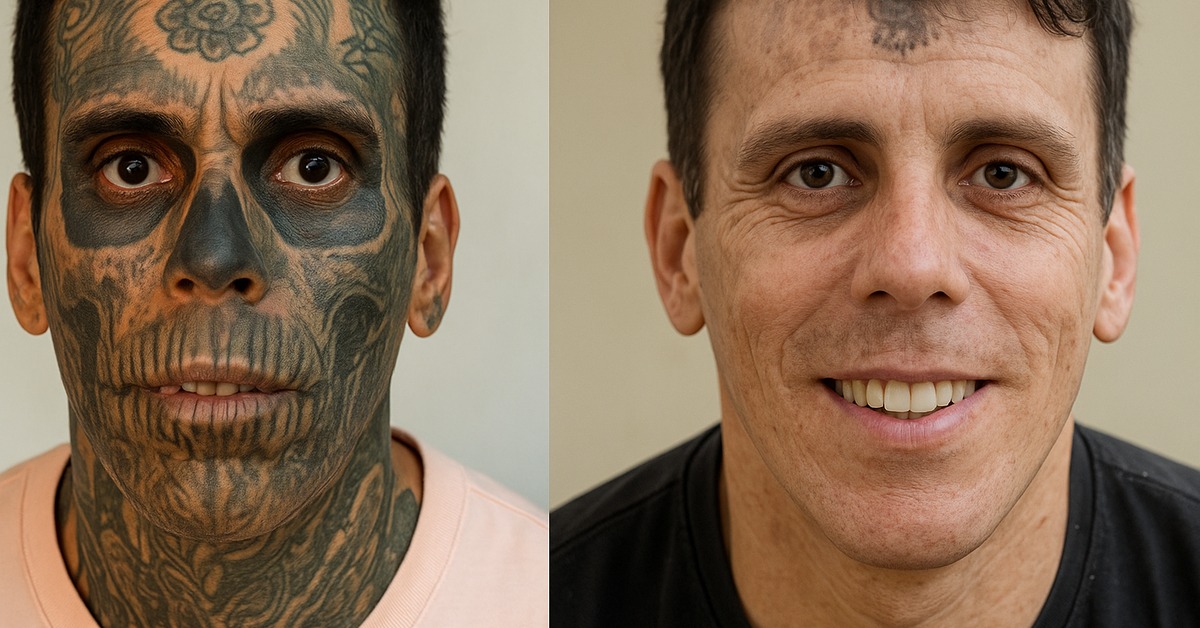
He photographs the process himself. Before and after shots that he shares, quietly, as testimony. Not to build a following. To hold himself accountable.
What the Science Says About Regret and Identity
Why does this matter beyond one man’s story? Because the numbers suggest Leandro is the visible edge of something much larger.
A 2016 study published by the British Association of Dermatologists found that approximately 17% of tattooed individuals in the United Kingdom reported some degree of regret, with that figure rising to nearly 28% among those tattooed before age 18. In the United States, the American Society for Dermatologic Surgery reported in 2022 that laser tattoo removal had become one of the fastest-growing cosmetic procedures in the country, with hundreds of thousands of sessions performed annually. Turns out, the body has been working on this problem the whole time: as Smithsonian Magazine’s investigation into tattoo science noted, pigment particles are constantly being consumed by immune cells called macrophages, which is why old tattoos fade and why, when macrophages die, their ink gets passed to neighboring cells. The body never fully accepts a tattoo. It spends a lifetime trying to quietly remove it.
The tattoo removal transformation Leandro is undergoing isn’t just cosmetic — it’s neurological and psychological. Research published in 2021 by the University of Nottingham’s School of Psychology found that the physical act of altering appearance in alignment with a new identity reinforces the psychological coherence of that identity. In plain terms: removing the marks of a past self helps the brain update its map of who you are. For someone emerging from addiction, incarceration, and homelessness, that recalibration isn’t a luxury. It’s close to essential.
When the evidence lines up this cleanly — psychological research, dermatological data, and lived experience all pointing the same direction — dismissing tattoo removal as vanity starts to look like willful blindness.
The hardest tattoos aren’t the largest. Leandro knows this. “Face tattoos are the hardest to take back,” he says — meaning both the procedure and the social weight. Facial skin is more vascular, more sensitive, and more visible. Every laser pass on his face is a public declaration, impossible to hide beneath a collar or a sleeve.
Tattoo Removal Transformation as Testimony
Recomeço Ink — loosely translated as Fresh Start Ink — began operating in São Paulo in 2023, connecting formerly incarcerated Brazilians with pro bono dermatologists willing to perform laser tattoo removal. Their founding research, drawn from data compiled with the Federal University of São Paulo (UNIFESP), showed that visible gang-affiliated or prison tattoos were a significant barrier to employment. Hiring managers in 74% of surveyed small businesses in São Paulo said they were less likely to interview candidates with facial or neck tattoos. That number, stripped of sentiment, explains a great deal about why Leandro is lying under a laser rather than simply wearing long sleeves. It’s not shame, exactly. It’s pragmatics layered over something more personal.
And what he wants, underneath all of it, is almost aggressively ordinary. Leandro wants to work. He wants to reunite with his family — estranged through the years of chaos, now cautiously reachable. He’s dreaming of something unremarkable: a steady job, mornings without dread, his children knowing his face as a father’s face rather than a curiosity’s. Each laser session costs the equivalent of several hundred Brazilian reais, and he has fundraised portions of it through social media, where his story has attracted both admiration and cruelty in roughly equal measure. The process is expected to take two more years to complete. He has not once, in documented interviews, expressed doubt about continuing.
His counsel to young people is pointed and specific. Not “don’t get tattoos.” He says: think about your face. Think about what you want employers, strangers, your future children to see first. Think about the distance between the person you are at 17 and the person you’ll need to be at 35. That distance, he knows firsthand, can be enormous.
How It Unfolded
- 1997 — Leandro de Souza receives his first tattoo at age 13 in Rio Grande do Sul, Brazil, beginning a process that will eventually cover 95% of his skin.
- Early 2010s — Competing at Santa Rosa’s International Tattoo Expo, Leandro is publicly recognized as Brazil’s most tattooed man, with 170 distinct tattoos documented.
- 2022 — Following years of substance abuse, incarceration, and homelessness, Leandro converts to evangelical Christianity and begins planning his tattoo removal transformation.
- 2023–2025 — Undergoing a scheduled eight-session laser removal program requiring general anesthesia, Leandro documents his progress publicly as an act of testimony and outreach.
By the Numbers
- 95% — the estimated proportion of Leandro’s body surface covered by tattoos at the peak of his inking, across 170 individual designs.
- 8 — total planned laser removal sessions, each requiring general anesthesia and weeks of recovery time between appointments.
- 17% — percentage of tattooed adults in the UK who reported tattoo regret in a 2016 British Association of Dermatologists study, rising to 28% for those tattooed before age 18.
- 74% — share of small business hiring managers in São Paulo who told UNIFESP researchers they were less likely to interview candidates with facial or neck tattoos.
- Trillionths of a second — the pulse duration of picosecond laser technology used in modern tattoo removal, shattering ink particles without burning surrounding tissue.
Field Notes
- Amateur tattoo inks — frequently used in prison environments — are often harder to remove than professional inks because they contain irregular, unrefined pigment particles that scatter laser energy unpredictably, requiring more sessions and causing greater skin trauma. Dermatologists at the Universidade Federal de São Paulo noted this pattern in 2021.
- The immune system never fully stops fighting tattoo ink. Macrophages — white blood cells tasked with consuming foreign particles — ingest ink continuously throughout a person’s life, which is part of why tattoos fade naturally over decades even without intervention.
- Face and neck tattoos require up to 40% more laser sessions than arm or torso tattoos on average, due to the increased vascularity and thinner dermal layers of facial skin — making Leandro’s removal process among the most technically demanding a dermatologist can perform.
- Researchers still can’t fully predict which patients will develop post-inflammatory hyperpigmentation after laser removal (researchers actually call this a “treatment complication of uncertain onset”) — the darkening of treated skin that can, in some cases, be more visible than the original tattoo. The variables involving skin tone, ink chemistry, and immune response remain too complex to model reliably.
Frequently Asked Questions
Q: What does a tattoo removal transformation actually involve, and how long does it take?
Tattoo removal transformation using laser technology typically involves multiple sessions spaced 6 to 12 weeks apart to allow the skin to heal and the lymphatic system to clear shattered ink particles. The number of sessions depends on ink colour, depth, age, and skin tone. Black ink responds fastest. Blues and greens are the most stubborn. For someone as extensively tattooed as Leandro, the full process can take two to four years and requires anesthesia for large surface treatments.
Q: Why do people who were heavily tattooed seek removal, and is regret the main driver?
Regret is one driver, but it’s rarely the only one. Employment barriers are a significant factor — studies consistently show that visible tattoos, particularly on the face and neck, affect hiring decisions across many industries. Life changes like religious conversion, recovery from addiction, or leaving gang affiliation are also major motivators. Leandro’s case combines all three. The British Association of Dermatologists found in 2016 that regret was most common among people tattooed at a young age or during emotionally turbulent periods of their lives.
Q: Is laser tattoo removal completely effective — does the ink fully disappear?
Complete removal is possible but not guaranteed, and it’s one of the most common misconceptions people carry into their first session. Results depend heavily on ink colour, ink depth, the age of the tattoo, and the individual’s immune response. Black ink on lighter skin tones has the highest clearance rate. Coloured inks — particularly greens, yellows, and certain blues — can be significantly more resistant. Most dermatologists use the term “significant fading” rather than “complete removal” to set accurate expectations, particularly for older or amateur tattoos.
Editor’s Take — Sarah Blake
What strikes me most about Leandro’s story isn’t the removal — it’s the photographing. He documents every session, every scar, every week of healing skin. The man who once wore his life outwardly has turned inward, and now he points a camera at the evidence. That’s not performance. That’s something closer to rigour — the same discipline that got him through prison and rough streets, redirected. The tattoos may fade. That quality won’t.
Leandro de Souza’s tattoo removal transformation is many things at once: a medical procedure, a spiritual act, a job application, a letter to his children. It asks something uncomfortable of anyone watching — which is whether we believe people can fundamentally change, or whether we prefer them frozen inside the choices they made when they were 13 and the world still felt like a surface waiting to be marked. Somewhere in São Paulo, the laser is already scheduled for its next pass. The skin is still healing from the last one. And underneath all of it, something is slowly, stubbornly becoming visible again.
Illustrations are AI-generated. Article fact-checked and human-edited. Our editorial standards.