LNG Tankers: How -162°C Keeps the World’s Lights On
Here’s the thing about liquefied natural gas: the entire global trade depends on a physical transformation most engineers once considered commercially impossible. Cool methane below -161.5°C and it collapses into a clear, still liquid — one six-hundredth of its original volume, calm enough to carry across oceans. An LNG tanker liquefied natural gas carrier holds that transformed state together for weeks at a time, in the middle of a warm sea, while the world on the other end waits for the heat it produces.
Natural gas in its gaseous state is unruly, enormous, and almost impossible to ship across oceans. That single physical fact — the volume collapse at cryogenic temperatures — has quietly built one of the most complex and consequential logistics chains on Earth. But how safe is a system that depends on maintaining an almost impossibly low temperature, across thousands of ocean miles, every single hour of every single day?
Key Facts
- Methane becomes liquid at atmospheric pressure when cooled below -161.5 degrees Celsius, collapsing to one six-hundredth of its volume
- The 1944 Cleveland LNG disaster killed 130 people and destroyed a square mile of the city
- The modern LNG shipping trade began in 1964 when the Methane Princess made the first commercial voyage from Algeria to the UK
- Global LNG trade reached a record 404 million tonnes in 2023 (International Gas Union World LNG Report)
- A Q-Max class carrier stretches over 345 meters long and can carry up to 266,000 cubic meters of LNG, enough to heat around 45,000 British homes for a year
In short: An LNG tanker liquefied natural gas carrier holds methane cooled below -161.5 degrees Celsius, shrunk to one six-hundredth of its gaseous volume, stable in a warm ocean for weeks. From the 130-death 1944 Cleveland disaster to a record 404 million tonnes traded in 2023, it is one of Earth’s most consequential and invisible logistics chains.
The Physics of Cold: How Liquefied Natural Gas Actually Works
Natural gas — primarily methane — becomes liquid at atmospheric pressure when cooled below -161.5°C. British chemist Michael Faraday pointed toward cryogenic science as early as 1823 when he first liquefied chlorine, but industrial-scale liquefaction of methane didn’t arrive until the 20th century. The modern LNG industry traces its commercial origins to 1964, when the Methane Princess — operated by British Gas and Shell — made the first commercial LNG voyage from Algeria to the UK. According to the Wikipedia entry on liquefied natural gas, global LNG trade now exceeds 400 million tonnes per year, serviced by a fleet of more than 600 purpose-built carriers worldwide. The physics behind that fleet is elegant and brutal in equal measure.
Methane’s boiling point at sea level is -161.5°C — colder than the surface of Mars on its darkest nights. To keep it liquid during transit, LNG tankers don’t actively refrigerate the cargo. Instead, they rely on auto-refrigeration (researchers actually call this a closed-loop thermodynamic solution): the cargo is allowed to boil slightly at its surface, and the vapor produced carries heat away, keeping the bulk of the liquid stable. A small amount of gas — called boil-off gas — is constantly generated. Modern ships burn it as fuel.
The cargo tanks themselves are engineering marvels. Built from nickel steel alloys, aluminium, or membrane systems lined with Invar, they withstand extreme thermal contraction without cracking. At -162°C, ordinary steel becomes brittle as glass. Touch the outer hull and it’s room temperature. Three meters inward, it’s colder than Antarctica has ever recorded.
A History Written in Disasters and Hard-Won Rules
Every safety protocol aboard a modern LNG tanker liquefied natural gas carrier carries the shadow of what happened in Cleveland, Ohio, on October 20, 1944. A storage tank at the East Ohio Gas Company failed — almost certainly due to a sub-standard steel alloy that couldn’t withstand cryogenic temperatures — and LNG spilled into the sewer system. When it vaporized and ignited, it destroyed a square mile of the city, killing 130 people and leaving thousands homeless. The disaster set back LNG development by more than a decade. Much like how the hidden dangers of a small object lodged in the wrong place for forty years can rewrite medical understanding through a single case, the Cleveland disaster turned one catastrophic failure into a generation of safety standards that still govern the industry today.
What changed? Everything, starting with the International Maritime Organization’s IGC Code — first adopted in 1983 and substantially revised in 2016.
That code governs tank construction materials, valve design, emergency shutdown systems, crew training, and the spacing of vapor detectors. LNG carriers now carry redundant systems at every critical juncture: dual-redundant cargo pumps, double-walled pipes that contain any leak before it reaches atmosphere, and gas detection systems that trigger automatic shutdowns when methane concentrations reach 20% of the lower explosive limit — well before any ignition risk. Aboard the carriers, crews run vapor detection checks every four hours. Pressure gauges on each tank are monitored from a central control room that looks more like a nuclear submarine than a ship’s bridge. Every number has a ceiling, a floor, and an alarm.
The Global Network That Keeps the Lights On
Roughly 100 LNG carriers were operating globally in 2000. By 2023, that number had grown to more than 650, according to the International Gas Union’s annual World LNG Report. The growth follows geopolitical fault lines with precision: Japan, South Korea, and China together account for more than half of global LNG imports. Europe’s dependence surged after 2022, when Russia’s invasion of Ukraine forced the continent to rapidly rewire its gas supply chains, with terminals in Germany, the Netherlands, and Italy scaling up import capacity at a pace that would have seemed impossible a decade earlier.
And yet the trade remains almost entirely invisible to the people who depend on it most.
Gas arrives at a regasification terminal — warmed back into vapor, fed into pipelines — and enters a home as the same blue flame on a kitchen stove it always was. No one sees the carrier that crossed 12,000 nautical miles to deliver it, the cryogenic tanks, or the crew standing four-hour watches at -162°C cargo monitors. There are currently more than 40 active LNG export terminals worldwide, from Qatar’s Ras Laffan — still the largest single LNG complex on Earth — to newer facilities in the United States, Australia, and Mozambique. Each represents years of construction and billions of dollars of infrastructure, built on the assumption that cold gas will keep moving, and that ships will keep arriving on schedule.
LNG Tanker Design: Engineering at the Edge of Possibility
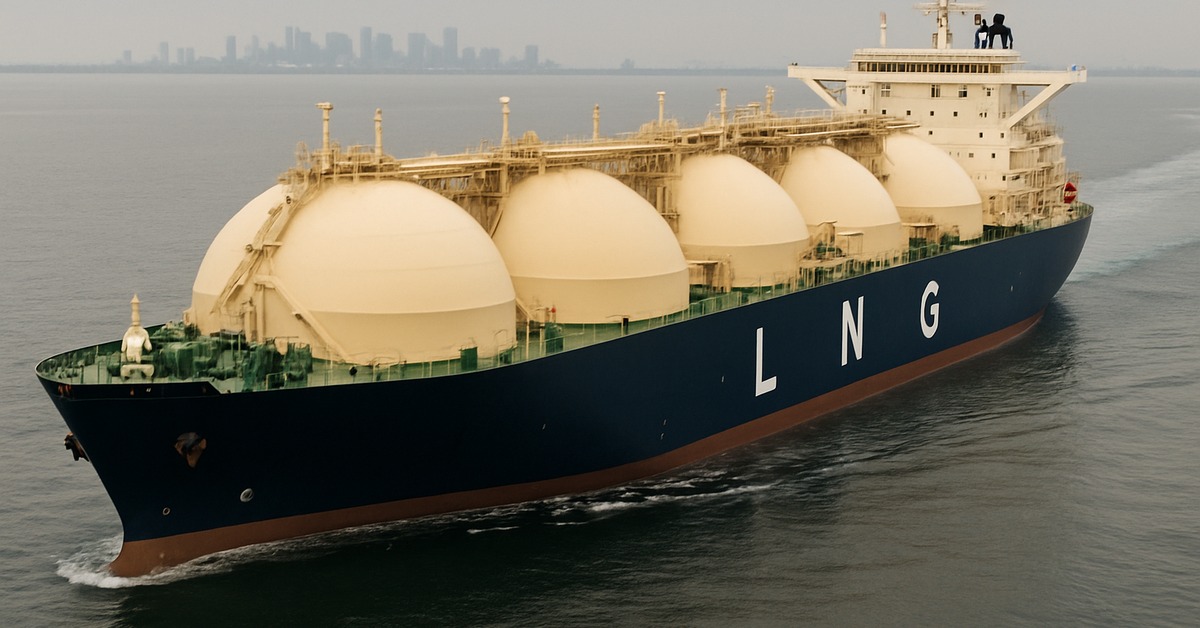
A modern Q-Max class vessel — among the biggest ships ever constructed — stretches over 345 meters in length, longer than the Empire State Building is tall. Developed by QatarEnergy in partnership with Hyundai Heavy Industries, with the first vessel, Mozah, delivered in 2008, it can carry up to 266,000 cubic meters of LNG: enough gas, once regasified, to heat around 45,000 British homes for an entire year. The design was dictated by Qatar’s need to move enormous volumes across long distances with maximum efficiency, pushing naval architects to reimagine what a cargo vessel could be.
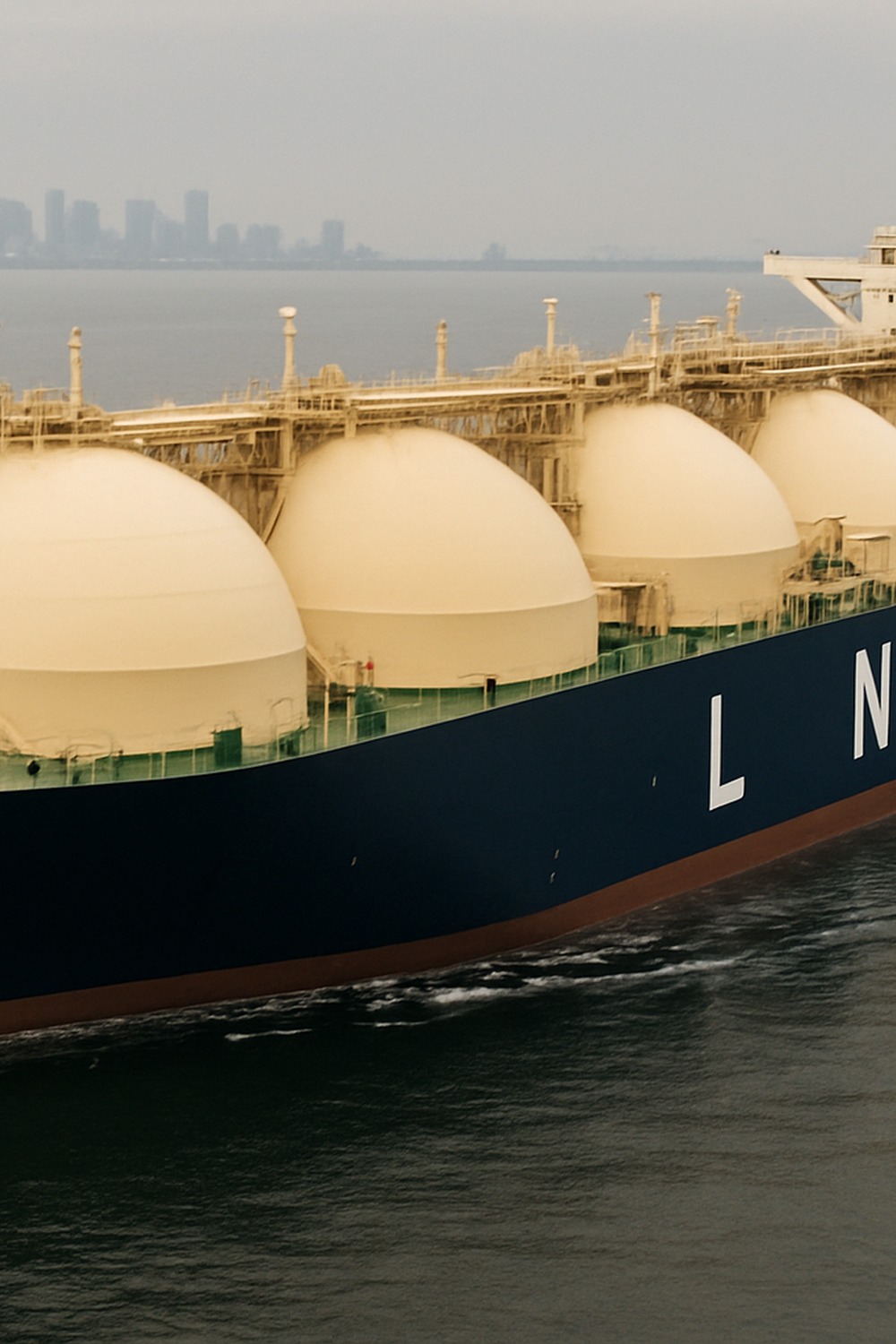
Two primary containment systems define these ships. The Moss spherical tank system is recognizable by dome-shaped tanks visible above the hull. The membrane system — developed by French company GTT (Gaztransport & Technigaz) in the 1960s — holds LNG in flat-sided tanks lined with corrugated metal membranes just 1.2 millimeters thick, and now dominates new construction because it allows more cargo per hull. The corrugated pattern isn’t decorative: it absorbs the thermal contraction as tanks cool from room temperature to -162°C, preventing metal from cracking under stress.
Modern vessels also incorporate reliquefaction plants that capture boil-off gas, cool it back down, and return it to cargo tanks rather than burning it. At the volumes being traded, even small improvements in boil-off management translate to millions of dollars annually — which is why this technology, now standard in new builds, spread as fast as it did.
The Future of LNG: Bridge Fuel or Permanent Fixture?
Proponents of LNG argue that natural gas — emitting roughly half the CO₂ of coal per unit of energy — is an essential bridge fuel, giving developing economies a path away from the dirtiest fossil fuels while renewable capacity is built. The counter-argument centers on methane leakage: methane is approximately 80 times more potent than CO₂ as a greenhouse gas over a 20-year timeframe. A 2022 study published in Science found that methane emissions from fossil fuel operations were 70% higher than official estimates — a finding that significantly complicated the LNG-as-clean-fuel narrative. Studies from Stanford University and the Environmental Defense Fund had already documented leakage rates from LNG infrastructure that partially erode the climate advantage over coal.
The data left no room for comfortable interpretation — and the industry knew it.
Major operators including Shell, TotalEnergies, and QatarEnergy have announced net-zero targets and are investing in technologies to reduce methane slip — the small amounts of unburned gas that escape from engines and cargo systems. New dual-fuel engines burning LNG alongside hydrogen or ammonia are in development. Several carriers have already been retrofitted with carbon capture systems. Whether these measures arrive fast enough to align with global climate commitments remains the central unanswered question hanging over every vessel that leaves port. Stand on the Rotterdam dock and you feel the weight of it physically: the carrier in front of you is a technical marvel, and also a reminder that the world’s energy system is still running, in large part, on a fuel extracted from the ground.
How It Unfolded
- 1917 — First commercial production of LNG occurs in the United States, at a small plant in West Virginia, demonstrating that large-scale methane liquefaction was technically feasible.
- 1944 — Cleveland LNG disaster kills 130 people after a storage tank failure, halting industry development but generating the safety frameworks that govern the industry today.
- 1964 — Methane Princess completes the first commercial transoceanic LNG voyage, from Algeria to Canvey Island in the UK, launching the modern LNG shipping trade.
- 2023 — Global LNG trade reaches a record 404 million tonnes, driven by European demand following the Russia-Ukraine war, according to the International Gas Union’s World LNG Report.
By the Numbers
- 404 million tonnes of LNG traded globally in 2023, a record high (International Gas Union, World LNG Report 2024)
- -161.5°C — the precise boiling point of methane at atmospheric pressure, below which natural gas becomes liquid
- 1/600 — the ratio of LNG volume to its gaseous equivalent; one cubic meter of LNG produces approximately 600 cubic meters of natural gas
- 345 meters — length of a Q-Max LNG carrier, exceeding the height of the Empire State Building by roughly 5 meters
- $200–250 billion USD — estimated cumulative global investment in LNG infrastructure between 2010 and 2024 (Wood Mackenzie, 2023)
Field Notes
- In 2019, a crew aboard the LNG carrier Flex Ranger documented a boil-off gas rate drop of 40% after retrofitting a new partial reliquefaction system — the first data confirming that mid-life retrofits could meaningfully improve efficiency without full tank replacement. The finding accelerated a wave of similar retrofits across the global fleet.
- GTT-designed membrane tanks use corrugated metal thinner than two stacked credit cards, yet membrane failures remain extremely rare — the corrugation geometry distributes thermal stress with an efficiency that early engineers couldn’t fully predict when the design was first certified.
- Qatar’s Ras Laffan industrial city — the world’s largest LNG export complex — produces more LNG than the entire continent of Africa, yet occupies a coastal strip barely 60 kilometers long on Qatar’s northeast coast.
- Researchers at MIT’s Energy Initiative still can’t fully model the long-term climate impact of LNG under all plausible methane leakage scenarios. The uncertainty range spans outcomes from meaningfully better than coal to marginally worse — depending on measurements that haven’t yet achieved industry-wide standardization.
Frequently Asked Questions
Q: What makes an LNG tanker liquefied natural gas carrier different from a regular oil tanker?
An LNG tanker is fundamentally different in almost every dimension. Cargo must be maintained at -162°C, requiring specialized insulated tank systems built from cryogenic-grade materials. The ships carry their own gas detection and auto-shutdown infrastructure, and crew training requirements are far more demanding than on conventional tankers. Every element of the vessel is designed around a single constraint: keeping an extremely cold liquid stable in a warm ocean environment for weeks at a time.
Q: Is an LNG tanker dangerous to the people who live near ports?
Modern LNG carriers have an exceptionally strong safety record. LNG doesn’t explode on contact with air — it must reach a specific concentration range (5–15% in air) and find an ignition source to combust. If spilled on water, it disperses and evaporates rapidly. Port authorities worldwide maintain exclusion zones and emergency response plans around LNG terminals. The risk is real but tightly managed through engineering controls and regulatory oversight developed over 60 years, largely in response to the 1944 Cleveland disaster.
Q: Is LNG actually a cleaner fuel than coal, or is that a myth?
Burning natural gas emits roughly 50% less CO₂ than coal per unit of energy — that part is straightforward. But methane itself is a far more potent greenhouse gas than CO₂ in the short term, and the answer depends heavily on leakage rates along the supply chain. If those rates exceed approximately 3–4%, the climate advantage over coal largely disappears. A 2022 study in Science found real-world leakage was significantly higher than official figures suggested, making “clean LNG” a genuinely contested claim rather than a settled fact.
Editor’s Take — Dr. James Carter
What strikes me most about LNG isn’t the scale of the ships or the extremity of the temperatures — it’s the invisibility. Half the world heats its homes and runs its factories on gas that crossed an ocean inside a floating thermos flask, maintained at a temperature no human could survive. The Cleveland disaster killed 130 people in 1944 and rewrote an industry. The question now is whether methane leakage data rewrites it again — this time before the damage accumulates quietly, without a single dramatic moment to force the reckoning.
Energy systems are rarely as simple as the flames they ultimately produce. The LNG tanker liquefied natural gas trade is a chain of extraordinary engineering, learned hard lessons, and geopolitical urgency stretching from Qatar’s desert coast to Rotterdam’s winter mist. It has kept the lights on for billions of people during one of the most turbulent decades in living memory. Whether it’s a bridge to something cleaner or a path that locks in another generation of fossil fuel dependency may be the most consequential infrastructure question of the coming decade — decided quietly, in terminals most people will never see, aboard ships they’ll never board.
Illustrations are AI-generated. Article fact-checked and human-edited. Our editorial standards.