A Bicycle Is Saving Lives Where Hospitals Never Arrived
The rider leaves before the village wakes up. By the time the sun is high enough to matter, he’s already at the third homestead, checking a grandmother’s blood pressure with equipment that fits in a pannier bag.
In northern Uganda’s Karamoja region, the numbers are quietly devastating: roughly one doctor for every 25,000 people, roads that dissolve into cattle tracks after rain, and children dying from malaria that costs less than a dollar to treat. Communities didn’t wait around for governments to close that gap. They found something else. Something with two wheels and no engine and a 200-year head start on every piece of modern medical infrastructure we take for granted.
Key Facts
- Uganda’s Karamoja region has roughly one doctor for every 25,000 people per WHO workforce data, compared with a global average closer to 1 per 1,000
- The bicycle was invented in 1817, predating the automobile, antibiotics, and most modern medical infrastructure
- BRAC’s community health worker programs across sub-Saharan Africa have reached over 1.5 million households, with Uganda among the fastest-growing deployments
- Malaria treatment costs as little as $0.50 to $1.50 per course, and bicycle ambulance studies in East Africa found response times cut by 60 to 70 percent versus walking
- Some Karamoja communities sit 50 kilometers from the nearest hospital on roads that turn impassable after heavy rain
In short: In northern Uganda’s Karamoja region, trained community health workers ride reinforced bicycles loaded with solar-charged diagnostics, malaria tests, and rehydration salts to reach families up to 50 kilometers from the nearest hospital. With roughly one doctor per 25,000 people, this bicycle-based last-mile model, supported by organizations like BRAC, closes the gap that clinics and vehicles cannot.
Why Bicycle Health Workers Uganda Changed Everything
Uganda’s doctor-to-patient ratio sits among the lowest on Earth, per World Health Organization workforce data. Researcher Dr. Freddie Ssengooba at Makerere University School of Public Health has documented something that sounds obvious once you hear it but apparently needed documenting: the rural health gap isn’t just an infrastructure problem. It’s a distribution problem. Clinics get built near roads. People don’t always live near roads. So what fills the space between those two facts?
A machine invented in 1817. Predates the automobile. Predates antibiotics. Predates basically every tool we’d call essential to modern medicine.
And in Karamoja, it’s outperforming most of them.
These Riders Carry More Than Vaccines
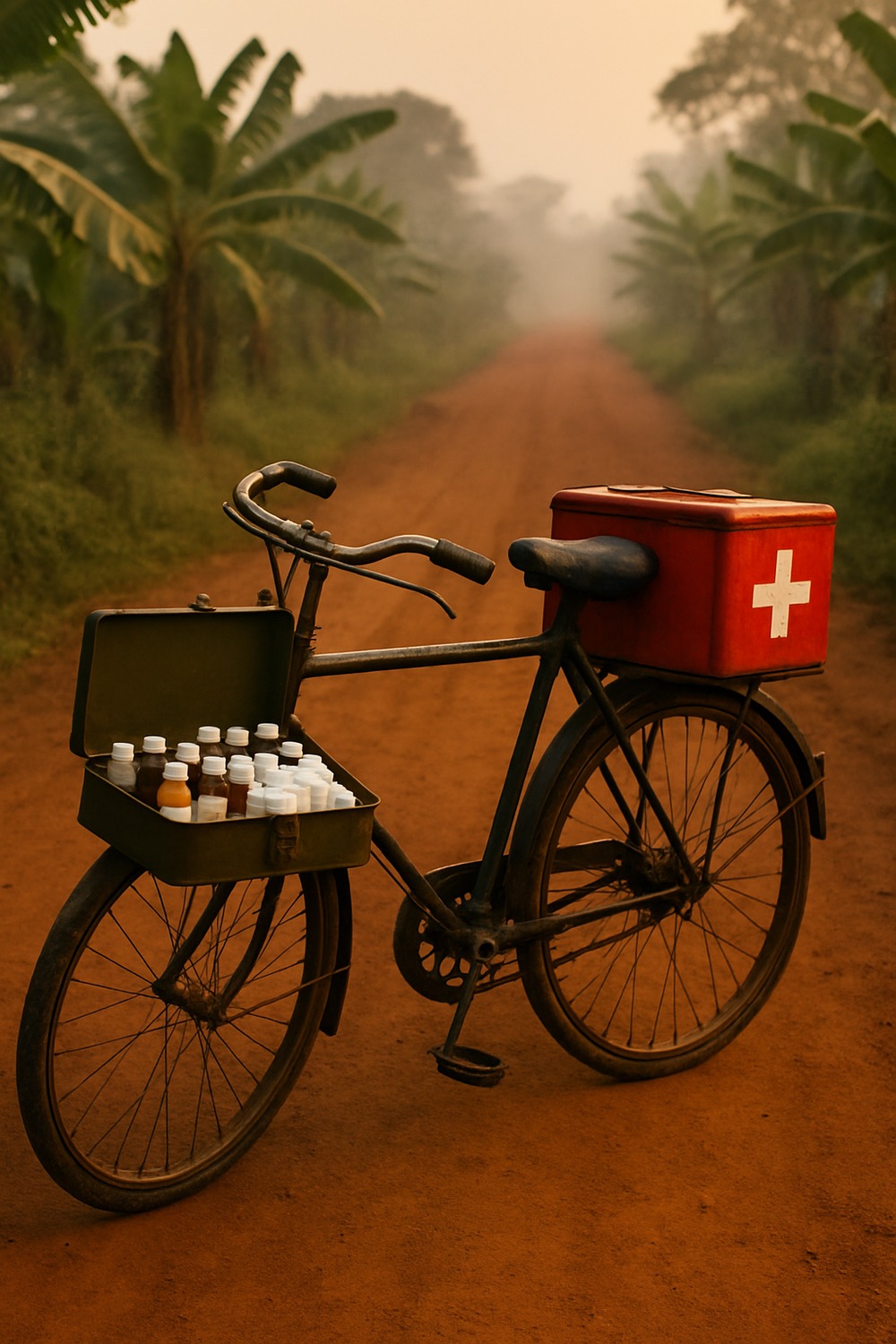
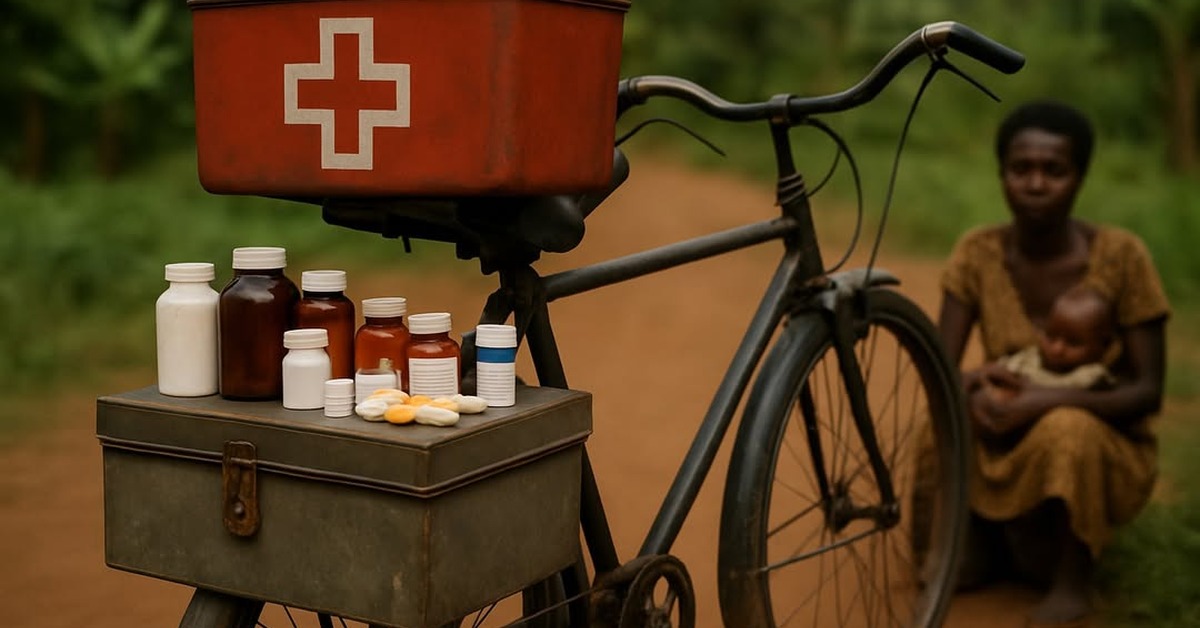
Organizations like BRAC Uganda didn’t just hand riders a bicycle and a bag. Frames were reinforced for weight and rough terrain. Custom storage compartments were fitted. The panniers got loaded with solar-charged diagnostic tools, oral rehydration salts, rapid malaria tests, blood pressure cuffs. One rider. One bicycle. A complete primary care visit, delivered before the day gets hot.
But here’s what the equipment list misses: these aren’t couriers. They’re trained community health workers who know the families on their routes by name. They know which grandmother quietly skips her hypertension medication. Which child missed the last vaccine round. That knowledge doesn’t live in a clinic database — it lives in a person who shows up every week, in the same muddy boots, and actually notices. You can read more about how grassroots health delivery is reshaping communities at this-amazing-world.com.
The Villages That No Map Marked as a Priority
Karamoja sits in Uganda’s northeast, a semi-arid plateau where cattle herding still defines daily life and seasonal migration means families aren’t always where the census expects them to be. Some communities sit 50 kilometers from the nearest hospital, on roads that turn impassable after heavy rain. Bicycle health workers Uganda programs treat this not as a logistical obstacle but as the baseline condition to design around. The bicycle doesn’t need fuel. It doesn’t need a charging station or a paved surface or a maintenance crew. It needs a path wide enough for two wheels, and there’s almost always one of those.
Children under five here die from diarrheal disease. From respiratory infections. From malaria — which a trained health worker with a basic kit can catch early and treat or refer before it becomes a death. The bicycle closes the distance between knowing what to do and actually doing it.
That gap — between knowledge and access — is where people die.
The Part That Took Me a While to Fully Absorb
Governments and international aid organizations have spent decades and billions of dollars building the infrastructure that was supposed to make these bicycle riders unnecessary. Clinics. Roads. Cold chain supply systems. And those investments matter — nobody’s arguing against hospitals. But the community health worker model has kept demonstrating, in study after study, that last-mile delivery doesn’t scale with buildings alone. It scales with trust. With relationships. With the ability to move through terrain that vehicles can’t navigate and knock on doors that wouldn’t open for a stranger.
A bicycle health worker can reach a family that a four-wheel-drive Land Cruiser can’t. That’s not a metaphor — that’s a literal geographic fact in Karamoja. The paths between homesteads are too narrow, too soft, too winding for anything larger. But a rider who grew up in the area knows every shortcut, every seasonal detour, every family that moved their homestead two kilometers east after the last drought.
That last detail kept me reading about this for another hour. The riders aren’t just navigating terrain. They’re holding an informal census in their heads.
By the Numbers
- Uganda had approximately 1 physician per 25,000 people as of 2022 WHO data — compared to a global average closer to 1 per 1,000. One of the lowest ratios on Earth.
- BRAC’s community health worker programs across sub-Saharan Africa have reached over 1.5 million households, with Uganda among the fastest-growing deployments.
- Malaria treatment: as little as $0.50–$1.50 per course.
- Studies on bicycle ambulance programs in East Africa found response times cut by 60–70% compared to walking patients to the nearest clinic — a margin that, in obstetric emergencies, is often the difference between two outcomes that couldn’t be more different.
Field Notes
- Some riders carry laminated picture-based health guides instead of text documents — literacy rates in remote Karamoja communities can be low, and a drawing communicates across language barriers that even trained interpreters sometimes can’t cross.
- Solar-charged pulse oximeters and blood pressure cuffs now fit in a standard pannier bag. That portability didn’t exist in an affordable form until roughly the last decade, which is part of why this model is only now reaching its full potential rather than having solved this thirty years ago.
- Not unique to Uganda.
- Similar programs run in Zambia, Malawi, Bangladesh, and parts of rural India — which suggests this isn’t a regional workaround but an actual delivery model that holds up across different geographies, health systems, and disease profiles.
What a Bicycle Tells Us About Where We Look
Think of it like this: we’ve spent generations designing healthcare as something that radiates outward from a building. Clinic to patient. Pharmacy to household. The assumption built into almost every major health investment is that if you build the facility, access follows. That assumption works fine until the geography gets complicated — and then it fails quietly, in places no one is counting.
Bicycle health workers Uganda programs flip that logic. Care flows inward, from the rider to the home, to the family, to the child who would otherwise never be seen by anyone with a thermometer. It’s not a workaround. It’s a different model of how care actually reaches people — and it’s been sitting in plain sight, on two wheels, the whole time.
The implications stretch well beyond Uganda. Remote communities exist on every continent. The evidence that this approach works isn’t in question — it keeps accumulating. What’s still in question is why it’s treated as supplementary rather than central to how global health systems get designed and funded in the first place.
Before sunrise, a bicycle rolls through red mud toward a homestead that no ambulance has ever found. At the end of that path, a child gets vaccinated who otherwise wouldn’t have been. That’s not a small thing. That’s a different trajectory for an entire life. The tools we overlook are sometimes the ones doing the most work — and there are more stories like this one at this-amazing-world.com.
Frequently Asked Questions
Q: Why are bicycles used instead of vehicles for rural healthcare in Uganda?
Karamoja’s paths between homesteads are too narrow, soft, and winding for four-wheel-drive vehicles, and roads dissolve into cattle tracks after rain. A bicycle needs no fuel, charging station, paved surface, or maintenance crew, only a path wide enough for two wheels. Riders who grew up locally know every shortcut and seasonal detour, allowing them to reach families that larger vehicles literally cannot access, even when clinics exist nearby.
Q: What equipment do bicycle health workers carry?
Organizations like BRAC Uganda equip riders with reinforced frames built for weight and rough terrain, plus custom storage compartments. Panniers carry solar-charged diagnostic tools, oral rehydration salts, rapid malaria tests, and blood pressure cuffs. Some riders also carry laminated picture-based health guides because literacy rates in remote Karamoja communities can be low, and drawings communicate across language barriers that even trained interpreters sometimes cannot cross effectively.
Q: How effective are these bicycle health programs?
Studies on bicycle ambulance programs in East Africa found response times cut by 60 to 70 percent compared to walking patients to the nearest clinic, a margin that in obstetric emergencies often determines survival. BRAC’s community health worker programs across sub-Saharan Africa have reached over 1.5 million households. Riders treat malaria for as little as $0.50 to $1.50 per course and catch respiratory and diarrheal disease early in children under five.
Q: Who is researching this bicycle health model?
Dr. Freddie Ssengooba at Makerere University School of Public Health has documented that the rural health gap is not just an infrastructure problem but a distribution problem, because clinics get built near roads while people do not always live near roads. World Health Organization workforce data underpins the doctor-to-patient ratios cited, and BRAC Uganda has operationalized the model at scale across sub-Saharan Africa with rapidly expanding deployments.
Illustrations are AI-generated. Article fact-checked and human-edited. Our editorial standards.