A Stray Cat Refused to Move — and Saved a Baby’s Life
Nobody was looking for him. That’s the part that keeps sticking with me — a newborn in a freezing entryway in January, in Russia, and the first living thing to find him wasn’t a person.
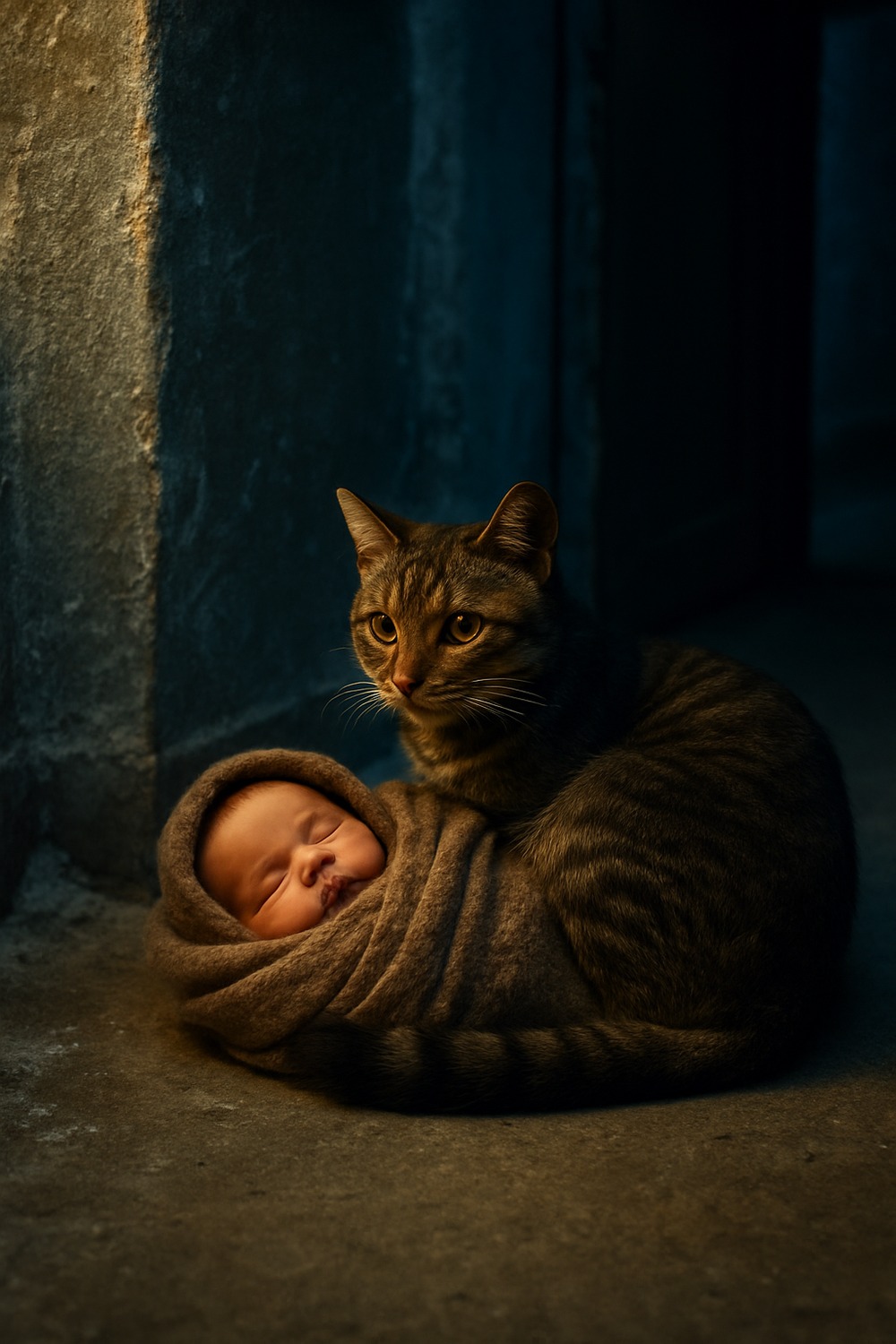
It was 2015 in Obninsk, a small Russian city about 100 kilometers southwest of Moscow. Temperatures had dropped well below freezing. Someone had abandoned a newborn in an apartment building’s entryway — wrapped, but alone, and running out of time. A cat found him before anyone else did.
Key Facts
- The rescue occurred in 2015 in Obninsk, a Russian city about 100 kilometers southwest of Moscow.
- Obninsk recorded average January temperatures of around -8 degrees Celsius (18 F) in 2015.
- Newborns can develop hypothermia in as little as 20 minutes in sub-freezing temperatures (Pediatric Emergency Care, 2017 review).
- Domestic cats maintain a core body temperature of 38 to 39 degrees Celsius, about one degree warmer than humans.
- An estimated 70 million stray cats live in the United States alone, according to the ASPCA.
In short: The stray cat saves baby story comes from Obninsk, Russia in 2015, where a stray cat curled around an abandoned newborn in a freezing entryway and meowed loudly until residents found the infant. With January temperatures near -8 C and newborns able to develop hypothermia in 20 minutes, the cat’s warmth and persistent calls helped the baby boy survive without lasting injury.
How a Stray Cat Saves Baby From the Cold
She didn’t just stumble past and keep walking. She curled her body around the infant and stayed there, pressing warmth into him like a living blanket. Domestic cats maintain a core body temperature between 38 and 39 degrees Celsius — slightly higher than a healthy adult human. According to researchers studying hypothermia, even a one or two degree differential in ambient warmth can meaningfully slow the onset of dangerous heat loss in newborns. Dr. Gordon Giesbrecht, one of the world’s leading hypothermia researchers, has documented how quickly core temperature drops in cold, still air.
So how much time did this cat actually buy?
Newborns have almost no ability to regulate their own body heat. Their surface-area-to-body-weight ratio is enormous, which means they lose warmth fast — and in a freezing stone entryway, we’re not talking hours. We’re talking minutes.
She Didn’t Just Warm Him — She Called for Help
Here’s what makes this story different from a simple act of animal warmth: the cat meowed. Not once. Loudly, persistently, with the kind of urgency that cuts through walls and closed doors. Residents of the building came to investigate the noise and found the infant, alive, nestled against the cat’s fur. They rushed him to a local hospital immediately. You can read about other moments where animals and humans have crossed paths in extraordinary ways over at this-amazing-world.com, but this one sits in a category of its own.
Think about what that actually means.
The cat didn’t run when she found something strange and small and helpless in the dark. She made a decision — or something that looked exactly like one — to stay. And then to be loud about it. Loud enough that people came. Loud enough that it worked.
What the Stray Cat Story Reveals About Instinct
Animal behaviorists have long debated the line between instinct and something closer to empathy in domestic cats. Cats respond to distress calls from kittens — even kittens that aren’t their own — with nurturing behavior. A newborn human baby crying or whimpering may trigger something similar, activating maternal instincts that run deeper than species boundaries. The stray cat saves baby story from Obninsk isn’t an isolated incident either; it fits a broader pattern of cats responding to vulnerable, small, helpless creatures in ways that look remarkably deliberate.
And she was a stray. No owner. No warm home to return to. No particular reason to trust humans or help them.
She was surviving on her own. But she stayed.
Turns Out, Cats Have Done This Before
This isn’t the only time a cat stepped in when humans failed to. In 1996, a cat named Scarlett ran into a burning building in Brooklyn five times to rescue her kittens, suffering severe burns to her eyes, ears, and paws in the process. In Argentina in 2008, a stray cat was reported to have kept a one-year-old boy alive on the streets, curling around him for warmth on cold nights. The pattern is consistent enough that researchers have started asking whether cats have a more developed social awareness than their reputation suggests — and that last fact kept me reading for another hour.
Cats have historically been framed as aloof, self-serving, indifferent. The evidence keeps complicating that story. These animals act. They intervene. And sometimes they do it at exactly the right moment.
By the Numbers
- Newborns can develop hypothermia in as little as 20 minutes in sub-freezing temperatures — a 2017 review in Pediatric Emergency Care found that infants lose body heat three to four times faster than adults in identical conditions.
- A cat’s resting body temp: 38–39°C (100.4–102.2°F). About one full degree warmer than a healthy adult human. That margin matters enormously as an external heat source pressed against a newborn.
- Obninsk recorded average January temperatures of around -8°C (18°F) in 2015, with overnight lows potentially dropping much further — well within the range that causes fatal infant hypothermia within an hour of exposure.
- An estimated 70 million stray cats live in the United States alone, according to the ASPCA. Which suggests these kinds of encounters happen far more often than anyone documents.
Field Notes
- Cats have a specialized vocalization called the “solicitation purr” — a purr embedded with a higher-frequency cry — used specifically to prompt humans to respond. It’s possible the meowing in the Obninsk case wasn’t random noise. It may have been a targeted attempt to get attention.
- Semi-feral cats responding to mammal distress calls. Documented at the University of Lincoln in the UK.
- Despite their reputation for cold independence, domestic and semi-feral cats show strong responses to the distress vocalizations of other mammals, including humans — behavior that animal cognition researchers have been quietly building a case around for years.
- The baby: a boy, believed to be only a few weeks old. Survived without lasting injury.
Why This Story Still Matters Years Later
The stray cat saves baby story out of Obninsk has been circulating for a decade now, and it keeps finding new audiences. That’s not an accident. It touches something that’s genuinely hard to articulate — the idea that in one of the coldest moments possible, in a place no one was watching, a small animal with no obligation to anyone made a choice. Whether we call that instinct or empathy or something we don’t have a word for yet, the outcome was the same.
A child lived who might not have.
The cold doesn’t care. The building didn’t care. But the cat did. And because she did, someone grew up.
Some stories don’t need embellishment. A baby, a frozen entryway, a stray cat who refused to leave — that’s the whole thing, and it’s enough. Survival sometimes shows up in the smallest, most unexpected forms. Fur and warmth and a voice loud enough to reach the right ears. If this kind of story keeps you up at night, there’s more at this-amazing-world.com — and the next one is even stranger.
Frequently Asked Questions
Q: Where and when did the stray cat save the abandoned baby?
The rescue took place in 2015 in Obninsk, a small Russian city about 100 kilometers southwest of Moscow. Someone had abandoned a newborn boy, believed to be only a few weeks old, in an apartment building’s freezing entryway during January, when average temperatures hovered around -8 degrees Celsius. A stray cat found him, curled around him for warmth, and meowed persistently until residents investigated and rushed the infant to a local hospital, where he survived without lasting injury.
Q: How did the cat actually help the baby survive the cold?
The cat provided two forms of help. First, it pressed its body against the infant, supplying external warmth: domestic cats maintain a core temperature of 38 to 39 degrees Celsius, about one degree warmer than humans, which slows dangerous heat loss in newborns. Second, it meowed loudly and persistently, drawing residents to the entryway. Since newborns can develop hypothermia in as little as 20 minutes in sub-freezing conditions, both the warmth and the alarm calls were critical.
Q: Have cats rescued humans in other documented cases?
Yes, the Obninsk story fits a broader pattern. In 1996, a cat named Scarlett ran into a burning Brooklyn building five times to rescue her kittens, suffering severe burns. In Argentina in 2008, a stray cat was reported to have kept a one-year-old boy alive on the streets by curling around him on cold nights. Researchers note cats respond strongly to distress vocalizations of other mammals, including humans, suggesting these interventions are more common than documentation captures.
Illustrations are AI-generated. Article fact-checked and human-edited. Our editorial standards.