Dragonfly Nymphs: The Explosive Ambush Predators You’ve Never Seen
Two years of waiting. Two years of molting in darkness, of hydraulic strikes too fast to see, of hunting in cold sediment at the bottom of a pond — and then the dragonfly nymph predator climbs a reed stem and simply ceases to exist. What emerges isn’t an upgrade. It’s a completely different animal wearing the ghost of the one it was. Before anyone understood adult dragonflies, before summer skies filled with their jeweled bodies, there was this: the real predator, the one nobody watches.
Most people never look past the adult dragonfly. The hovering spectacle. The jeweled wing. But the aquatic larval stage is arguably the more extraordinary creature. Spend one to five years submerged, cycling through up to 17 body transformations, hunting with a weapon so mechanically sophisticated it defies easy observation — and then vanish into air.
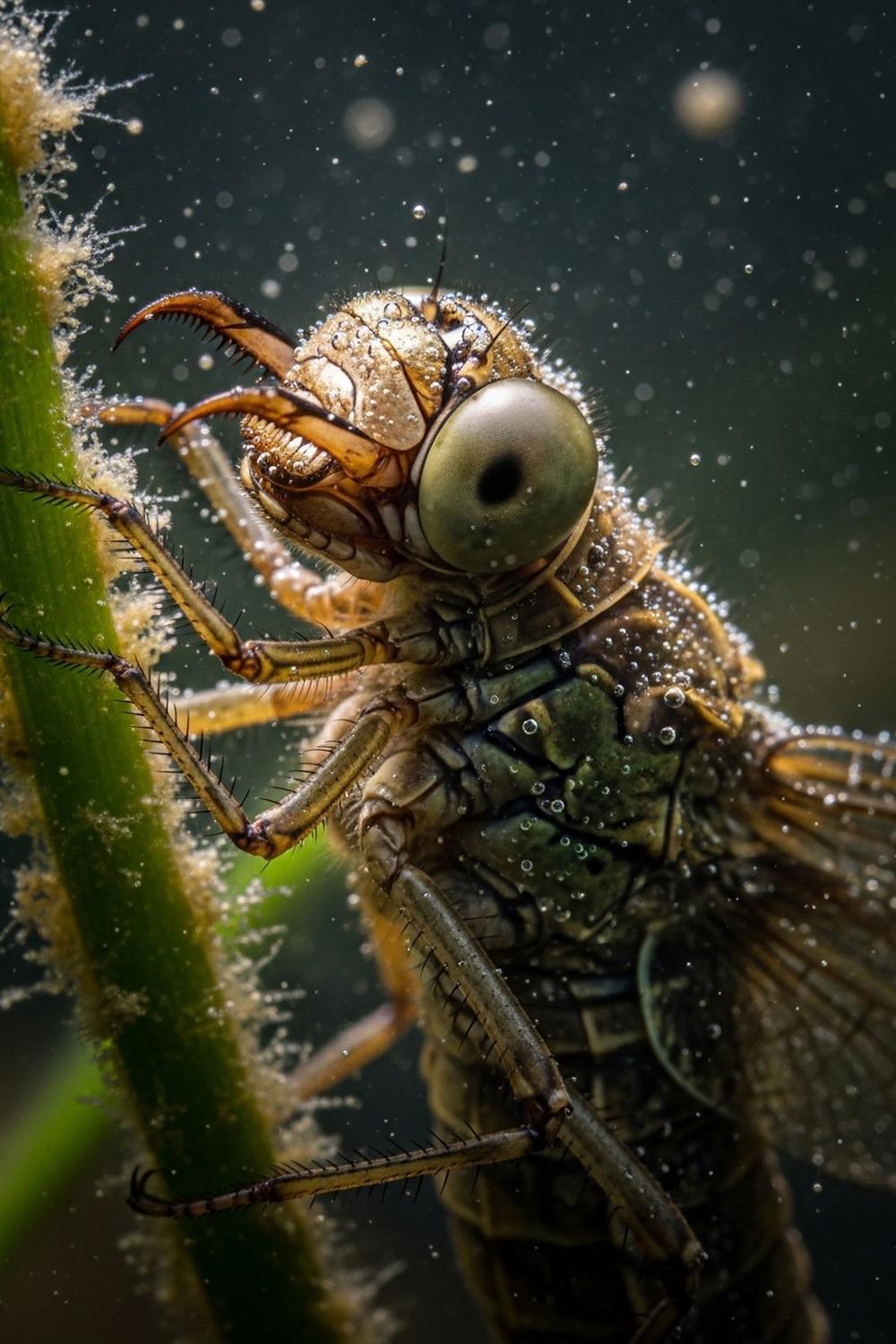
How does something this remarkable stay so completely hidden from popular science?
Key Facts
- The dragonfly nymph spends one to five years submerged, molting up to 17 times before emerging as an adult.
- The nymph’s prehensile labium extends in under 25 milliseconds, three times faster than the average 150-millisecond human blink.
- The labium can extend to roughly one-third of the nymph’s body length and capture prey at distances up to 40 millimeters.
- Dragonflies as an order have existed for approximately 325 million years, predating dinosaurs by roughly 100 million years.
- Neonicotinoid exposure reduced nymph strike success by up to 35 percent in University of Exeter laboratory tests in 2019.
In short: The dragonfly nymph predator is the aquatic larval stage that spends one to five years underwater, molting up to 17 times. It hunts with a prehensile labium that fires in under 25 milliseconds using hydraulic pressure. After years submerged, it climbs a reed stem and metamorphoses into a winged adult, leaving behind a hollow exuvia shell.
The Labium: Catapult Engineering in an Invertebrate
At the heart of dragonfly nymph predator hunting is one of the most mechanically sophisticated structures in the invertebrate world. The prehensile labium is a modified mouthpart folded beneath the head like a hinged arm. It can extend to roughly one-third of the nymph’s entire body length in a single explosive movement. Under 25 milliseconds. That’s what researchers at the University of Wageningen clocked when they analyzed the strike biomechanically in detailed studies published as far back as 1996. A human blink averages 150 milliseconds. This happens three times faster.
The mechanism isn’t purely muscular. Here’s the thing: it relies on a catapult-like hydraulic system. The nymph builds pressure in its body cavity, then releases it in a single instant, launching the labium forward with devastating speed and precision. The prey — a tadpole, a water flea, a small fish — doesn’t register the threat in time. Two hooked palps grip the moment contact is made. There’s no second chance for the target and no wasted energy for the hunter.
What strikes even experienced observers is the labium’s reach. In field observations conducted in the Norfolk Broads wetlands of eastern England, researchers watching nymph behavior through underwater cameras noted that prey items were captured at distances of up to 40 millimeters. Visual estimates of labium length would suggest half that distance possible. The hydraulic reach surprised them.
The nymph doesn’t chase. It waits — sometimes for hours, buried in silt or pressed against submerged vegetation with only compound eyes moving. Efficiency this extreme is the product of hundreds of millions of years of evolutionary pressure. Why? Because dragonflies have been on Earth for roughly 325 million years, and the basic nymph body plan has changed surprisingly little.
Two Years Building a Lethal Predator
For many species, the aquatic phase spans one to two full years. Some larger species in colder climates spend up to five years as nymphs before emerging. They molt repeatedly during that time — shedding their exoskeleton as many as 17 times, a process called ecdysis. Each instar (the stage between molts) represents a larger, more capable predator. Picture a lion cub that had to shed its entire skeleton more than a dozen times before it could stand. That’s the parallel that barely works.
Dragonfly nymph predators don’t limit their prey to insects. Mid-instar nymphs routinely take mosquito larvae, aquatic worms, and small crustaceans. By the final instars, larger species like the emperor dragonfly (*Anax imperator*) will take tadpoles and juvenile fish. This predatory range, documented across freshwater ecosystems globally, mirrors what ecologists observed in other apex hunters — the green anaconda quietly controlling riverine food webs from below the waterline, a pattern that took decades to fully map.
Between molts, vulnerability arrives. The new exoskeleton is soft, pale, and slow to harden — a window of danger lasting several hours. Nymphs typically molt in sheltered spots, wedged under leaf litter or pressed against submerged wood.
Temperature doesn’t just affect timing. It shapes body size, prey choice, and ultimately reproductive success in the adult phase. Researchers at the Freshwater Biological Association in the United Kingdom noted in 2008 that inter-instar timing varies significantly with water temperature: a cold spring extends a single instar by weeks, pushing the full nymphal period well beyond two years in temperate populations. In warmer tropical streams, the same developmental sequence compresses to under six months.
A field researcher working in the Scottish Highlands in summer 2019 described watching a final-instar nymph hold completely still for 47 minutes before striking at a stickleback fry less than a centimeter away. The patience is deliberate, not passive — nymphs actively regulate their breathing during stalks, reducing gill movement to avoid creating micro-currents that alert fish prey to nearby disturbances.
Emergence: The Final Metamorphosis
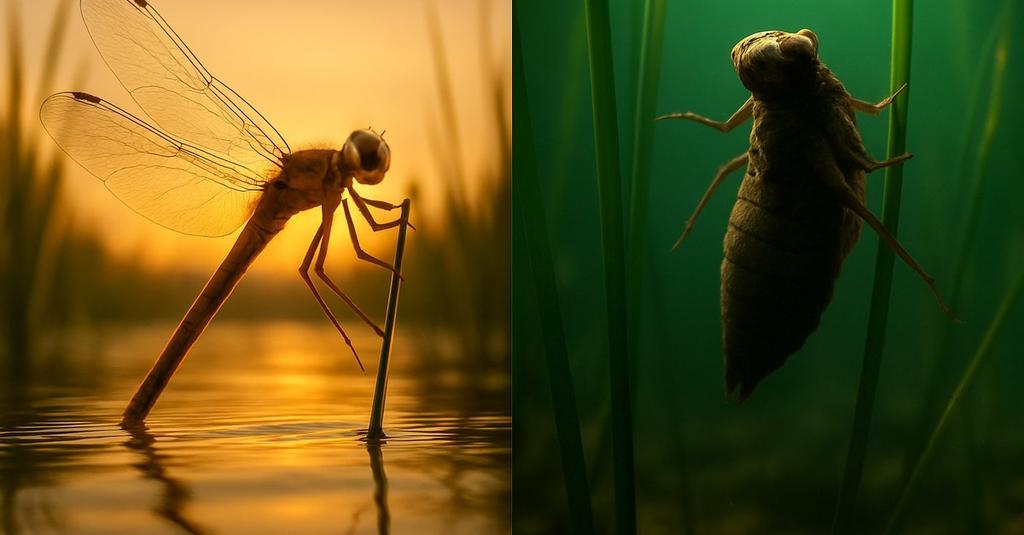
When emergence finally comes, it arrives with almost no warning. Photoperiod — the lengthening of daylight — and a threshold water temperature appear to trigger the event, though the precise hormonal cascade is still being studied. What follows is one of the most dramatic transformations in the animal kingdom. The nymph, which has spent up to five years as a fully aquatic predator, climbs a reed stem, a stone, or a piece of driftwood above the waterline. It stops. Then, over several hours, it simply splits itself open.
The emerging adult pulls itself free from the nymphal case — called the exuvia — by expanding its body with air. According to National Geographic’s deep dive on dragonfly biology, it inflates its abdomen like a slow balloon. The wings, crumpled and pale, unfold through hemolymph pressure rather than muscle movement. Within two to four hours, they harden into rigid, veined structures capable of hovering, banking, and accelerating at up to 10 body lengths per second.
The vulnerability during emergence is extraordinary. The new adult can’t fly, can’t feed, can’t escape predators — birds, spiders, and even other dragonflies will take emerging individuals if accessible. Most emergence happens at night or in earliest dawn hours. The dragonfly nymph predator that spent years hunting from the shadows makes its most dangerous crossing in darkness, one final time. By sunlight, only the exuvia remains: a perfect ghost-shell still gripping the reed, paper-thin and anatomically exact.
The abandoned exuvia is itself a research tool. Ecologists use exuvia counts along riverbanks to estimate population size and species diversity without disturbing living animals. A single morning’s survey of a healthy chalk stream in southern England yields dozens of shells representing multiple species — a biodiversity census written in molted chitin.
What Nymphs Tell Us: Biology as Warning System
Dragonfly nymphs sit at the top of the micro-predator food chain. But they’re also something else: sensitive indicators of the water quality around them. Because they spend years in direct contact with sediment and water chemistry, they accumulate and respond to pollutants, oxygen levels, pH changes, and habitat degradation in ways surface-level monitoring misses entirely.
Since the 1980s, the British Dragonfly Society has used nymph survey data to track freshwater habitat health across the UK. Their records show clear correlations between nymph population density and broader wetland quality metrics. A 2017 study published through the Freshwater Biological Association found something remarkable: the disappearance of certain nymph species from a monitored stretch of river preceded measurable chemical deterioration by an average of 14 months. The nymphs detected trouble before the instruments did. That kind of biological early warning system is difficult to replicate artificially, and it makes the conservation of nymph habitat a practical priority.
Watching a species respond to environmental damage at this speed, you stop calling it a side effect.
Agricultural runoff is the principal threat. Nitrate and phosphate loading drives algal blooms that deplete dissolved oxygen — eutrophication — which suffocates gill-breathing nymphs before any other visible damage appears at the surface. Silt from ploughed fields buries the clean gravel substrate where many nymph species anchor themselves between hunts. In rivers with heavy siltation, dragonfly nymph predator populations can collapse within a single season. Pesticide drift from surrounding farmland adds chemical pressure. Neonicotinoid compounds, shown in laboratory studies at the University of Exeter in 2019, impair strike coordination in late-instar nymphs, reducing capture success rates by up to 35%.
But restoration efforts have demonstrated something equally clear: nymphs return quickly when conditions improve. Several chalk streams in Hampshire underwent gravel restoration and riparian buffer planting between 2014 and 2018. Measurable nymph recolonization occurred within two breeding seasons. The animals don’t require complicated interventions. They require clean, oxygenated, structured water.
Where to See This
- The Norfolk Broads National Park in eastern England (spring and early summer) offers some of Europe’s most accessible dragonfly emergence watching. Species including the Norfolk hawker (*Anaciaeschna isoceles*) complete their nymphal phase in open fen waterways — peak emergence runs May through July.
- The British Dragonfly Society (british-dragonflies.org.uk) publishes annual recording schemes and runs citizen science nymph surveys across the UK, welcoming volunteers with no prior entomology experience.
- For close observation, try pond-dipping in early spring. A simple white tray and fine-mesh net in any healthy freshwater body surface final-instar nymphs, which are large enough to observe clearly with the naked eye and will often display the characteristic labium extension posture within minutes of capture.
By the Numbers
- 17 molts during the nymphal phase across species, with each representing a complete shedding and replacement of the exoskeleton (Corbet, 1999, *Dragonflies: Behaviour and Ecology of Odonata*).
- Labium strike speed: under 25 milliseconds in studied hawker dragonfly species versus 150–400 milliseconds for the average human blink.
- The largest known dragonfly nymph on record belonged to the prehistoric *Meganeura* lineage, with wingspans exceeding 65 centimeters — the nymphal phase of such species likely lasted several years.
- Neonicotinoid exposure reduced nymph strike success by up to 35% in controlled University of Exeter laboratory conditions (2019).
- Dragonflies as an order have existed for approximately 325 million years, predating dinosaurs by roughly 100 million years — the nymphal body plan has remained structurally consistent throughout most of that span.
Field Notes
- In 2011, researchers observing nymphs in Japanese rice paddies documented a behavior not previously recorded in European populations: nymphs actively repositioning themselves upwind of prey items by sensing micro-vibrations through leg sensory hairs. They were “hearing” approaching mosquito larvae through water movement before striking. The finding suggested the labium strike isn’t purely reactive — deliberate positioning precedes it.
- Dragonfly nymphs can survive partial desiccation. Some species in temporary wetlands enter a semi-dormant state when pools dry out, buried in moist sediment for weeks before rehydrating when water returns — a resilience that almost no other gill-breathing insect larva can match.
- The exuvia left after emergence is anatomically complete enough to identify species, sex, and approximate age — making it a richer data source than a living specimen that might be disturbed or missed entirely during field surveys.
- Researchers still can’t fully explain what triggers the exact moment of emergence within the multi-week window when conditions are suitable. Individual nymphs in identical laboratory tanks with identical conditions will emerge days apart, suggesting an internal timing mechanism not yet understood.
Frequently Asked Questions
Q: How dangerous is a dragonfly nymph predator to other pond life?
Genuinely dangerous at the micro-scale. Final-instar dragonfly nymphs rank among the top invertebrate predators in freshwater ecosystems, routinely taking prey larger than themselves. Tadpoles, small fish fry, aquatic worms, and other insect larvae are all documented prey items. In garden ponds, large nymphs can significantly reduce tadpole survival rates within a single season. Some researchers estimate a single nymph may consume several hundred prey items during a two-year nymphal period.
Q: How does the dragonfly nymph’s labium actually work mechanically?
The labium is a two-jointed structure folded flat beneath the nymph’s head when at rest. When a strike is triggered, hydraulic pressure built up in the body cavity releases suddenly, straightening both joints simultaneously and projecting the labium outward at extreme speed. The tips carry a pair of hooked palps that clamp shut on contact. The whole structure retracts in the same hydraulic motion, pulling prey directly to the mouthparts. It’s a catapult, not a muscle-powered reach — which is why it’s so much faster than any equivalent muscular movement could achieve.
Q: Are dragonfly nymphs harmful to humans or pets in garden ponds?
Not a serious threat, but large nymphs will bite if handled carelessly — the labium can deliver a sharp pinch. Small ornamental fish like goldfish fry are at risk in ponds where nymphs are present. Many pond keepers discover nymph predation only when fish numbers drop unexplainably. Adult garden pond fish are generally too large to be targeted. The more significant ecological point: nymphs in a garden pond are a strong sign of good water quality and should be treated as a positive indicator, not a problem.
Editor’s Take — Alex Morgan
What stays with me about the dragonfly nymph isn’t the speed of the strike — it’s the patience before it. An animal capable of a 25-millisecond attack that chooses to wait 47 minutes for the right moment. That’s not instinct in the simple sense. Something more considered is happening in that sediment. We’ve spent centuries cataloguing the adult dragonfly and almost no time at all understanding what it took to become one. The nymph isn’t a larva. It’s the main event.
Somewhere beneath the surface of an ordinary park pond, in water that looks empty and still, a dragonfly nymph predator is waiting. It’s been there for a year, maybe two. It’s molted six times. It will molt again. And at some point in the coming weeks, it will climb a reed stem in the dark and split itself open and become something with wings — leaving behind a perfect hollow shell as the only evidence it was ever there at all. The freshwater world is full of this kind of secret drama. The question is whether we protect the water well enough for it to keep happening.
“
Illustrations are AI-generated. Article fact-checked and human-edited. Our editorial standards.