The Fastest Animal Alive Kills With One Clenched Fist
At 320 kilometers per hour, a peregrine falcon isn’t hunting anymore. It’s become a projectile with a heartbeat, and nothing in the animal kingdom moves faster. The kill, when it comes, is over before the prey’s nervous system can process what just happened.
This whole thing started bothering me around 2 AM last Tuesday. I’d been reading about how these birds fold their wings and just… drop. But the more I looked into it, the stranger it got. Not because they’re fast — plenty of things are fast. But because their bodies shouldn’t survive what they’re doing. At all. The forces involved would liquefy most creatures. Yet here’s this bird, doing it dozens of times a week like it’s nothing.
Key Facts
- Peregrine falcons reach dive speeds of around 320 km/h under natural conditions, with researcher Ken Franklin clocking a trained bird at 389 km/h (242 mph) in 2005
- The peregrine’s dive (called a stoop) became a family strategy roughly 25 million years ago, when a falcon ancestor began diving rather than chasing prey
- Tiny bony structures in the falcon’s nose called tubercles redirect incoming air around the lungs to prevent over-pressurization; some jet engine intake designs use the same principle
- Peregrines can see ultraviolet light, have two foveas instead of one, and visual acuity two to three times sharper than human vision
- Strike success rate during the stoop hovers around 70-80% in the wild, and the entire dive-impact-recovery sequence takes less than 30 seconds
In short: The peregrine falcon is the fastest animal alive, reaching about 320 km/h in a natural dive — and 389 km/h in a 2005 measurement by Ken Franklin. Evolution rewired the bird around the stoop roughly 25 million years ago: nasal tubercles redirect air around the lungs, UV vision tracks prey, and one clenched foot kills with a 70–80% success rate.
How Did a Bird Become the Fastest Animal on Earth?
Somewhere in the fossil record, about 25 million years ago, a falcon ancestor made a choice that evolution ran with. Instead of chasing prey through the air like every other raptor, this one started diving. Straight down. The stoop — that’s the technical term, borrowed from falconry — became the family strategy, and over millennia, every single system in the bird’s body rewired itself around that one idea.
The numbers are surreal. Researcher Ken Franklin clocked a trained peregrine at 389 km/h (242 mph) in 2005. Most studies cite 320 km/h as the baseline under natural conditions. Either way, nothing else comes close. Not the sailfish. Not the cheetah. Not the golden eagle diving from altitude. The peregrine falcon fastest animal on Earth — and it’s not even a competition.
The weird part? Nobody was looking for a new speed record. Franklin was studying dive dynamics when one of his birds just… happened to be faster than anything previously recorded.
You can dig deeper into the biology on Wikipedia’s peregrine falcon page, but here’s what matters: the real engineering challenge wasn’t getting fast. It was surviving fast.
The Physics Problem That Shouldn’t Have a Solution
At 300 km/h, air pressure should crush a bird’s lungs. Full stop. The falcon doesn’t have the luxury of a pressurized cockpit or a fighter pilot’s suit. It has biology.
The answer is almost absurdly elegant.
Inside the falcon’s nose are tiny bony structures called tubercles. They look like nothing — barely visible to the naked eye. But they redirect incoming air around the lungs instead of into them, preventing catastrophic over-pressurization. Engineers noticed this. Now some jet engines use the same principle for their intake systems. A bird designed this solution 25 million years before we invented powered flight.
The chest muscles are equally absurd. They don’t just hold the bird rigid — they’re engineered to compress the entire body into a teardrop shape that minimizes drag. The skeleton itself is reinforced in specific ways that distribute impact forces rather than concentrating them. Every bone, every muscle, every feather arrangement exists because at some point in the last 25 million years, the ones that didn’t shatter at high speed got to reproduce.
Evolution doesn’t usually design. It just kills the failures. But sometimes the failures get killed hard enough and long enough that what survives looks intentional.
The Stoop Isn’t a Dive. It’s Controlled Weaponization.
Here’s what a human pilot would call a high-speed controlled descent. Here’s what a peregrine calls Tuesday.
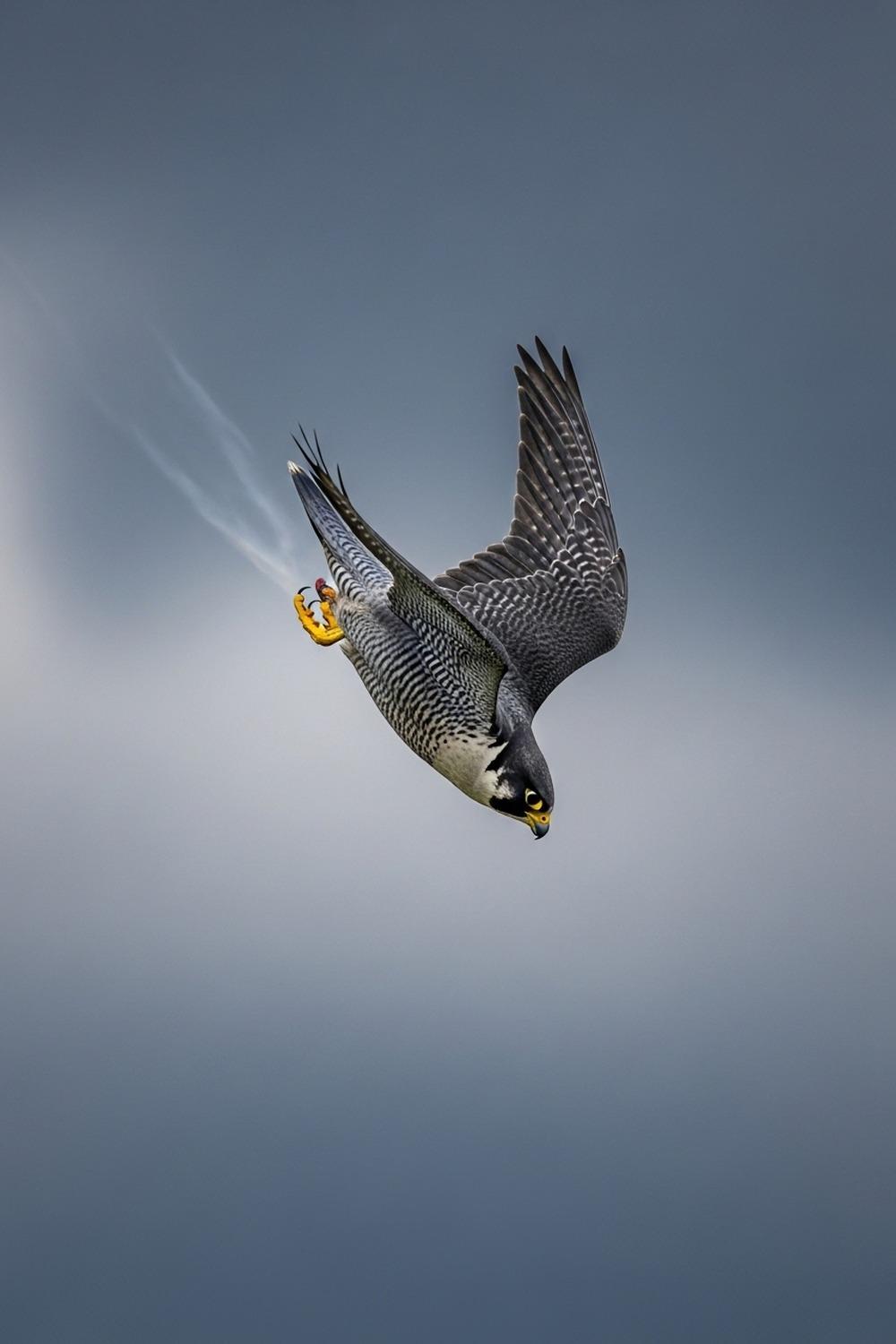
The bird starts hundreds of meters up, often just circling. When it spots prey — and it’s seen them from over 3 kilometers away using vision that’s two to three times sharper than ours — wings fold. The body compresses. Gravity takes over. But gravity is just the beginning.
Even at 300 km/h, the falcon is actively steering. Tiny adjustments in tail feathers. Microscopic shifts in wing angle. It’s tracking a moving target that’s trying to dodge while traveling at highway speed. At any point, a miscalculation of inches means a miss. And a miss means diving straight into the ground. Yet the strike success rate hovers around 70-80% in the wild.
That last fact kept me reading for another hour.
Most predators are passengers at those velocities. The peregrine is the pilot. It’s not just falling. It’s aiming.
The Eyes That See Wavelengths We Can’t
There’s a transparent eyelid called a nictitating membrane sliding across the peregrine’s eye during the dive. It’s clearing debris. It’s moistening the cornea. It’s maintaining vision locked on a target moving in three dimensions while the entire bird is experiencing forces that would liquefy a human brain.
But here’s the thing: peregrines can see ultraviolet light. Their prey can’t hide in the spectrum we can’t access because the falcon operates in both. It’s seeing a world stacked with information we literally cannot perceive. When you look up and see a peregrine, it’s already catalogued you, your shadow, every bird within visual range, and probably what you had for lunch based on UV reflectance.
Two foveas instead of one. Disproportionately large eyes. Visual acuity that makes fighter pilots look like they’re squinting. And all of it locked onto something going 320 km/h.
One Fist. That’s the Whole Weapon.
People imagine raptors killing with talons spread open, like hands grabbing. The peregrine falcon fastest animal — and its fastest killer — doesn’t work that way.
On the stoop, it clenches one foot into a fist. That’s it. One clenched foot moving at the speed of a race car, impacting a bird in mid-flight. The impact is concussive. Spine-snapping. Skull-shattering. Often the prey is dead before the nervous system finishes processing that something happened.
The talons aren’t really the weapon. They’re just the contact point. Velocity is the weapon. Physics is the execution.
After the strike, the falcon circles back, catches the falling body mid-air, and carries it off. The whole sequence — dive, impact, recovery, retrieval — takes less than 30 seconds from beginning to end.
Pulling Out of a Dive That Would Kill Most Vertebrates
At the bottom of the stoop, the peregrine experiences gravitational forces around 25 G. Fighter pilots black out at 9 G without a pressurized suit. This bird is doing it bare-bodied, multiple times a day, casually, like it’s nothing.
The cardiovascular system is engineered to maintain blood pressure to the brain under conditions that would stop human hearts.
And then it’s perching. Preening its feathers. Eating lunch. By the time the prey has stopped moving, the falcon’s heart rate is already dropping back to baseline. Researchers studying wild stoops report birds returning to their regular hunting pattern within minutes. The recovery that would require a fighter pilot’s emergency decompression protocol is just how the peregrine’s Tuesday goes.
By the Numbers
- 389 km/h — the top speed Ken Franklin recorded in 2005 using a trained peregrine in a controlled sky-dive scenario.
- 25 G of force during pull-up maneuvers. That’s enough to black out trained fighter pilots.
- 80-90% population crash across North America by the 1960s due to DDT pesticide thinning eggshells until the species hit endangered status in 1970.
- By 2000, peregrines were removed from the U.S. Endangered Species List after one of the most successful raptor recovery programs in history, with captive breeding programs releasing over 6,000 birds back into the wild.
- 280-degree visual field with roughly 40 degrees of binocular overlap and two foveas per eye instead of one — allowing simultaneous sharp focus on near and distant objects.
- Can spot a pigeon from over 3 kilometers away. Can see ultraviolet light. Has visual acuity estimated at 2-3 times sharper than humans.
Where the Peregrine Lives Now
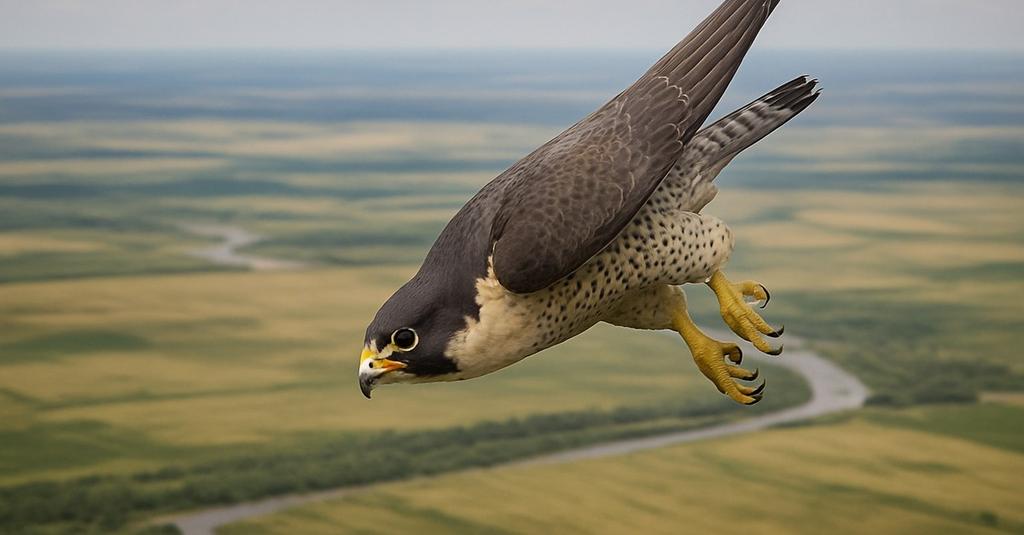
Here’s what nobody predicted: the peregrine didn’t just recover from near-extinction. It colonized cities. Thrived in them. Some urban populations now subsist almost entirely on pigeons and starlings — skyscrapers mimic the cliff faces where they naturally nest, and the hunting conditions are arguably better than the wild. Prey is concentrated. Disoriented by glass and artificial light. Defenseless.
The word “peregrine” comes from Latin: peregrinus, meaning “wanderer” or “pilgrim.” Appropriate for a species found on every continent except Antarctica. Some individuals migrate over 25,000 kilometers in a single year. They’re nesting on hospital rooftops. Bridge girders. Communication towers. Human architecture became their preferred habitat without us really noticing.
Falconry with peregrines dates back over 3,000 years. Medieval Europe restricted them by law to royalty. In some regions, stealing one was punishable by death.
Now they’re hunting above parking lots.
Why This Still Matters
The peregrine falcon fastest animal story is a conservation case study that reshapes how scientists think about what’s reversible in ecological collapse. The species nearly vanished in a single human generation and then not only survived but adapted in real time to environments we created. That changes the entire conversation about extinction and recovery.
There’s also the engineering. Jet engine design borrowed from peregrine nose structure. High-speed aerodynamics research. Drone flight optimization. A bird that evolved before the first humans walked upright is still teaching us physics we haven’t figured out alone.
Every few days, somewhere above a city you’ve walked through, a peregrine drops out of the sky at 320 km/h. The entire event — approach, dive, impact, recovery, retrieval — is finished before the sound of wings reaches the ground. It hunts above our buildings now. Nests on our infrastructure. Shares the same airspace we move through, mostly invisible, faster than anything else that breathes.
And if stories like this keep you digging at 2 AM the way they do for me, this-amazing-world.com has more of them — each one stranger than the last.
Frequently Asked Questions
Q: How fast can a peregrine falcon actually dive?
Most studies cite around 320 km/h as the baseline under natural conditions. Researcher Ken Franklin clocked a trained peregrine at 389 km/h (242 mph) in 2005 while studying dive dynamics. Nothing else in the animal kingdom comes close — not the sailfish, not the cheetah, not the golden eagle diving from altitude. The dive is called a stoop, borrowed from falconry terminology, and the bird folds its wings, compresses its body into a teardrop shape, and lets gravity take over.
Q: How does the falcon survive forces that should crush its lungs?
Tiny bony structures called tubercles inside the falcon’s nose redirect incoming air around the lungs instead of into them, preventing catastrophic over-pressurization at speeds above 300 km/h. Engineers noticed this and some modern jet engines now use the same principle for intake systems — a bird solved the problem 25 million years before humans invented powered flight. The chest muscles also compress the body into a low-drag teardrop shape, and the skeleton distributes impact forces rather than concentrating them.
Q: How does the falcon kill its prey at that speed?
It clenches one foot into a fist. That single clenched foot, moving at race-car speed, impacts a bird in mid-flight with concussive force — spine-snapping and skull-shattering. The prey is often dead before its nervous system finishes processing what happened. The talons are just the contact point; velocity is the weapon. After the strike, the falcon circles back, catches the falling body mid-air, and carries it off. The entire sequence — dive, impact, recovery, retrieval — takes less than 30 seconds.
Q: How sharp is a peregrine’s vision?
Peregrines see prey from over 3 kilometers away with vision two to three times sharper than human eyesight. They have two foveas in each eye instead of one, disproportionately large eyes, and a transparent nictitating membrane that clears debris while maintaining target lock during the dive. They can also see ultraviolet light, accessing a layer of information their prey cannot hide in. Strike success rate hovers around 70-80% in the wild — extraordinary precision for a target moving at highway speed in three dimensions.
Illustrations are AI-generated. Article fact-checked and human-edited. Our editorial standards.