Japan’s Plan to Ring the Moon With Solar Panels
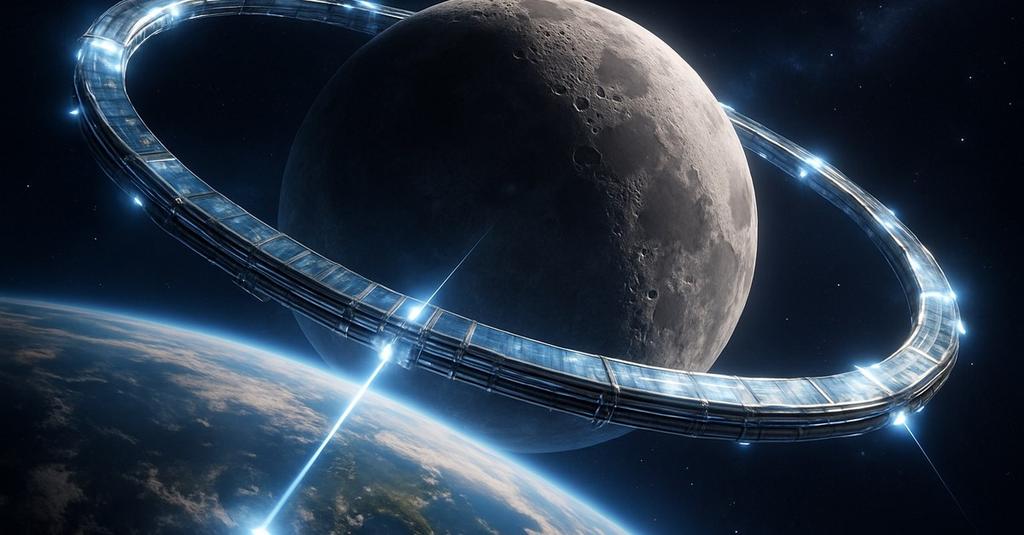
Shimizu Corporation, a Japanese engineering firm that’s been around since 1804, proposed wrapping the Moon’s equator in solar panels and beaming the power back to Earth. Nobody really paid attention when they unveiled it in 2013. That might have been a mistake.
The Luna Ring solar power concept sounds like something a physicist sketched out at 3 AM on a whiteboard. Except this one came from a legitimate company with a hundred-year track record of building impossible infrastructure. They weren’t joking. They’ve got detailed proposals, engineering specifications, and a pretty straightforward answer to the question everyone asks first: how would you even build something like that?
Key Facts
- Shimizu Corporation, founded in 1804, unveiled the Luna Ring concept in 2013
- The proposed solar belt would stretch 11,000 kilometers around the Moon’s equator
- Space-based solar collection can be up to 8 times more efficient than ground-based panels
- Earth consumes roughly 18 terawatts of energy per year (International Energy Agency, 2023)
- Lunar surface temperatures swing from 127 degrees C in sunlight to -173 degrees C in shadow
In short: The Luna Ring solar power concept, proposed by Japan’s Shimizu Corporation in 2013, would wrap 11,000 kilometers of solar panels around the Moon’s equator and beam energy to Earth. With space-based collection up to 8 times more efficient than ground panels, it targets Earth’s 18-terawatt annual demand.
The Luna Ring Solar Power Concept, Explained Simply
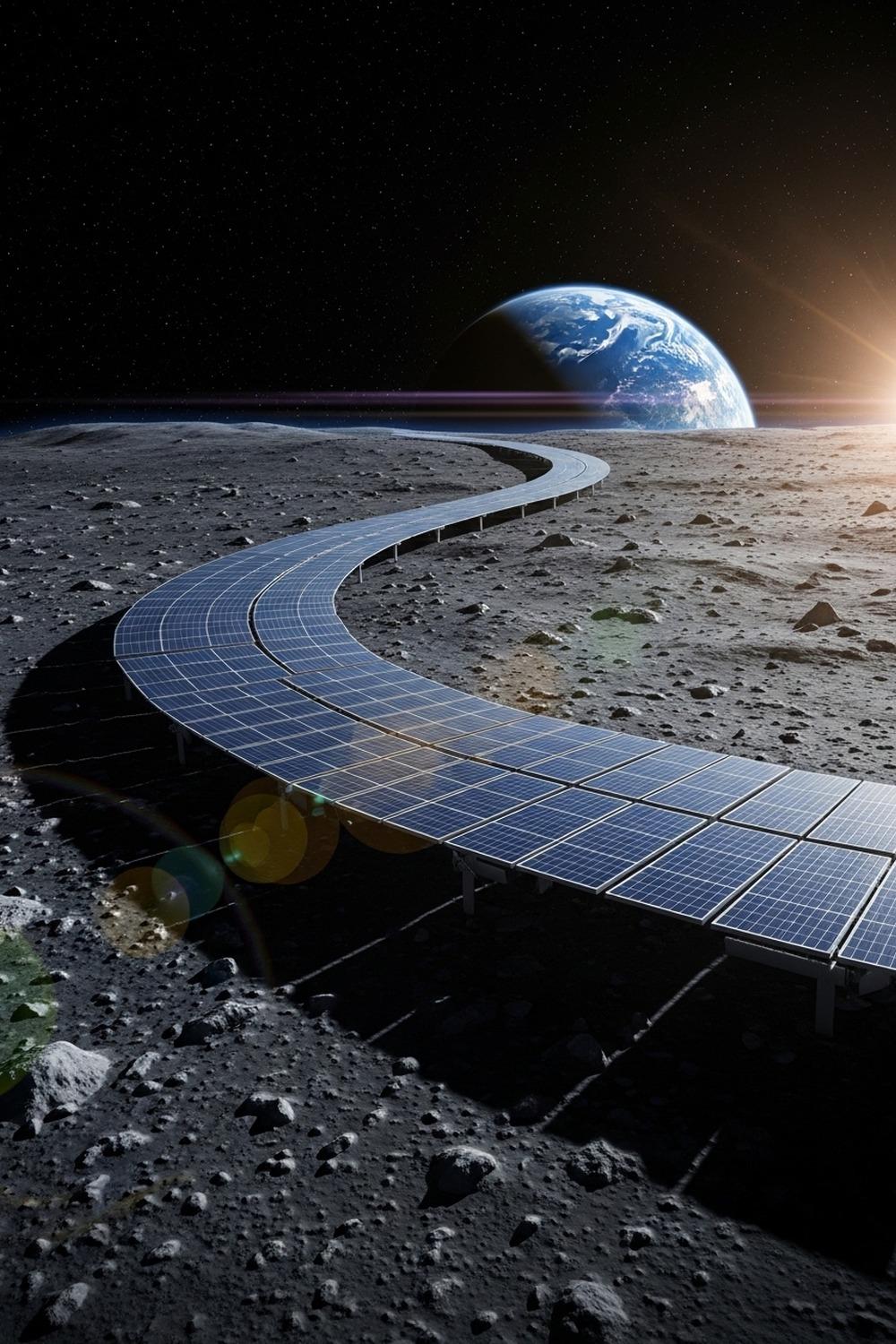
Here’s the elegant part. The Moon has no atmosphere. No clouds. No rain. No night — not really, not at the equator where the proposal sits. A band of solar panels stretched 11,000 kilometers around that equatorial belt would collect sunlight almost constantly. Convert it to electricity. Then transmit it back to Earth using microwave and laser beams.
The physics here isn’t speculative. According to solar power satellite research, space-based collection systems can be up to eight times more efficient than ground-based panels. Eight times. On Earth, your solar panels deal with weather, dust, nightfall, atmospheric interference. On the Moon? Just raw sunlight, 24/7.
And the transmission works too. Targeted energy transmission has already been demonstrated in experiments.
The physics works. What doesn’t exist yet is everything else.
How Humans Would Actually Build It
This is where it gets interesting. Shimizu isn’t proposing to ship 11,000 kilometers of solar panels from Earth. That kept me reading for another hour. The plan is to use lunar soil — regolith — as raw material. Process it on-site. Build the panels directly on the Moon using robots and automated construction systems. It’s called in-situ resource utilization, and space agencies like NASA have been developing it for years as the foundation for long-term lunar missions.
Teleoperated machines.
Guided from Earth or lunar orbit. Doing the heavy lifting. Rover technology has advanced dramatically. Several nations are already testing autonomous construction systems designed for extraterrestrial environments. It sounds like science fiction until you realize: we’re actually getting close to having the tools to do this.
The construction workforce would be almost entirely robotic. Think of it like having a planetary-scale factory that nobody has to live in.
Why Earth’s Energy Problem Makes This Worth Considering
Earth consumes roughly 18 terawatts of energy per year. That number climbs every year as populations grow and economies develop. Every climate model points to the same uncomfortable fact: we need to decarbonize our energy systems fast, and we’re running out of easy options.
Renewable energy on Earth has hard limits.
- Solar gets clouded over. Wind is inconsistent. Storage technology is still catching up to demand.
- The Moon has none of those problems — just completely different, arguably harder ones.
- That tension between an almost-perfect energy source and almost-impossible engineering? That’s exactly why the Luna Ring is so hard to dismiss.
The Transmission Problem Nobody Talks About
Beaming energy across 384,000 kilometers of space sounds impossible until you realize: we’ve already done it. William C. Brown demonstrated microwave transmission of electrical energy back in the 1960s. The California Institute of Technology successfully transmitted solar energy collected in space back to Earth’s surface in 2023. Small amounts, yes. But the proof of concept exists. It’s not a dealbreaker — it’s an engineering puzzle.
The receiving stations on Earth would need to be enormous. Kilometers-wide antenna arrays, likely placed in remote areas or offshore. The transmission beam would need precision. Microwave energy diffuses over distance, which reduces danger but also reduces efficiency. Very large problem. Very expensive problem. Not an impossible one.
By the Numbers
- 18 terawatts — Earth’s total annual energy consumption (International Energy Agency, 2023). The Luna Ring was theoretically designed to meet a significant portion of this.
- 11,000 kilometers around the Moon’s equator. Roughly the distance from New York to Nairobi. Lined entirely with solar collection infrastructure.
- 8 times more efficient. That’s how much more energy space-based solar panels collect compared to equivalent panels on Earth’s surface, due to zero atmospheric interference and no weather.
- Shimizu Corporation has been operating since 1804 — over 200 years. One of the longest-operating engineering firms to publicly propose a lunar energy grid.
- Temperature swings from 127°C in sunlight to -173°C in shadow. The cables connecting the solar belt would need to survive that. We don’t have those materials yet.
Field Notes
- The Moon rotates slowly enough that its equatorial region receives almost continuous sunlight from a fixed solar collector. Compare that to Earth, where day-night cycles interrupt collection every 12 hours. That’s the reliability advantage nobody talks about.
- Shimizu’s proposal includes a cable system running across the lunar surface. The engineering challenge isn’t just the panels — it’s the connective infrastructure. Materials science that doesn’t fully exist yet.
- Japan isn’t alone in this thinking. China’s space agency has announced plans to test space-based solar power transmission by 2028. The European Space Agency has funded feasibility studies into orbital solar power collection. The race for space-based energy may already be quietly underway.
What This Means for the Future of Energy
The Luna Ring is more than an engineering curiosity. When one of the world’s oldest and most respected engineering firms puts its name on a concept this ambitious, something shifts. It moves space-based solar from science fiction into uncomfortable territory: unlikely but not impossible. And in the history of technology, that’s usually the last stop before inevitable.
Decades of incremental progress are quietly making pieces of this achievable. SpaceX’s reusable rockets have already changed the economics of getting things into orbit. Lunar missions are accelerating. Autonomous construction technology is maturing. No single breakthrough unlocks the Luna Ring. But a hundred smaller ones might.
The stakes are entirely human. Climate change isn’t abstract. Energy poverty affects billions of people right now. If a band of solar panels around the Moon could one day supply clean, continuous power to receiving stations across the planet — no emissions, no fuel costs, no geopolitical chokepoints — the impact would be difficult to overstate.
That’s not hype.
That’s just math applied to a very big idea.
Shimizu’s Luna Ring is still a concept. It may stay that way for decades. But the fact that it exists — fully rendered, seriously proposed, and technically grounded — says something important about how we’re thinking about the future. Big problems invite big thinking. And sometimes, the ideas that sound most absurd today are the ones that define tomorrow. If this kind of story gets under your skin, there’s more at this-amazing-world.com — and the next one is even stranger.
“
Frequently Asked Questions
Q: What is the Luna Ring solar power concept?
The Luna Ring is a proposal by Japan’s Shimizu Corporation, unveiled in 2013, to build a belt of solar panels 11,000 kilometers long around the Moon’s equator. The panels would collect near-constant sunlight, free of weather and atmosphere, then transmit the energy back to Earth using microwave and laser beams. Shimizu, founded in 1804, proposed building it largely from lunar soil using robotic construction rather than shipping materials from Earth.
Q: How would energy be transmitted from the Moon to Earth?
Energy would be beamed across roughly 384,000 kilometers using microwave and laser transmission. The concept builds on real demonstrations: William C. Brown showed microwave power transmission in the 1960s, and Caltech transmitted space-collected solar energy to Earth in 2023. Receiving stations on Earth would need enormous antenna arrays, kilometers wide, likely placed in remote areas or offshore to capture the diffused beam efficiently and safely.
Q: Why consider building solar panels on the Moon at all?
The Moon offers near-perfect solar conditions: no atmosphere, no clouds, no weather, and almost continuous sunlight at the equator. Space-based solar collection can be up to 8 times more efficient than equivalent panels on Earth. With global energy consumption around 18 terawatts per year and rising, and the urgent need to decarbonize, a continuous clean-energy source with no fuel costs or emissions becomes worth serious engineering study despite the enormous challenges.
Q: Is the Luna Ring technically possible today?
The underlying physics works, but the full system does not yet exist. Key challenges include materials that can survive lunar temperature swings from 127 degrees C to -173 degrees C, large-scale robotic construction using lunar soil, and precise long-distance energy transmission. Other nations are advancing related work: China plans to test space-based solar transmission by 2028, and the European Space Agency has funded orbital solar feasibility studies. No single breakthrough unlocks it, but incremental progress is steady.
Illustrations are AI-generated. Article fact-checked and human-edited. Our editorial standards.